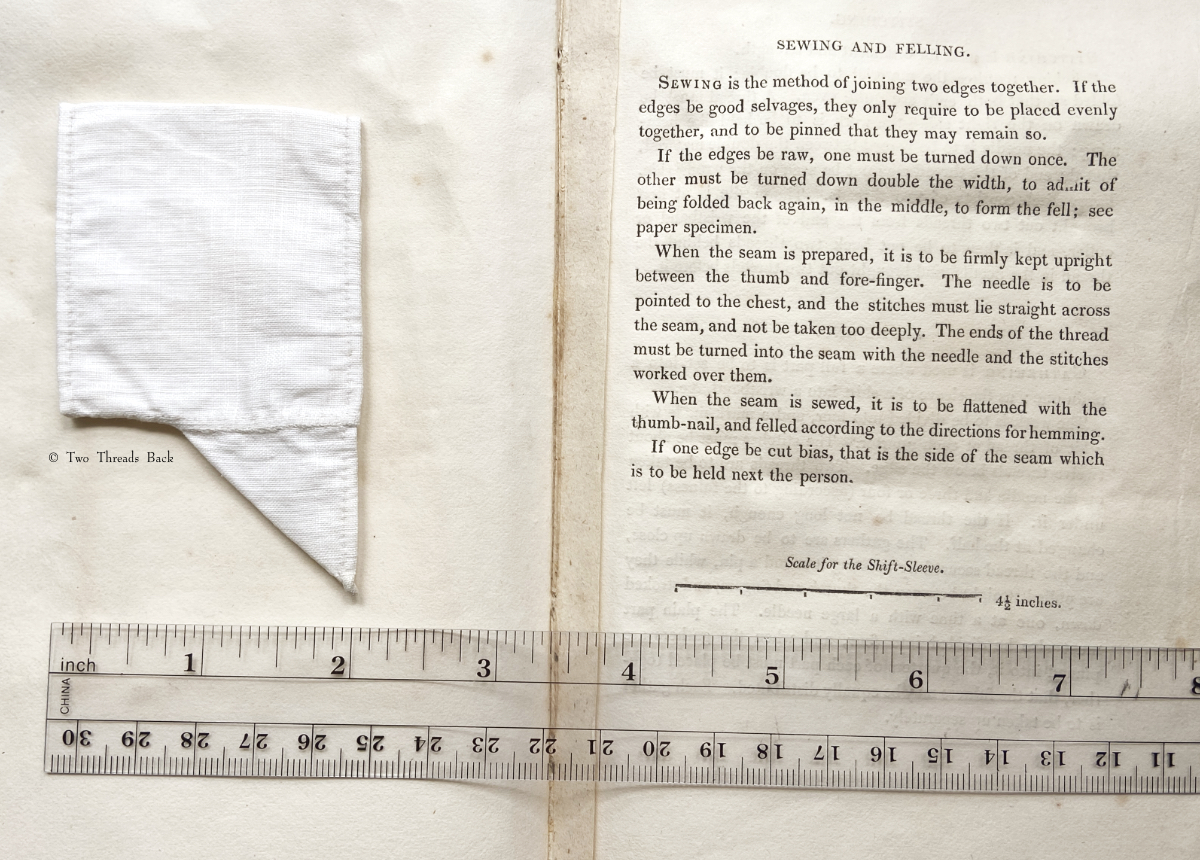
Sewing instruction manual belonging to Miss Peacocke, 1832. She conquered Sleeve Gussets for a Shift.
Tutorials aren’t usually a feature of this plain sewing blog, but I set out the steps for someone who needed help with sleeve gussets, and thought I’d share for anyone who flirts with insanity when inserting them for dolls or costume. I like pictures in sequence best – except maybe when assembling anything from Ikea!
A gusset is a little piece of fabric inserted to reinforce or to increase the ease of movement in garments like shirts and shifts – you can see in the pictures how it gives more room under the arm. They were used up until mid-19th-century-ish when fashion, fitted patterns, and sewing machines made them pretty much obsolete, though some sewing classes included directions for small ones at garment openings into the 20th century.
Plain sewing projects might include a sample sleeve gusset, because they used basic stitches like hemming, felling, and sewing/seaming1. A miniature size was practical, saving both time and material; the ones pictured here were pasted in books meant as guides for sewing teachers.
Closeup look at another specimen. It’s also been hemmed on the side that would be inserted into the body of the garment, but that’s only for extra hemming practice and tidiness of the specimen.
So just how hard can it be to sew straight seams on a little square? Well, if you want all the edges to be neatly enclosed, lie flat, and the right size when finished, it can be a pain in the armpit! The following sequence shows the “sew-and-fell” method, replicating the miniature specimens above. I’ve seen other methods – and I have some examples – but this one set the standard for fine needlework.
Note: In 19th century manuals, the deeper double fold for felling was always completed before any sewing was done. See pics Fig. 50 and 51 here. That’s difficult to illustrate in a photo sequence, so I’ve made the second fold after the seaming is done.I’ve used a coarse cotton printed on one side, contrasting thread, and big stitches (ha!) so that it’s easier to see.
Above: The sleeve piece is on the left, the gusset on the top right, and a finished gusseted sleeve on the bottom right.
Above: Fold the sleeve edge down to the desired width of the seam. Crease the gusset diagonally and then fold it down twice as deep as the sleeve.
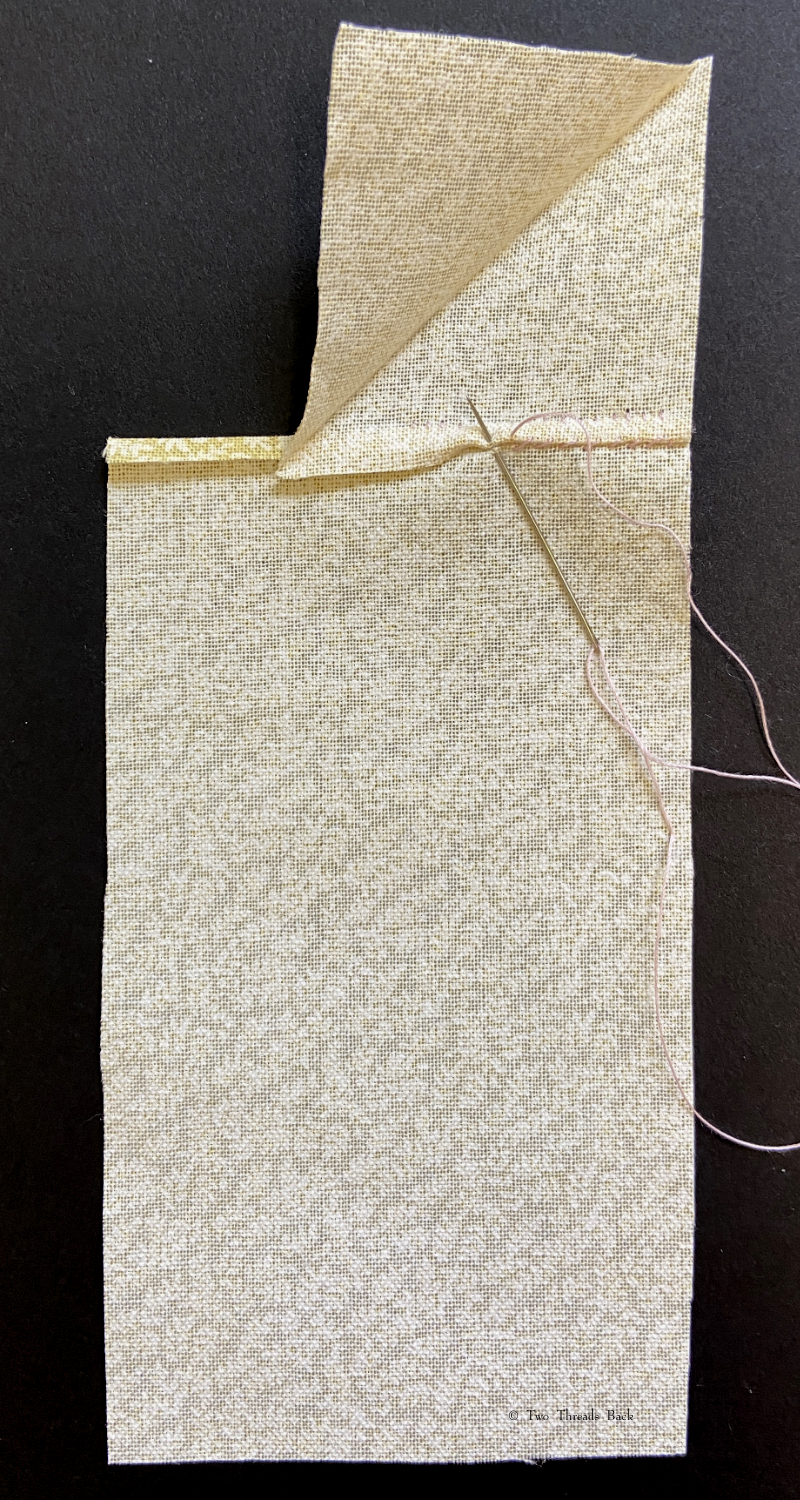
Above: Place the sleeve and gusset wrong sides together and then seam together, stopping just short of the end, since that side will be folded next.
Above: This is the same step as above, viewed from the side. You can see that the gusset side fold is twice as deep as the sleeve side fold. (It should already be folded back again, ready for felling, if you want to do it exactlyas they taught it.)
Above: Fold/fell the gusset edge down over the sleeve edge. WARNING: OPTICAL ILLUSION! Sometimes the gusset crease in this photo appears to be folded back onto the right side instead of forward onto the wrong side. It’s all in how your eye first perceives the image. It’s actually folding forward toward the needle.
Above: Next, fold the adjoining edge of the gusset – this time it’s the gusset’s turn to be the narrower fold! (You can see why the stitching wasn’t taken all the way to the edge earlier.) Fold the bottom edge of the sleeve twice as deep. Then with a little twist, bring corner A down to meet corner B, fold to fold.
Above: Now seam the gusset and sleeve together, and keep on going past the end of the gusset, seaming the rest of the sleeve together.
Above: A view of the inside, looking up into the sleeve from the gusset opening, before the sleeve edge is felled down over the gusset edge.
Finally, fell the sleeve edge over the gusset and keep on going, all the way to the end of the sleeve. This photo is peeking inside the sleeve, to give perspective. Of course when you’re actually SEWING it, you’ll need to turn the sleeve inside out!
The author of The Workwoman’s Guide (1838) may have been a little impatient with gusseting herself. She suggests simply hemming the gusset evenly all around, hemming the sleeve where it will be inserted, and then seaming the two together. I’ve done that myself! As long as the work is neat….
Gussets – Much depends upon the nicety of the putting in and finishing off, but when well accomplished they have a peculiar charm to a good needlewoman.
Personally, I find peculiarcharm in just finishing one with my good humor intact. I’ll save the appreciation of niceties for those glorious gussets worked long ago.
1 Terms used for stitches differ according to time and place. The stitch I’m referring to here, a very shallow overcasting used to “butt” two pieces of fabric together, was called seaming or sewing. The term sewing was more common in the first part of the 19th century in English and Irish manuals. Seaming was more popular later. There are no early American sewing manuals, but in the U.S. over-and-over stitch was frequently used by mid-century and then overhanding was popular later (as distinct from overcasting which was a wider stitch used to prevent edge raveling). I usually call the stitch seaming because calling it sewing would be really confusing (even more than this footnote!) and over-and-over stitch is too wordy to verbify!
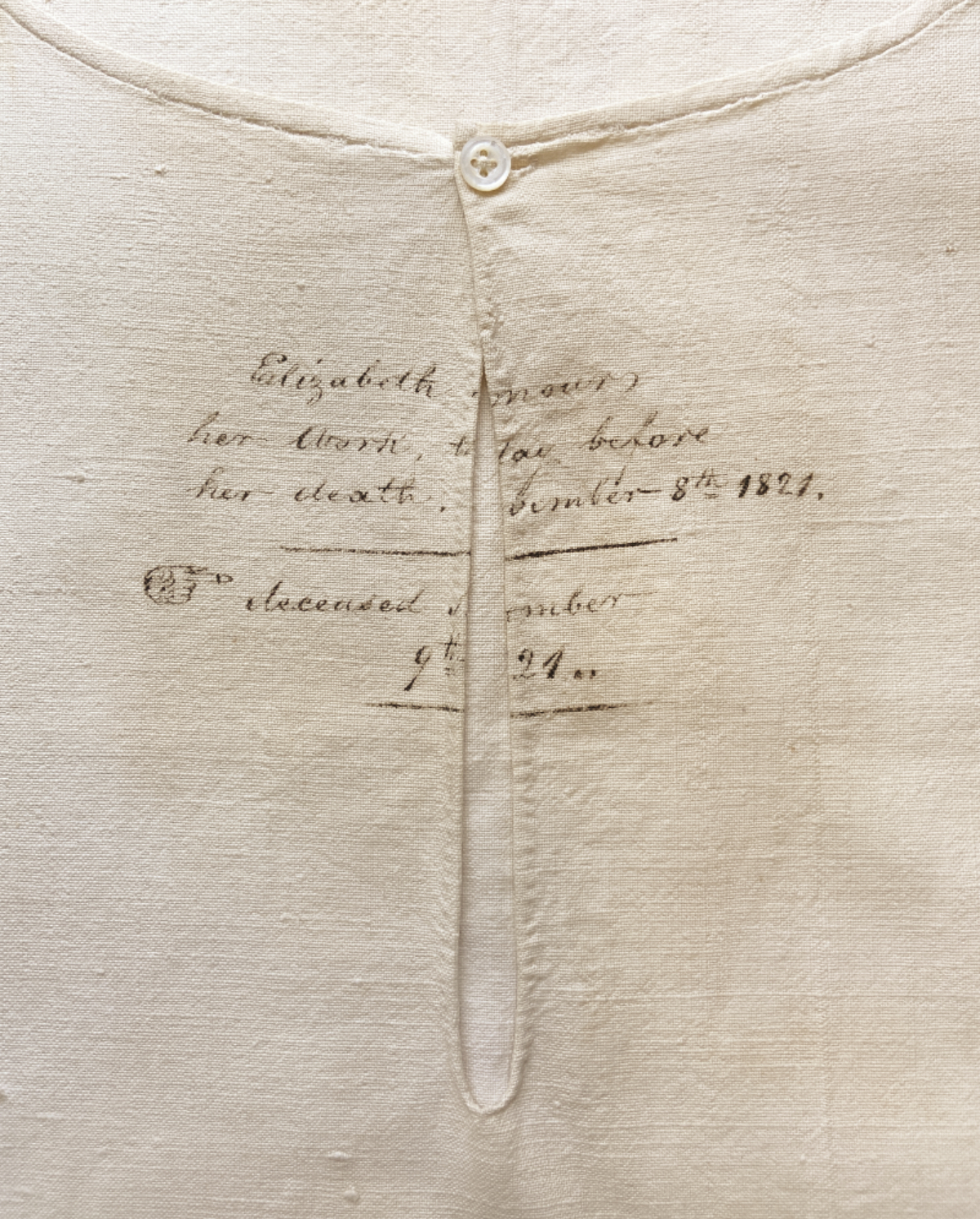
Elizabeth Armour, her work, the day before her death. November 8th, 1821. deceased November 9th, 1821.
Most of the time we never know who wore the antique clothing that we preserve and study, much less who made it and when. So it’s thrilling to find a piece with a story that connects us to a life lived long ago. Her name makes her real.
Shifts and chemises follow closely behind men’s shirts as prime examples of plain sewing. This rare linen shift has its provenance inscribed in ink across the heart. Not only does it give the name of the maker, Elizabeth Armour, but it tells when she made it, November 8, 1821, and when she died – the next day.
Occasionally notes are found attached to clothing, usually intended for family members to pass down, or perhaps when donated to museums. But I’d never seen one quite like this! How could I help but try to find out more about Elizabeth?
Elizabeth Armour’s plain shift, still in excellent condition.
Thanks to the wealth of genealogical data available online now, it was easy to search for a woman with that name and date of death. What a thrill to find her! Of course, I can’t be positive it’s the same person, but the odds seem pretty good.
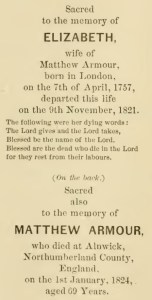
Transcript of Elizabeth’s gravestone.
Elizabeth, wife of Matthew Armour, was born in London on April 7, 1757, and died on November 9th, 1821 in Philadelphia. She was buried there in Christ Church and St. Peter’s Churchyard on November 11, 1821. Her name was entered in the register of burials as “Eliza. Armor.” I don’t know whether the gravestone still exists, but at least a record of it does:
The following were her dying words: The Lord gives and the Lord takes, Blessed be the name of the Lord. Blessed are the dead who die in the Lord for they rest from their labours.
Who was Elizabeth and what was her life like? I found traces. Elizabeth Nesbet married Matthew Armour in the City of London at the church of St. Andrew Holborn on July 2, 1780. She next appeared as the mother of Susannah Nesbitt Armour who was christened at Christ Church and St. Peter’s in Philadelphia on July 3, 1785.
Wait, Philadelphia? 1785? It bargles (as my daughter used to say) the mind! More American history than I can even begin to explore. I suppose there are so many books, essays, and dissertations written on that place and time that they would collectively collapse my little local library. Even the church the Armours attended has a past so rich it makes me dizzy. Benjamin Franklin, George Washington, Betsy Ross, and many of the signers of the Declaration of Independence attended, all during the years the Armours were worshiping there as well.
In 1788, son William was born. Matthew appears on various records during those years as a house carpenter. If there were other children besides Susan and William, I didn’t find a record of them. We know the hazards of illness and accidents in those days, but in 1793 a yellow fever epidemic (here’s a compelling read) struck Philadelphia killing 5,000 of the 45,000 residents, and caused another 17,000 to abandon the city. It struck again in 1797, ’98, and ’99. Did it touch the Armours or their kin? I doubt I’ll ever know.
Matthew continues to appear in the early 1800s on tax, census, or manifest records (he made trips to England) as a carpenter. The family moved several times within the city through the years, and siblings Susan (as she was known) and William apparently never married, but kept house together and owned a dry goods store. In an 1811 affadavit sworn as a super cargo, William (at age 22) states he was 5’9″, fair complexion, blue eyes, with 3 scars on his left forefinger! There’s something eerie about knowing 200-year-old personal details like that. But perhaps no more than slipping my hand in the sleeve of Elizabeth’s chemise?
Elizabeth may have been ailing by 1821, since the cause of death was “dropsy.” We know what she was doing in the days before her death because of the inscription on her shift. More poignantly, we know how much her handwork meant to someone, probably her daughter Susan. I understand how that feels; I have handmade treasures from my late parents that move me to tears when I hold them.
Philadelphia, Nov. 9th, 1821 Died this day of Dropsy Elizabeth Armour aged 64 years.
Matthew returned to England sometime after Elizabeth’s death, where he died at Alnwick on January 1, 1824, aged 69. In 1830, Susan and William’s cousin, Martha Cheesman (b.1818), came from England to live with them in Philadelphia. William died in 1851, and Susan in 1857. She left an estate of $15,000 with bequests to Christ Church Hospital, the Northern Home for Friendless Children, her nieces, and the remainder to her “cousin Martha Cheeseman.” That was a lot of money for the time. It seems that the dry goods business was very profitable! I was getting a little lost and weary of genealogical research at this point, so I let the trail end with cousin Martha’s death in 1906. Perhaps the shift had been left in her care?
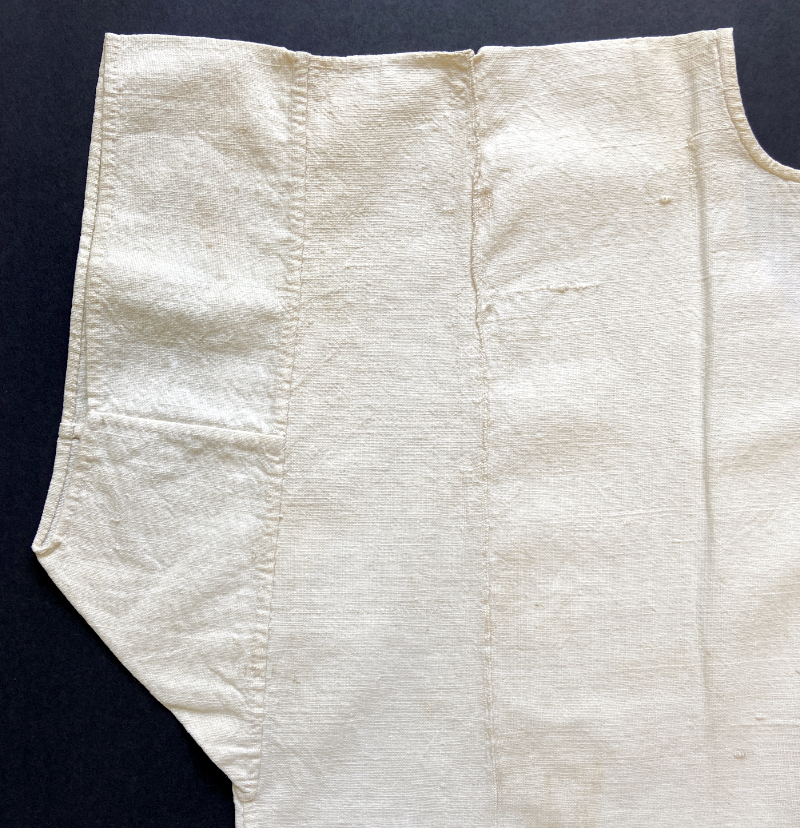
The shift is very simple. The linen is homespun and sewn with linen thread. The economic impact of the War of 1812 and then the Panic of 1819 meant times were still hard, so perhaps homespun was a necessity. The stitching is neat and even, but not particularly fine. The fabric was of insufficient width and so another piece was seamed to it to make the full width of the body, and then folded at the shoulder.
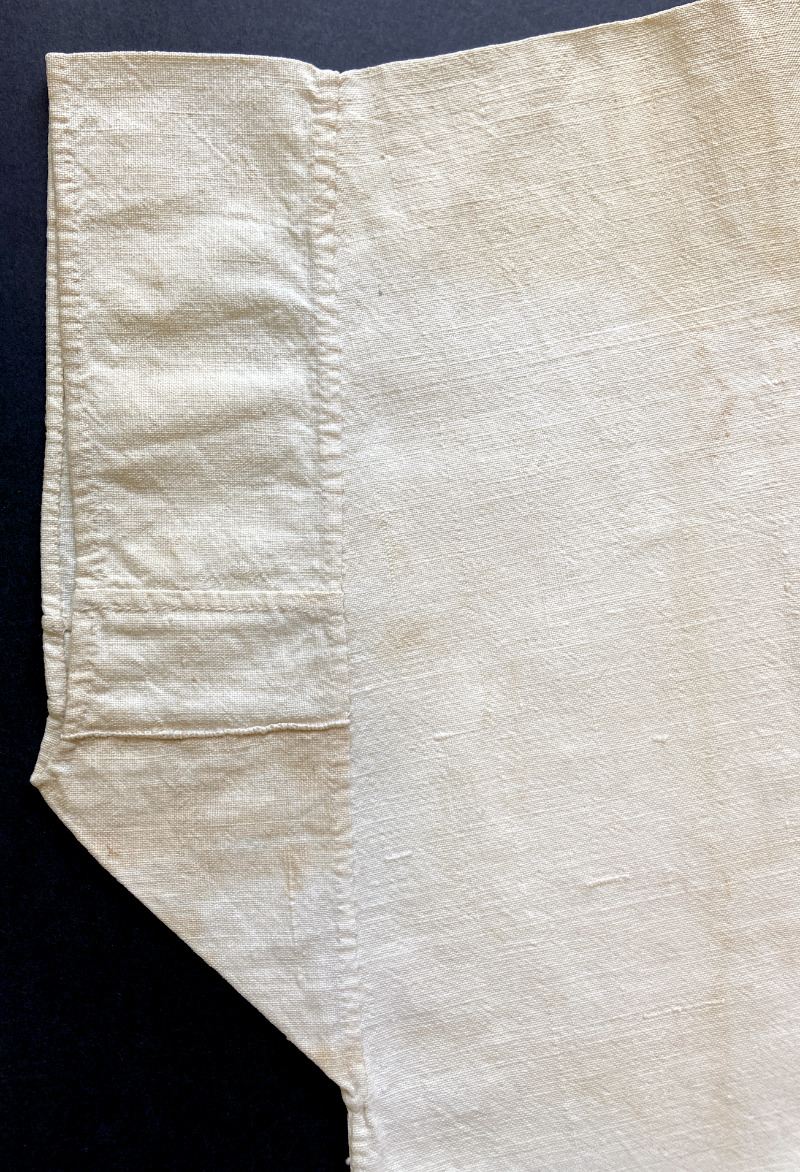
Left sleeve viewed from the back. You can also see the seamed join where fabric was added to a selvedge to make it wide enough.
The sleeves are short, and the right one is pieced. There are gussets under the arms with a small curve at the bottom. It angles slightly wider toward the hem, but has no gores. The seamed join was sewn from the outside, and because the materials were a bit coarse and the stitches a bit deep, it makes a slight ridge. I can see why it’s positioned on the outside, since it would be rather uncomfortable against the body. The inscription was made before the slit was cut for the opening, because the writing is folded under where it’s hemmed. I don’t know if Elizabeth made the shift for herself, her daughter, or a servant, but it could be considered a “comfortable” size more than a petite one.
The right sleeve is pieced, using every scrap of fabric. The left one is whole.
A view of the narrow hem and join. You can see how she “seamed” (narrow overcasting) with wrong sides together. It should make a flat, nearly invisible seam, but the linen and thread are coarse and she took the stitches rather deep.
Elizabeth Armour, maker of the shift, lived from 1757 until 1821 in England and America, through the years of the founding of the United States in a city where the most radical historical events were occurring. And what serendipity! She was there when JOSEPH LANCASTER was living (briefly) in Philadelphia! She learned plain sewing in 18th century England, and was able to make a thrifty shift of homespun linen using a minimum of fabric, in the “old” fashion – just as styles were about to change from “shifts to chemises.”
The majority plain needlework I’ve seen (or drooled over) through the years, whether manuals, samplers, or items of clothing, has been from England, and the rest from here in the U.S. It’s truly remarkable to find “threads” from England, America, world-changing history, endearing family sentiment, Joseph Lancaster, and plain needlework all sewn together with a story in this shift. I’m awed.
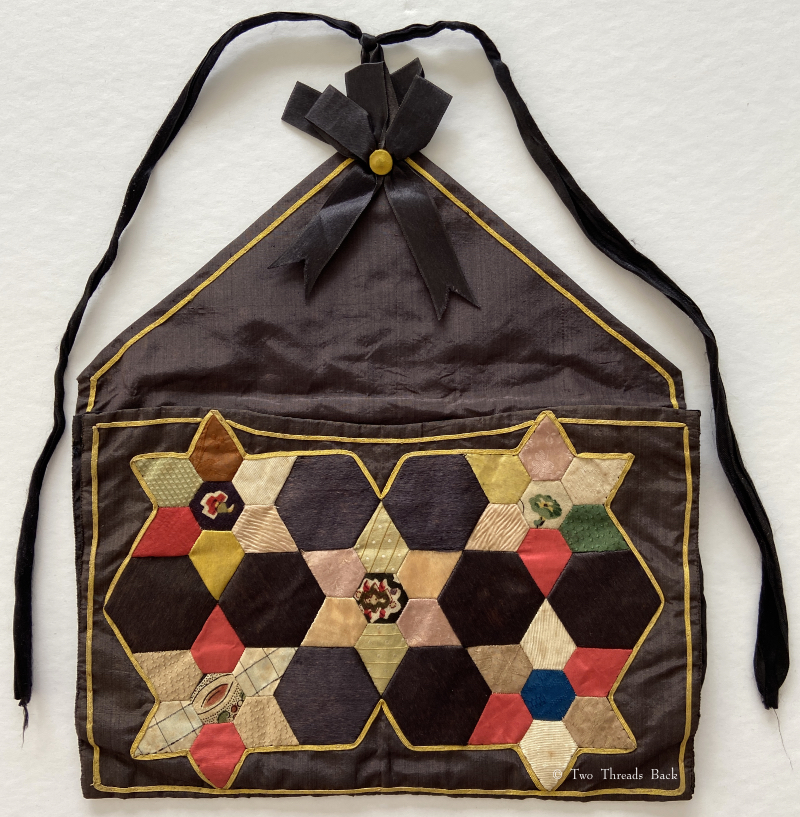
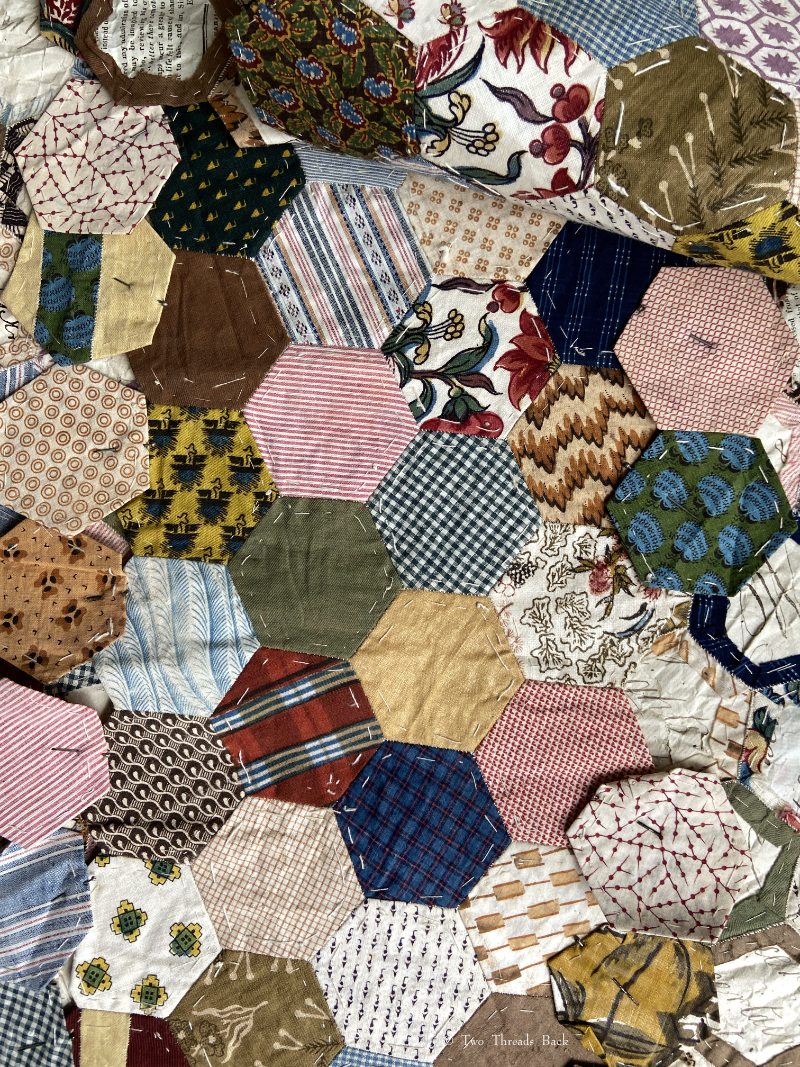
Patchwork projects, c1820. English paper piecing: an elegant silk “pocket” or case – perhaps for letters or needlework? – resting on unfinished panels of utilitarian cotton remnants (more pics below).
Patchwork quilting has earned a lofty place among the textile arts today, but 200 years ago a few writers felt inclined to poke fun at it. I was happily following rabbit trails, chasing plain sewing nuggets, when I came across some entertaining words on patchwork. A sketch written in 1821 found fault with the work AND the worker:
PATCH-WORK.
I have an old female cousin, who has passed a quarter of a century in rags, or rather amidst patches, destined to a most marvellous arrangement, for the furniture of a suite of apartments–a saloon, a boudoir, and a bed chamber. She began her paltry collection by begging of all her acquaintance, and wearing out every one by messages, notes, and applications for odd bits and patterns [i.e., printed fabrics].
She also told two score of lies, in order to obtain samples of different linen-drapers, but upon a very unwelcome observation of mine, she changed her operations.
Asking me one day if I did not think that the window curtains, ottomans, sopha-covers, et cætera, of her bow-windowed saloon would have a very novel, tasteful, and fantastic appearance, if composed of patch work judiciously arranged and bordered by a vandyke pattern worked by herself? I replied, “that the best patch-work which I ever saw had but a beggarly appearance, and that it would take her half her life, and lose her half her acquaintance, to collect the materials; that I always looked upon a patch-work curtain, or quilt to be fit only for a servant’s bed at an inn; that it was a complete make-shift, nay, that if she would make shifts for herself, or for the poor, she would be much more laudably employed. For I consider this patch-working something like lady-shoemaker’s work, below the dignity of the performer, and of little use when done.
All my observations would inevitably have been disregarded, for my cousin Cassandra is like many other old maids–she constantly asks advice with a predetermination to take her own way, but the term beggarly hurt her pride, and the thought of loss of company, to one who could not live without a morning gossip, and an evening casino, was very alarming; so she determined on buying remnants and small pieces of a thousand patterns; and in the long period above mentioned, she completed her patch-work hangings and furniture, which every one praised before her face, and treated with contempt behind her back. This chef-d’oeuvre of useless toil, was, however, shown to all her acquaintance, and furnished the subject of a hundred morning and tea-table conversations. –The Hermit in London, 1821
Well, that was pretty harsh! And I daresay a few million quilters today would agree. I’d rather he’d directed the fun toward installation art, but oddly enough it wasn’t around then. Satire could be brutal back in those insensitive days, and of course anything that hinted of vulgarity (patches!) was fair game. Knowing that the author was writing to entertain made me think perhaps it was a one-off, and the prevailing attitude was more favorable.
However, Lydia Maria Child (not one for tepid opinions), author of the Girl’s Own Book, was rather condescending as well when she said “we do not want young ladies to emulate their grandmothers in making patch-work quilts, or covering their apartments with hexagon- or octagon-starred carpets,” although in an earlier edition she admitted it to be a tolerable alternative to boredom:
PATCH-WORK. This is old-fashioned too; and I must allow it is very silly to tear up large pieces of cloth, for the sake of sewing them together again. But little girls often have a great many small bits of cloth, and large remnants of time, which they don’t know what to do with; and I think it is better for them to make cradle-quilts for their dolls, or their baby brothers, than to be standing round, wishing they had something to do. The pieces are arranged in a great variety of forms; squares, diamonds, stars, blocks, octagon pieces placed in circles, &c. A little girl should examine whatever kind she wishes to imitate, and cut a paper pattern, with great care and exactness. –The Girl’s Own Book, 1833
Perhaps she had a point about tearing cloth just to sew it back together! But to balance out the disparaging remarks, I found a sweet essay about a patchwork quilt written in 1845 –and it mentions PLAIN SEWING! True, the author ranks a beloved patchwork quilt below a snowy counterpane, but the following excerpt glows with the warmest nostalgia. (Other textile historians have referenced it, but here’s a link to the original if you’d like to read the whole piece without my edits for brevity.)
THE PATCHWORK QUILT.
There it is! in the inner sanctum of my “old-maid’s hall”–as cosy a little room as any lady need wish to see attached to her boudoir….
Yes, there is the Patchwork Quilt! looking to the uninterested observer like a miscellaneous collection of odd bits and ends of calico, but to me it is a precious reliquary of past treasures…. Gentle Friends! it contains a piece of each of my childhood’s calico gowns, and of my mother’s and sisters’; and that is not all.
I learned of the world’s generosity in rewarding the efforts of the industrious and enterprising…. What predictions that I should be a noted sempstress; that I should soon be able to make shirts for my father, sheets for my mother…. What legends were told me of little girls who had learned patchwork at three years of age, and could put a shirt together at six. What magical words were gusset, felling, button-hole stitch, and so forth, each a Sesame, opening into an arcana of workmanship… and a host of magical beauties!
Here is a piece of the first dress I ever saw, cut with what were called “mutton-leg” sleeves. Here, too, is a remnant of the first “bishop sleeve” my mother wore; and here is a fragment of the first gown that was ever cut for me with a bodice waist… and, oh, down in this corner a piece of that in which I first felt myself a woman- that is, when I first discarded pantalettes.
Here is a fragment of the beautiful gingham of which I had so scanty a pattern, and thus taxed my dress-maker’s wits; and here a piece of that of which mother and all my sisters had one with me. Here is a piece of that mourning dress in which I thought my mother looked so graceful; and here one of that which should have been warranted “not to wash,” or to wash all white. Here is a fragment of the pink apron which was pointed all around. Here is a token of kindness in the shape of a square of the old brocade-looking calico, presented by a venerable friend; and here a piece given by the naughty little girl with whom I broke friendship, and then wished to take it out of its place…. Here is a fragment of the first dress which baby brother wore when he left off long clothes; and here are relics of the long clothes themselves. Here a piece of that pink gingham frock so splendidly decked with pearl buttons. Here is a piece of that calico which so admirably imitated vesting, economical, bought to make “waistcoats” for the boys. Here are pieces of that to set off my quilt with, and bought strips of it by the cent’s worth – strips more in accordance with the good dealer’s benevolence than her usual price for the calico. Here is a piece of the first dress which was earned by my own exertions! And here are patterns presented by kind friends, and illustrative of their tastes.
Then there was another era in the history of my quilt. My sister–three years younger than myself–was in want of patchwork, while mine lay undisturbed. Yes, she was to be married; and I not spoken for! I gave her the patchwork.
Then came the quilting, a party not soon to be forgotten, with its jokes and merriment. Here is the memento of a mischievous brother, who was determined to assist otherwise than rolling up the quilt as it was finished, snapping the chalk-line, passing thread, wax and scissors, and shaking hands across the quilt for all girls with short arms. He must take the needle and thread. Well, we gave him white thread, and appointed him to a very dark piece of calico, so that we might pick it out the easier; but to spite us, he did it so nicely that it still remains, a memento of his skill with the needle.
And why did the young bride exchange her snowy counterpane for the patchwork quilt? These dark stains at the top of it will tell–stains left by the night medicines, taken in silence and darkness. The patchwork quilt rose and fell with the heavings of her breast as she sighed over the departing joys of life. Through the bridal chamber rang the knell-like cough which told us that we must prepare her for an early grave. The patchwork quilt shrouded her wasted form as she sweetly resigned herself to the arms of Death.
And back to me, with all its memories of childhood, youth, and maturer years; its associations of joy, and sorrow; of smiles and tears; of life and death, has returned to me The Patchwork Quilt. The Lowell Offering, 1845
Did you notice the reference to plain sewing? And making shirts? She’s singing my favorite song! An “arcana of workmanship.” Now there’s a title for a future post. Of course I don’t really think most people disparaged patchwork. There are too many survivors that show just how artistic, skillfully worked, and beloved pieced fabric was. I probably admire it more than most because I have no “pattern sense,” I can’t work with measures, shapes, design layout without a mental meltdown.
I’m happy simply to share the sentiments of the “Old Maid” above whose patchwork looked
to the uninterested observer like a miscellaneous collection of odd bits and ends of calico, but to me it is a precious reliquary of past treasures; a storehouse of valuables, almost destitute of intrinsic worth; a herbarium of withered flowers; a bound volume of hieroglyphics, each of which is a key to some painful or pleasant remembrance, a symbol of—but, ah, I am poetizing and spiritualizing over my ” patchwork quilt.”
The points of the stars are all silk, and the centers are linen.
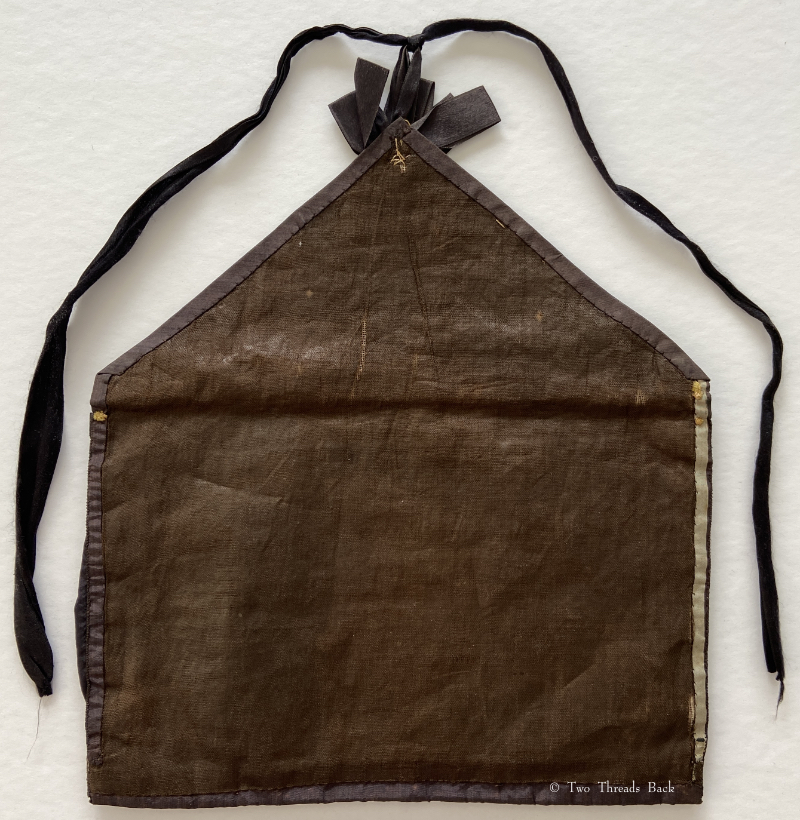
The back is made of brown glazed linen, and the stripe on the edge is a selvedge on the silk binding.
It’s made to allow room to for holding contents (whatever they might have been!), and the decorative button is handmade of silk over a wire ring.
More of the unfinished panels. You can see closeups of the patches in the Flower Patch posts.
Who doesn’t love to watch a magic trick? I think they can be a lot of fun, at least as long as I’m not the volunteer from the audience. Especially for this trick!
1784
To pull off any Perfon’s Shirt without undreffing him or having Occafion for a Confederate.
This trick requires only dexterity, and nevertheless when I performed it at the Theater-Royal in the Hay-Market everybody imagined that the person whom I had tricked out of his shirt was in a confederacy with me.
The means of performing this trick are the following, only observing that the cloaths of the person whose shirt is to be pulled off be wide and easy.
Begin by making him pull off his stock, and unbuttoning his shirt at the neck and sleeves, afterwards tye a little string in the button-hole of the left sleeve; then, passing your hand behind his back, pull the shirt out of his breaches, and slip it over his head, then pulling it out before in the same manner, you will leave it on his stomach; after that go to the right hand, and pull the sleeve down so as to have it all out of the arm; the shirt being then all of a heap, as well in the right sleeve as before the stomach, you are to make use of the little string fastened to the button-hole of the left sleeve, to get back the sleeve that must have slipped up, and to pull the whole shirt out that way.
To hide your way of operating from the person whom you unshirt and from the assembly, you may cover his head with a lady’s cloak, holding a corner of it in your teeth.
In order to be more at your ease, you may mount on a chair, and do the whole operation under the cloak. Such are the means I used when I performed publicly this trick.
–PHYSICAL AMUSEMENTS and DIVERTING EXPERIMENTS, 1784
That kind of describes what it feels like when I’ve tried to change clothes in the car. Actually, I think this trick would require a good bit of dexterity, as well as a few practice runs. But still not as much as was required to make this little boy’s shirt. A lot of stitches went into it; decorative backstitching on the collar and cuffs measures about 32 per inch. The simple hemming was 12-14 stitches per inch and seaming (like shallow overcasting) was up to 20 per inch!
A small boy’s shirt, early 19th century. The fineness of all the plain sewing I try to photograph is hard to convey, since close-up shots make the materials seem coarser. But in a more scaled shot, it’s hard to see the dainty stitching. Maybe this one where I’m holding it adds perspective. It would fit a 4 or 5 year old.
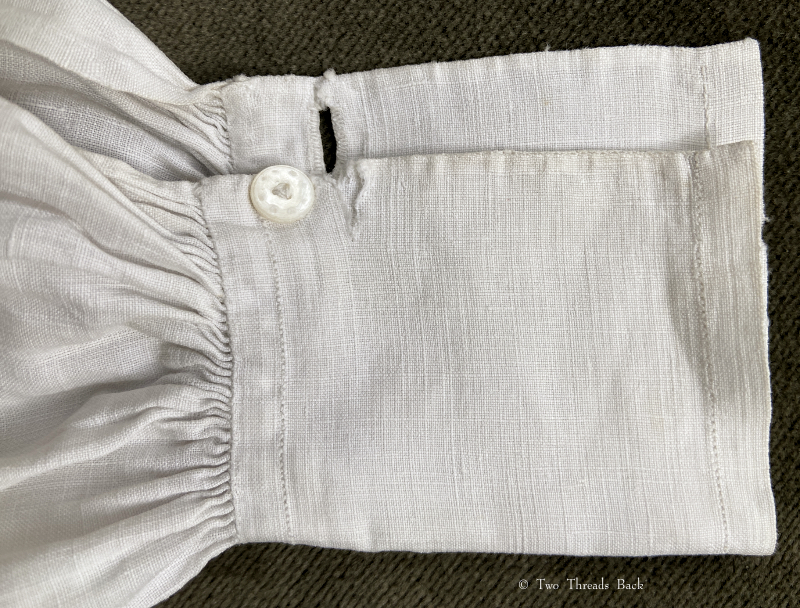
He did get some wear out of it! There are several mends and worn spots, like on the wristband here. So this buttonhole is where the conjurer would attach the string!
The boy’s shirt is made like a man’s shirt. There were 20 parts in a “gentleman’s” shirt:
The body, two sleeves, two wristbands, two binders, two shoulder-straps, one collar, two sleeve-gussets, two neck gussets, two side-gussets, two wrist gussets, one for the bosom, and the frill.
This one, however, was made with without the shoulder straps (a strip of linen along each shoulder), binders (lining next to the armscye), wrist gussets, or a “bosom gusset.” It did have a frill and an inserted pleated front made out of finer linen
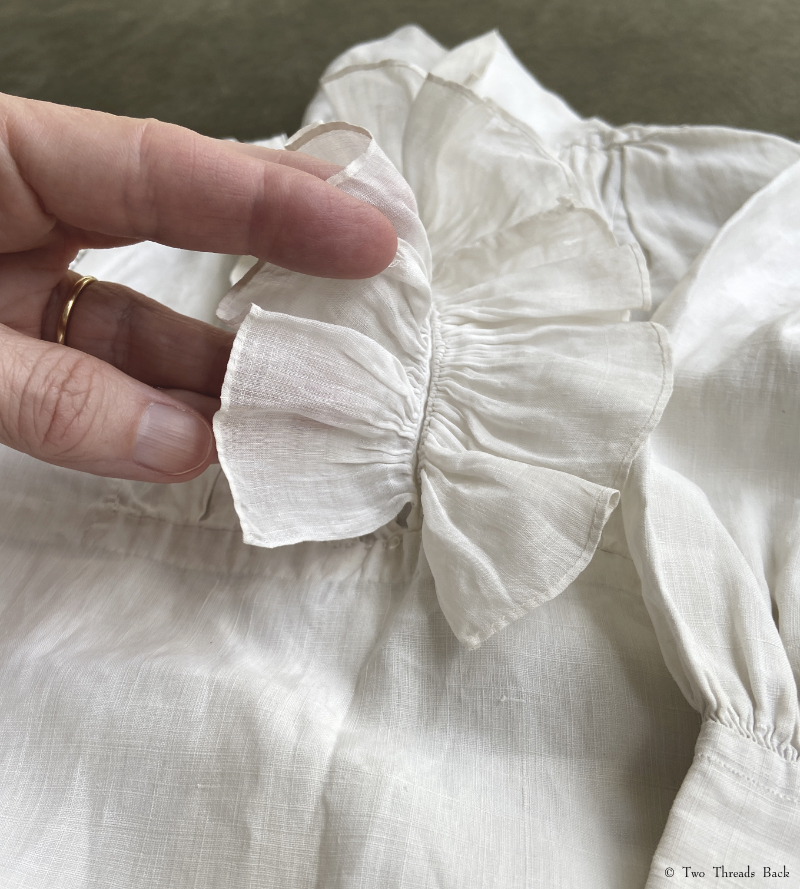
It was interesting to see that the two separate ruffles were both sewn to the wearer’s left side, and hemmed folded in the same direction, making them look correctly worn when both are folded over toward the right and exposing the pearl buttons. On all the other shirts I have or have seen, the ruffles are hemmed with each side’s hem folded inward toward the front opening.
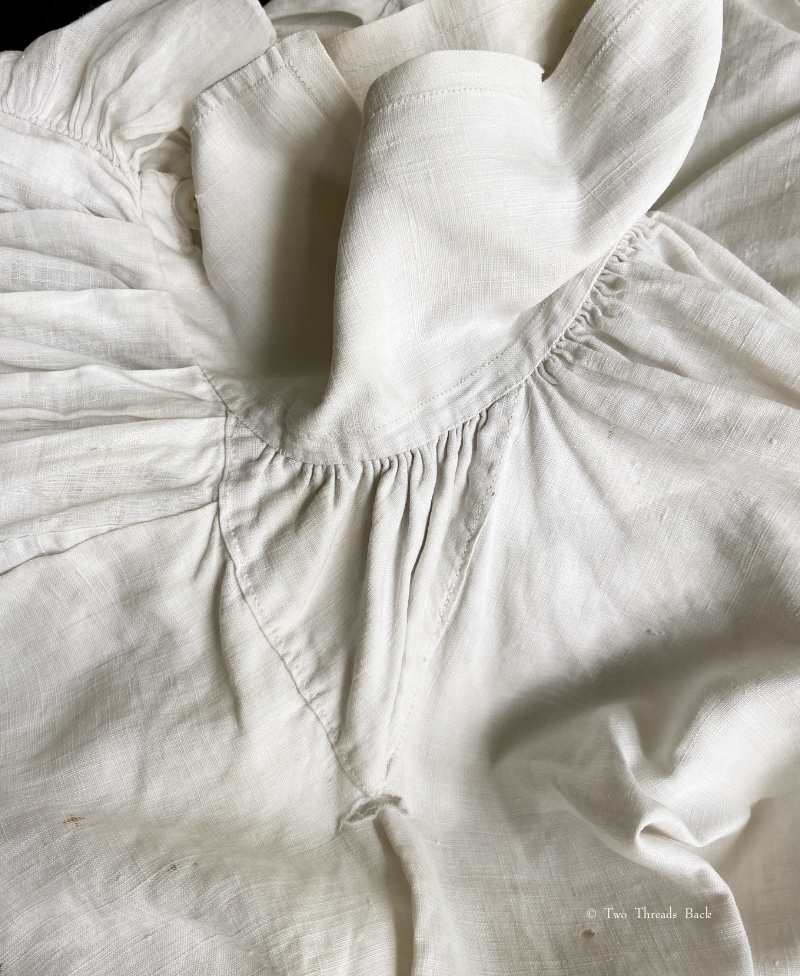
This is the neck gusset next to the collar, and the tear at the point along the shoulder gives a hint why most shirts needed the reinforcement of “shoulder straps.” Perhaps more for strength when tugged than for abrasion!
Bet the little guy couldn’t wait to unbutton his collar – it measures barely over 10 inches when buttoned!
The neatly sewn underarm gusset.
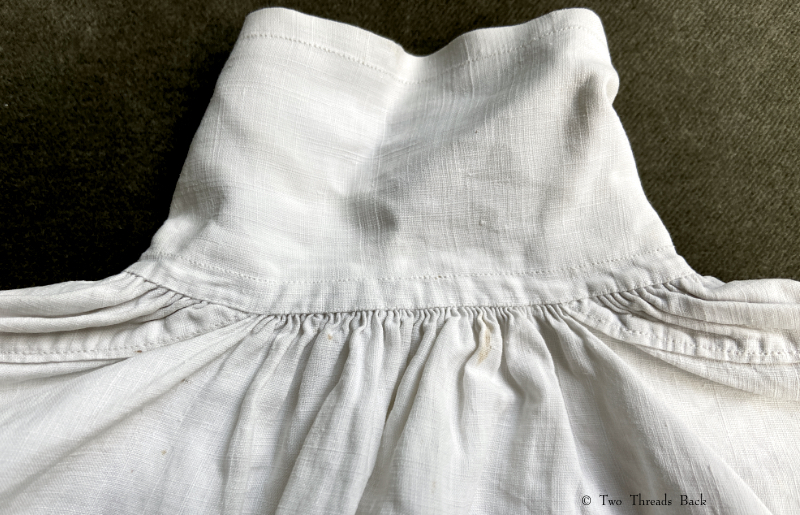
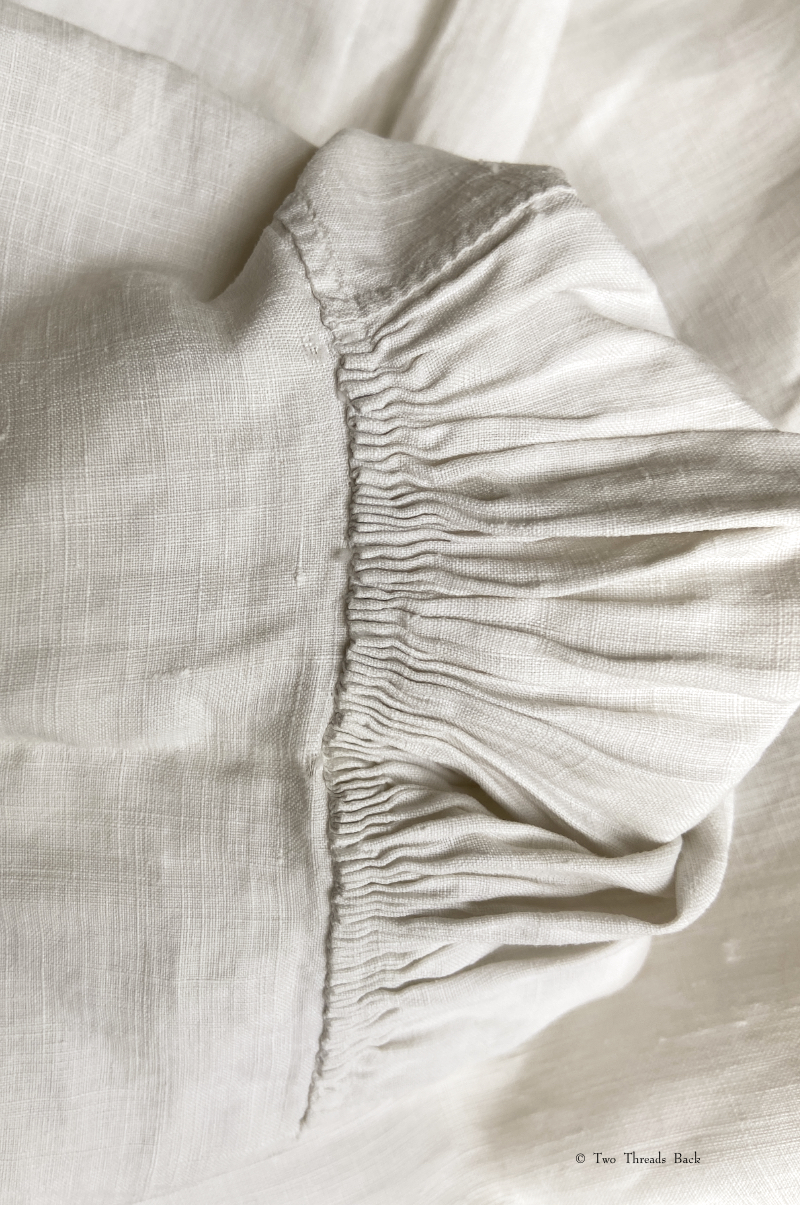
Inside view of the sleeve gathers at the shoulder. These aren’t usually visible in surviving shirts, because they are hidden inside “binders” which weren’t used on this one. The other shoulder has two coarsely-mended vertical tears, one at the same point on the gusset.
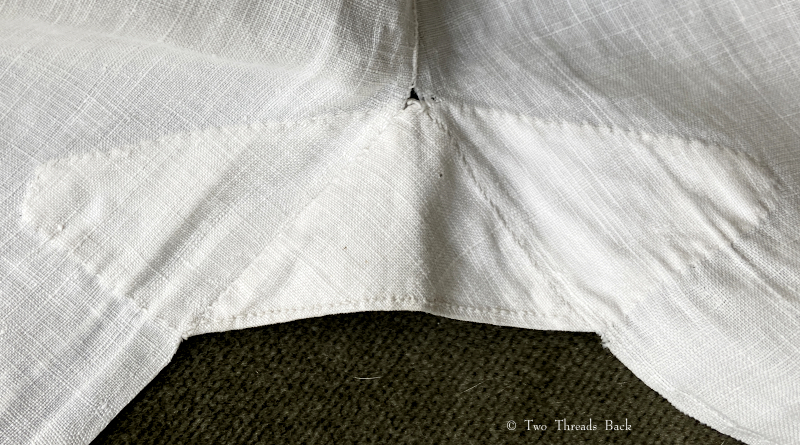
Side gusset exterior.
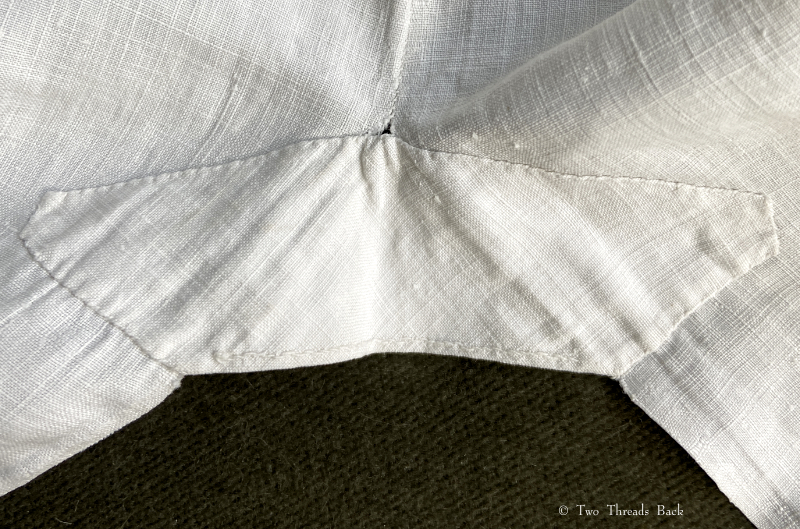
Side gusset interior.
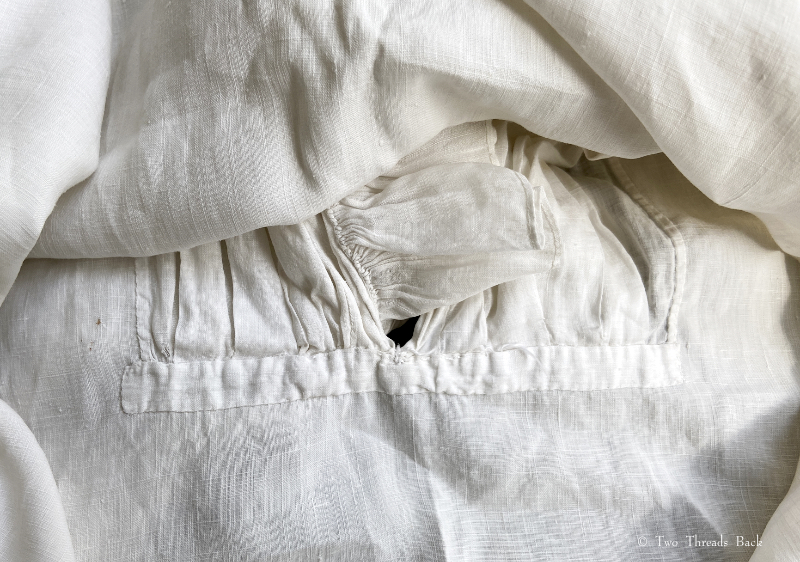
A peek inside the the shirt front, which had 4 pleats on each side of the front opening. A narrow strip of linen covers the bottom edge.
The SHIRT TRICK was republished in other books over the following decades. It even showed up as late as 1870, but by that time the cut of a man’s shirt was more fitted and complex, and I doubt the stunt would work as easily. Maybe the little fellow who wore this had a copy of the The Boy’s Own Book (1828) and had a go at it? I can’t imagine the maker would have appreciated seeing her work handled so roughly and the “person who was unshirted” might have had to conjure up an explanation!
Click to enlarge and see the decorative dot in the center of each diamond.
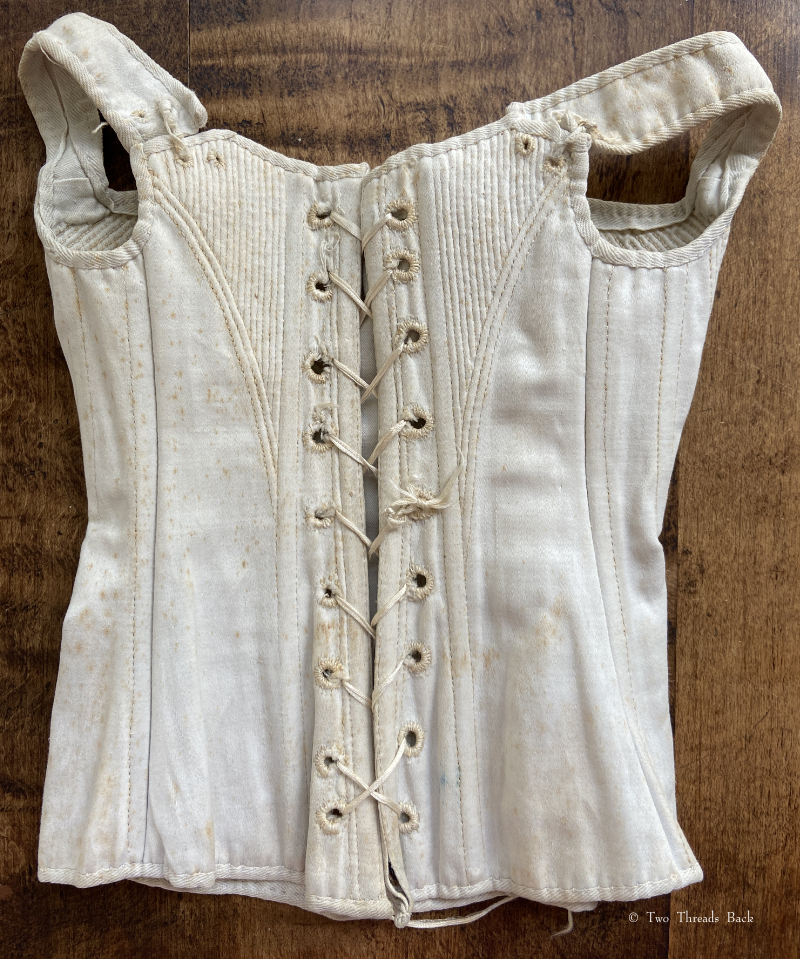
Not only do I have a weakness for plain sewing, but for miniature things as well. Tiny garments like doll clothes, or the samples that girls made when they were learning to sew are irresistable! That’s why I was thrilled to find this half-size treasure from – can it be the 1820s? At first I thought it must have been made for a doll, but it would have required a pretty large little lady for that time, and the incredible detail seems extreme for a doll. Maybe it was a shop model, or sent from a corset-maker to a client as a style sample? It’s certainly a puzzle, so I’d welcome any expertise!
Signs the lacing was pulled too tight…hmm…
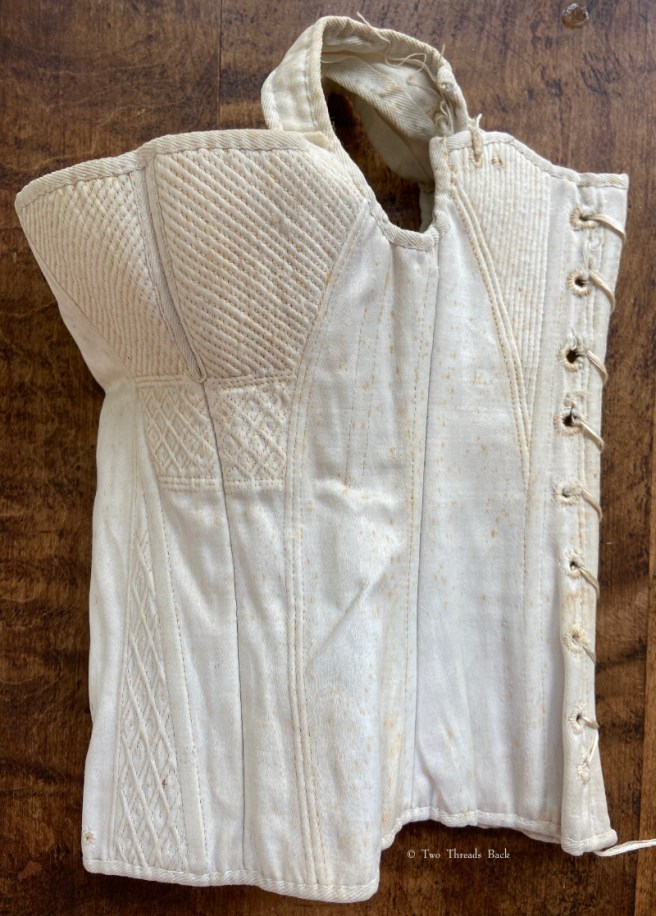
The side view shows how the pattern was designed for the well-endowed! It’s not as noticeable from the front.
It’s seven inches in length, 12 around the waist, made of two layers of cotton sateen, bound with twill tape, and of course, hand-stitched. The silk laces are in place as found, laced closed. It’s sewn with very fine silk thread which I believe was originally white, but has now yellowed a little more than the cotton fabric. I can see whalebone inside one of the boning channels where there is a slight separation at the end. I have no idea what the cording is, but the backstitches that hold it in place are worked about 20 per inch!
Click to enlarge for better view – their stitching wasn’t totally perfect, but a whole lot better than mine!
Compared to earlier 18th century stays that were heavy and heavily boned, or to later corsets that might contort and constrict the female torso, this style – excluding the busk – seems pretty comfy. That didn’t stop the lectures on tight-lacing, even during the early 19th century. The Poughkeepsie Journal opined in 1823:
I deem the corset of the present day to be the perfect engine of torture, and infinitely worse than the stays of days gone by. These last besure were injurious, but they left the resemblance of a female shape; the corset on the contrary presents the waist as regularly round and untapering as a white lead keg. The olden stays I remember were laced with a silken string of the size of the finest twine, but the corset requires a cord equalling the bow-string of a Kickapoo Chief.
What on earth is a white lead keg? Well, I checked. There was such a thing. Like a metal paint bucket today – just don’t use it to draw your well water! The author insists
no other animal could survive it. Take the honest ox, and inclose his sides with hoop poles, put an oaken plank beneath him and gird the whole with a bed cord and then demand of him labor. He would labor indeed but it would be for breath. Splinter and belay a pig in the same way and a whine might be aspirated, but it would be a whine of expiration.
Assuming your ox was honest, it would probably agree with the author. Unfortunately, the belayed pig wouldn’t have a chance! (It’s not often that 19th century prose make me LOL, but that last sentence succeeded.)
In the 1820s, Dr. Godman, a physician, anatomist, and naturalist who lived a remarkably full but too-short life (click here to follow a quick rabbit trail) denounced busks – lengths of flat wood, bone or steel inserted into a channel down the center front of a corset – as especially injurious:
Another instrument of torture is added in the form of a steel or hickory busk, which is pushed into its sheath in the already too tight corset, extending along the whole length of the breast bone… to keep the body from bending forward in the centre, and to prevent the dress and corset from ‘hooping up,’ as it is called.
The following scene occurred at a boarding-house in Philadelphia. The girl of the house … filled the tea-kettle, and brought it to the kitchen hearth, where she placed it on a bench. To place it over the fire required considerable stooping, and this, as it turned out, was impossible to her. Repeated and fruitless were her attempts, by a sort of crouching attitude, to accomplish her object; there was no one present to assist or to relieve her from the restraint which prevented stooping, and in despair she gave up, and stood by the kettle as if debating what she should do. The mistress came to inquire if the water was boiling, and found it not yet on the fire! – to her utter amazement, ‘the young lady’ confessed that she had her ‘long-busk’ on – that her ‘lacing,’ which was excessively tight, was in a ‘hard knot’ and that she ‘could not possibly stoop’ to put on the kettle!
He wasn’t without humor either:
Can anything on earth be more ungraceful than the gait, the walk of a female who is extremely corsetted? From the shoulders down, as stiffly inflexible as the parlour tongs, she can only advance by a sideling shuffle of the feet, which appear to get forward by stealth…
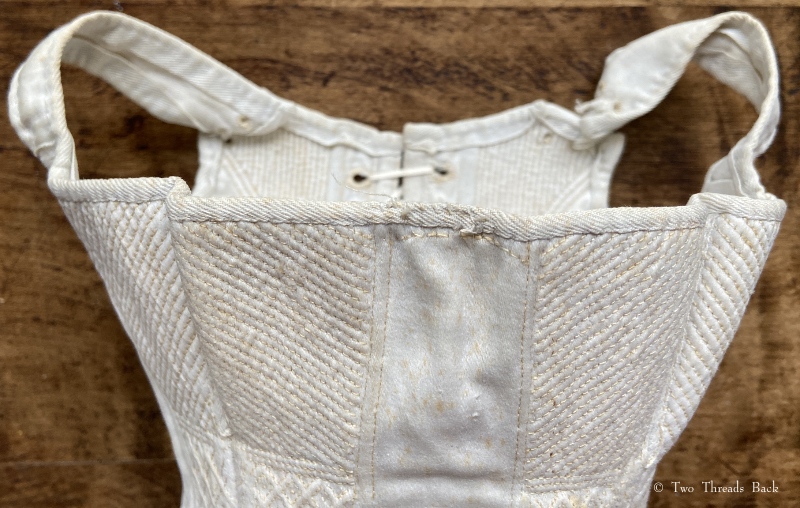
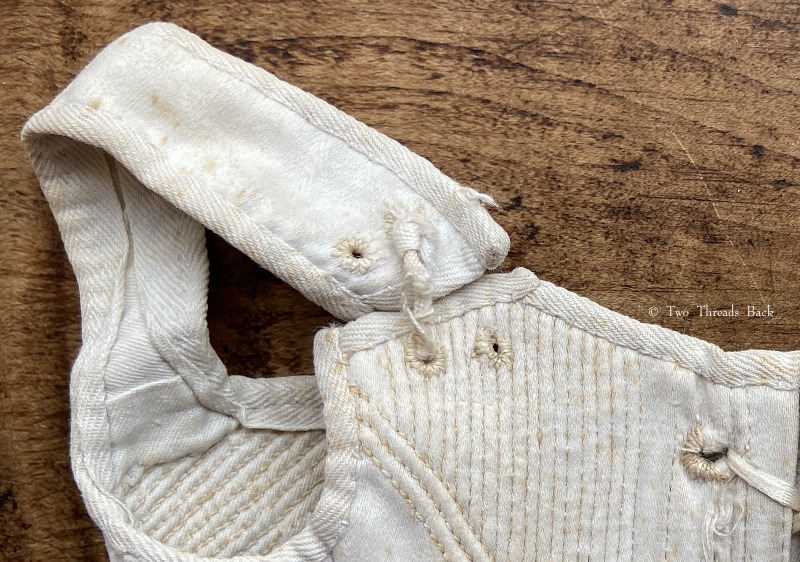
Here you can see the bottom of the busk pocket from the outside and the eyelet holes for a tape or cord to hold it in place.This is the bottom of the corset showing the inside of the busk pocket. I’ve used a broken ivory fan stick to show how it was inserted.You can see the top of the busk pocket has a curved row of stitches to keep the busk in place.One strap is tied with a tape, and the other with a narrow cord. I can imagine a little girl doing this for her doll.
Maybe I’ll never know what this little corset was made for. The workwomanship (assuming it was a female stitcher) is exquisite, which suggests a model, either to exhibit skill or make a sale. But a few signs indicate wear, which makes me think it adorned a doll. Maybe its history included it all: made as a specimen of skill, served as a model or sample, and then retired to spend its later years on a later doll. Of ‘corset’ doesn’t really matter, whatever its past, it’s still a work of art!
Maybe you’ve heard of “l’esprit d’escalier” or “staircase wit.” I hadn’t until recently, even though I’ve suffered from it all my life. It describes that maddening moment when you come up with the perfect, brilliant reply – after it’s too late to be useful. Well, finding the perfect image just a little too late can happen in blogging, too!
It’s been a year since I wrote the last post about sewing aprons. I’d wanted an example to study and to illustrate the post, but in decades of searching and collecting I’d never come across one. Wouldn’t you know, it was only two weeks later that I actually found a real surviving one! It’s obviously not an early nineteenth century apron like I’d really love to find, and I can’t be positive it was used for sewing, but it fits the all the descriptions to a T.
A closer look at the button, the featherstitching, the direction of the hems on the sides, and the “seamed” band.
It’s a charming white dimity with pink featherstitching and a waistband that buttons. Late 1800s, early 1900s perhaps? It looks like it could have been made in school, rather than at home. I say that because the stitches seem to be textbook-style hand sewing: precise (if not dainty) hemming, seaming, setting-in, and buttons, combined in a class-projecty sort of way. And a couple of tiny ink spots near the bottom!
Seeing an example close up did answer the hemming question for me: did they fold the side hems face up or face down before turning up the bottom for the pockets? Or did they do a little snip on the edge so that each hem could be folded to the back, the way I did for the doll’s apron? Answer: face up. For this one, anyway. The nice deep pockets are then seamed together so that the folded hems are inside.
I hope the maker was happy with her little apron. I suspect she treasured it since it’s survived all these years. Maybe it proved useful for holding her sewing things while she was climbing stairs – and she had the wit to appreciate it!
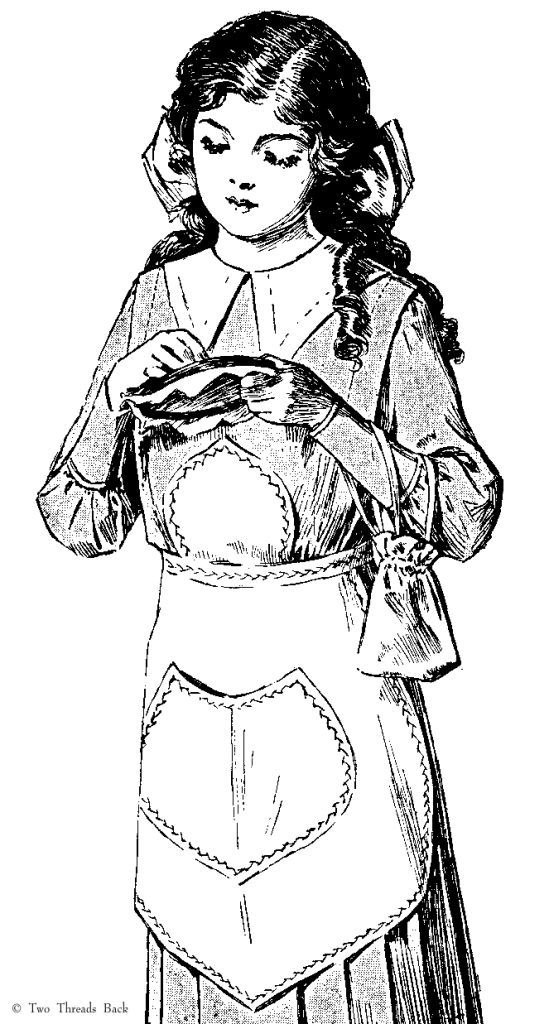
I don’t remember where I first came across the term “lap-bag.” It was used in the infuriatingly casual way that long-dead authors have of assuming we know what they’re talking about, and I didn’t give it much thought. But when I recently came across the illustration below, c.1860, my reaction was – in the words of my 4-year-old grandson – “what is the heck of that?”
Of course I pursued the elusive lap-bag, only to discover it wasn’t so peculiar after all. It has a respectable history, especially if you consider it’s only a variation on a very useful, very humble, and very common garment. I think this young emigrant to Australia summed it up perfectly in 1850:
The ladies gave me a nice piece of print to make a lap-bag, which will be very handy on board ship, as it ties round the waist, and has little pockets to hold one’s thimble and scissors.
It’s simply a type of pocketed apron that was used for keeping sewing items handy, something especially helpful for girls’ sewing classes. The pinafore was another variation, recommended as early as the 1810s for plain needlework lessons, both in England and America.
Each girl should be provided with a pin-afore, or slip … taken in at the conclusion of school time…. The pin-afores are marked 1, 2, 3, &c. up to the number of girls that the desk contains: the number of the desk is also marked upon them, thus – 5/3, which would signify that the pin-afore belongs to the 5th girl in the third desk.
In 1858, when Alice Neal penned her reminiscences of Eliza Leslie for Godey’s Lady’s Book, she remembered her own school days.
As long ago as sewing was made a special branch of female education – and we leave our readers to infer the date [she was born in 1828] – the Wednesday afternoons at the school which I attended in Boston were enlivened by reading aloud. The circle of little people, with their pink and blue chintz “lap-bags,” a style of sewing receptacle entirely unique, stitched away on their sheets and patchwork, while the older girls read in turn.
A children’s story from 1871 tells how “The girls all had to be provided with lap-bags, worn like aprons, with the ends brought up and stitched together. These were to keep the work from getting soiled, and hold the thimble, cotton, needles, scissors, etc.” School inventories included lap-bags, and one teacher explained,
These little lap-bags,” remarked the teacher, are the very first articles I teach the children in the Primary class to make; and they use them through all the grades until they graduate from the cutting department. Each bag is labelled, and at the close of the sewing hour the work is neatly rolled up, put inside, then collected in these large baskets.
Some later sources called them sewing aprons, but these matched the description as being aprons “made of extra length to allow the turning up of a quarter yard or so for a pocket.” After reading all about these receptacles, I decided to attempt my own. It’s quicker and cheaper to make things in miniature, so doll size it would be!
But what to use? I found references to brown holland (unbleached linen), calico prints, Scotch gingham (a better quality gingham), and pink and blue chintz. My obsession with charity sewing schools inclined me toward the brown holland, since that was the utility fabric they suggested. I just happily happened to have a bit of it with the original glaze (a glossy sizing) remaining, so the next step was to make sense of the directions that accompanied the illustration. Simple. For most people.
A pattern to scale. Yes, including the gusset.
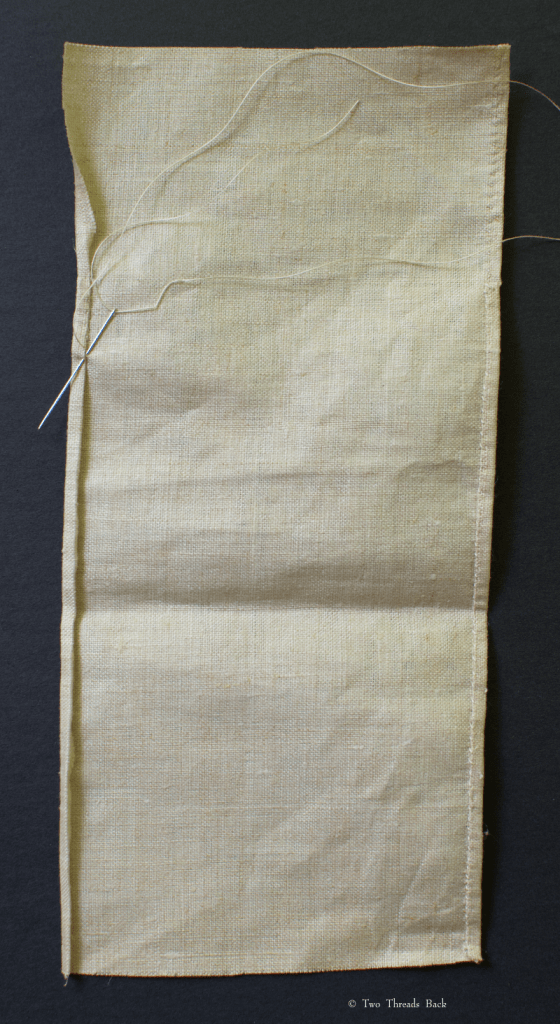
Oops. I had actually started hemming one side before it dawned on me that either the pocket or the apron would be hemmed the wrong side out. Snip and flip to the rescue!
Time to insert the gusset. Yes, the pattern was to scale. Apparently the finished gusset had a growing spell.
Next came the marking. As much as I wanted to follow advice and place the numbers where they’d show when the work was folded, I couldn’t make it work. But my doll will still take her place as the “fifth girl in the third row.”
I also made the “pincushion of white calico with a cover of coloured print to which the tape is sewn, so that the pincushion being taken out, the cover may be washed with the bag.” In theory.
A lap-bag ready for work.
Trust writers of the era to impart moral virtue into anything that would hold it. I don’t mind, at least not when they’re praising hand sewing.
If it is best to train the child along aesthetic lines in any phase of art, then let him be trained to appreciate and prefer a piece of true art in needle-work, even plain sewing, over a wholesale manufactured article which may be bought at cheap rates.
Let me illustrate by a school girl’s sewing apron, neatly though plainly made, hand-sewed by herself, and appreciated because she wove into its very stitches her own power and love of doing a thing for herself, and, too, having done it the best she could, over a very elaborate one selected from a whole boxful in a store marked “your choice for 10c.”
As aesthetic development and culture help to make a person a better person, so sewing can be made to help a girl to become a better girl and a more powerful and valuable woman to society.
Why not turn up your nose at that 10¢ store-bought apron, make your own, and become a powerful woman! You’ll be glad you did.
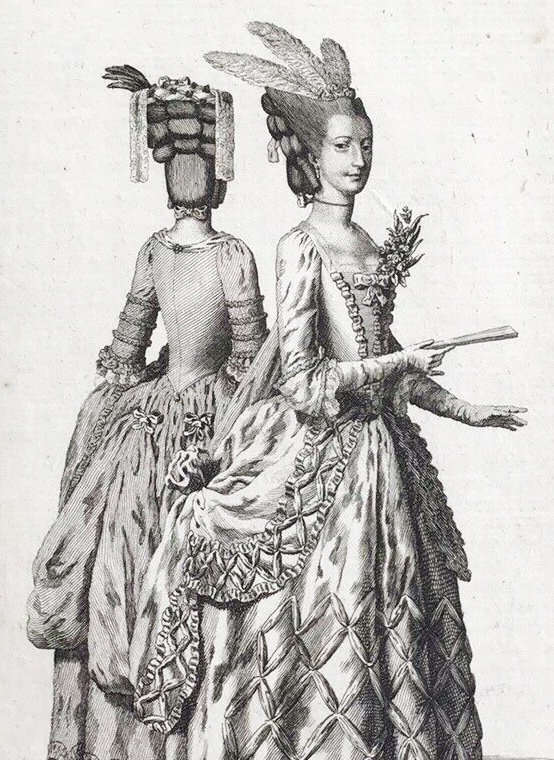
I know what lappets are, costumely speaking, and with regard to women’s millinery. They’re those long, lacy, streamer things that hang down from a headdress. The fanciest ones were made of fine lace and could be terribly expensive. They were popular in the 18th century but seemed to fade by 1800 when the classical look was in vogue, and then regained favor, at least with “mature” ladies, in the middle to late 19th century. Early ones were usually found in pairs, or occasionally joined slightly shaped in the middle, while 19th century ones could be . . . more creative.
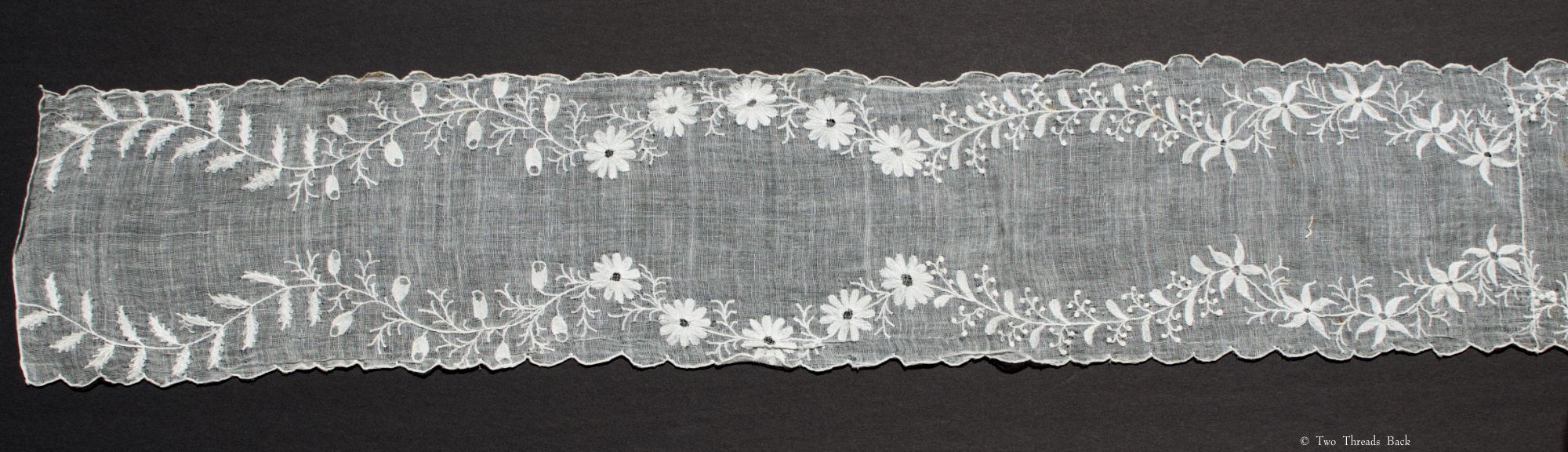
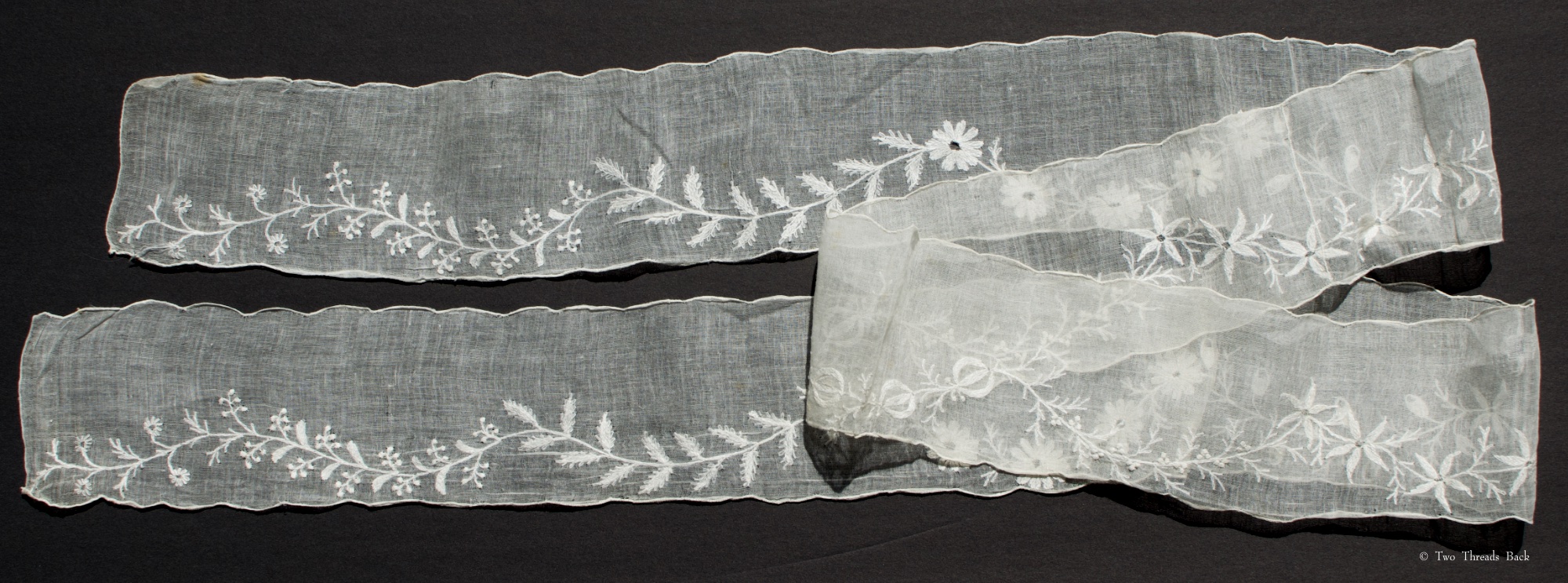
But what have I got here? Two different long strips of fine white muslin, neatly (but probably not professionally) embroidered with whitework. Are they one-piece lappets, or something else?
They appear to date to the late 1700s or early 1800s, judging by the materials and floral patterns. One is 58″ x 4″ and the other is 63″ x 3.” The design on the wider one is mirrored on both edges, while the other is worked along one edge only. All edges are scalloped, and there’s a join on both at 20 inches (not the middle) from one end which the embroidery carries right across. Found together + like patterns + like materials = same maker? The design was embroidered to fit, which indicates they weren’t cut from another garment. They seem too fragile for a sash and too narrow for a scarf.
So how in the world would you wear them? It seems like draping across the top of your head would be a bit awkward. I’d feel about as graceful wearing a length of toilet paper.
The most fabulous book on accessories of this era is Heather Toomer’s Embroidered with White, and I searched it for clues. It has beautiful photos of lappets. In pairs. With dense embroidery. Sigh. In her book on the next time period (just as brilliant), lappets appear as extensions of other accessories, such as fichus and pelerines. So I’m still wondering what these were for. Help!
The fabric is joined about 20″ from one end (not centered) on both pieces.
The darning is finer than the embroidery!
While on the subject of long narrow textiles, I’ll present my next puzzle: tuckers. I’m wandering into dangerous territory when discoursing on 18th century costume, since I know so little. However, I had no trouble finding period references to tuckers. Their wearing location on female anatomy guaranteed attention, one way or another.
Tuckers, as defined in 18th century dictionaries:
TUCKER, tuk’-ur. f. A small piece of linen that shades the breasts of women.
-A Slip of Linen or Lace, pinned along the Top of Women’s Stays -A border of linen or lace on the bosom of a shift -A fine piece of lace, cambrick, &c. pinned or sewed round the neck of a woman’s shift, gown -A shred of linen &c., about the neck of a woman’s shift -A slip of fine linnen, run in a small kind of ruffle, around the uppermost verge of the women’s stays -A strip or ornament of linen worn by women at the uppermost verge of the stays
Then we have Garsault’s 1771 L’art de la lingère, where I’m up to my tucker in speculation:
Tour de gorge en mousseline festonnée. Il se fait d’une aune de long sur un seizieme de large. Painfully translated: Scalloped muslin tucker. It is made one [≈yard] long by one sixteenth wide. A 1788 French-English dictionary defines “tour de gorge” as “tucker,” and “tour de dentelle” as a lace tucker.
This post is already too long to include Joseph Addison’s slightly naughty essay on the tucker – although if you’re curious, you can find one of many reprints here.
There’s no lack of period illustrations of tuckers, but it’s the logistics that have me baffled. Sure, you can tuck a straight band of fabric around the top of your stays – but then all but a few inches in front is hidden under a gown. You can tuck a straight length around the neckline of your gown – but then you have to negotiate the curves, and my mystery pieces seem awfully wide to do it without looking rumpled.
A Lady’s Maid Soaping Linen c.1765-82 Henry Robert Morland 1716-1797 CC-BY-NC-ND 3.0 I don’t presume to know if she wearing a “separate” tucker, or if that’s trimming on her shift. Or neither. But it’s a good illustration of the trickiness of turning corners!
A Laundry Maid Ironing c.1765-82 Henry Robert Morland 1716-1797 CC-BY-NC-ND 3.0 Her frill seems to be a little fuller.
Many paintings show gathered ruffles at the neckline, whether lace or embroidery, although the Lady’s Maid Soaping doesn’t look very frilly. Of course you could always adorn your own tucker, if you were good with a needle.
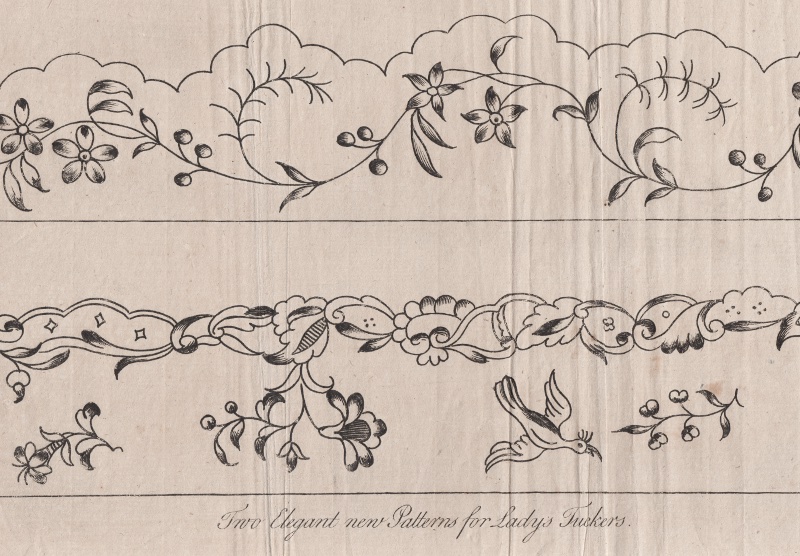
A pretty pattern from 1772.
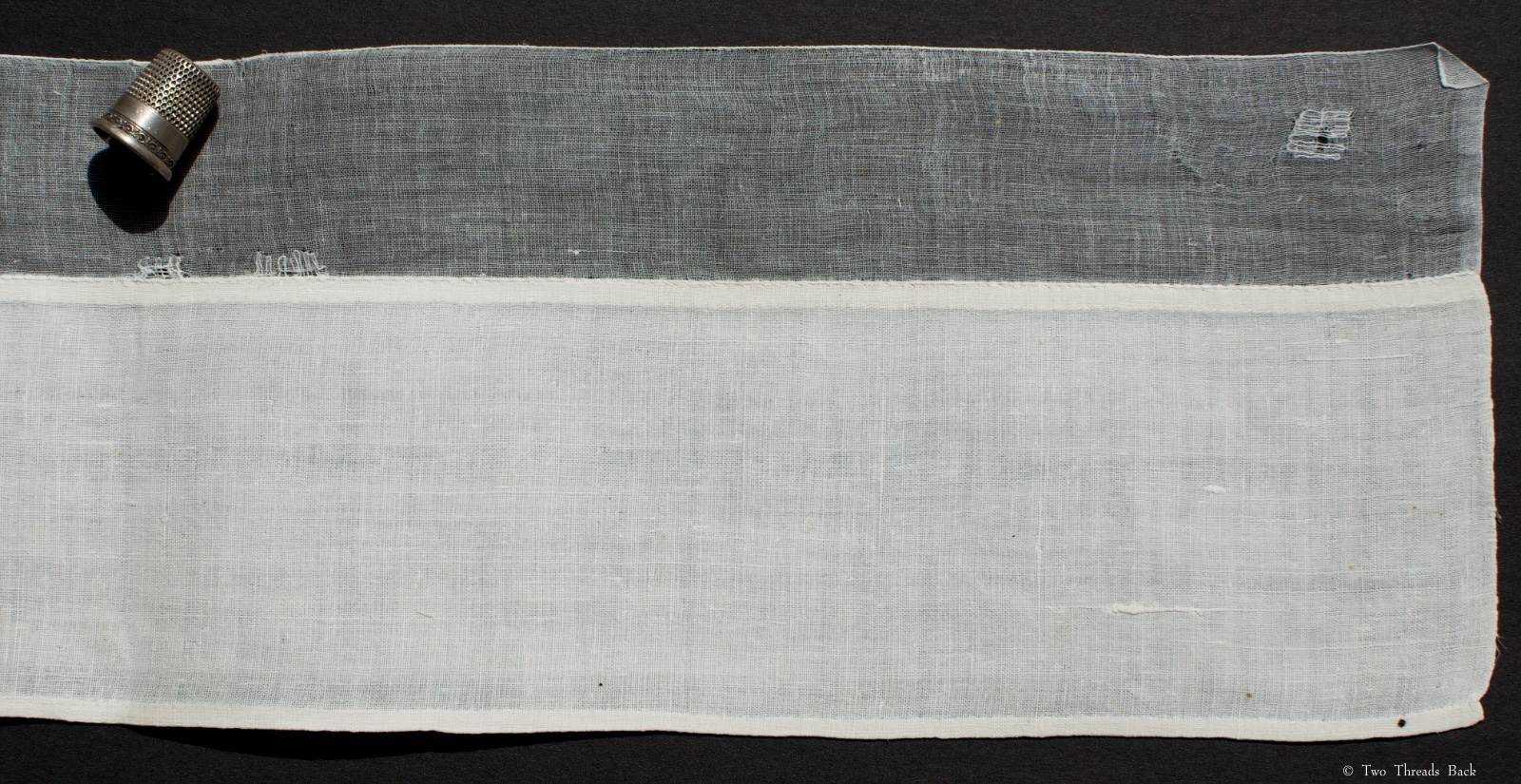
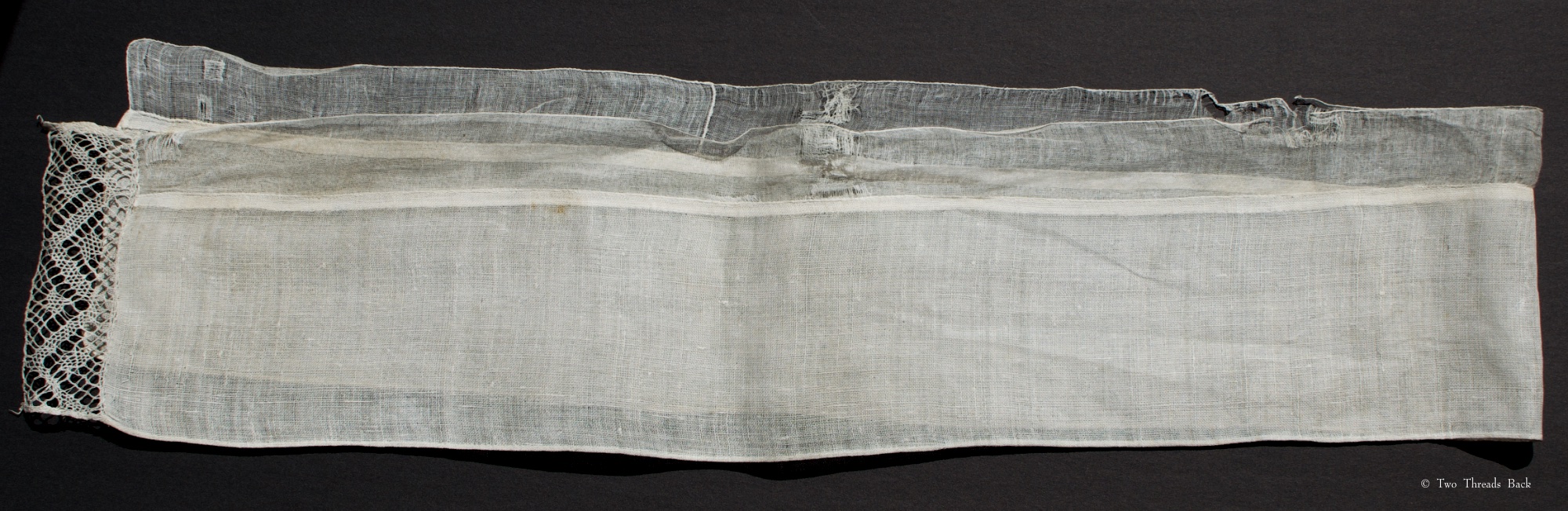
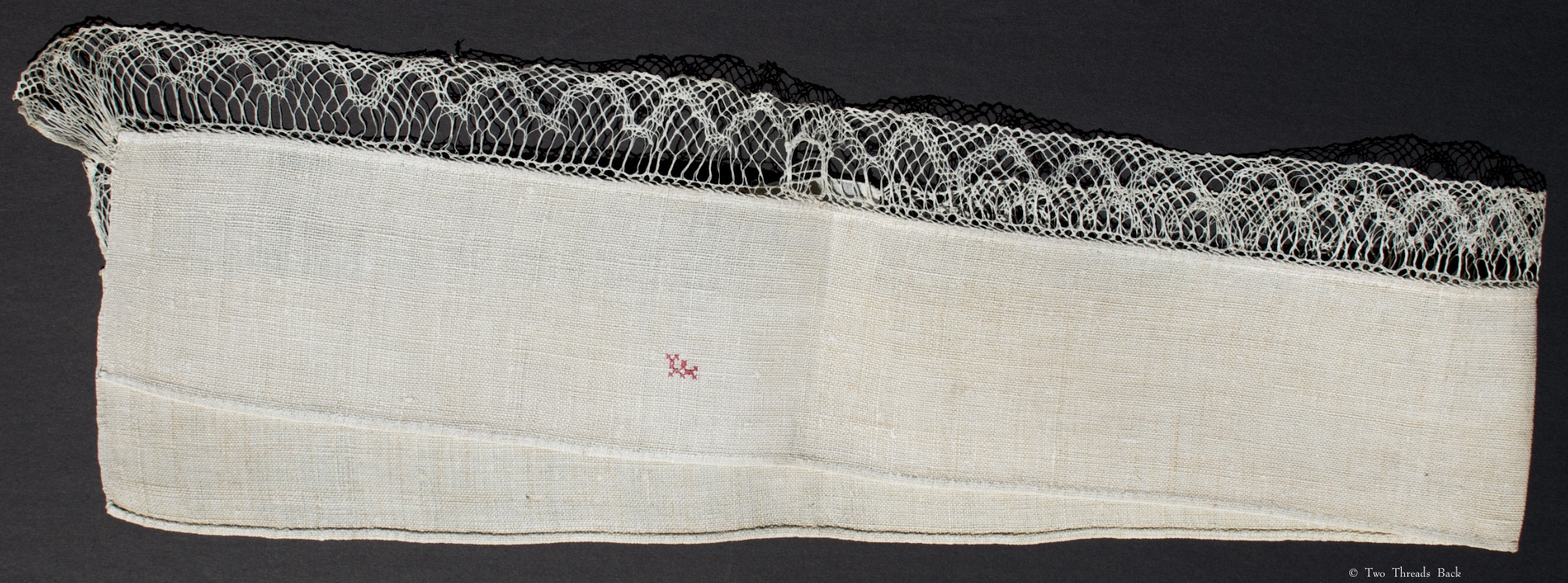
Now here are the four long strips of linen that perplex me, ornamented along one edge, all owned by a woman who lived from 1760-1805, in France. They measure a bit over 40″ long and the linen is @3.5″ wide. If they’re not tuckers, what the heck are they and how did she wear them? Maybe they were part of a headdress. Folk costume. Dresser scarf. Tourniquet with feminine flair.
A closeup of the careful mending. The darns are as fine as the other plain sewing.
There’s a bit of lace on one end only, and a cambric border on one edge. You can see there’s also a good bit of wear.
This one is in better shape, has lace along the edge, no trim on the ends. And her “marked” monogram.
A beautifully simple one, marked with both initials, although the cambric trim on this one didn’t fare so well.
I’ve called these pieces lappets and tuckers, but I truly don’t know. Research didn’t settle anything for me this time, so any help is welcome. Maybe someday in the future our descendants will ask the same questions about our garments. I know I’ve shopped for workout clothes and been just as confounded – these strappy scraps of spandex go how?!



























 Two Threads Back