The UFO

UFO
The UFO

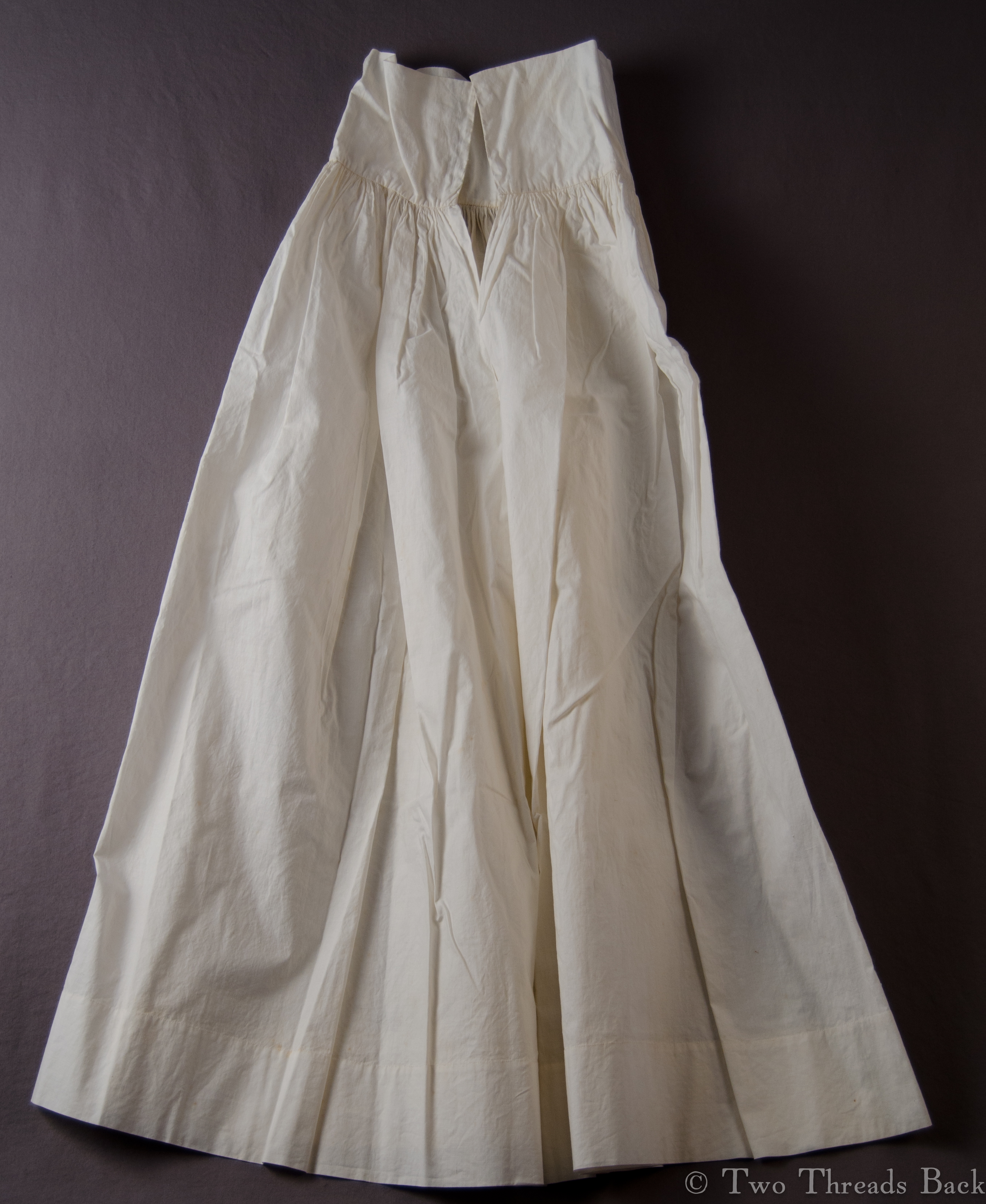
I am referring to an Unidentified Fabric Object. From eBay to flea markets, mystery objects abound, and this one is often misidentified. No wonder, it’s not something that is used today, and it was probably a bit of a nuisance to the wearer in its own time!

Take a small rectangle of cotton or flannel, and gather or pleat a much longer rectangle to it, neatly finish the edges and there you have it: a tiny apron/skirt/slip/unfinished sleeve for a skinny short person! Or not. What you really have is a barrow, barrie-coat, barra-coat, barrar coat, pinning blanket, night flannel, or petticoat.

These skirts were worn by babies in days gone by, layered somewhere between the shirt and diaper (clout or napkin) and outer petticoats or gowns.
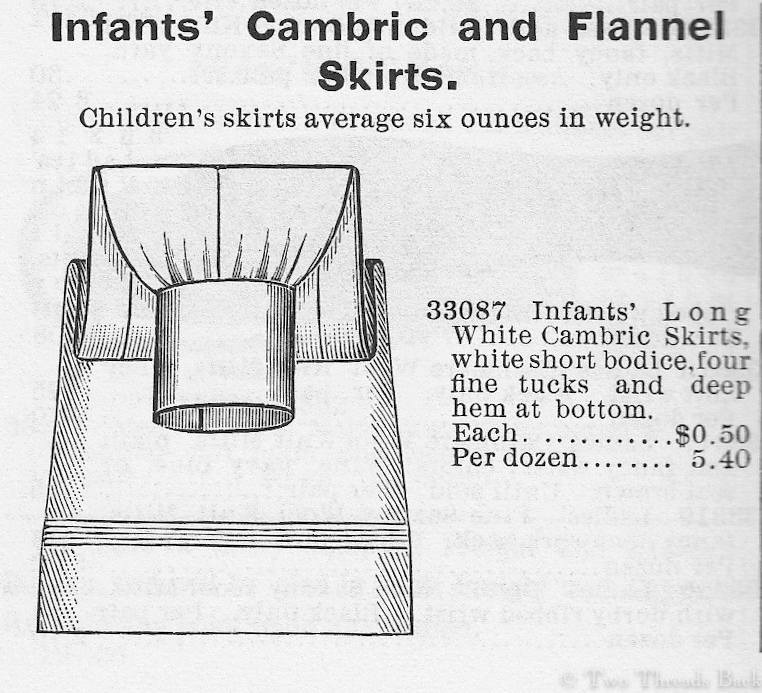
UFO Catalog Illustration
From an 1895 Montgomery Ward Catalog

According to The Nursery Basket, published in 1854, the night petticoats

“are nothing more nor less than the old-fashioned open pinning blanket, or the English barrar coat. In the simplest form, a night petticoat has a skirt of one breadth, three quarters of a yard in length. Turn a hem as shown above, of two inches, at the bottom, less than half an inch or the sides, and cross-stitch, as on the bands, with white silk. Gather it slightly into a double linen waist (waistband fashion), 22 inches in width, and 6 in length, which will allow for seams.

Choose the same quality as for the bands, finer rather than coarser, as it comes next to the shirt and at first completely wraps the delicate limbs of the infant. The real flannel petticoat is not usually put on until the child is six weeks old. The pinner is then used for the night, six weeks longer, when most babies of spirit kick themselves fairly out of its narrow limits.

We have found this sufficient for all ordinary purposes. There is another style, now in use, where the band and skirt are made to lap at the side, and the skirt is tied over by tape strings, instead of being pinned up, as in the first instance. This will require two breadths, of flannel, a yard in length, to keep the child’s feet and limbs sufficiently warm, and is more cumbersome to infant and nurse. The waist can be made in the same fashion as the second band, to tie over.”

The author, Sarah Hale, goes on to describe possible trimmings and ornamentation, but suggests that “as the garment is only for transient use, it would seem a waste to expend much time or labor upon it.” And after all, most “babies of spirit” wouldn’t appreciate it.
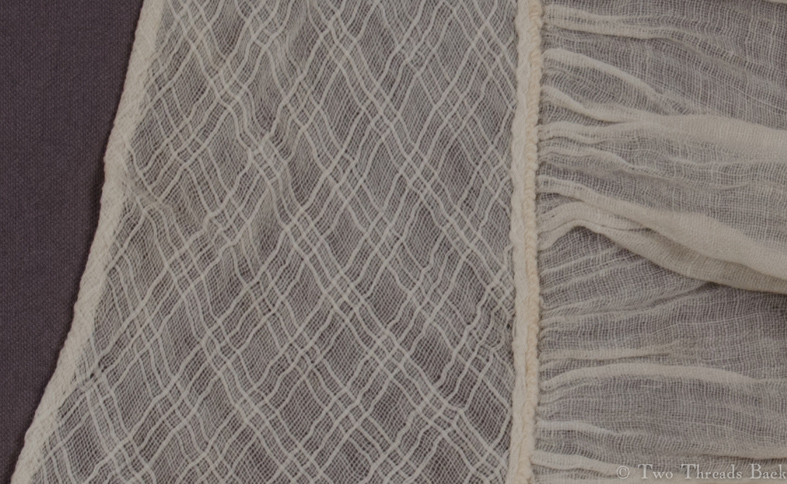
Mulling it Over

Ah, the quest to identify the delicate fabric! So many surviving caps, collars, aprons, and gowns. Mull, book, or clear muslin; longcloth, cambric, nainsook, lawn, batiste. Not to mention spotted, sprigged, flowered, figured, checked, worked, striped, and embroidered!

Cross-barred Muslin
Gossamer-thin collar of cross-barred muslin with a sheer muslin frill.

Because so many of the textiles that fascinate me are white cotton or linen, my inquiring mind wanted to know what to call that pretty little antique baby gown – mull? Cambric or jaconet? Swiss, Indian, or Scottish manufacture? Surely something more than white cotton!

Muslin Pink Spotted
Infant gown of pink spotted muslin.
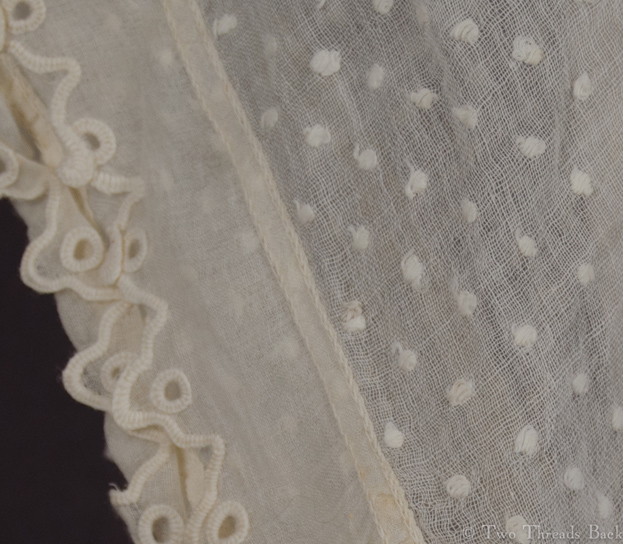
Spotted Muslin
Cap of spotted muslin with edging of plain muslin embroidered with scallops and eyelets.
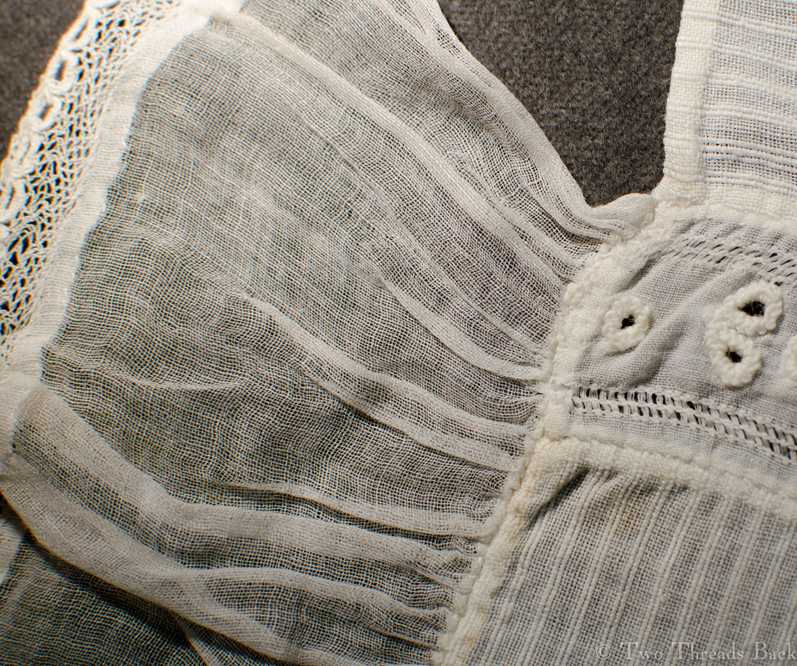
Muslin Cap
Three different types of cotton in one piece: airy frill, ribbed body, and a sturdier foundation for the embroidered insertion.
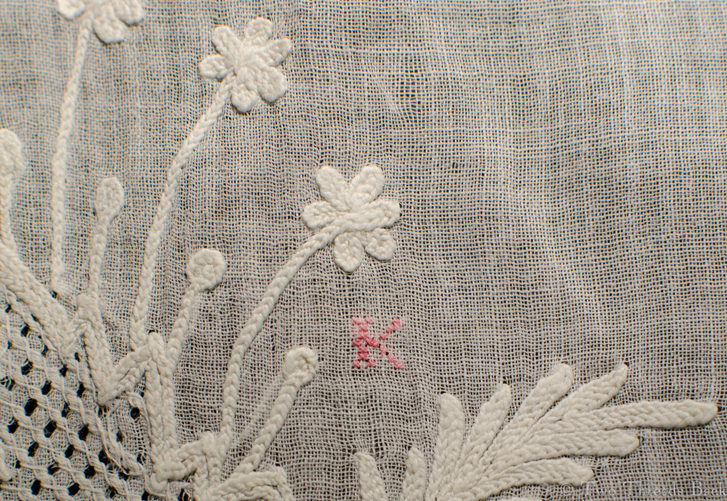
Muslin Apron
Apron of thin cotton, Dresden embroidery.

So many names show up in period writing. Some of the adjectives are unambiguous: spots are spots, then and now. But for years I puzzled over terms and asked any textile historian I came across (ok, there weren’t many) to explain how to identify each kind. Silly me.

I searched novels and dictionaries, magazines and swatch books, sewing textbooks and inventories galore. And guess what? Even more confusion. My eyes became as “glazed muslin.”  There was no consistency or authoritative answer to what was what. Or at least not enough for me to astonish my friends with my blindfold fabric naming tricks.

Yes, lawn and cambric were once only linen, names denoting origin; voile came rather late for my area of interest. And  often the context of the term (especially when it was attached to a dated sample!) was extremely useful. But I was looking for an answer that wasn’t. I mean, there isn’t one definitive answer, consistent for all times and places. The evolution of the stuff, as well as language, has seen to that!

After all, a maker who calls a fabric by one name, the wearer half a world away who calls it something else, and the lucky one who finds it in an attic 200 years later and doesn’t know what to call it – may all refer to the same thing. It all depends on Who, Where, and When. So I guess I’ll just call it all muslin!

Muslin
Muslin, by Sonia Ashmore,
image courtesy V&A

Speaking of books and muslin … the V&A published a book last year, Muslin, by Sonia Ashmore, and it’s my latest chair-side companion. Superb research, gorgeous photos – a must-have for any historic costume/textile enthusiast.

And anyone who wants more information on period textiles will find Florence Montgomery’s Textiles in America, 1650-1870, Sally Queen’s Textiles for Colonial Clothing, Textiles for Clothing of the Early Republic by Lynne Basset (the whole series, actually), and All About Cotton by Julie Parker to be excellent resources – and all but the first have samples!

Oh! And then there’s A Lady of Fashion, Dating Fabrics, Clues in the Calico

Post scriptum (ancora imparo and all that):

From The New Encyclopaedia, 1807, a hint of how muslin compared,
Cotton Goods are divided into different classes, each proportionally lighter than the other. The heaviest of these are, 1st. Shirtings, 2d. Cambrics, 3d. Cossias, 4th. Jaconetts, 5th. Lawn grounds, 6th. Mulls, 7th. Books.