Pharaby Sets Her Cap

Pharaby Cap 4

Actually, that should be “Pharaby Sets Her Cap Aside” – for now, anyway. I haven’t completely neglected Pharaby all these months, but sometimes remembering to take photos, and then remembering where I saved them, delay my writing about her wardrobe’s progress.

This project also took longer than I thought it would. It was hard figuring out what I wanted her to wear. Most surviving Queen Anne dolls just have little bits of lace and silk gathered and stuck atop their heads, or if they’re wearing more constructed caps, the photos don’t show sufficient details for me to copy. And sometimes the surviving headwear is not original to the doll, being so obviously 19th century that even I can tell!

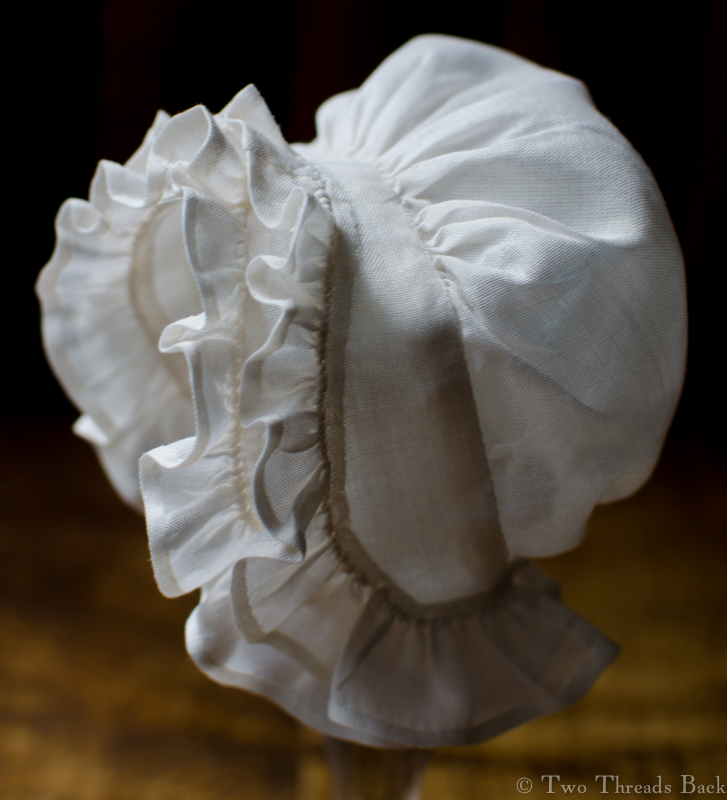
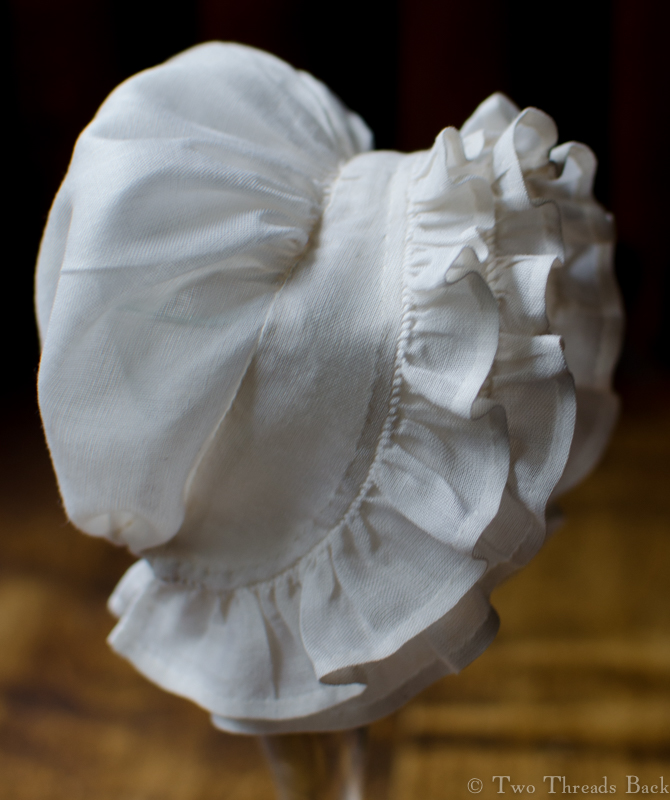
In the end I decided on this style, because it was easy to make a pattern and I’m familiar with the sewing techniques. The cap is formed from a simple half circle gathered at the base of the neck and the crown and trimmed with plain frills.
Pharaby Cap 1

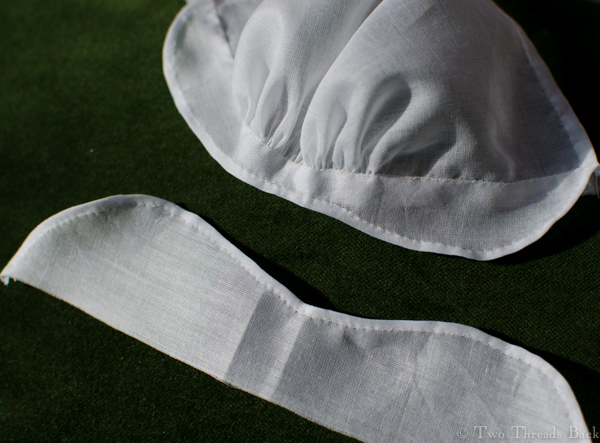
I did experience one of those aha moments when attaching the headpiece/band/brim to the crown. It was easy to “set in” the little gathers on the top thanks to the fact that the band was double. It worked just the same way as setting a gathered sleeve into a cuff! Maybe that’s why they so often had double brims?

Pharaby Cap 8

My attempt at narrow hems was a flop, at least compared to what 18th century women could do. But I did manage a very nice tiny eyelet for the back drawstring. It would have been nicer if I’d also remembered to put in the strings and tack them in place before I hemmed the casing down! Did you know that you can thread a large needle and retro-fit a string into a casing?

Pharaby Cap 7

Pharaby Cap 3

Perhaps you’ve noticed none of these pictures show Pharaby wearing the cap? That’s due to my inadequacies as a perruquier. Every time I place something on her wig and then remove it, a few mo-hairs (groan) come loose from the carefully arranged style. In order to keep it all together until her final dressing, I had to limit the try-on’s. Pharaby won’t be modeling her cap for a while, so I let a wineglass serve as a mannequin – and then serve to celebrate one more project done!

Staying Put

Staying Put G
Pharaby’s new old busk.

It’s been a while since I added anything to Pharaby’s wardrobe, and with heaps of projects competing for my time I decided to tackle the quickest thing: a busk for her stays. Perhaps that might keep her happy until I have a little more leisure? I figured I could take a damaged “bone” from my stash, trim it to fit, and etch her initial. No problem.

Ha! I think the Spirits of Whales Past saw to it that I paid for my callousness towards history and nature. If you are extremely sensitive to the sacredness either, you may want to skip this post. If your curiosity exceeds your delicacy, here is the process in photos.

Staying Put B
The doll stays, pocket sewn in the lining, awaiting a 2-inch long busk.
Staying Put A
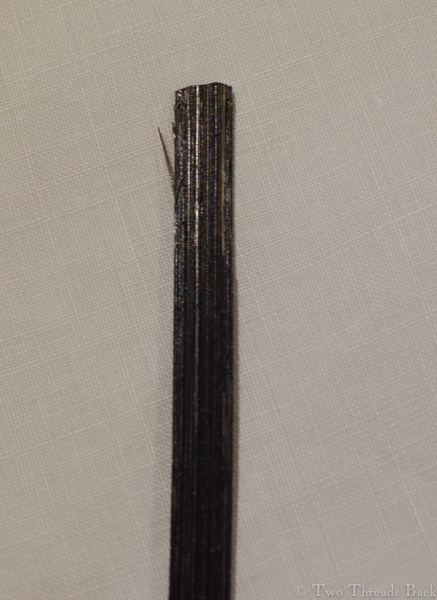
The aged and injured piece of baleen I started with, shredding on one side and blistered on the other.
Staying Put C
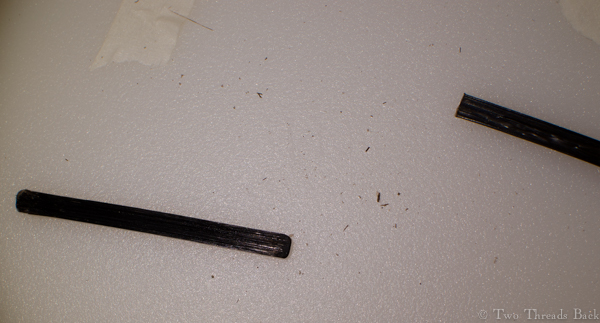
Now it’s taped in place on the cutting board for a quick trim. Not! After sawing and sawing for a while, it was time for Plan B.
Staying Put E
Plan B: I recalled a period domestic guide advising that boning should be soaked in hot water. Here we have baleen soaking. Soaking is not enough.
Staying Put E
Or was that boiling water? Here we have baleen soaking in boiling water. It sufficed, barely.
Staying Put F
Success at last! And for the final touch, a little filing to smooth the edges. What, no etching of her initial? A verse, a heart? After a little discussion, we decided to wait until her sailor sweetheart returns from the sea and let him do it. The busk will keep her stays put for now.


Picking a Pocket

Pocket 1

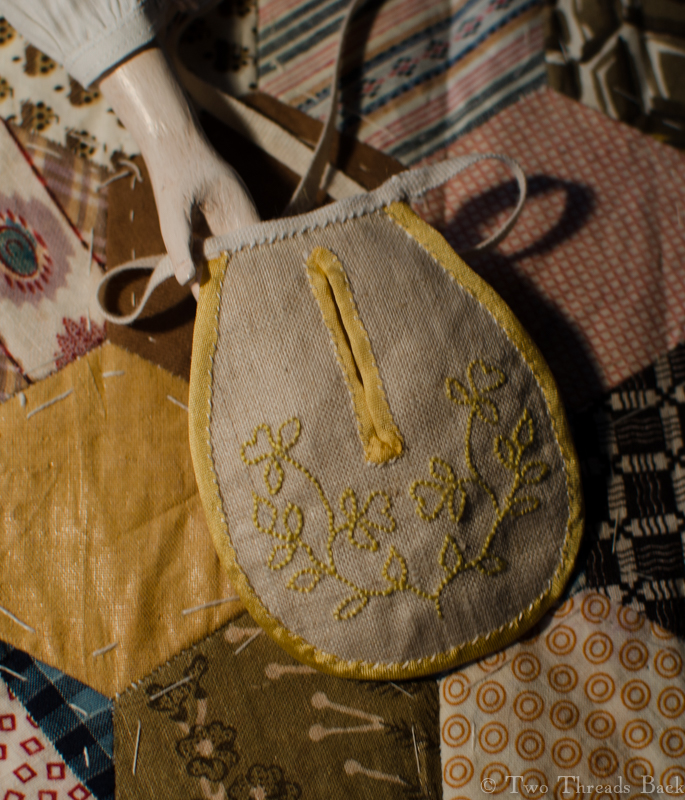
Pharaby’s pocket’s been picked!

(If you expected the Lucy Locket quote on this one, maybe I succeeded in surprising you?)

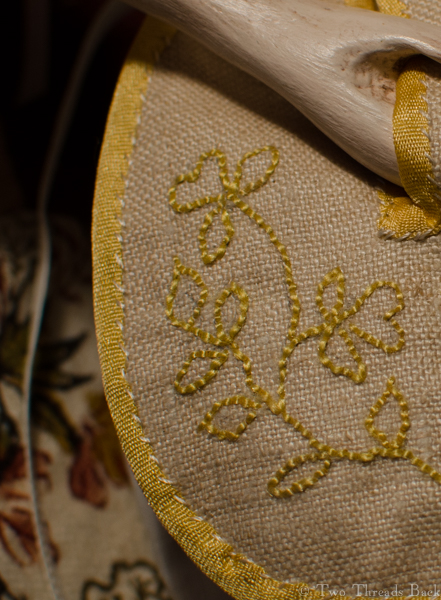
There are so many images available online that it was hard to choose a model for her pocket. I finally settled on “the look” of a sweet little doll version in the online Pockets collection at the VAD. (Click the link and then search for “doll´s pocket Nottingham.”) It resembled a couple of others, also worked in yellow thread, that were made for women rather than dolls. And it only required a backstitch!

The pattern: traced, pricked, and pounced. The fluff of canary-colored silk is the remains of
The pattern: traced, pricked, and pounced. The fluff of canary-colored silk is the remains of my fight with the floss.

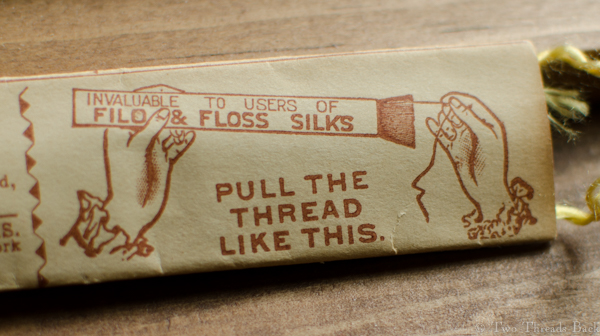
The design I used was loosely based on an 1770s pattern from The Lady’s Magazine. I scanned the original pattern and scaled it down to Pharaby-size. Then I raided a stash of old 1890s embroidery silks. I tried using the thread as it came from the skein, but it was way too thick – using only one ply made it almost small enough. And I can tell you that it did NOT work like the illustration on the wrapper!

Pocket 4As you can see from the remaining yellow fuzz, it was a struggle. But once that was done, it was pretty simple to cut out the front and back, then bind them with some matching yellow silk.

Pocket 6
I tried. It didn’t work like the picture.

To finish the pocket, I added narrow tapes on the ends. Yes, one MORE thing to go around her waist. But now she has a place to carry her handkerchief – when I make her one.

Pocket 5Oh! And while she was showing off her pocket, I took a picture of her wearing her marked shift. I neglected to do that in the last post, and she let me hear about it.

Pharaby's Marked Shift

X Marks the Spot

Pharaby's shift is now marked.
Pharaby’s shift is now marked.

“The art of marking was brought to perfection many years ago, and if our great grandmothers could but see the meagre attempts made by us now-a-days, I fancy they would have some contempt for the system by which our needlework abilities are tested.”

– A. K. Smith, 1892

They would certainly have some contempt for how long it took me to mark Pharaby’s shift, regardless of the quality of my work! I should have tended to this little essential when I first made it, but better late than never. We can’t have her single shift getting lost in the laundry, can we?

X Marking 2
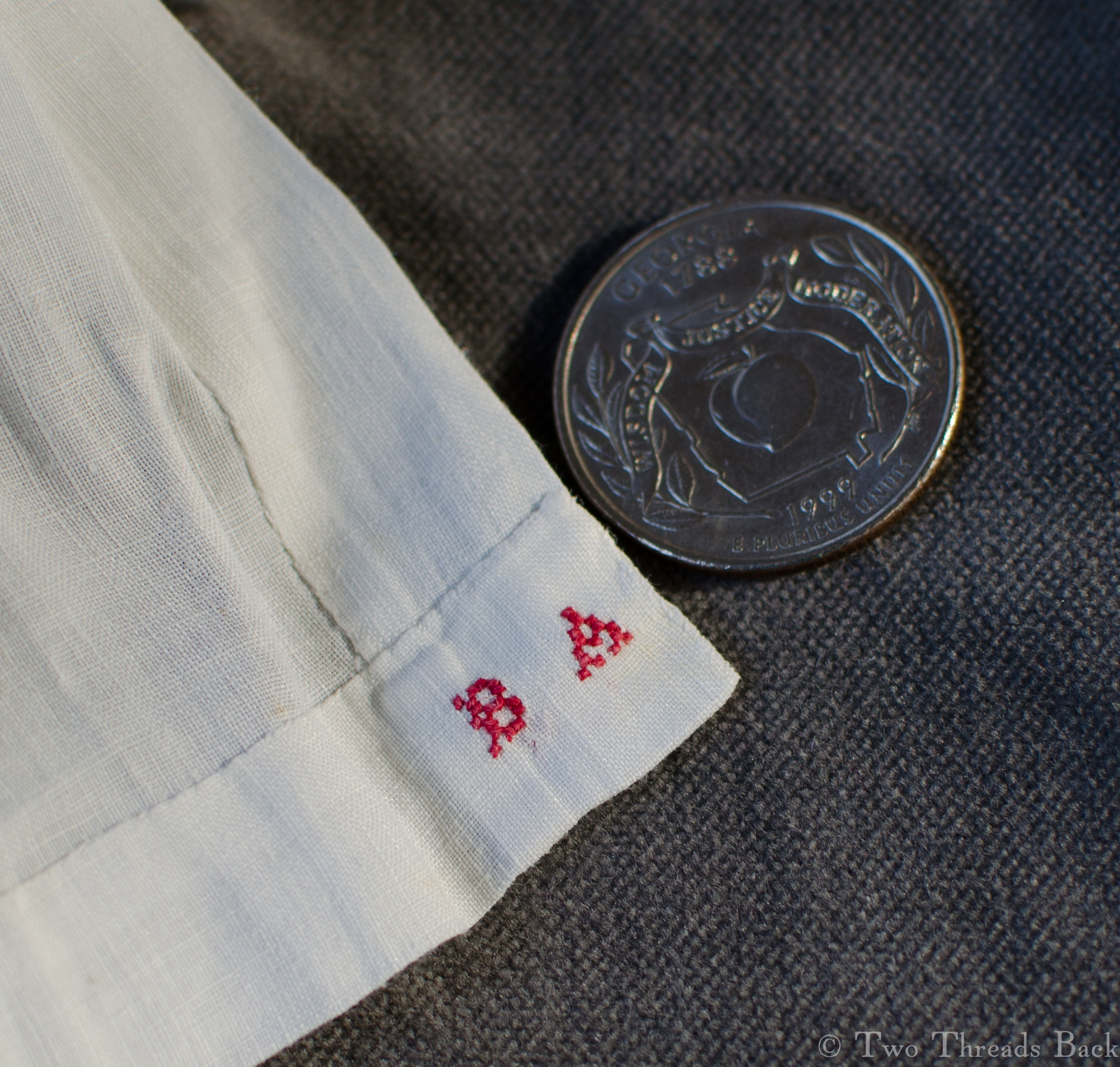
A lovely linen baby shirt marked with Turkey red cotton; note the quarter next to it for size. I’ve kept the image full size, for anyone who wants to view beautifully done original marking up close – just click the image.

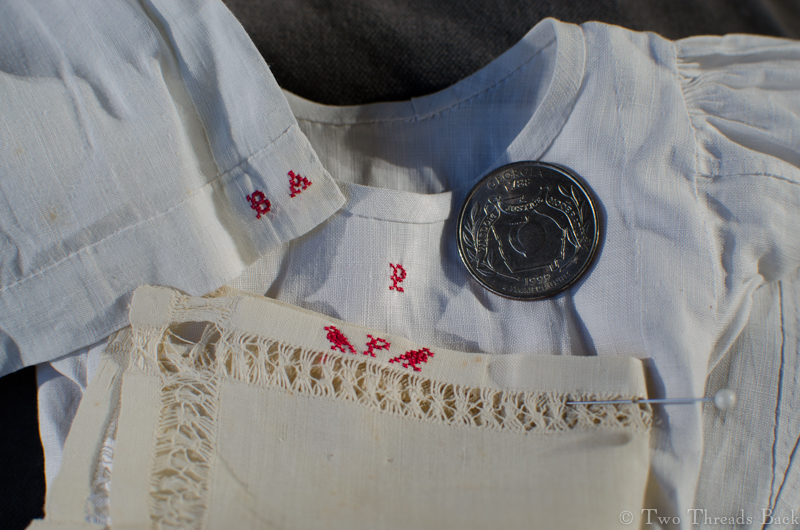
First I had to do some practice stitching. Sampler collectors and makers would laugh at how astonished – and intimidated – I am by the miniscule cross-stitches made during the past 200 years. You can see from this little baby shirt (last quarter 19th C) how blithely they marked countless linens. I’m guessing at the “blithely” part, but since I have many shirts from this baby, somebody was doing a lot of marking!

Making it to Pharaby’s scale would be impossible, since barely matching ordinary period work would be the best I could hope for.

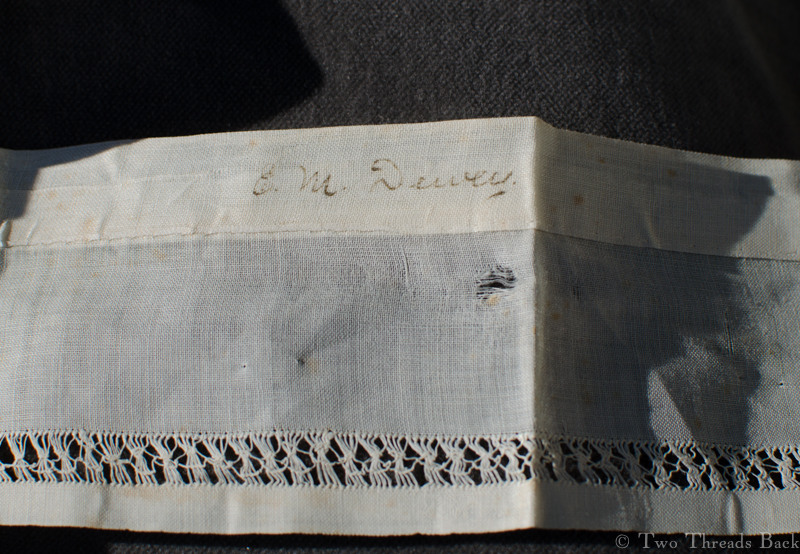
I used a pretty little c1900 linen collar to experiment on (damaged – I wouldn’t inflict my needle on it otherwise), as you can see in the picture.

X Marking 3
A linen collar marked with ink that I used for practice. “No textiles were harmed during the making of this experiment.”

Since the threads in linen are not all exactly the same size, my stitches over two threads looked a bit messy. I tried sewing over four (too big) or over however many made a perfect square (too awkward). By this time I was just about ready to use ink, like the collar owner! But hey, I’m all about plain sewing, right?

A lot of trial and error showed that to be small enough, I’d have to work over two threads, no matter how lumpy my letters looked. I found that just like many projects, things that look pretty awful as I’m working, look a little better when I’m done. Or maybe I’m just cross-eyed by then!

X Marking 5
The baby shirt, Pharaby’s shift, and the practice piece, all together. The little birds I tried were from a pattern by the most knowledgeable sampler collector I’ve ever met. Maybe Pharaby will make a sampler one day….


Tick Tack Tocking, No Clocking on Her Stocking

Stockings
“A Lady’s Leg is a dangerous Sight in whatever Colour it appears; but shewing us your Legs in White, is next to shewing us them naked.”

It’s fun how a search for one thing can lead to other quirky discoveries. That’s what happened when I looked for information on stockings for Pharaby. Who knew that clocked stockings were the subject of a racy little song in 1902? (Will F. Denny, on archive.org)

I’m sure ornamented stockings were worth a peep in the 18th century as well! And did you know that wearing silk stockings could be hazardous to your health? At least during a thunderstorm.

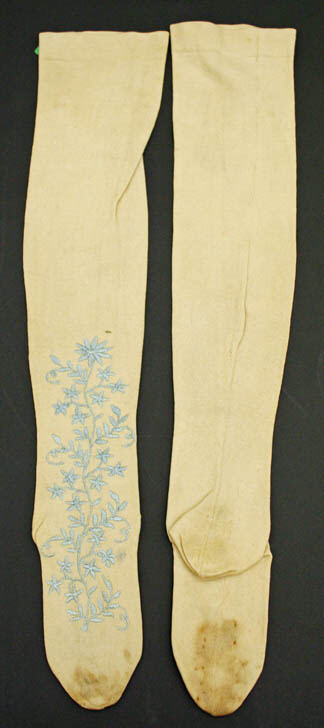
Met Stocking
A late 18th century stocking, metmuseum.org.

According to the Scots Magazine in 1773, a lady in Switzerland nearly suffered a shocking fate:

Her disease, like all others which the doctors can make nothing of, was decided to be a nervous one; but it was afterwards discovered to be owing to her wearing silk stockings, and wires in her cap. How little do our ladies imagine, when they surround their heads with wire, the most powerful of all conductors, and at the same time wear stockings, shoes, and gowns, of silk, one of the most powerful repellents, that they prepare their bodies in the same manner, and according to the same principles, as electricians prepare their Conductors for attracting the fire of lightning.

Ladies may laugh at all this, but it is too serious a matter to be made a joke of. A very amiable lady, a Mrs Douglas of Kelso, had nearly lost her life by one of those caps mounted on wire. She was standing at an open window during a thunder-storm: the lightning was attracted by the wire, and the cap was burnt to ashes. Happily her hair was in its natural state, without powder, pomatum, or pins, and prevented the fire from being conducted to her head.

A good strong head of hair, if it is kept perfectly clean, and dry, is probably one of the best preservatives against the fire of lightning. But so soon as it is stuffed full of powder and pomatum, and bound together with pins, its repellent force is lost, and it becomes a conductor.

Hmm… personally (and modern-tastefully) I find the “loaded” hairstyle more repellent!

But I digress. Pharaby most certainly wanted stockings, and I wanted to make them. Well, I wanted her to have them. To be honest, I was at a loss for how to make stockings, so first I spent some time searching for ready-made.

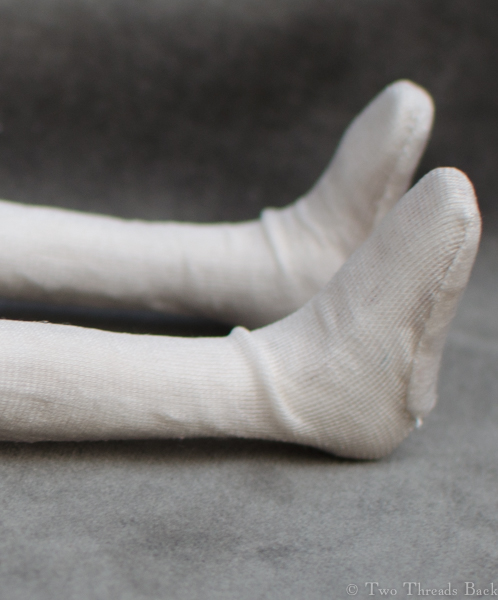
What would fit her? Her limbs are not exactly the same size and shape (well neither are mine), and her feet are shaped to stand flat on the ground. Or table. So off-the-rack doll stockings, unless I was willing to accept nylon tubes, were not an option.

Stocking Foot
I know what it’s like to have baggy socks around my ankles.

I decided I’d have to make them after all. Knitting was out of the question since I don’t know how. The stockings would have to be cut and sewn. Pondering a source for slightly-aged stretchy silk one day, I experienced a flash of brilliant resourcefulness. Gloves! With silk lining! Ebay! I found a worn vintage pair that were just right and managed to extricate the lining from the leather.

Next I found and adapted a pattern on this lovely site and practiced fitting it, using an old t-shirt so I wouldn’t waste the silk. That took a while, but once I settled on the size, I had another idea. Why not embroider clocks on her stockings? My brilliant ideas are often followed by some real flops, and so this one proved.  I made three attempts to embroider a half-inch design on thin stretchy silk. It looked horrible, no matter what thread or stitch I tried. There would be no clocks this time.

Fortunately Pharaby didn’t know I was even trying, so she suffered no disappointment; she was pleased to have any stockings at all. They may be her only pair. We have a lot of thunderstorms.

Operation Petticoat

Petticoat1

Pharaby has been following me with a reproachful gaze for a few weeks now. I promised her a petticoat (an “under” petticoat) and I’ve been awfully slow in making one.

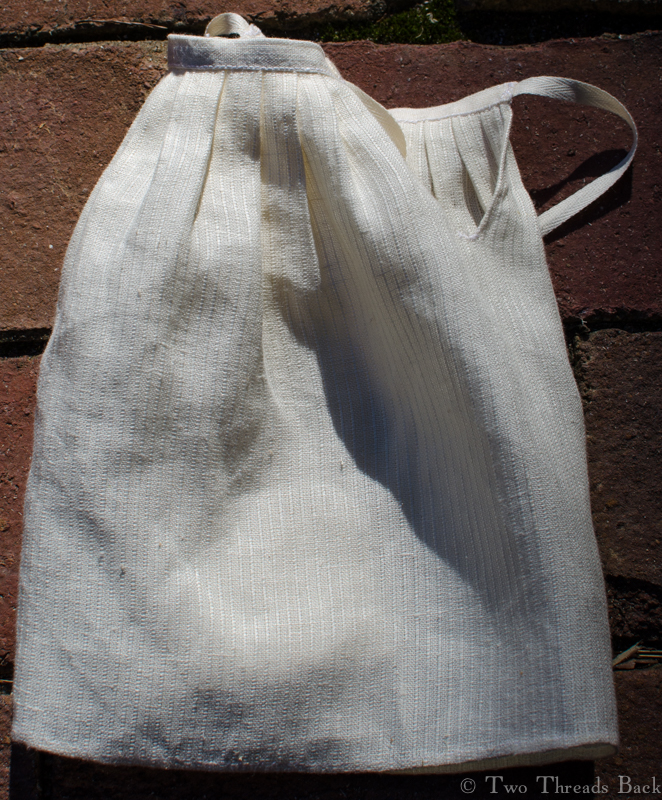
I finally got around to it this past week. It was pretty simple really, just a length of ribbed linen stitched up the side and pleated into a band. Making the pleats match was the hardest part. No, wait – finding a band to fit the doll “scale” was the hardest part!

Petticoat2
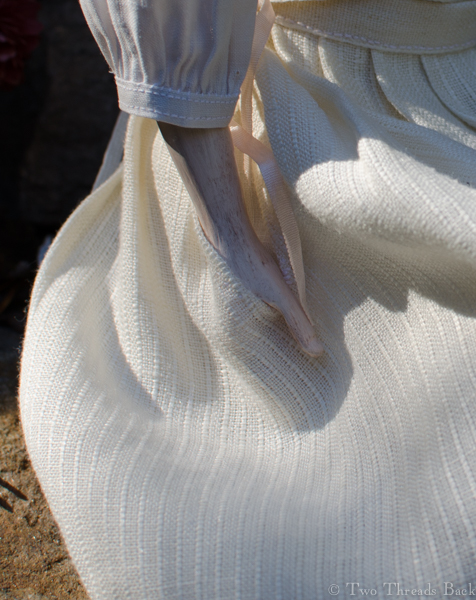
Just enough room for her to reach a pocket inside. When she has one, that is.

I only had a small assortment of cotton and linen tapes to choose from. None was the exact size and weave I wanted, but, well, that’s how it is with dolls and costuming. You have to compromise!

So now she’s got a petticoat. The next question is, does she wear it over, or under, the bum roll? We’ve tried it both ways and are hoping for some expert advice. But what really concerns me is the direction we’re headed: exactly how many ties, bands and layers of gathering can the female form support at the equatorial line?

Because we’re not done yet…

Petticoat3
Pharaby modeling her petticoat, a last photo shoot before the freeze tonight. No more flowers till spring, I fear. She may start hinting for a wool petticoat!

Fluffy Ruffles

Fluffy Ruffles 1
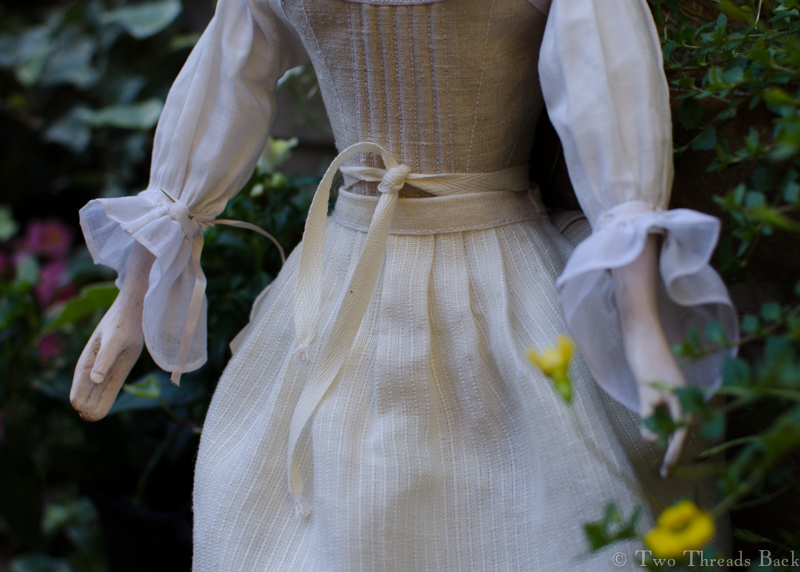
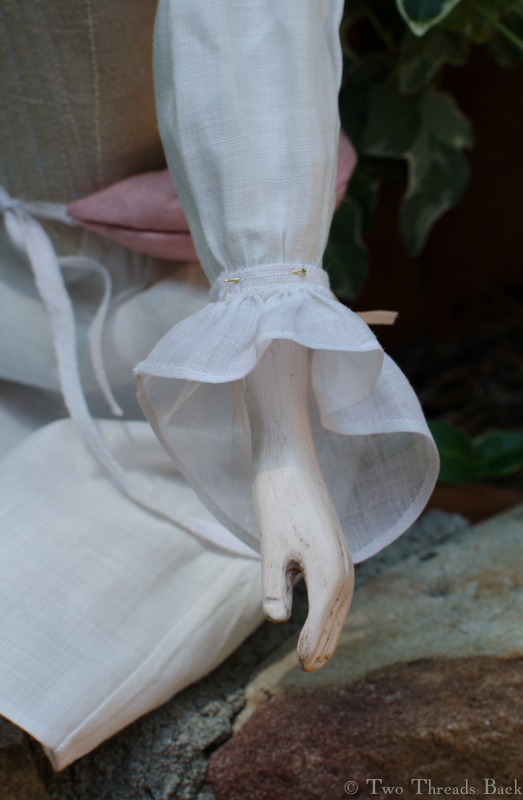
Engaging engageantes for Pharaby.

I’m not sure how I got distracted and neglected to let Pharaby show off her new sleeve ruffles, but we shall make amends. Here they are!

Fluffy Ruffles 2

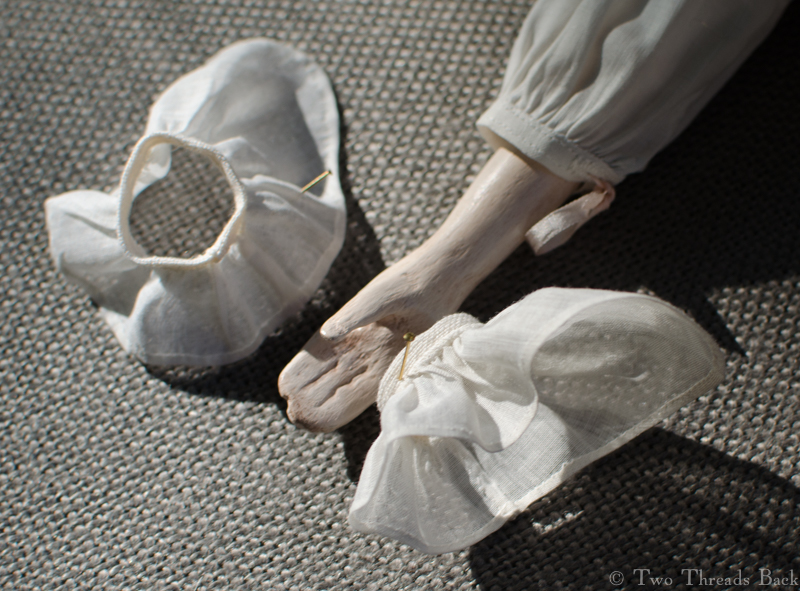
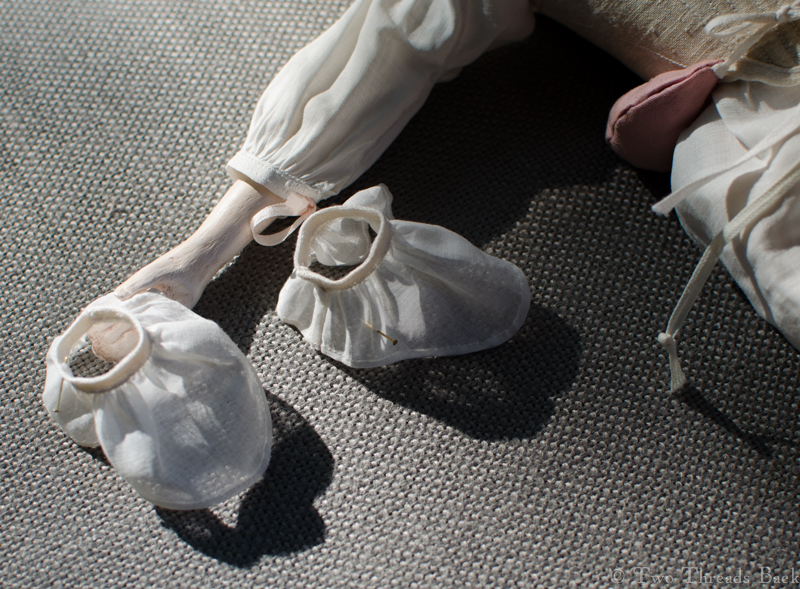
From that same stash of unsold ebay scraps I selected a pretty little bit of muslin. Now I admit I’ve handled a lot of fine muslin and can usually tell when it’s wearing Sizing of the Ages. But this piece had me stumped. It was originally an unfinished embroidery project with a homemade pattern marked in blue ink, a typical edging design, and I’m pretty certain it was mid-19th century. But washing – a lot – didn’t affect the nice bounce at all. So we got the effect of nicely starched ruffles without any stickiness.

Fluffy Ruffles 3

Fortunately, it was also forgiving. I managed to whip the edges with no problem, but one little ruffle had to be attached three times before I was satisfied with the linen band.

Fluffy Sheet Music
Fluffy Ruffles, 1907.

So now Pharaby has some fluffy ruffles. By the way, it was a family joke that my aunt named every pet she had Fluffy Ruffles. A little googling showed me why!

Fluffy was born in 1906, the creation of artist Wes Morgan, and featured in stories with verse by Carolyn Wells. Pretty, stylish, and spunky, she became a heroine of her era and the next few decades (that’s longevity for a fad!) saw her as a paper doll, a book, in music, on the stage, and yes, her catchy name was shared with crochet patterns and flower hybrids – and pets.

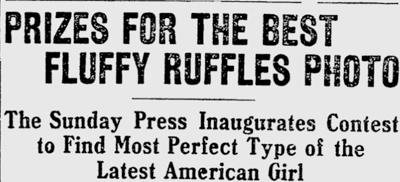
Fluffy Ruffles Contest
Fluffy Ruffles, the Perfect American Girl.


Drum Roll for the Bum Roll

Bum Roll Front
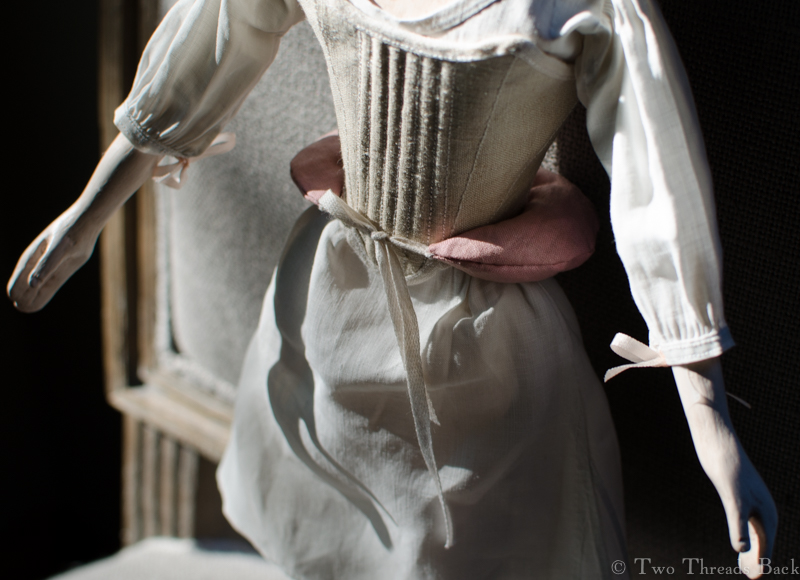
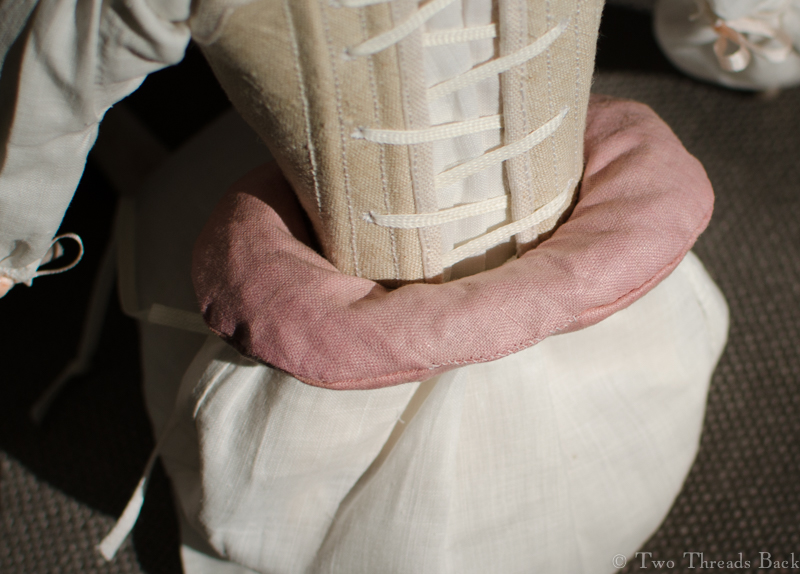
Fashionable Pharaby’s new cork bum.

Yes, Pharaby insisted on having this article in her wardrobe, the euphoniously termed BUM ROLL. The “cork bum” was subject to ridicule at the time, but goodness knows ridicule and fashion have always been comfortable together. Magazines of the day enjoyed satirizing high style:

“Nature appears to have been but a kind of bungler, We mortals are obliged to alter every piece of her works, before it can be fit to be seen…

And after all this being done, a Lady was supposed to be quite finished—

No such thing—

What was wanting?

What was wanting ? Blockhead! Don’t thee know?

A BUM was wanting !!

A BUM ! —

Mercy on us ! Who would have thought Nature could have made such a mistake as to create Ladies without bums.

Nothing is more certain. —

Bum-shops are opened in many parts of Westminster for the sale of cork bums, and report says they go swimmingly on.

Tall ladies, and short ladies — fat ladies and lean ladies, must have bums —

And this is what they call getting up behind.

So that in fact, a fashionable female, if she lay on her face, or creep on all fours, would exactly resemble a camel with a hunch in the middle of the back….

Let it be recorded, that in the auspicious year 1785, BUMS FOR LADIES, were made, cleaned, and repaired, so as far to exceed nature in size, or convenience.

When researching this little artifice, I was intrigued by the references to cork. Farthingales, panniers, etc. had been around for ages and were effective in supporting heavy skirts. So why cork, and what did they look like? I found a website that provided the most amazingly extensive research on the subject of skirt supports ever — with excellent images. And another site by a brilliant costumer who experimented with using cork blocks for the same purpose.

But I couldn’t find any images of extant cork “bums” to go by. So would Pharaby be happy with wool stuffing? Or would she insist on cork?

Cork-Cutter Cartoon
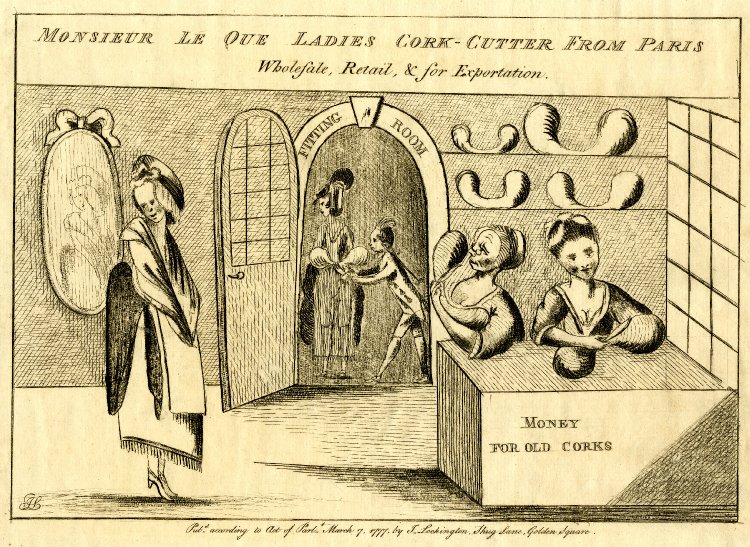
Ladies Cork-Cutter, 1777. Gives a whole new meaning to “put a cork in it.”

You know the answer. The next question being, what kind of cork?  The advantage, like the disadvantage, of dressing dolls is the scale. I could use a cork coaster to try carving a shape and then covering it, but the tiny size required was more than I wanted to tackle.

What if I used cork “crumbs”? One period satire implied that cork pieces were used: “Money for your old corks.” Ergo, they were cut, shaved, crumbled, etc., and used like stuffing. Well ok, maybe not. Maybe “corks” was short for “cork bums” and they wanted them for resale or recycling. I’m speculating in an attempt to defend my choice. Whatever, we went with cork granules.

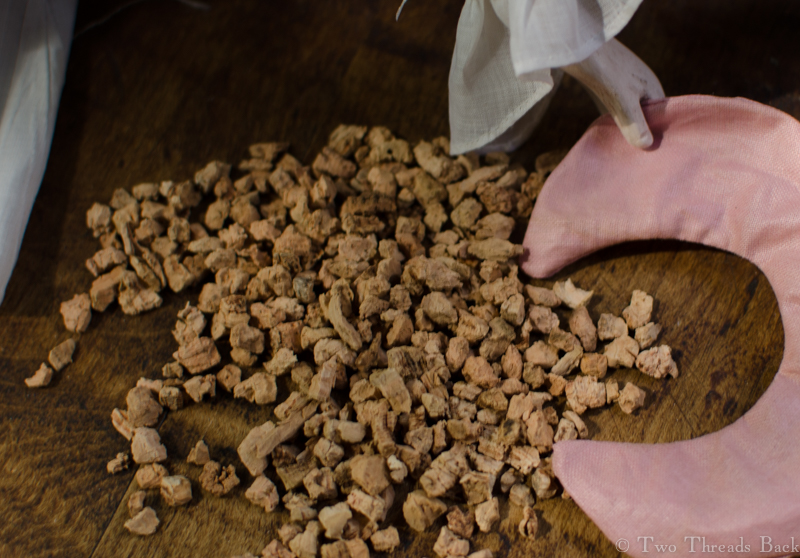
Bum Roll CorkNow, my husband makes wonderful wine (as a hobby — woohoo!) so why not crumble some corks we already have? Or chop up that trivet? Cheap, easy, and immediate, so of course I didn’t do it that way. My life is pretty tame and I was craving a touch of the exotic, so Pharaby and I sent for a package of cork from Portugal. I figured I could use the leftovers later for stuffing some vintage toys, to give them that authentic lumpy look.

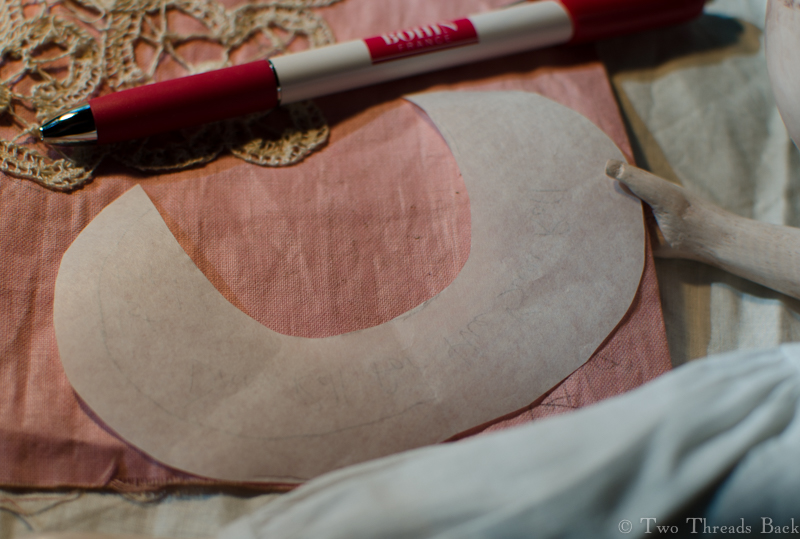
Bum Roll Pattern
First freehand try for a pattern, yay!

I drew a pattern (and used the first attempt, I’ll have you know). I found some grubby pink glazed cotton which I’d unsucessfully, thank goodness, tried to sell on ebay. And then I stitched and stuffed and added ties.

Let it be recorded that in the auspicious year 2014, Pharaby’s figure was enhanced.

And she did need it. Most wooden dolls are not noted for their shapely behinds.


The tricky part was getting cork from
The tricky part was getting cork from the outside to the inside.
Bum roll back.
Her rear from the rear. What a corker!