A Dorset Knot – I mean Knob – Button

Dorset Knob 1
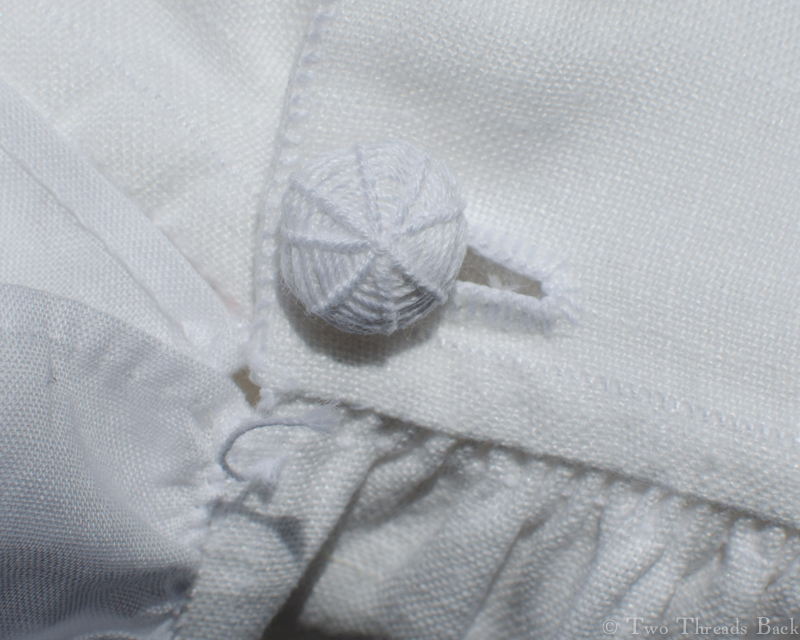
Dorset Knob Buttons, early 19th century

The Dorset Button! Not the more common flat disk with thread spokes, but a “high top,” a tiny sphere wrapped in a spider’s web of thread. I mentioned in the Love Shirt post that I would explain how I made the buttons for the shirt – a non-documented, unauthenticated version for the directionally challenged: me. Believe me, before I finished the trial button, it did look more like a Dorset Knot. But I persevered.

The originals I wanted to copy are pictured above. They seemed to be stuffed with a kind of fiber, but the base was a black substance with a greenish-yellow cast and waxy look. It had puzzled me for years. Then after reading more about Dorset knob buttons, I realized the material must be horn.
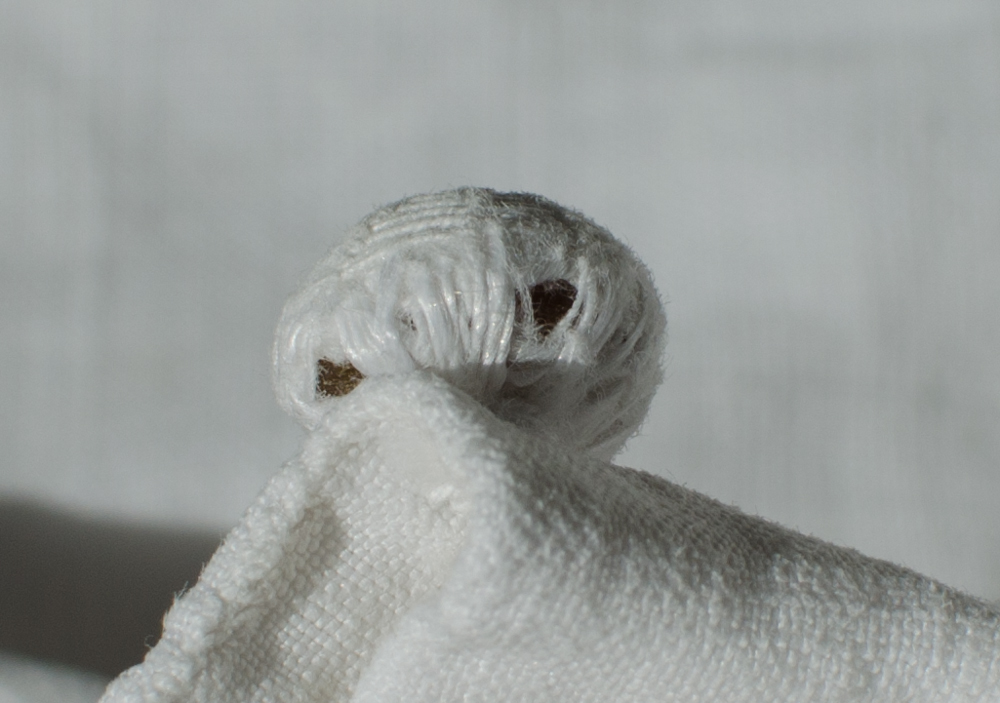
Dorset Knob 3
You can see the horn button base on the original.

I didn’t have horn buttons, so I used shell instead, about 1 cm in diameter. I cut a little square of linen, about 3.5 cm, and on that I traced and cut out a circle larger than the button. The scraps served as stuffing for the knob. Waste not, want not.

Next I ran a gathering stitch around the circle, put the scraps in the center with the flat button on top, pulled the gathers tight, and stitched them closed. Voilà! The mold!

Then I wrapped thread around the button in a compass rose pattern and anchored it. Beginning at the top, I circumnavigated the button, taking a backstitch around each “spoke” and moving on to the next. It was a bit fiddly, having to smush the lumpiness of the mold and realign the spokes as I worked toward the base.

Once I had made a final pass around the base, I took a few stitches to anchor it all. And then I had to make four more.

For those who like pictures better, see below. For those who want a more authentic method, there is a lot of serious research available online now. And for everyone else… well, there’s always velcro.

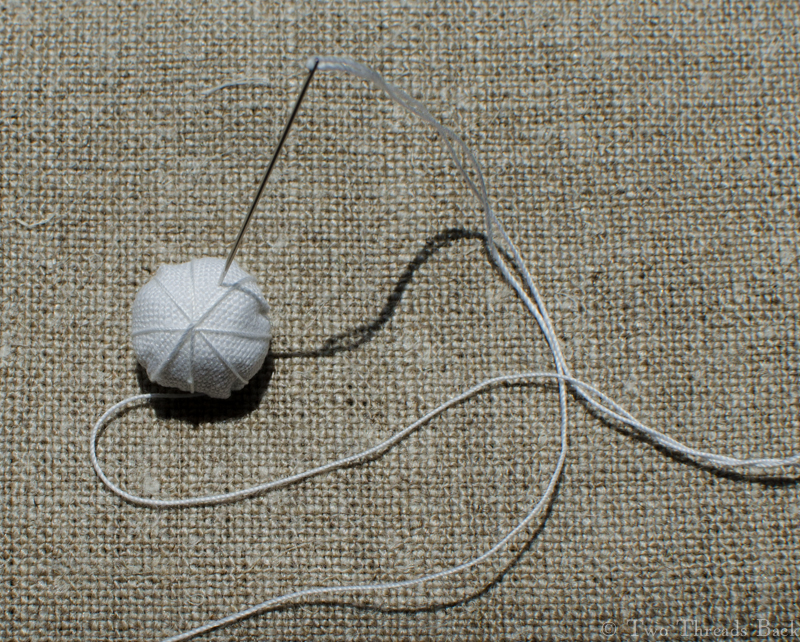
Stuffed and gathered.
Thread laced in spokes around the mold.
Dorset Knob Weaving
Circumnavigating the globe: backstitching around each spoke before going on to the next. Or back one, forward two.
Dorset Knob Done!
Dorset Knob Done!

Shiftless

Shift Full
Maybe Graceless, Pointless, Feckless, and Aimless – but not Shiftless!

Shiftless no more! Pharaby can compost the fig leaves now.
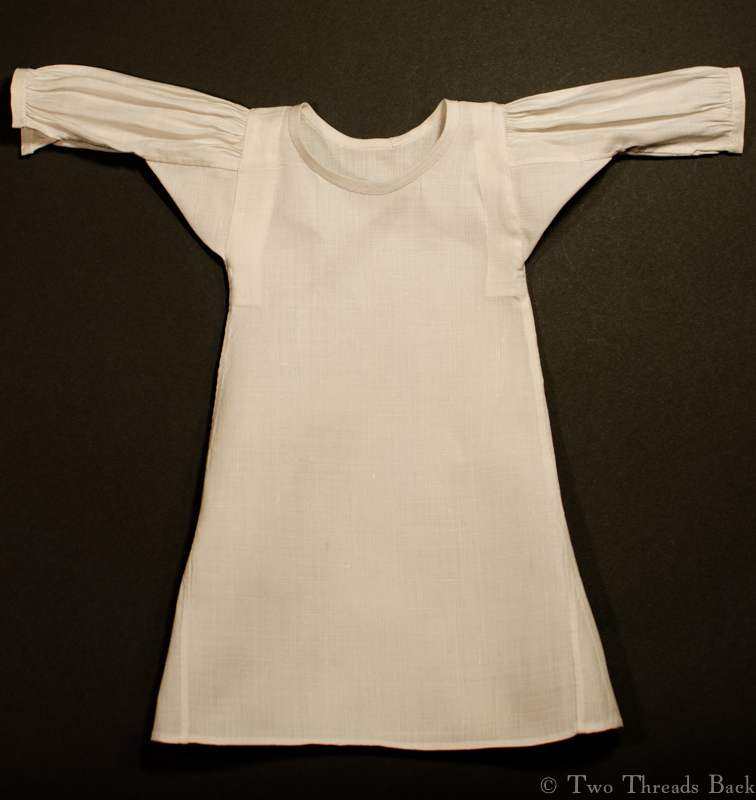
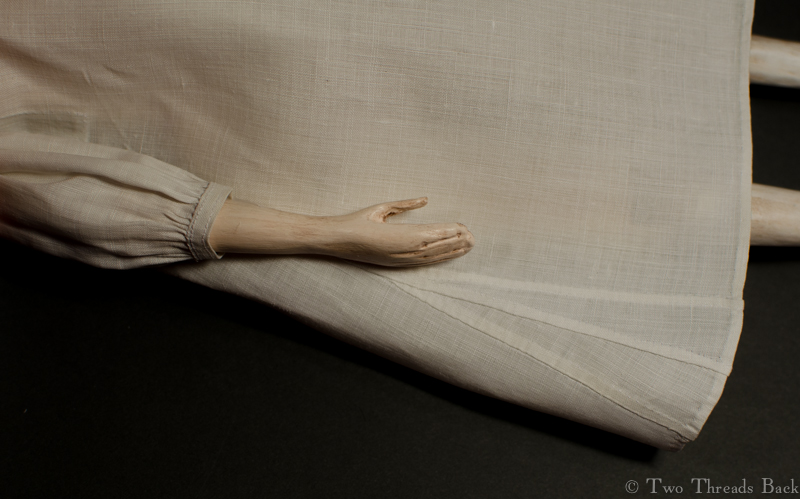
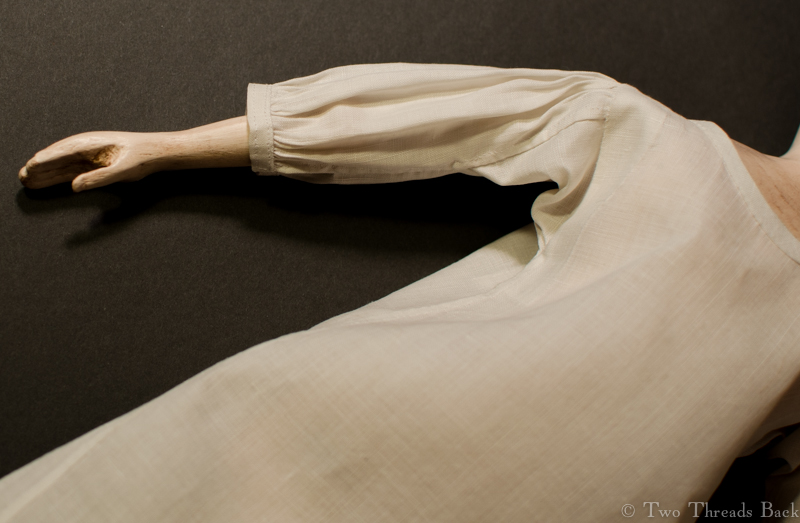
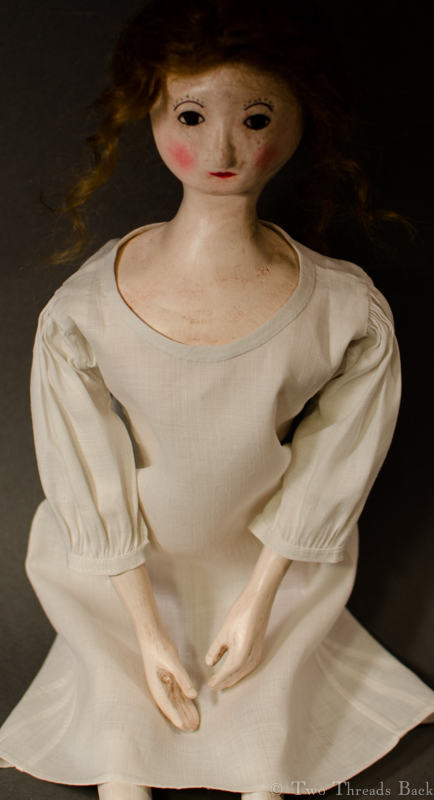
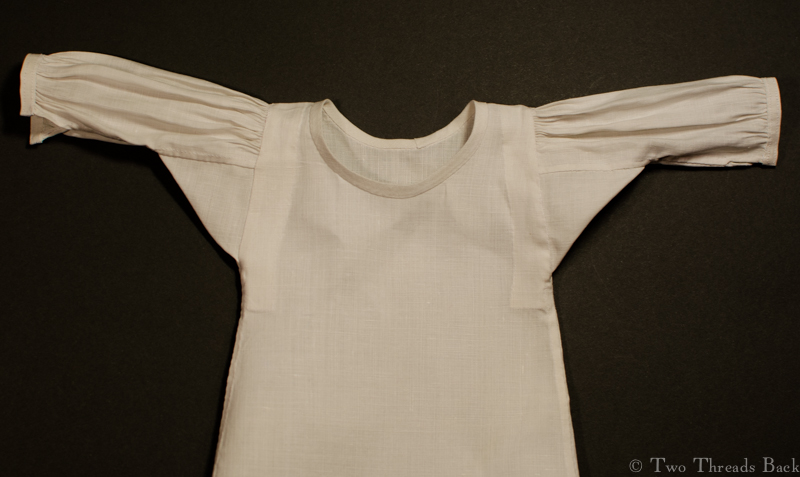
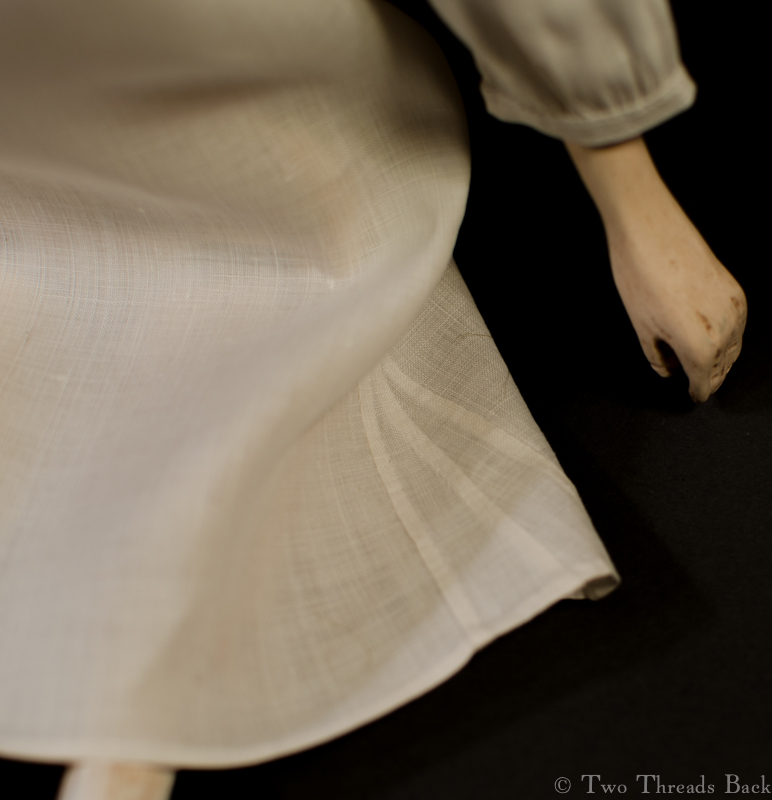
To make her shift, I used some fine old linen with a silky feel, and  I scaled a pattern in Costume Close-Up (is there anyone who doesn’t use that pattern?). Then I proceeded to sew up the gores, body, and neckline. Shift Hem When it came to the sleeves, though, I was perplexed. What was typical, plain or gathered? I reeeeally wanted to do gathered.

Not being an eighteenth-century-fashionista, I pulled out costume books and scoured the internet for guidance (see this awesome study). Most of the images of extant shifts I found – there were a few exceptions – had sleeves without gathers at the armscye, or shoulder. But period art seems to imply that  shifts did have them; otherwise, how so fluffy? That means that 1) I didn’t look in the right places,  2) I couldn’t see details and misinterpreted the pictures, 3) they didn’t survive as often, or 4) some dates were wrong. Maybe all four, plus some more reasons I haven’t thought of yet.  Oh well.

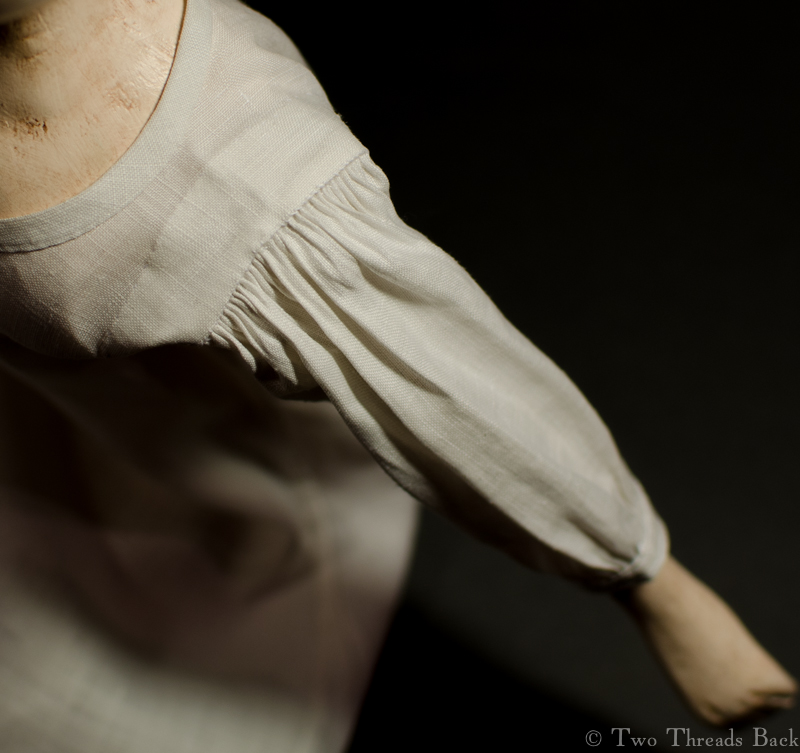
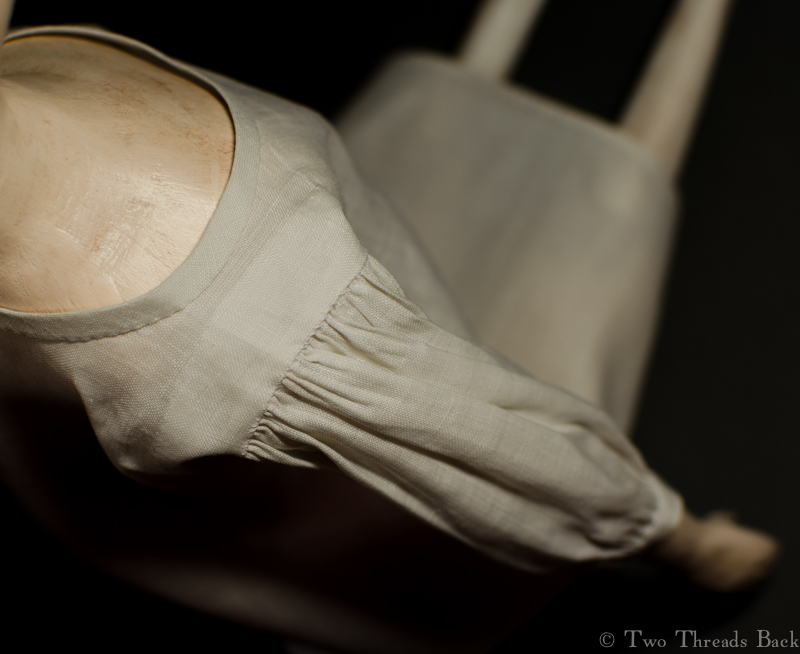
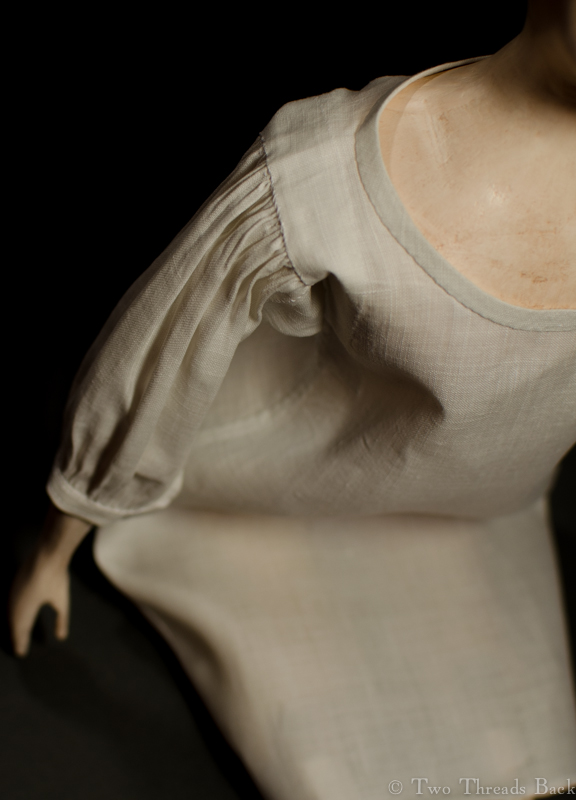
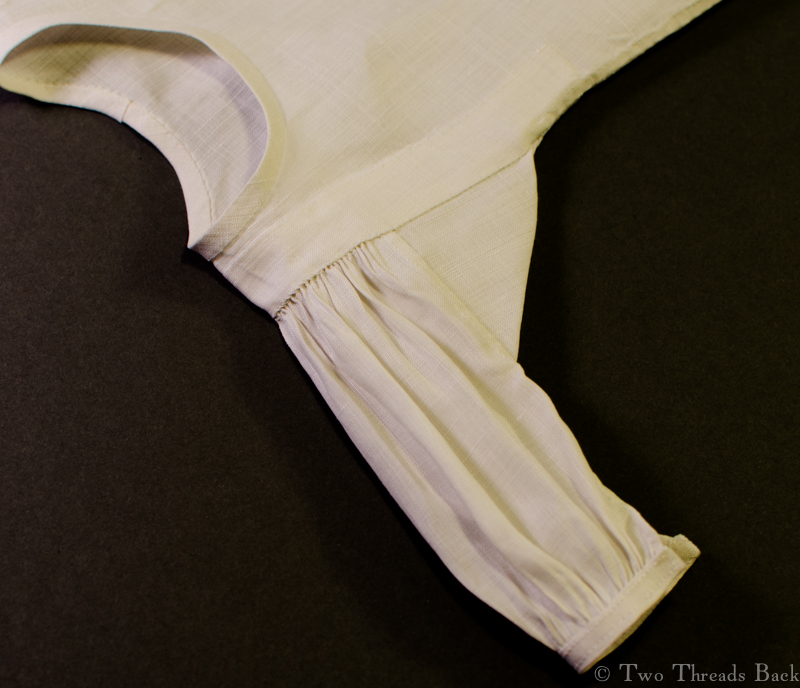
Shift Left ShoulderHowever! I found two or three images of exquisite little shifts on early wooden dolls in museums, and those had sleeves that were gathered at the armscye. I think. Anyway, I love setting in gathers and it’s my toy, so that’s what I did.

Now another dilemma. To stitch or not to stitch, that was the question. I was so accustomed to seeing the stitching (now called backstitching) on the wristbands of men’s shirts, that her little cuffs looked as bare as she did.   But, duh for me, I’d already set in the gathers. Could I do it, post hoc stitching?  Why not – if there’s a harder way, I’ll find it. You don’t see any close-up photos of the cuffs here, do you? Ha.

Shift RightNext came the binders, those reinforcing strips that are a standard feature in men’s shirts. I can only guess how common they were in women’s shifts, because they don’t usually show in photos, nor are they noted in descriptions. But I’ve long speculated that originally binders were there just for “setting in” gathers – support for a stress area was just a bonus. So in they went.

Now the question you’ve been too polite to ask: did it fit? Pharaby said it would do. She’s not fussy. Any doll destined to wear fashions spanning a century or so – at the same time – can’t afford to be.

Oh, but she does expect me to mark her shift and add ties for her cuffs. She hasn’t decided about frills.

Shift Pharaby

Shift Gathers

Shift Right Shoulder

Shift Neckline

Shift Gores

Shift Sleeve


A One Stitch Wonder

Calico Full

I’ve always loved order and simplicity. That sounds awfully smug, but I shouldn’t commend myself since it’s probably because my brain can’t handle very much at one time. This craving for minimalism is getting worse as I get older. Try googling the minimalist lifestyle and maybe you’ll see the attraction! Or not.

A conversation the other day started me thinking about simplicity in plain sewing. Hmm. What was the most basic stitch? Well, anyone who uses old sewing machines knows you can do just about anything with a straight stitch, which is closest to a backstitch in hand sewing.

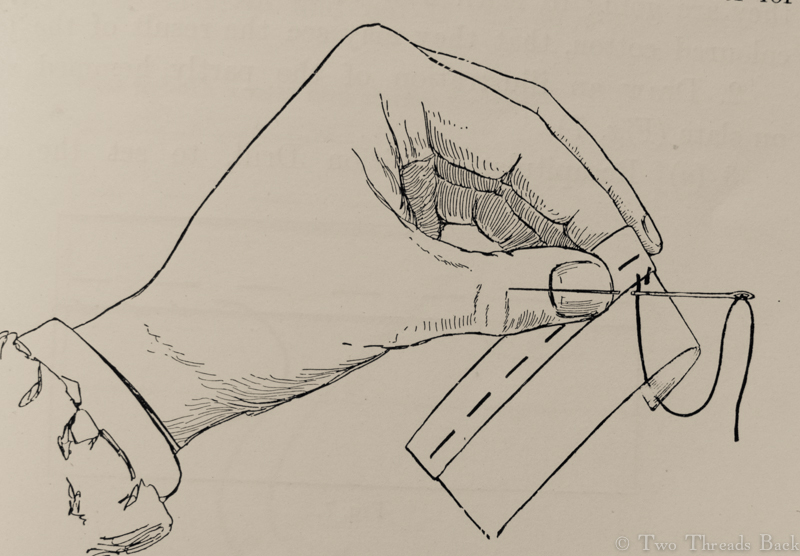
But backstitching wasn’t the primary stitch in 19th century sewing manuals, nor was running, as I learned when I studied plain needlework instruction. It was hemming. That’s the little slanted stitch that you would use to (surprise!) hem something. Once your hemming was neat enough, you could learn to work other stitches.

Hemming
“Simple hemming is the first step on the road to proficiency in needlework.”

By the way, I’ve noticed that most costume historians, or at least ones I’ve heard and read, call this same stitch “whip” instead of “hem.” For example, “the edge is folded back and whip stitched in place.” But then, why shouldn’t they? I understand perfectly what they mean. If you’ve seen my post on muslin you’ll know I’ve come to terms with terms!

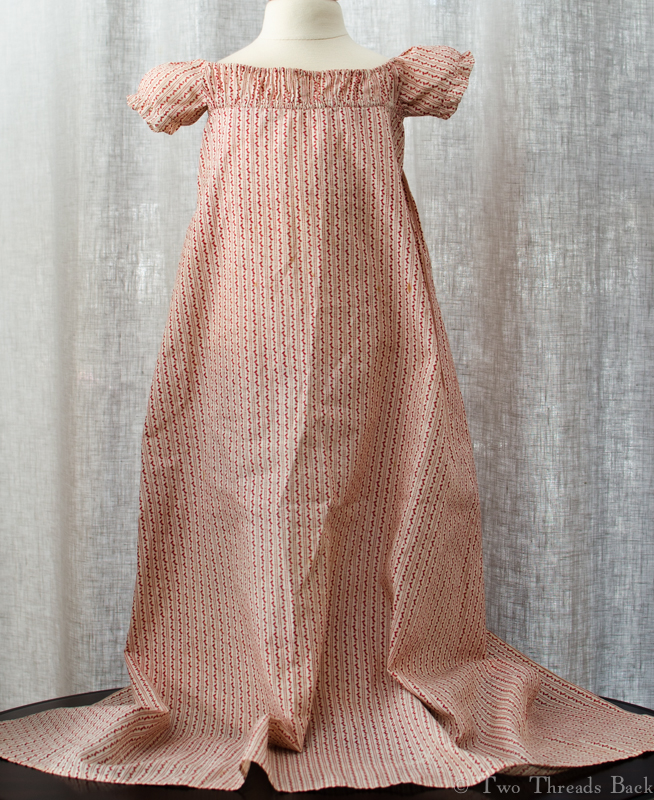
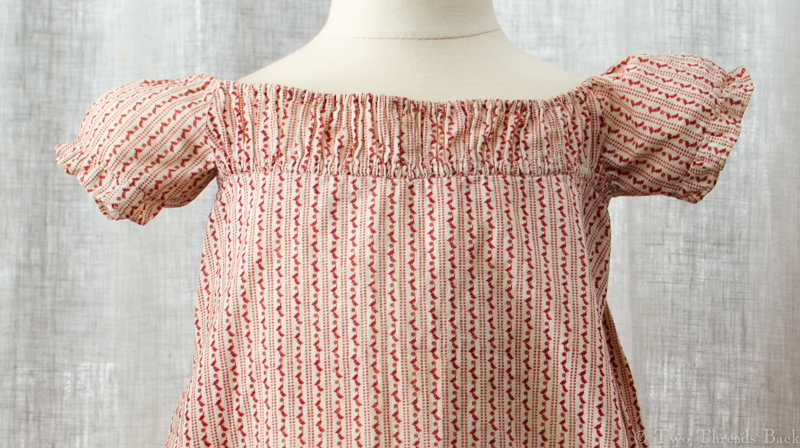
Getting back to simplicity. I decided to go closet diving for something that used only that one stitch, hemming, to construct a garment. And I found it! A Regency era calico baby dress. Granted, it didn’t have enough pattern pieces to warrant many stitches. But the whole gown was made by hemming!

Calico Baby Gown, c 1815.

Or was it? Well, in my eagerness to find what I was looking for, I didn’t look close enough, and I didn’t think it through.

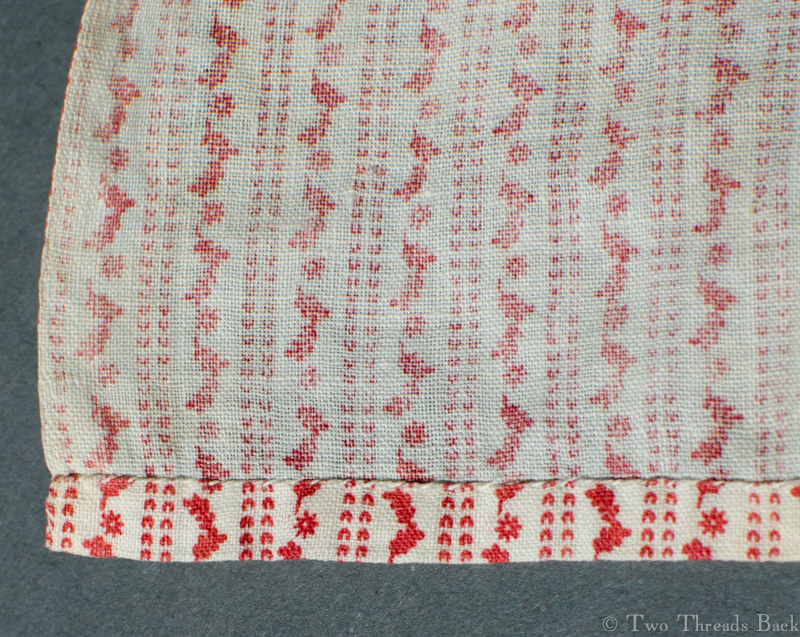
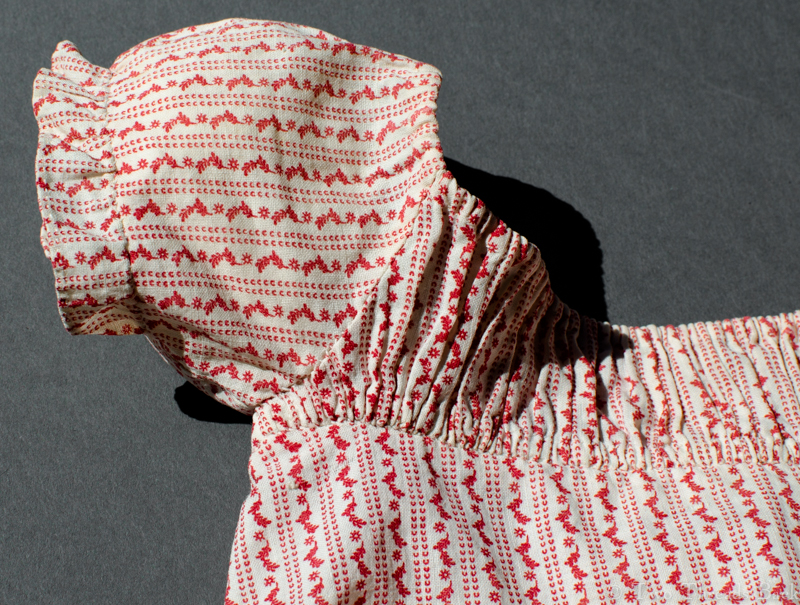
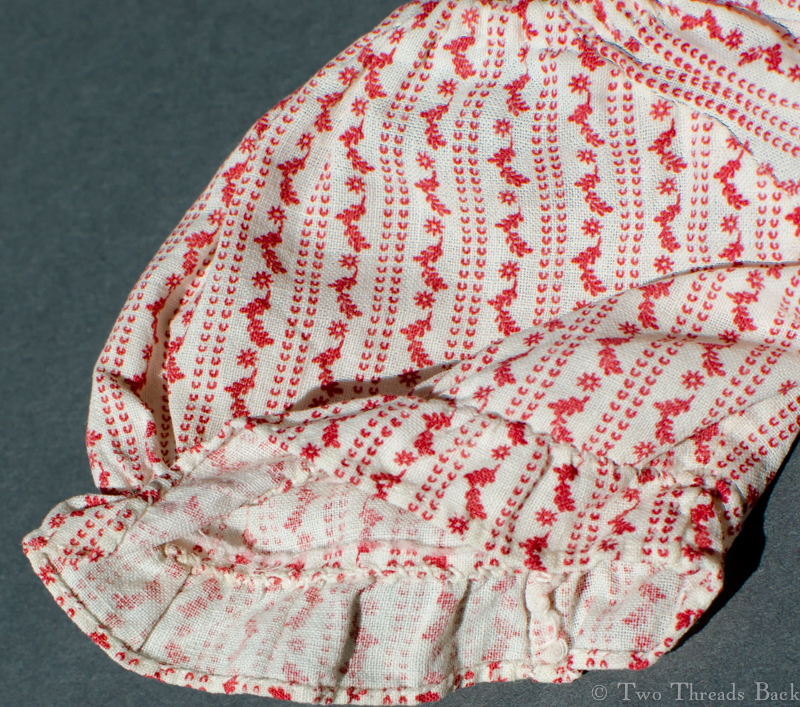
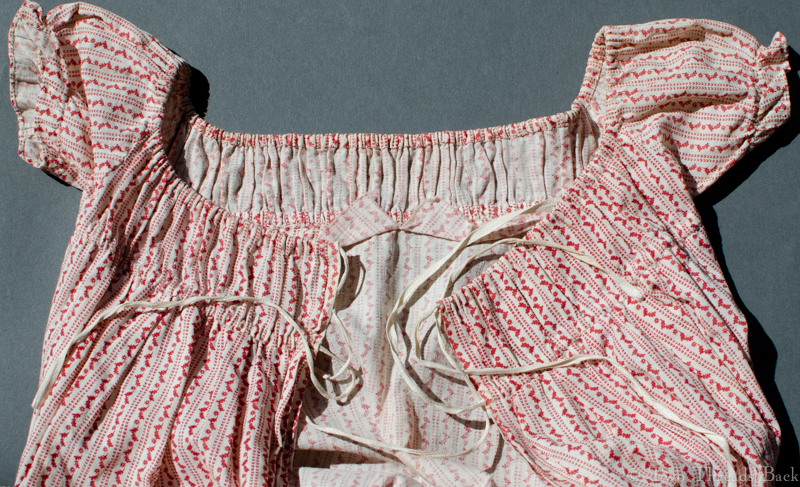
The skirt was made of one piece and hemmed, check. The casings for the strings were hemmed, check. The tiny ruffles on the sleeves were hemmed, check.

Calico Hem
Hem.

Calico Sleeve
Casings for drawstrings.

Sleeve ruffles.
Sleeve ruffles.

Calico Back
Back opening.

The bodice was hemmed to the skirt – whoa! Wait a minute. That wasn’t right. Things were unraveling. I mean my clever discovery, not the little frock.

Yes, the stitches looked the same at first glance, but any experience (or a practical mind) would tell you that you have to hold those two pieces face to face and sew them together. That makes it seaming, as they would have said, or overcasting, as we’d say today. Same thing for the ruffles attached to the sleeves.

And there was more. The tiny bodice sides, all three-quarter inch of them, were running stitch. As were the sleeves to the body – and then overcast!

So much for that, no single stitch here. I confess it doesn’t really bother me too much that it’s not pure minimalist stitching. I’m learning to slow down and look closer. And it’s still a wonder of simplicity!

The Love Shirt

Love Shirt Cuff
The Love Shirt, a replica by Yours Truly

Ta da! After ten grueling years (ok, I don’t really know how long, but it has been years) I finally finished a 19th century gentleman’s square-cut shirt of fine linen. Complete with all twenty parts, including the frill. And Dorset knob buttons.

Where did the name come from? Well, a long time ago a friend and I (I miss you, Janet!) were studying one of these shirts, one that had a heart-bit (see that blog). We reached frantically for our vinaigrettes, trying not to swoon on the artifact, as visions of Mr. Darcy flitted around the room. Somehow we started calling that handsome relic The Love Shirt. So it has been to me, ever since. And I wanted to make one myself.

That type of linen is impossible to find nowadays. However, a dear friend (thanks, Dianne!) provided the closest thing possible, and with a pattern from an 1820 book, I commenced.

Darned little gussets, all the work I did backstitching was mostly hidden when assembled.
Darned little gussets, all the work I did backstitching was mostly hidden when assembled. Having since acquired some cobwebby 100-year-old linen lawn, I intend to replace the muslin ruffles, this time hemming them the right direction. If there’s a harder way to do anything, I’ll find it.

Unfortunately I have a memory like Dory, so every time I put away the project for a spell, I’d have to practically learn how to do the next step all over. A 19th century seamstress would have been appalled to see me.

Love Shirt Full

Um, do I sew both ends of XYZ before I ABC? Do I cut or fold first? Did I sew the sleeve on backwards? Oops. Front and back are the same before the collar goes on, right? Not if you hemmed them first. Oh right, I was supposed to check that I was putting the slit in the front. Well… I’ll just cut the back shorter and make it be the front. And my g-g-g-g-great-grandmother could make one of these in a day or so? How embarrassing.

I did learn a lot. I learned how hard it is to backstitch over two threads without going blind. I learned that there is NO not-shiny sewing thread available today. I learned that linen thread breaks, other people’s buttonholes always look nicer than mine, knots are usually unnecessary, even poor work looks better when ironed, and a drawn thread is no guarantee you’ll sew a straight line. I learned that you had to love your man, or love survival to make one of these. And I learned how to make Dorset knob buttons, my own way! Maybe I’ll write about that next time.

Love Shirt Cuff
You can see the backstitching that nearly blinded me. And you can see the gauging thread I used to hold the stroked gathers in place. I’m going to leave it there a loooong time.

A Heart-bit for St. Valentine’s Day

Heart-bit? No, I don’t mean smitten with love, phrased in a folksy sort of way. I mean a little bit, or piece, in the shape of a heart! Worn right over the heart.

Heart Bit Shirt
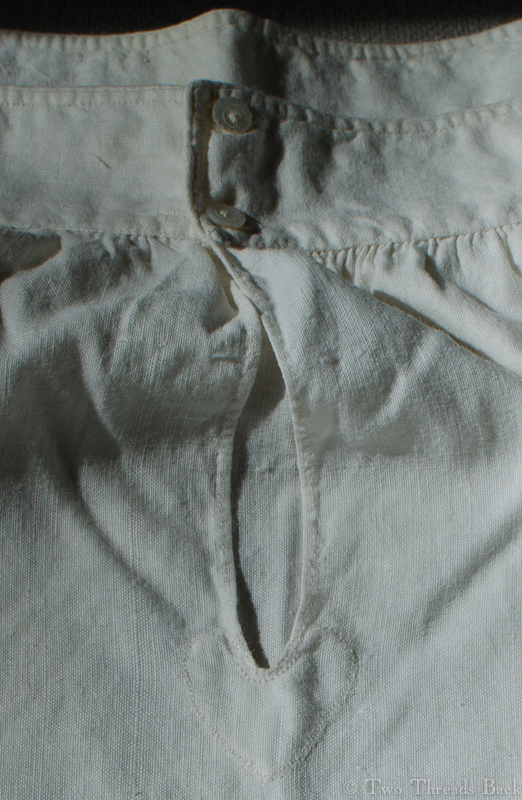
Heart-bit with decorative knots on an early 19th century man’s fine linen shirt. The shirt was rescued from captivity where it had been altered and abused with scissors, sewing machines, and synthetic trim!

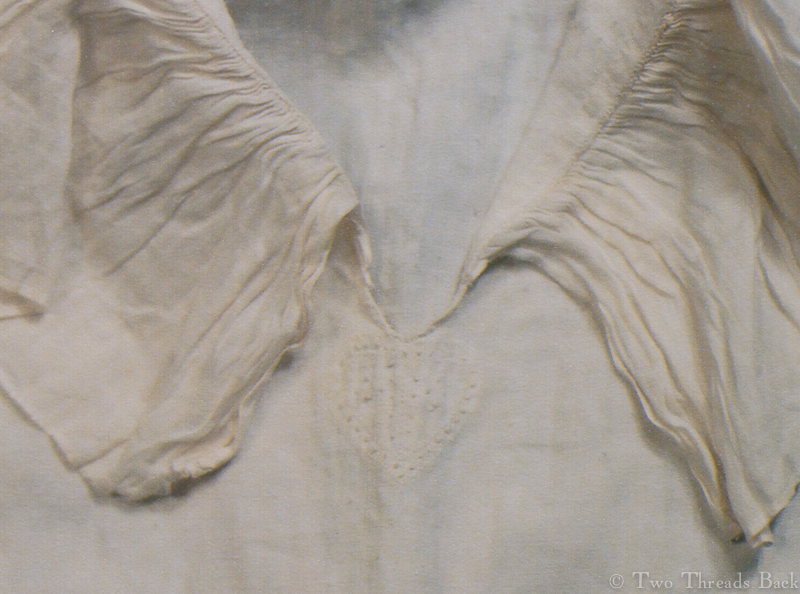
That perfect specimen of plain sewing, The Shirt, has a romantic soul. Back in days when shirts were only slit down the front, and not buttoned closed the full length, that end of the opening was vulnerable to tearing. There were various ways to prevent it, and I came across references to this lovely way when researching early sewing instructions. For example, Instructions for Cutting Out Apparel for the Poor, 1789, gives a description of cutting linen for shirts:

This half overplus being a quarter of a yard in length, serves to cut out hearts for the bosoms.

 Or a sewing manual from 1833:

 HEART-BIT

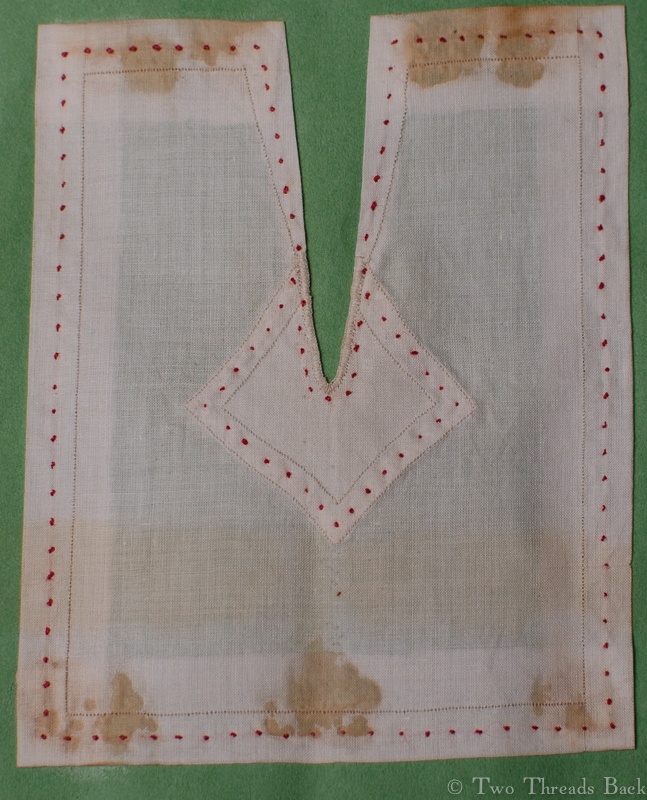
Before commencing the shirt, small pieces of muslin are given to each girl, for the purpose of learning to settle in, and work the breast-gusset.

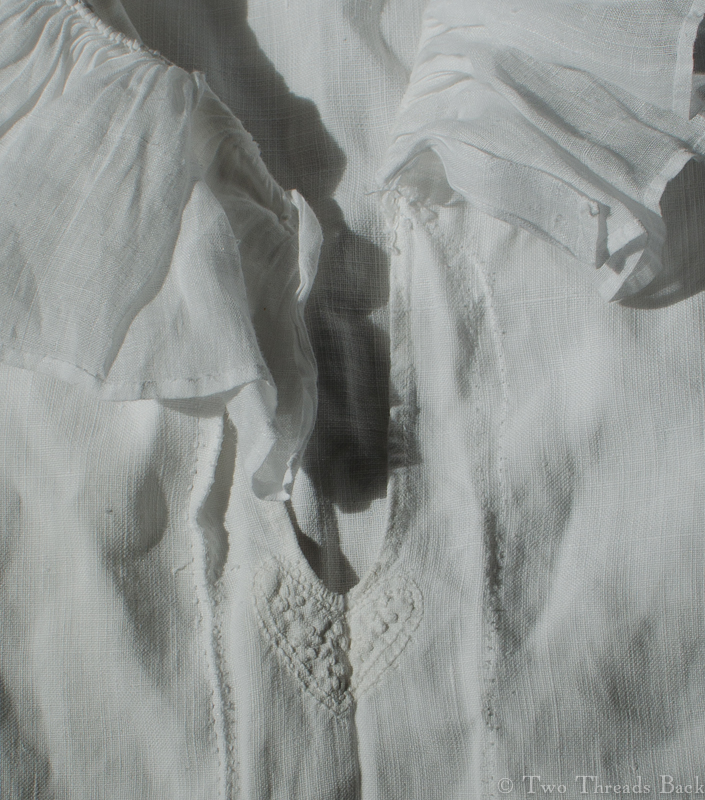
Of course not all shirts had them. Some had a triangular gussets, or a buttonholed reinforcement, or a tiny rectangular piece to prevent a tear, and some had nothing at all. But you have to love linen with a heart!

Heart Bit Shirt 2
Another early 19th century man’s fine linen shirt, with a beautifully worked heart-bit. Unlike the shirt above, this lucky gentleman spent his retirement carefully packed away.

Heart Bit Chemise
An early 19th century woman’s chemise made of muslin, showing she had a heart, too.

Heart Bit Manual
A girl’s sewing manual from the mid-19th century displays an alternative shape for the gusset, but still called in the instructions a Heart-piece.

Plain Meets Fancy

Infant Sacque
An infant’s sacque: a miniature version of Mother’s.

If I kept my attention only on plain work, I suppose I would be very limited indeed. And truly, the impulse to add ornamentation seems timeless and universal. Often the pretty pieces I study reveal high standards in the basic plain stitches, but also have considerable fancywork on them.

Infant Sacque, left
The profile reflects women’s styles of the same era.

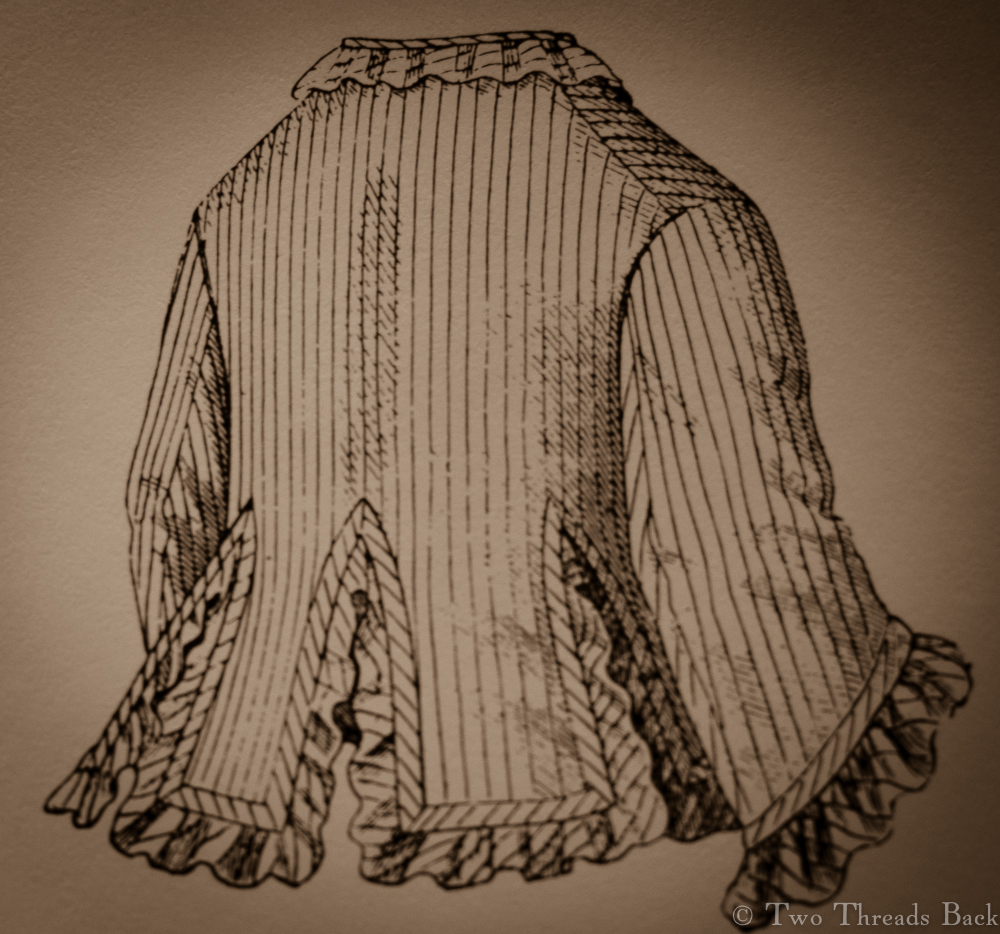
Here is one example which just seems to shout Baby Version of Mommy’s 1870 Upholstered Look! Notice the dropped shoulders, two-piece sleeves and sort of tabbed lower edge, with its allowance for a wee bustle? I doubt baby wore one, but the cut of the sacque would have suited it! The pattern is a match for women’s garments of the late 1860s and early 1870s.

The Look, c1870
Pretty fussy back! But I love it.

The Look, c1870
The Look, c1870

It’s made of a very fine muslin – a previous owner must have bleached it white again – and uses basic hemming, running, and stitching (called backstitching today).  It shows some of the earliest use of (what we call today) a french seam on the sides and shoulders. The sleeve seams are overcast.

Infant sacque, right
I’d love to see this with a poofy baby bustle! Not likely, sigh.

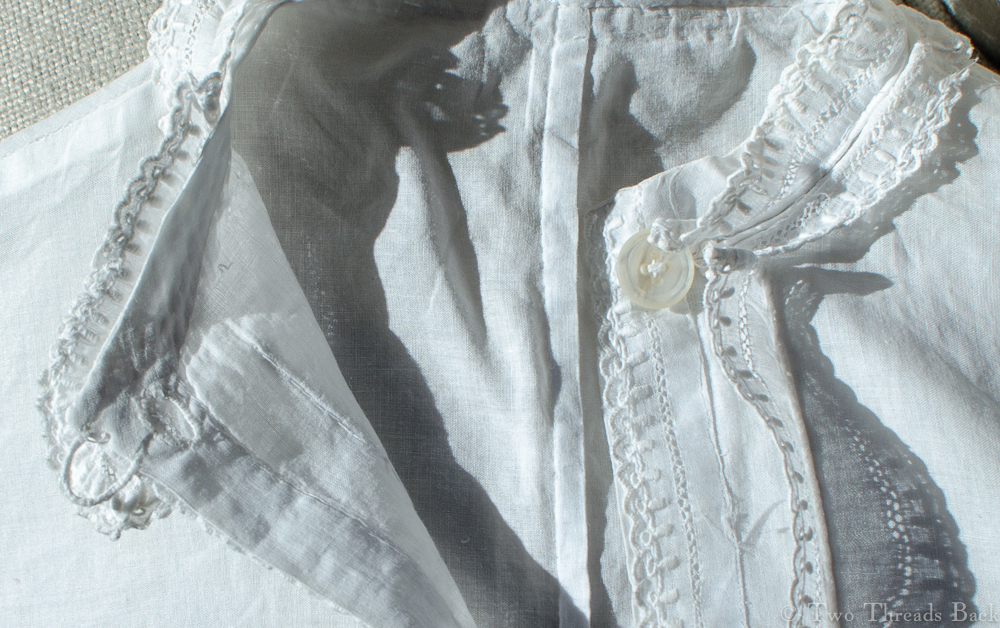
The sacque has a high collar with hand-embroidered trim and fastens with a single mother of pearl button and thread loop. There’s a buttonhole hiding under the trim on the collar, but Mother must have decided it was too tight or difficult to fasten. The same trim edges the front, hem, and cuffs. There’s even a bit of piping.

Infant sacque collar
Close up of the collar & fastening.

The cuffs were taken up with a hidden tuck to fit shorter arms, and they also have tiny thread tassels. I thought at first the threads were drawstrings for the cuffs, but closer examination shows them to be attached separately and knotted around… a bit of wool? …held with glue? I can’t see it well enough to tell, but it has yellowed over time.

Infant sacque, cuffs
Close-up of the little cuffs – you can just see the tassels.

Infant sacque, back view
A view of the back, showing the pattern.

The trim down the front is turned toward the center, the opening.  This is typical of 19th century clothing, although my modern expectation is to see tucks or trims folded or facing outward (toward the arms).

In all, it’s plain made fancy. And enough to make me swoon over the tiny confection!

Worn Out

Sewing a shirt
Fortunately my garret has a window.

In spite of my plain shirt obsession, it took me forever to finally reproduce one myself. I have a tendency to procrastinate, and it doesn’t seem to matter if it’s something I really love or not.

I’ll start with enthusiasm, and then the motivation fizzles and the project goes on the UFO shelf. So it’s been with the fine linen shirt I’ve been playing with for the proverbial seven years.

But then last year I had to make one for a local history event, and a Deadline With People Waiting On Me provided the necessary spark.

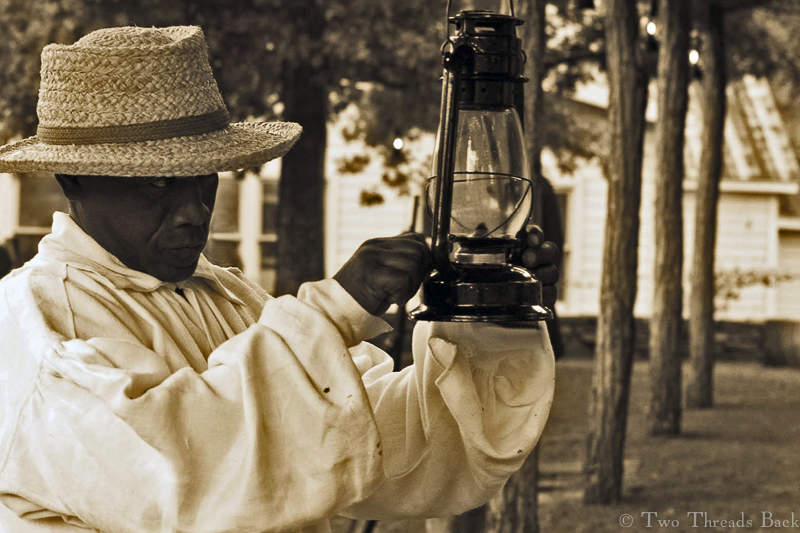
This square-cut shirt wasn’t made of fine fabric, but of worn-out linen, since it was to dress an interpreter at a historic slave cabin. It was easier to do since I was replicating an old and tattered garment: all my stitches didn’t have to be perfect, thread could be mismatched, patches were expected.

The hard part was working on a heavier material that still contained prehistoric starch, as well as making the shabby parts fit the pattern in the right places. Working over two threads on lumpy and uneven material made the finished product look a bit coarse. Um, not my fault… right. However, I made the deadline although both the shirt and I were worn out!

Cabin Shirt

All’s Fair

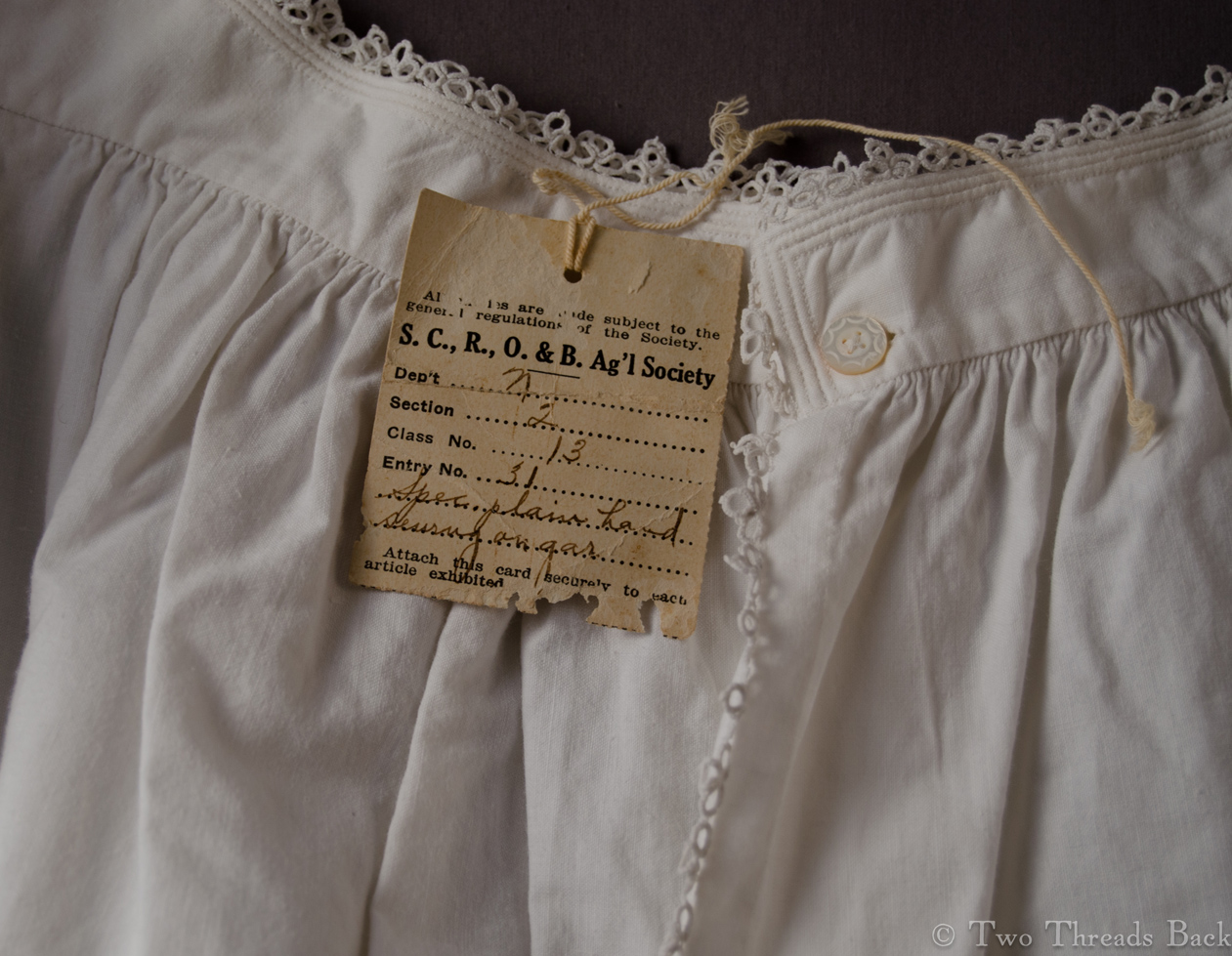
S.C., R., O. & B. Agricultural Society Fair 1860

Once upon a time, folks from all over would gather, bringing their best work to show off, to compete for prizes, and to sell. These were the agricultural fairs, a tradition whose roots go back many centuries and places. Nineteenth century America saw their development as a way to encourage innovation. By mid-century, agricultural societies were flourishing.

Today their records are a rich source of information on agricultural and domestic history of the era.  The premiums, which ranged from a few cents (female enterprise) to substantial sums (men’s categories!) must have been the source of great pride, outrage, bickering and boasting – oh to have been there to hear the drama! I spent a happy afternoon several years ago in a university library poring over the books full of juicy details. Yes, that was before google books.

“An embroidered map of Savannah… best collection of fall peaches … beautiful specimens of sewing silk … second best profane landscape … woolen counterpane, maker’s name unknown … from the crowded state of the room, and the great number of articles present, several paintings could not be found …  second best cow “Eloise” … the committee exhibited a marked partiality for apple pies, and awarded with singular unanimity fifty cents each to Mrs. … a basket of superb wax flowers, which the chairman of the committee on flowers pronounced superior to any in his department of natural ones … S. D., 7 years of age, worsted work executed while lying on his back with a broken thigh, .50 … worsted quilt, said to contain 9765 pieces; ingenuity and labor … lemons of enormous size, preserved in alcohol…” – the list fills volumes.

Crackers, lightning rods, stoves, plows, false teeth, butter, Muscovy ducks, headstones, cologne, down tippets, dog’s hair socks, essays, fishing boots, parsnips, daguerreotypes, golden pippins, rocking chairs, canaries, grain bags, gold pens, baby-tender. Was there anything they didn’t show?

To paraphrase one report, I am greatly embarrassed on account of the limited means placed at my disposal to mention such a large number of exhibits, and I wish to say, that I doubt not there are many articles not noticed which are as well worthy of premium or gratuity as some which have been thus honored. I am reluctantly compelled to pass them over.

Fair Chemise 2
Hand Sewn Chemise

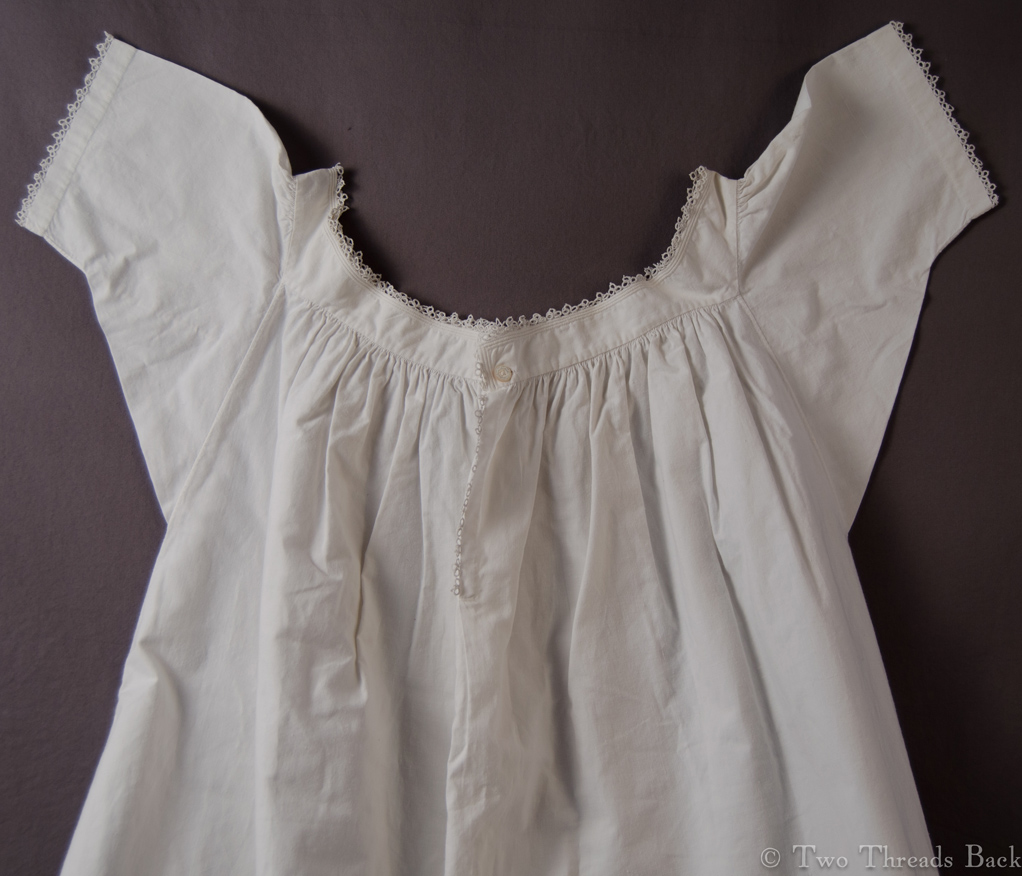
One category is especially interesting to me: plain sewing (surprise!). Here are some examples from the Sandy Creek, Richland, Orwell, & Boylston Agricultural Society of New York, c1860.

The chemises are exquisite, and it’s easy to see why their maker entered them in competition. I regret to say that I don’t know if they won a prize or not. There was no record of one with them. Nonetheless, they are fine work and perhaps the maker would be even more pleased if she knew how much, and how long, they would be admired!

By the way, check the calendar and visit your own state or local fair. If you’ve never toured the exhibits before, you’ll be amazed!