Aprons, No Strings

Apron 1854
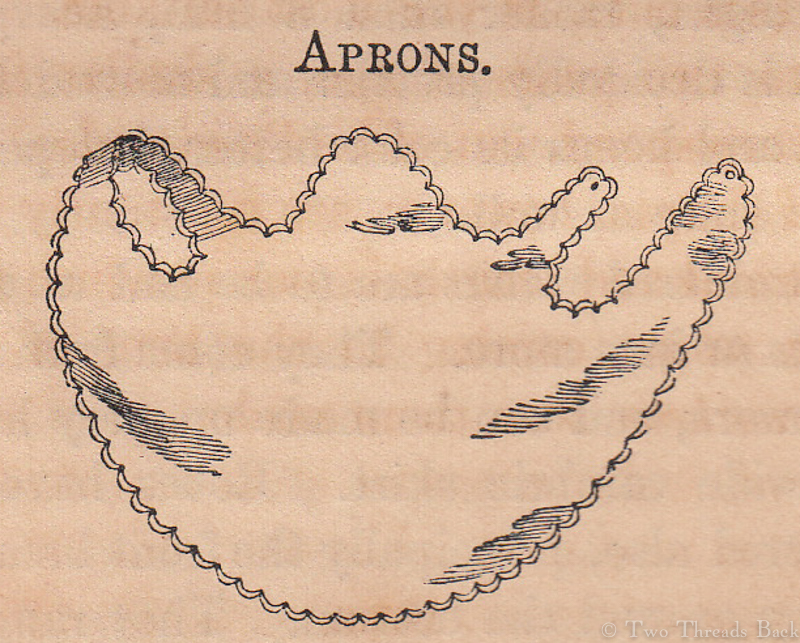
An apron pattern, c.1850 for the 19th century layette.

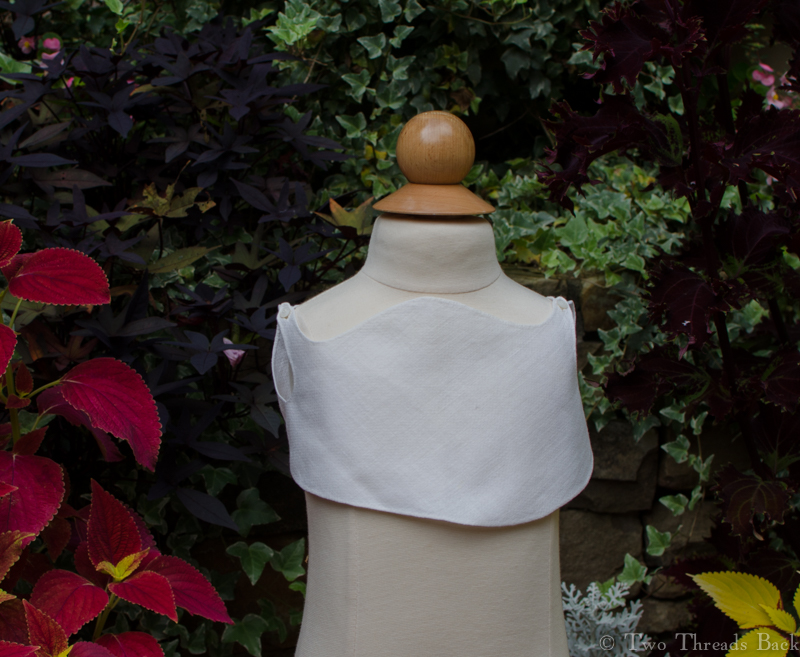
At three months old, it is usual to commence the use of aprons, which are made of bird’s-eye diaper, or, just now, brilliante, a firm, close-figured cambric, which will wear nearly as long. These last are bound with cambric, in solid colors, as pink, blue, buff, &tc. Bird’s-eye linen is usually trimmed with tatting or anything that wears well. At present, button-hole scollops, either plain or filled with dots, eyelets, &tc., are much used; they are made in this way ornamental, as well as useful. For an infant, the “bib-apron,” round front, coming a little below the waist, with a little shoulder strap buttoning around the arm (see cut), is the most suitable. From six months to two years of age, a similar front, with back to correspond, cut of bird’s-eye also. A large variety of shapes, however, are constantly to be had. The material and length is our province; no child needs an apron coming to the end of the dress skirt, as we have seen them made.

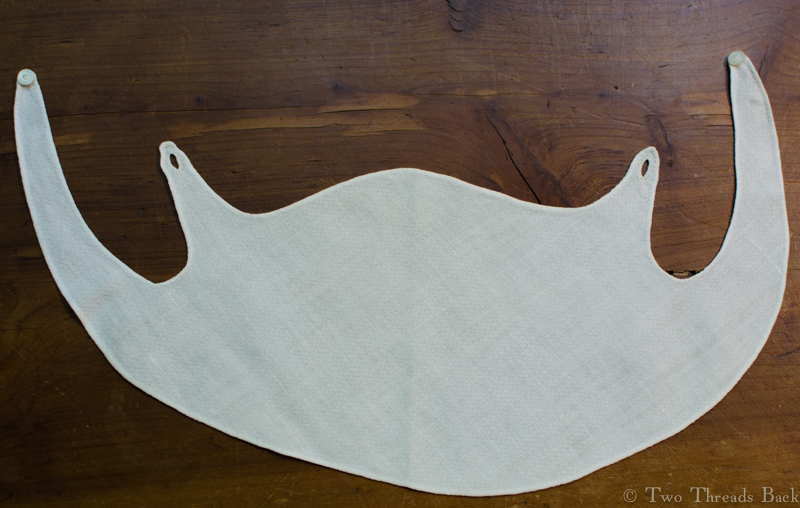
So says Sarah Hale, in a little instruction book written for new mothers in 1854. It amazes me that such a functional item could survive 150 plus years, but I come across them from time to time.  If you’d like an actual-size pattern of the one below, send an email to me, m at twothreadsback dot com, and I’ll send you a pdf – free. Gratis. No strings attached!

Apron 1A
An apron for a very small baby, made of cotton diaper by a mother who was cutting the pattern with one hand and holding the baby with the other.

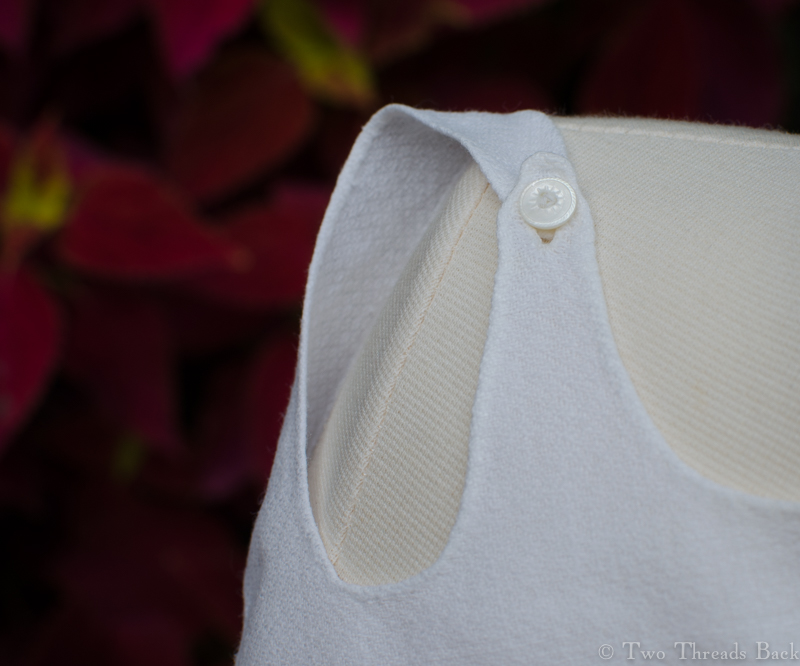
The hems are almost invisible, so I assume Mother was able to use both hands for that. The tiny buttons are made of delicately carved mother of pearl.

You can see the tiny mother of pearl buttons.
A close-up of the buttons and narrow hem.
The photo(s) are slightly underexposed because the apron is so white it's hard to see.
The photo(s) are slightly underexposed because the apron is so white it’s hard to see.
Apron 1D
The fabric is still so strong that the fold-down part in the front refuses to fold down – and I refuse to press it that way. Not a good idea for preserving old textiles!

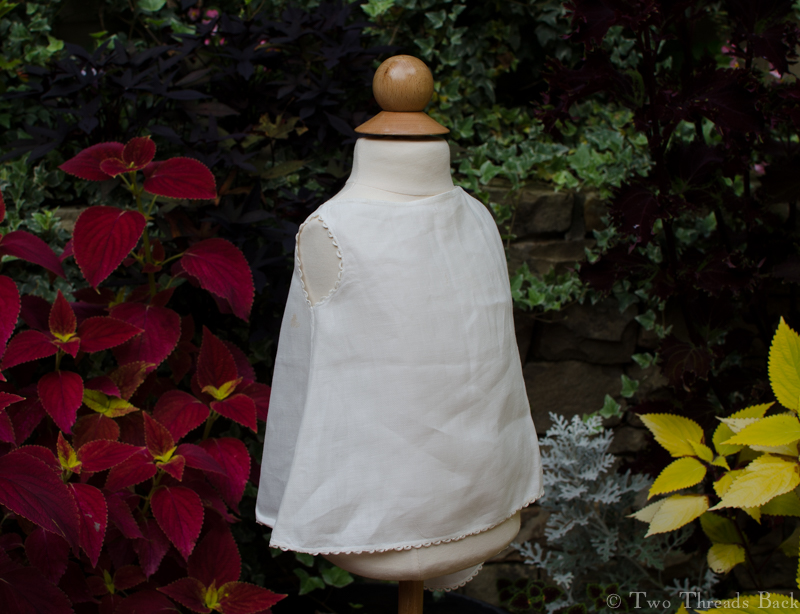
Another common pattern, made for an older child, is like the one pictured below. It’s also made of diaper – but in linen – and trimmed at the armscyes and hem.

Apron 2A
This one is less like a bib and more like what we’d call a pinafore today.
Apron 2B
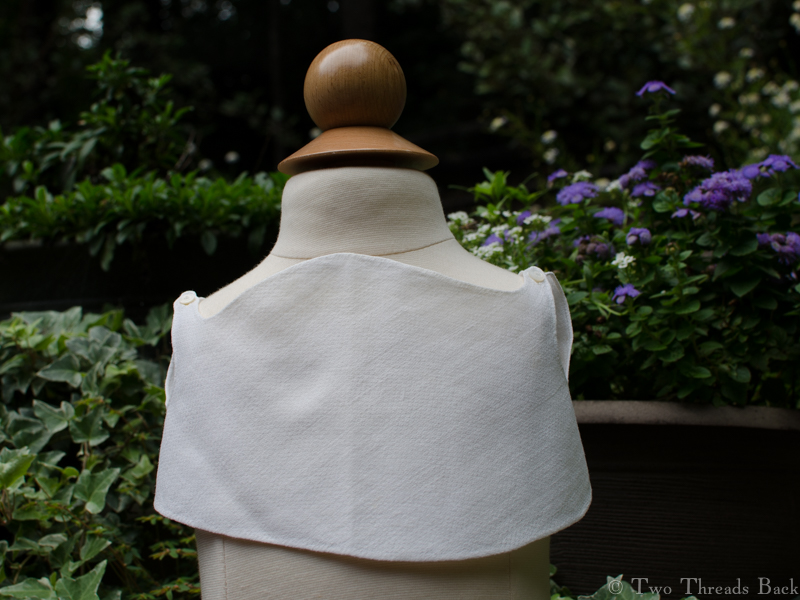
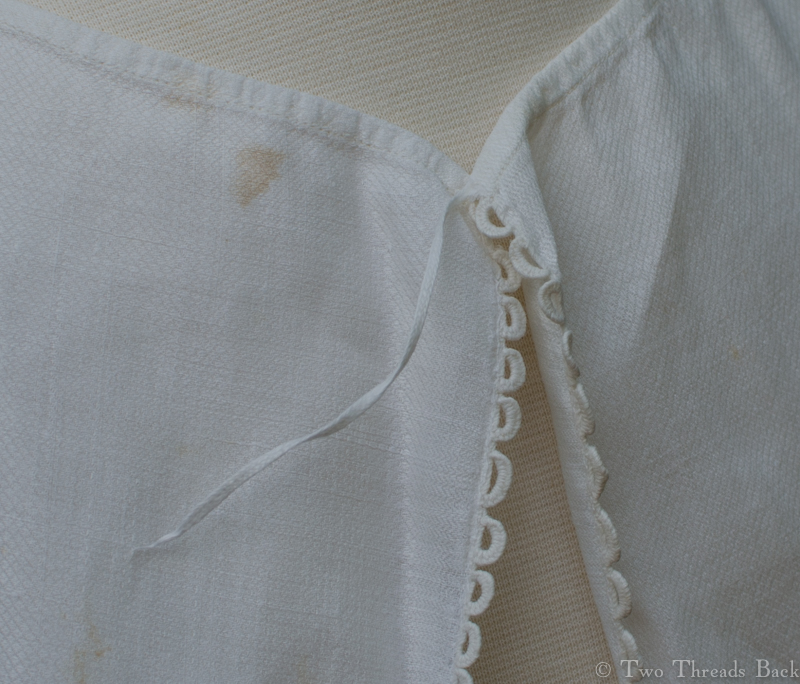
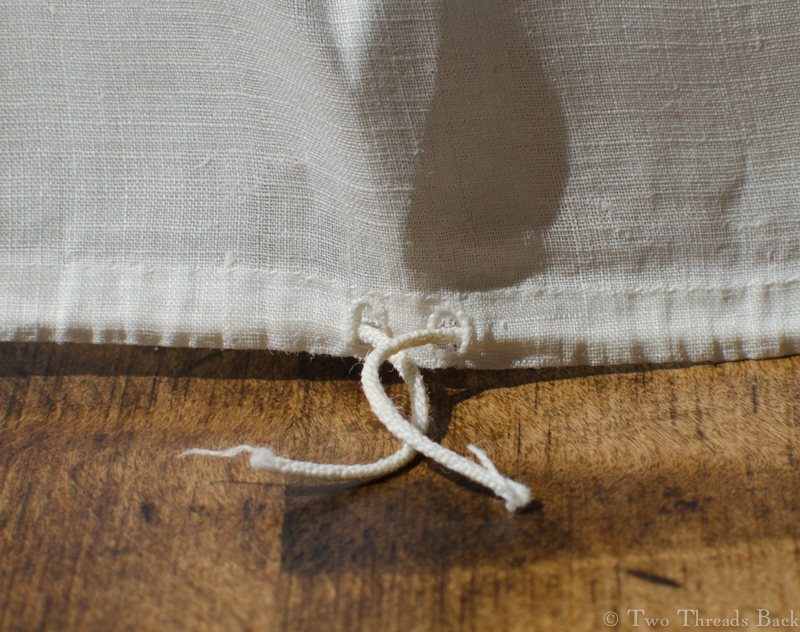
A view of the back to show the tape threaded through the neckline and the pretty buttonholed trim.

Apron 1854 Thumb

Flower Patch 2

Flower Patch 02
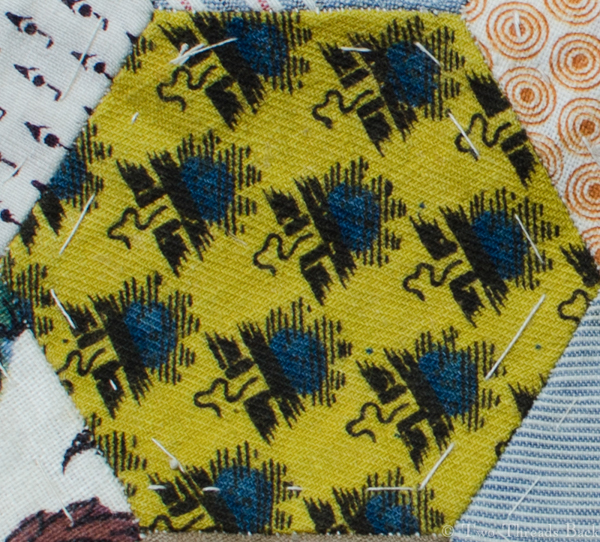
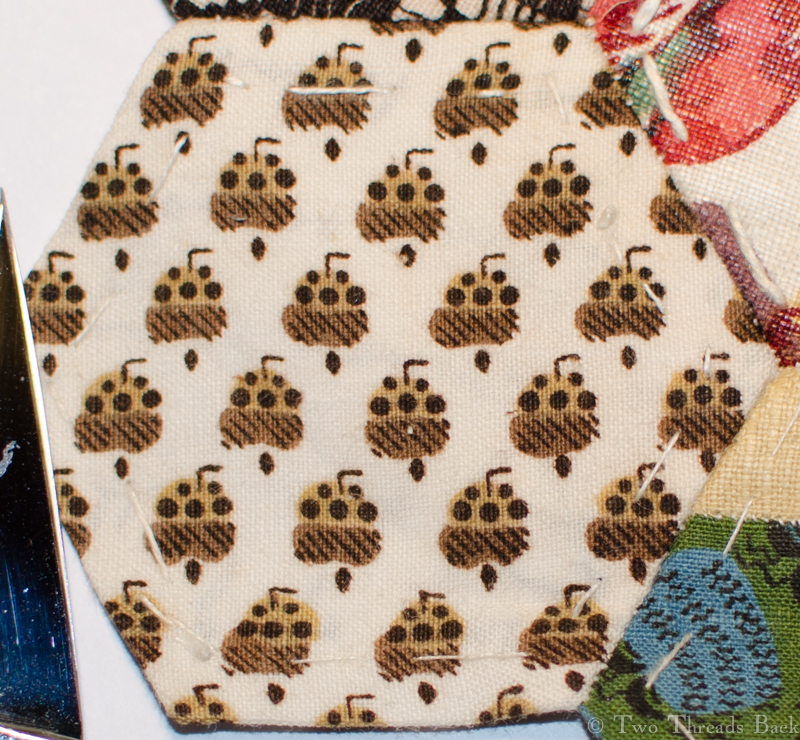
A bright yellow and blue calico patch, early 19th century.

Here we are with another patch from the same collection. There are a LOT of them, so I’ll probably not even mention that in future posts, but simply add the photo.

This one is bright and cheery in yellow and blue, with an absolutely bizarre design. It’s also reminiscent of Mousey Mousey – but perhaps when he was feeling blue on a bad hair day.


Fluffy Ruffles

Fluffy Ruffles 1
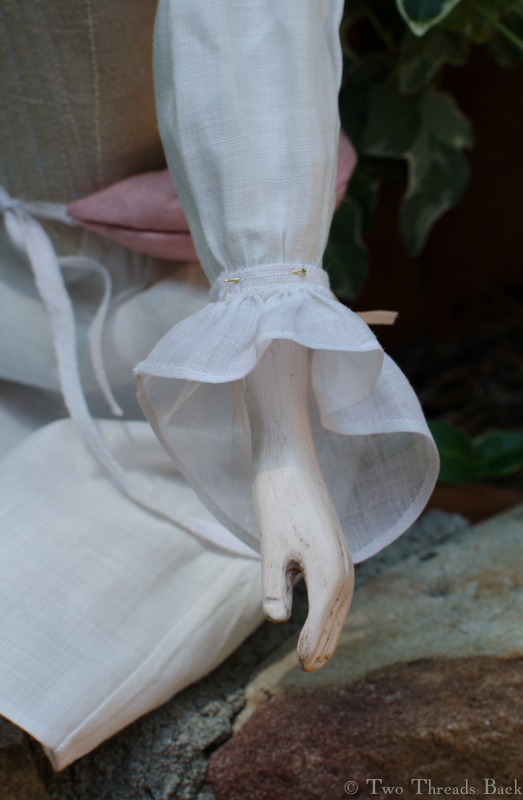
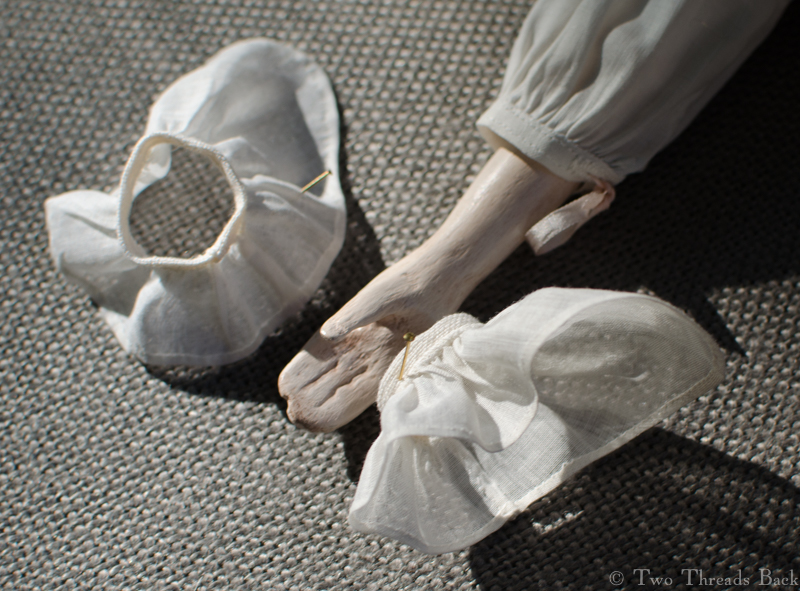
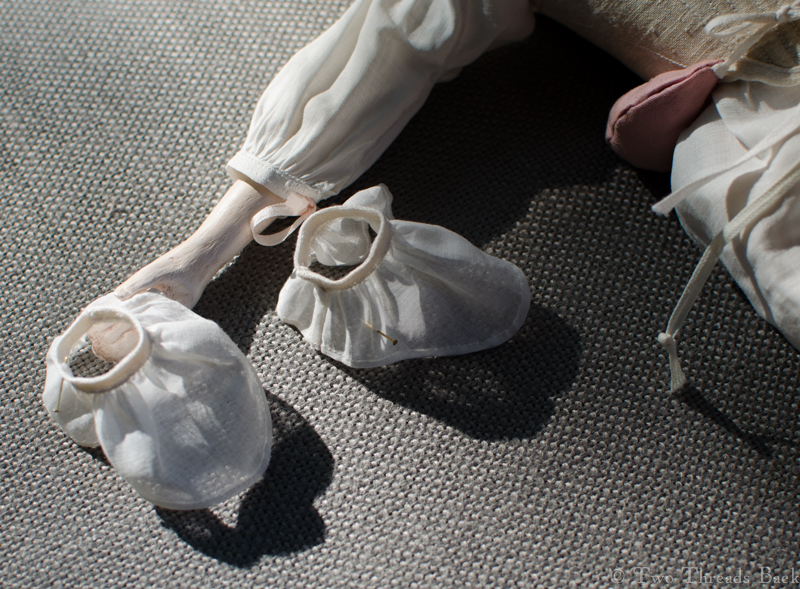
Engaging engageantes for Pharaby.

I’m not sure how I got distracted and neglected to let Pharaby show off her new sleeve ruffles, but we shall make amends. Here they are!

Fluffy Ruffles 2

From that same stash of unsold ebay scraps I selected a pretty little bit of muslin. Now I admit I’ve handled a lot of fine muslin and can usually tell when it’s wearing Sizing of the Ages. But this piece had me stumped. It was originally an unfinished embroidery project with a homemade pattern marked in blue ink, a typical edging design, and I’m pretty certain it was mid-19th century. But washing – a lot – didn’t affect the nice bounce at all. So we got the effect of nicely starched ruffles without any stickiness.

Fluffy Ruffles 3

Fortunately, it was also forgiving. I managed to whip the edges with no problem, but one little ruffle had to be attached three times before I was satisfied with the linen band.

Fluffy Sheet Music
Fluffy Ruffles, 1907.

So now Pharaby has some fluffy ruffles. By the way, it was a family joke that my aunt named every pet she had Fluffy Ruffles. A little googling showed me why!

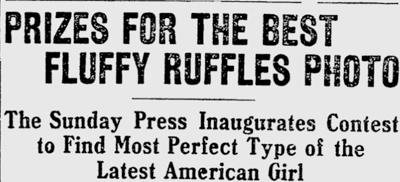
Fluffy was born in 1906, the creation of artist Wes Morgan, and featured in stories with verse by Carolyn Wells. Pretty, stylish, and spunky, she became a heroine of her era and the next few decades (that’s longevity for a fad!) saw her as a paper doll, a book, in music, on the stage, and yes, her catchy name was shared with crochet patterns and flower hybrids – and pets.

Fluffy Ruffles Contest
Fluffy Ruffles, the Perfect American Girl.


The Flower Patch

Flower Patch 01
An early cotton calico from English Paper Pieced Patchwork. (Say that really fast.) It measures 2×2 inches. The odd thing on the left is my embroidery scissors holding down the edge.

Welcome to the Flower Patch! Back in the olden days when I was a child, my sister and I would sometimes take our afternoon naps on “pallets.” These were great-grandma-made quilts, all soft and worn, laid on the floor in front of an electric box fan (we lived in The South). Compelled to be still and quiet, we’d make a game of picking out our favorite patterns. Of course it sometimes degenerated into squabbles: “You can’t have that first favorite, ’cause it’s my first favorite!” We’d usually fall asleep and wake up best friends again.

I’ve recently come across a few little quilt bits – can’t afford whole garments or quilts – from my favorite era, the early 19th century, and thought I’d post a picture of a patch now and then. I wanted to record all the patterns anyway, and this seems like a good way to share them at the same time. If you happen to recognize a print, or are blessed enough to have the whole garment (which might give me the vapours), I’d love it if you’d let me know!

These patches are from an “English Paper Piecing” set. I believe it dates to the early 1800s, not only because of the patterns but because some of the paper that’s used on the back is c1808-1812. There are a few pages from English newspapers (London National Register, Monthly Magazine, etc.), private letters, and a whole lot of pages from an old copybook. Of course that doesn’t make a certain date; some fabrics could be earlier or later and it all could have been pieced later. But I’ll leave that to the experts.

Mousy Mousy
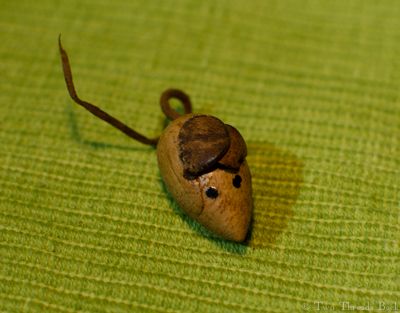
Mousey Mousey: a survivor.

The first patch I selected has a peculiar pattern. It reminds me of poor old Mousey Mousey. Mousey Mousey was a beloved toy that I still treasure, though heaven knows how anything so small (less than an inch) could survive the many decades and almost two dozen moves he has (we have) been through.

Pictured above is Flower Patch #1. By the way, it’s not my first favorite.


All Dressed Up & Nowhere to Sew

Sewing in the Parlor
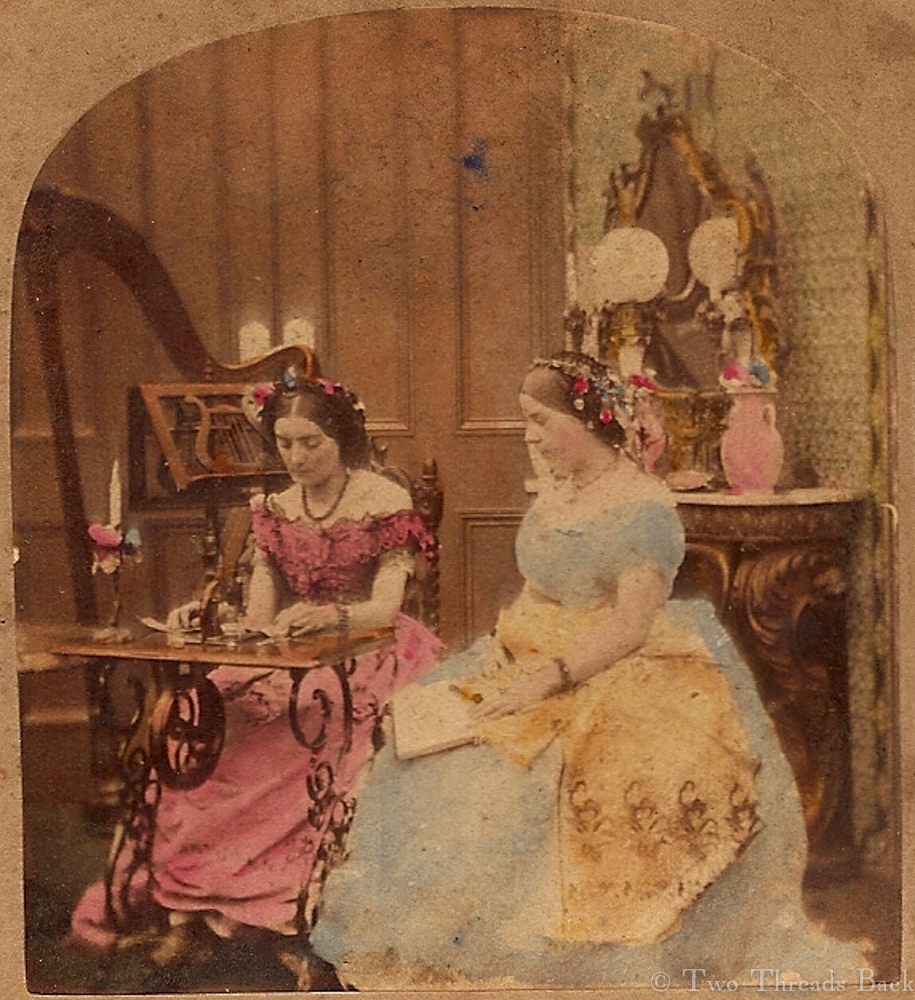
Sewing after dinner.

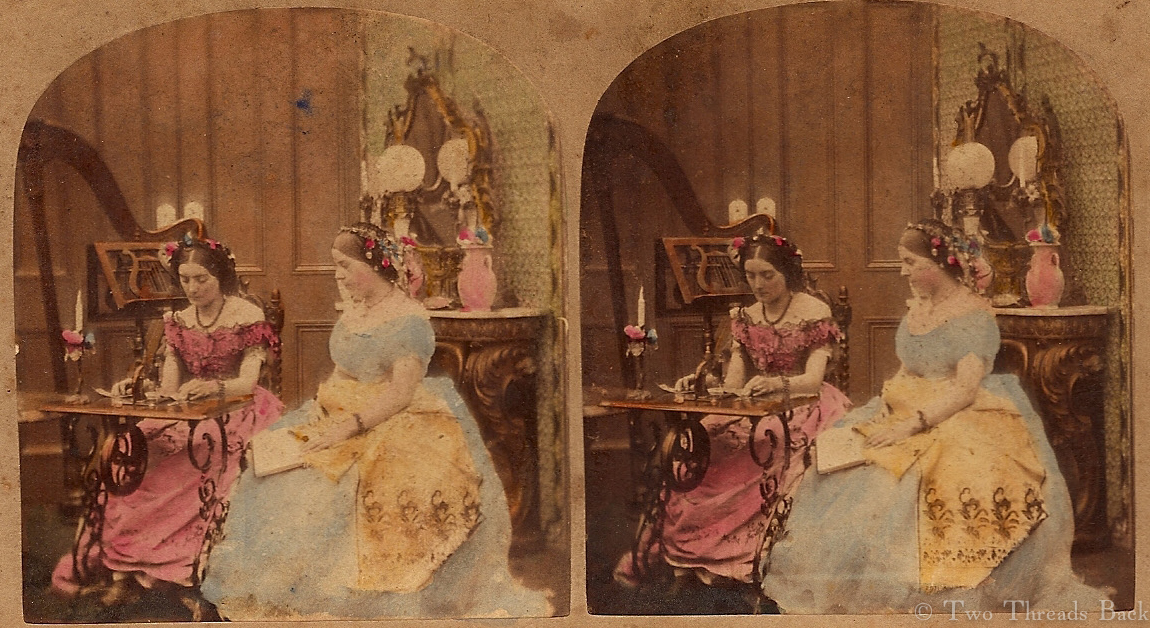
Except the parlor, perhaps? Well, it’s identified on the back as the boudoir, but the meaning of words changes according to time, place, and whim, so we’ll accept her terms. This is a charming stereoview image of two circa 1860s ladies in full dinner dress, sitting down to play with their new sewing machine.

I can’t identify the machine, but I see the seamstress has a music stand and harp close to hand, just in case she wearies of needlework. And a friend with a manual close by to instruct and advise. (Ok, it’s not a manual – what could it be?) A picture-perfect postprandial occupation while the gentlemen are smoking: a lamp, vases of flowers, elegant furnishings, and a congenial companion – what more could you ask?

Sewing in the Parlor Stereo
Full stereoview of the new sewing machine.

Little Biggin

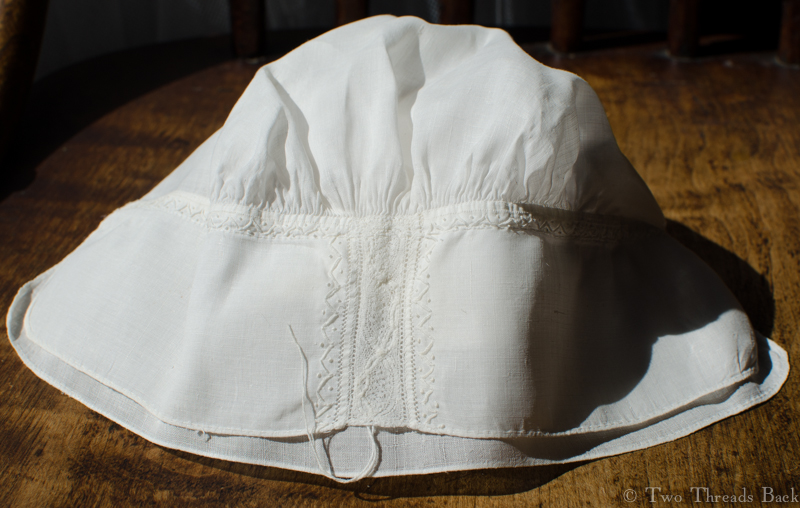
18th C Cap 1a
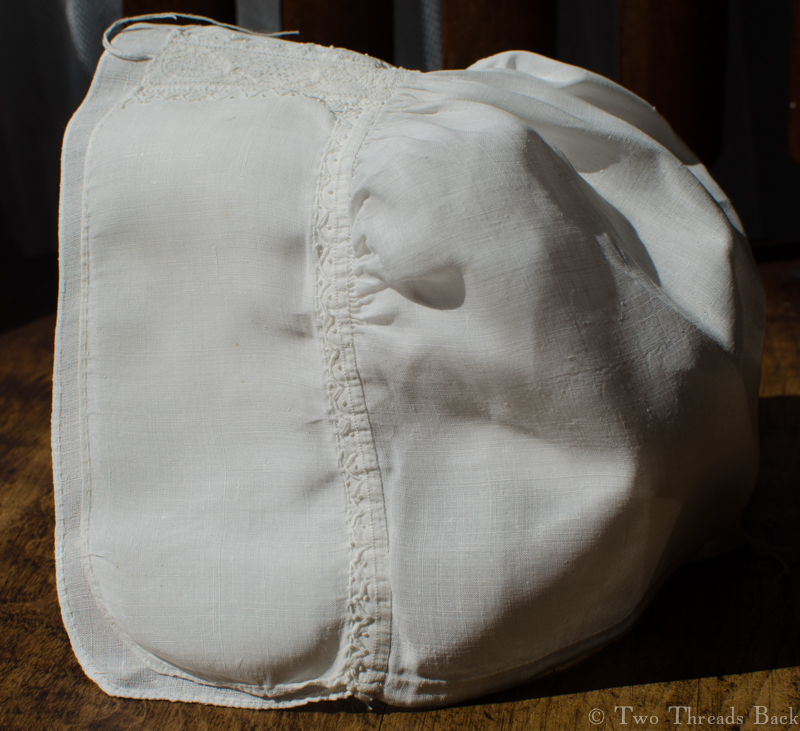
18th century linen cap for a baby.

Babies look so sweet in caps, and once upon a time they wore them from the time they were born. They wore a lot of things actually, as Thomas Jarrold wrote in this 1736 excerpt:

18th C Cap 1b
Infant’s linen cap, lace insertion on brim.

Formerly, the dress of an infant was cumbersome and oppressive, it is now much simplified, but still it admits of improvement; many parts are unnecessary, and even injurious, and require an experienced person to adjust them, and, in dressing the infant, so much time is consumed and so much toil occasioned as must greatly exhaust and weary it; to this it ought not to be subjected, that cannot be proper which distresses the child …. its dress should be light and warm, and so constructed, that the time occupied in dressing may not be greater than the capacity of the child to bear it.

18th C Cap 1fIndeed! The Foundling Museum’s record books also list a great variety of garments, and those for the head include cap, bonnet, biggin, forehead-cloth, and head-cloth – not necessarily worn simultaneously. I’m particularly fond of these little caps because they show such exquisite stitching. I don’t think anyone today does plain sewing so fine and dainty.

18th C Cap 1e
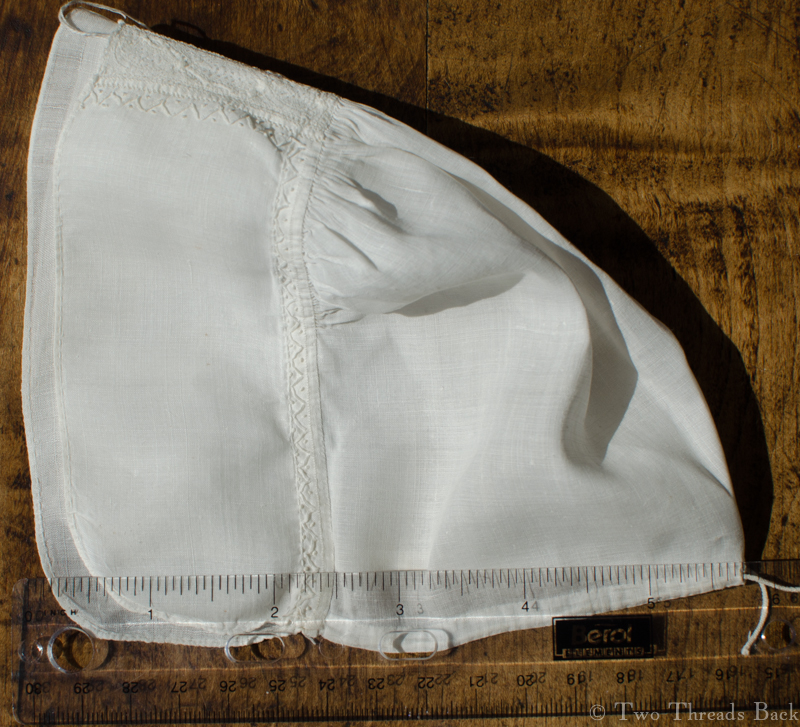
A measure to illustrate just how fine the work is – can you see the backstitching?

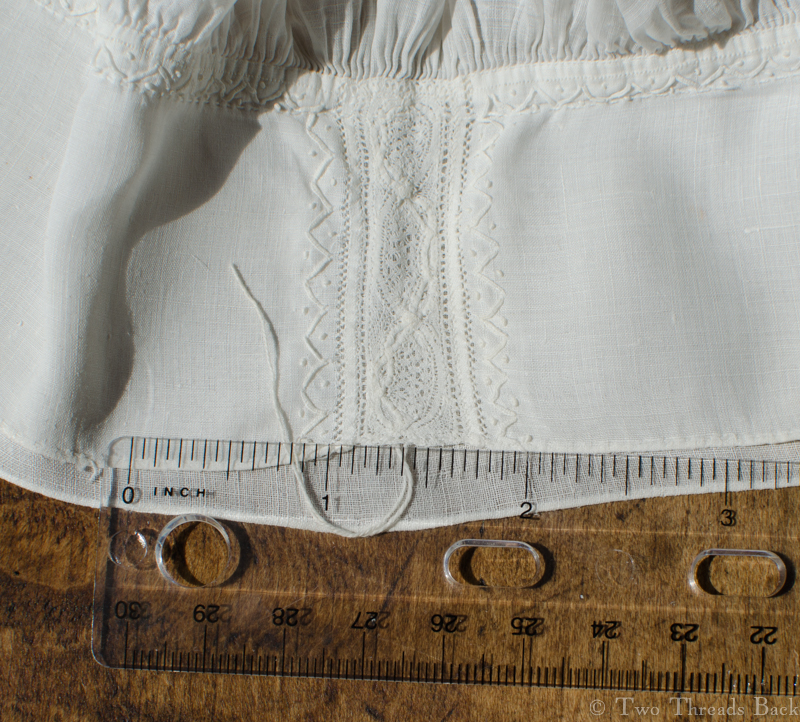
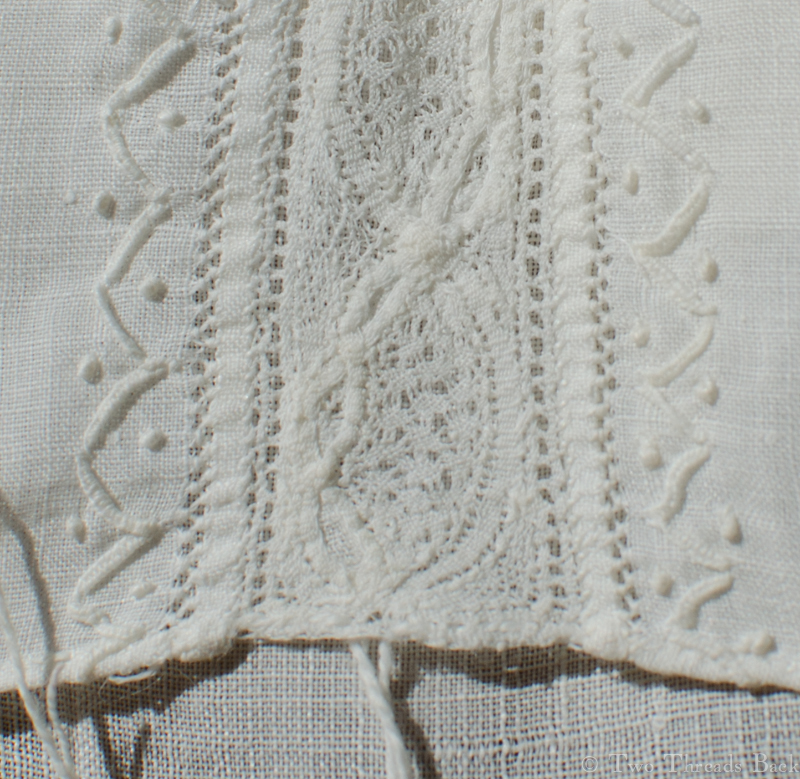
This elegant example is made of linen, and it measures about 10 inches across the double brim. From the front to the back hem is about 8 inches. The lace insertion is on the upper brim only. (If you can identify the lace, please let me know!)

The embroidery worked along the edge of the insertion and where the crown is gathered to the brim is typical of 18th century whitework on infant clothing.

Closeup of lace insertion on cap.

One puzzling feature is the running thread along the hem of the brim. On the under layer, it terminates a couple of inches short of the center on each side. It appears to function as the familiar “stay stitching” of today. However, on the upper layer, it continues from both sides, meeting in the middle. And the threads are left hanging!

The back is finished simply, with two tiny cords to draw for a closer fit. There are no ties (or pin marks) on the cap, another feature that was common into the early 19th century. Does that suggest that another head covering was worn with it? I don’t know of a baby today who could keep such a hat in place.  And “that cannot be proper which distresses the child!”

18th C Cap 1d
Little ties to adjust the fit of the back.

Recipe for Disaster

Laundry
Let’s hope she’s well-ventilated.

It’s so much fun to read housekeeping manuals and other domestic how-to books from days gone by. You come across many strange things in cookery, cosmetics, and cures: some fun, some funny, and some frightening. I found this delightful mixture in an old book on my shelf, The Complete Dressmaker, 1907.

A very highly recommended cleansing fluid may be made from the following:

Gasoline . . . . . . . . . . . . .1 gallon

Ether . . . . . . . . . . . . . . .1 teaspoonful

Chloroform . . . . . . . . ..1 teaspoonful

Ammonia . . . . . . . . . . . .2 teaspoonfuls

 Alcohol . . . . . . . . . . . . ..1 gill

Mix well and do not use near a fire or light, or in a closed room. (Seriously?) This fluid cleans silks and woolen materials, leaves a new finish and does not shrink the fabric or give white goods a yellow tinge. It may be used on the most delicate colors and fabrics and is very inexpensive.

Pour into a china washbowl sufficient of the fluid to cover the material or article to be cleaned; wash as you would in water, rub the soiled spots with an old, soft brush; a toothbrush will answer this purpose on a flat surface. Wring the material out of this fluid and rinse in a second portion. Wring out again and hang out in the air until the fluid evaporates.

Or the haz-mat team arrives.

In all fairness I should admit that the contents, if I knew them, of many products we use today would be just as shocking to a non-chemist like myself.  Still, this is one recipe I’ll let pass.

A Dorset Knot – I mean Knob – Button

Dorset Knob 1
Dorset Knob Buttons, early 19th century

The Dorset Button! Not the more common flat disk with thread spokes, but a “high top,” a tiny sphere wrapped in a spider’s web of thread. I mentioned in the Love Shirt post that I would explain how I made the buttons for the shirt – a non-documented, unauthenticated version for the directionally challenged: me. Believe me, before I finished the trial button, it did look more like a Dorset Knot. But I persevered.

The originals I wanted to copy are pictured above. They seemed to be stuffed with a kind of fiber, but the base was a black substance with a greenish-yellow cast and waxy look. It had puzzled me for years. Then after reading more about Dorset knob buttons, I realized the material must be horn.

Dorset Knob 3
You can see the horn button base on the original.

I didn’t have horn buttons, so I used shell instead, about 1 cm in diameter. I cut a little square of linen, about 3.5 cm, and on that I traced and cut out a circle larger than the button. The scraps served as stuffing for the knob. Waste not, want not.

Next I ran a gathering stitch around the circle, put the scraps in the center with the flat button on top, pulled the gathers tight, and stitched them closed. Voilà! The mold!

Then I wrapped thread around the button in a compass rose pattern and anchored it. Beginning at the top, I circumnavigated the button, taking a backstitch around each “spoke” and moving on to the next. It was a bit fiddly, having to smush the lumpiness of the mold and realign the spokes as I worked toward the base.

Once I had made a final pass around the base, I took a few stitches to anchor it all. And then I had to make four more.

For those who like pictures better, see below. For those who want a more authentic method, there is a lot of serious research available online now. And for everyone else… well, there’s always velcro.

Stuffed and gathered.
Thread laced in spokes around the mold.
Dorset Knob Weaving
Circumnavigating the globe: backstitching around each spoke before going on to the next. Or back one, forward two.
Dorset Knob Done!
Dorset Knob Done!