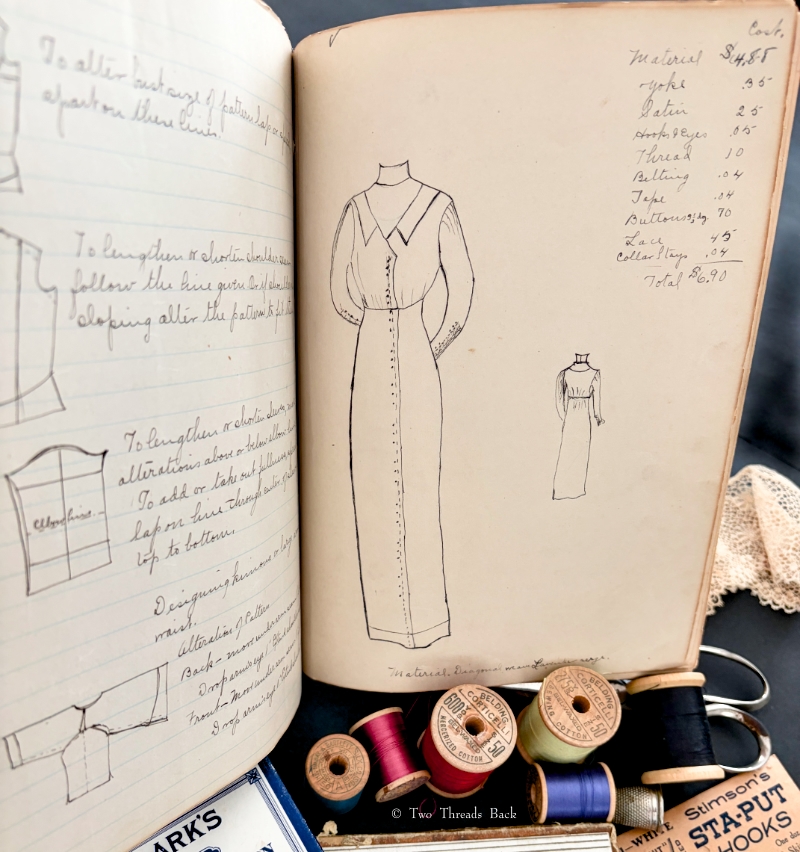
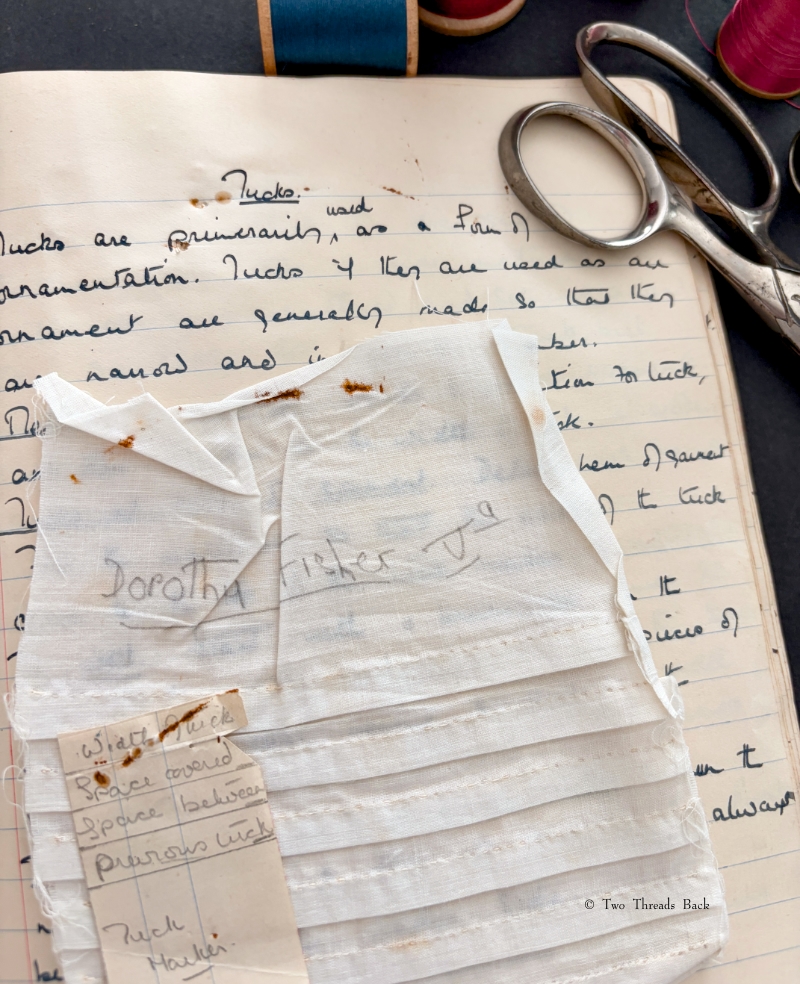
Well, one never was in Kansas and the other isn’t now! Here are two sweet sewing books. The one made by Eliza is American, from Kansas. The one made by Dorothy, who reminds me more of Glinda the Good, is from England. Besides the Wizard of Oz connection (I admit that was a stretch) they have other things in common.
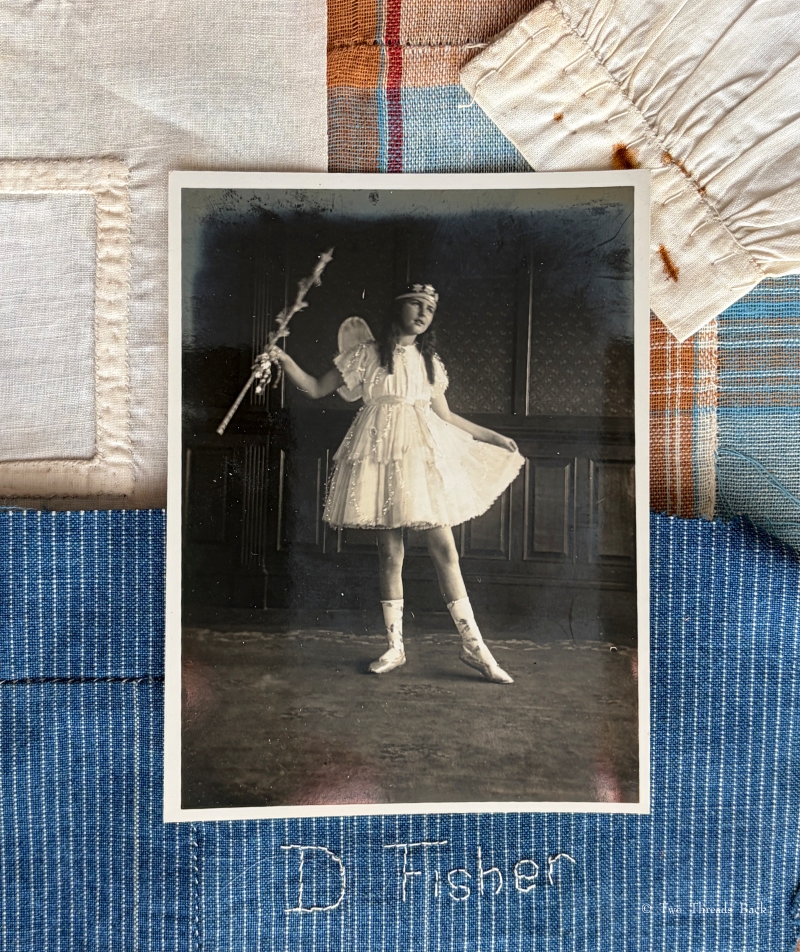
TIME. Eliza’s book is dated 1912-1913, and was compiled during her Home Economics Housekeeper’s Course at Kansas State Agricultural College. Dorothy’s book isn’t dated, but assuming the photo is of her and taken around the time she attended the class, it was probably made soon after Eliza’s. It seems they studied sewing at different ages, however. Dorothy was obviously still a young girl, while Eliza was over 30 when she completed her course, as census records show she was born in 1881.
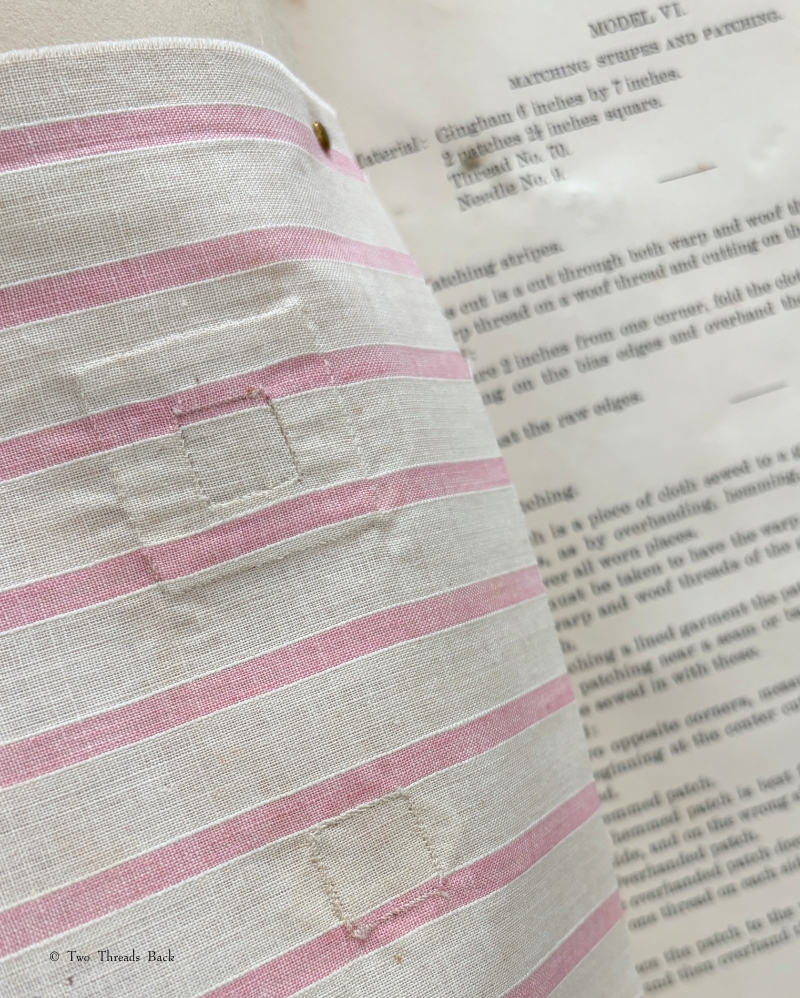
TECHNIQUES. Both cover the basic hand sewing stitches and seams, and they included samples of them in their books. They also learned patching, darning, and making plackets. Dorothy’s work is all done by hand, but Eliza has samples made by hand and machine.
Dorothy obviously put effort into her work, but compared to others I’ve seen, I don’t think sewing was her favorite subject.
Eliza’s work is more precise. However, she was older and likely more experienced when she took her course.
TEXTILES. Thrift was a virtue! Learning to make clothing economically was considered an important part of their education. Students needed to be familiar with fabric types and know which ones were appropriate for different garments. Truth in advertising could often be … well, elusive. And illusive. (For how to promote sales the right way, you can see some extravagant 1892 marketing here.) Textbooks practically encouraged suspicious shopping, and gave hints on how to distinguish good goods from bad goods. Both Eliza and Dorothy included swatches of fabrics in their books, a feature that became common after 1900.
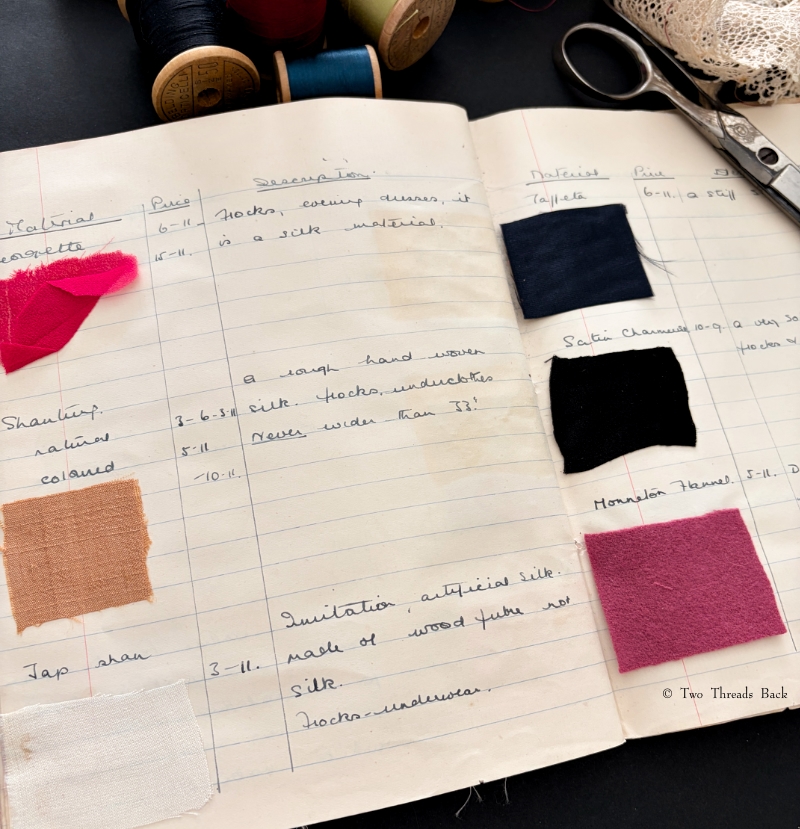
Dorothy noted prices and purpose. Some of the fabrics are the same, or at least they go by the same name, today: georgette, shantung, taffeta.
I wonder if Dorothy was allowed to sew with any of these? I suspect not.
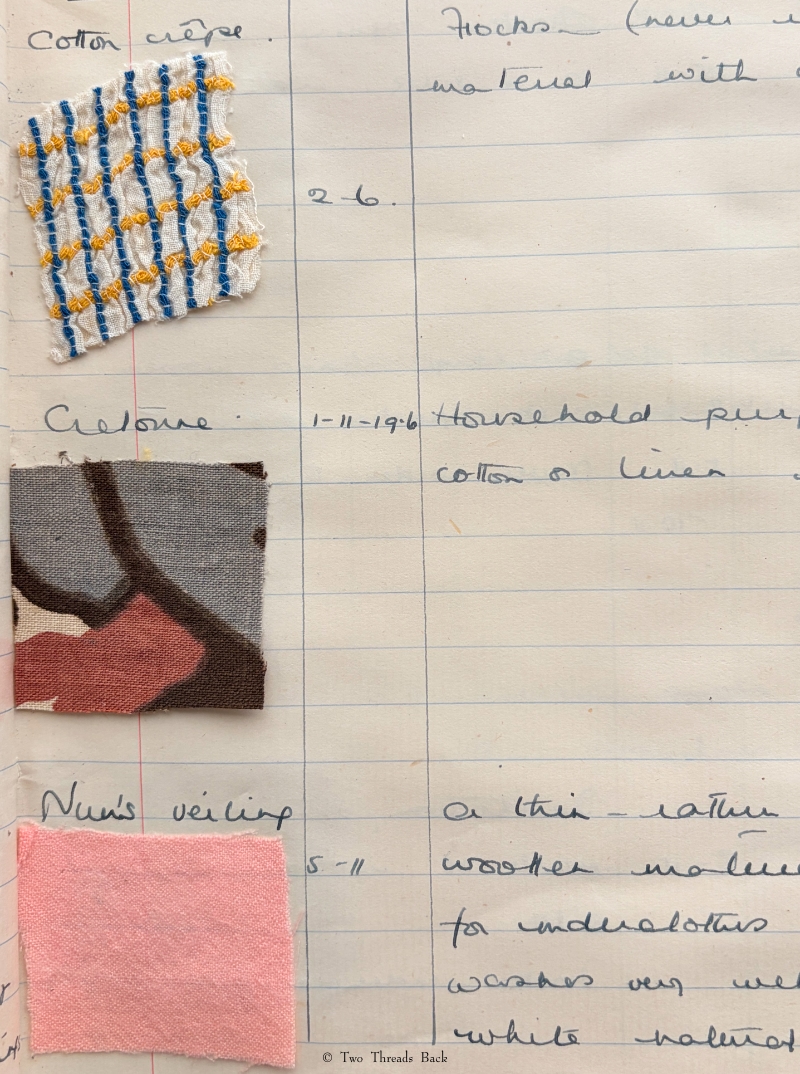
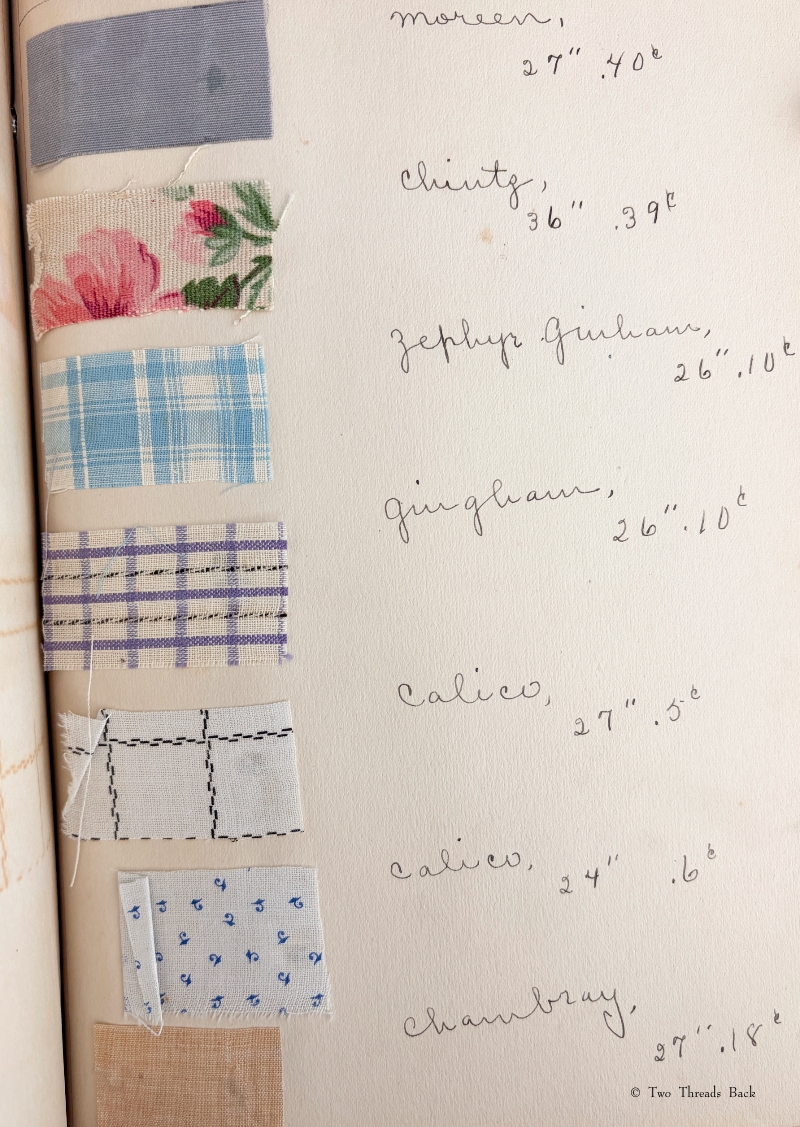
Eliza’s book has 3 pages of cottons, in addition to wool and silk!
The fabric samples are my favorite part of early 1900s-era sewing books. “Extinct” (or nearly) names appear in catalogs, journals, and books from those days, and while research and historians provide helpful descriptions, there’s nothing quite like seeing and touching a tiny bit of the textile for myself. Tarantulle is longcloth – who knew? Not me. A dictionary defines nun’s veiling, and yes, you can still buy it today (I checked), but it’s so much more fun to see a pink snippet from 1915. Textbooks tell me that albatross was wool, but Eliza had a nice cotton specimen. I can’t imagine asking for albatross at a fabric shop today! Well, if there were any fabric shops left today. There aren’t any near me. Maybe they’re still in Kansas?
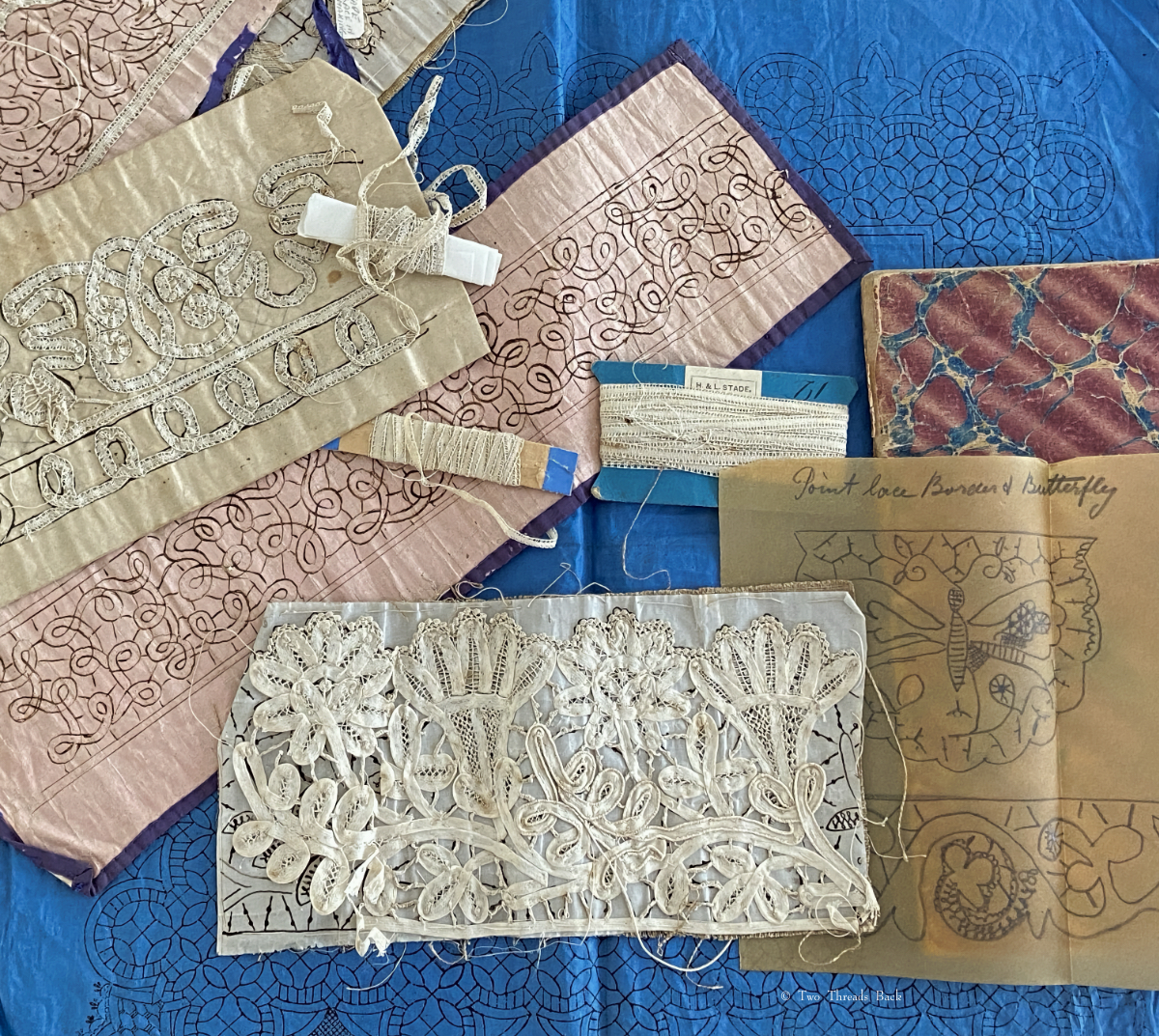
Lace is about as far as you can get from plain sewing, but this little collection is so sweet it deserves a bit of attention. “Point Lace, The Royal Point Lace Instructor,” by Mlle. Riego de la Branchardiere was published in 1869, and provided ladies who had crafty fingers, and some free time, with all they needed to make their own tape lace.
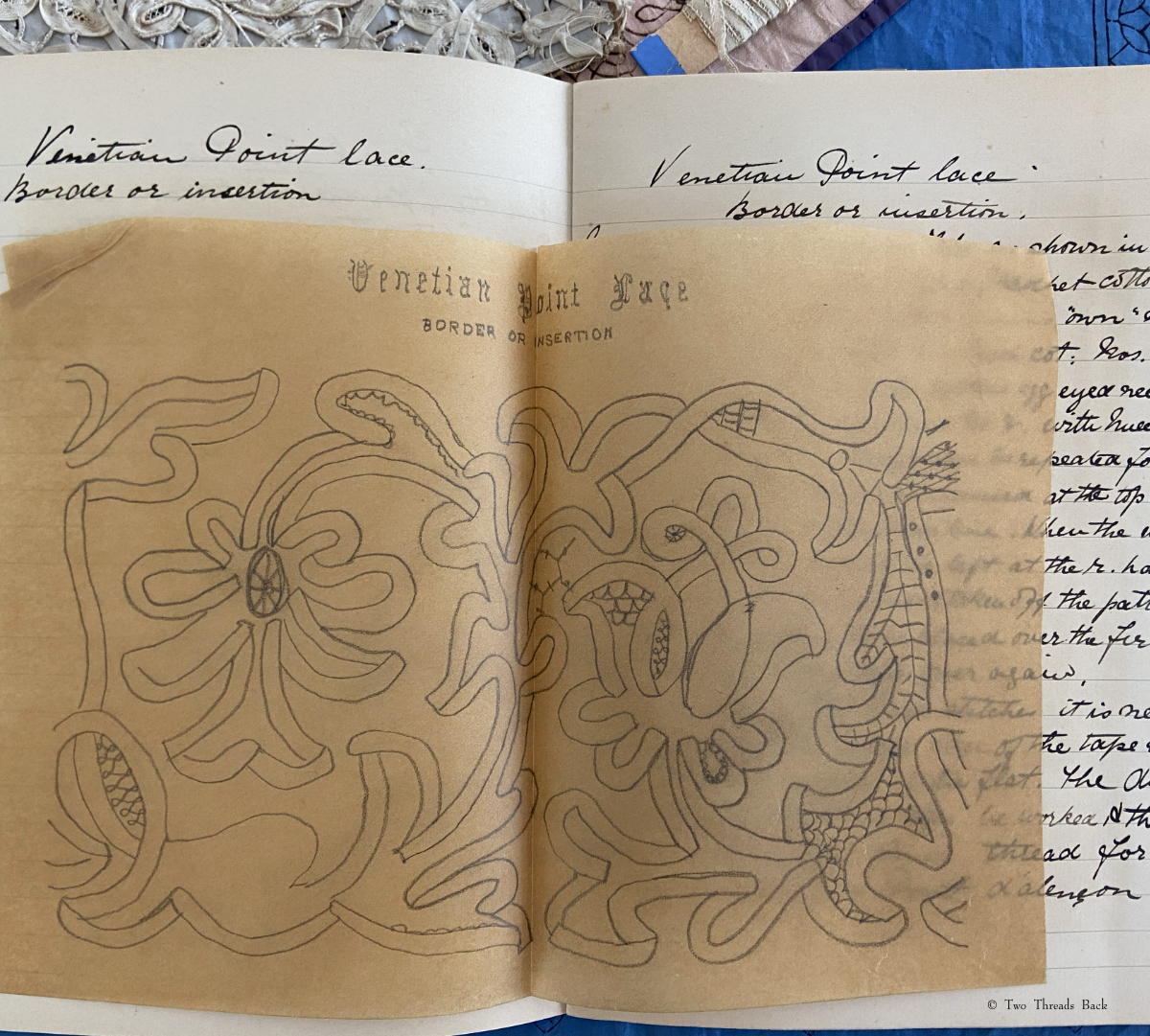
This handwritten version of Mlle. Riego’s book belonged to a woman born only a couple of years after the original was published. “Nanny” was a widow who worked as a children’s nurse for a family in Devon, England in the early 1900s. In 1901, she made a copy of the published book in a notebook of her own, and meticulously traced the patterns and illustrations onto tissue paper.
A large tissue pattern for a border or insertion of Venetian Point Lace.
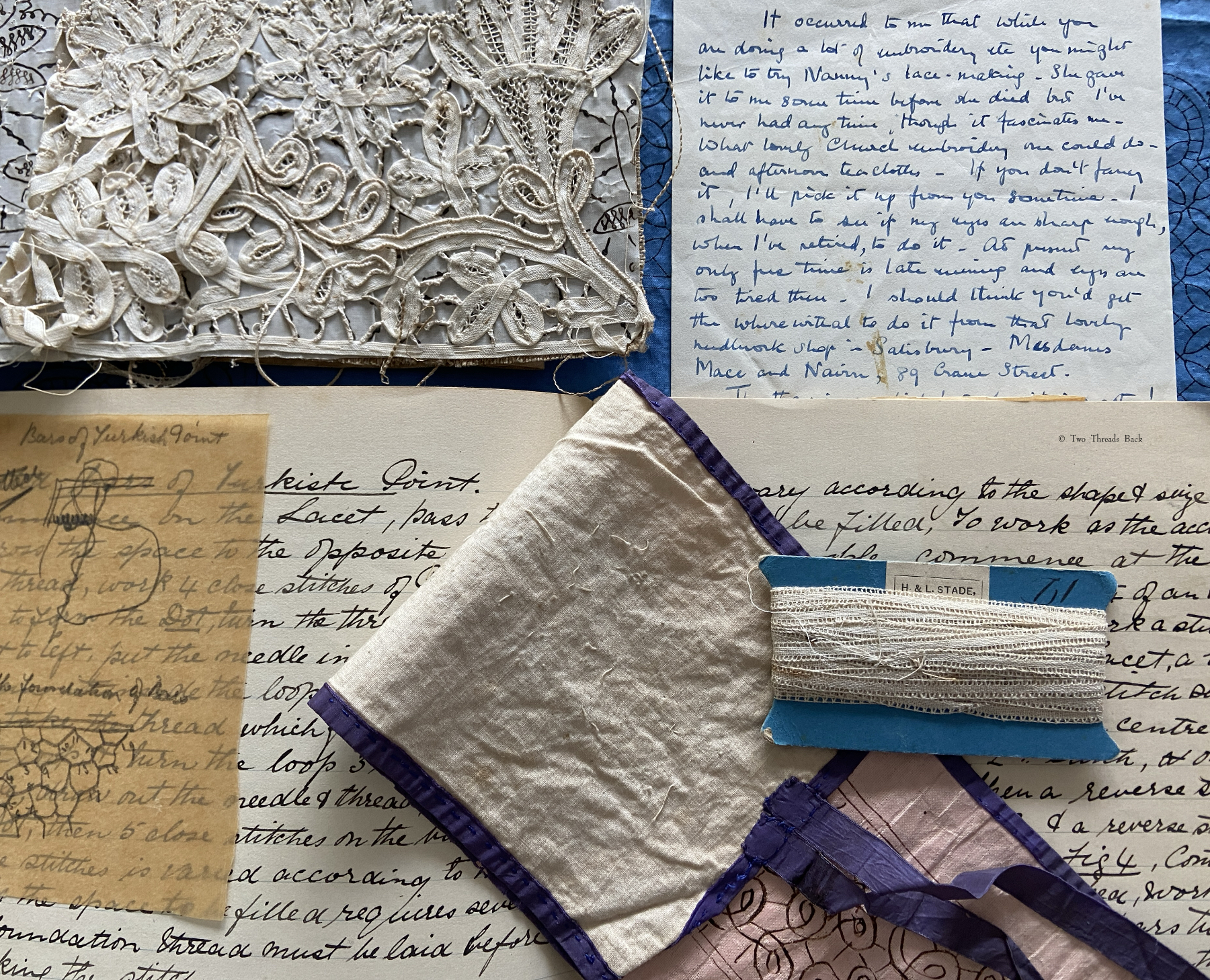
In a 1960s letter, a previous owner of the lace work recommended a needlework supplier, Mesdames Mace and Nairn, that may still be supplying embroiderers today!
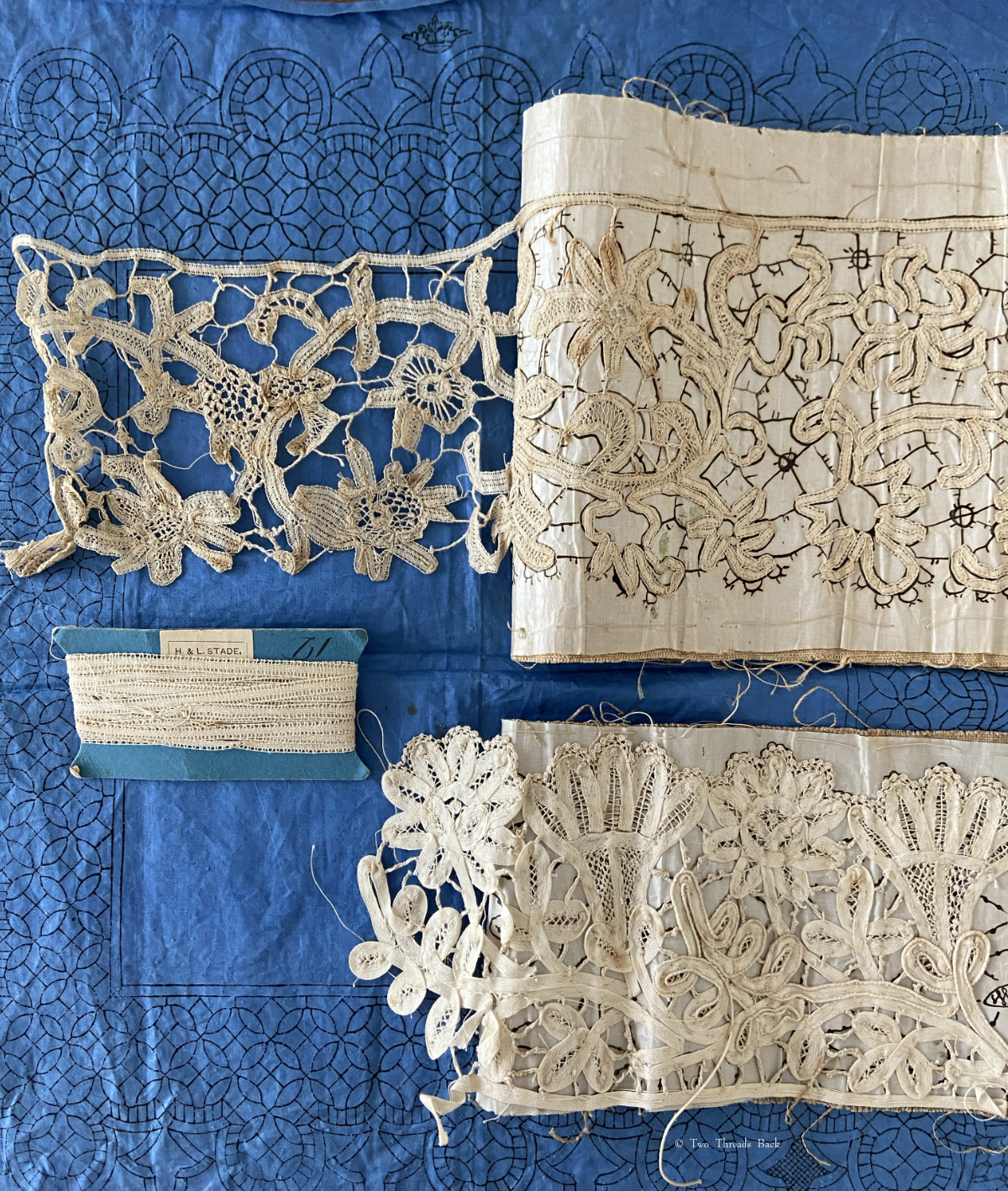
The collection comprises samples of unfinished work tacked to two layers of ground fabric. There’s one with a heavy canvas backing with a lighter cotton front, and two strips that are puzzling. They have a muslin back and pink glazed cotton front that has the lace pattern inked on it. What makes them unusual is that they’re constructed like old-fashioned sewing roll-ups (kits), bound with purple silk ribbon. You can see where they’ve had the tapes tacked to the pattern and then clipped off in places. Were they used for teaching? For reference? They’d be easy to roll up neatly and carry in a work box or bag! Or maybe they just allowed Nanny to work on a length of lace at a time, untack it, and then do another, while the “roll-up” kept the fabrics together and prevented raveling?
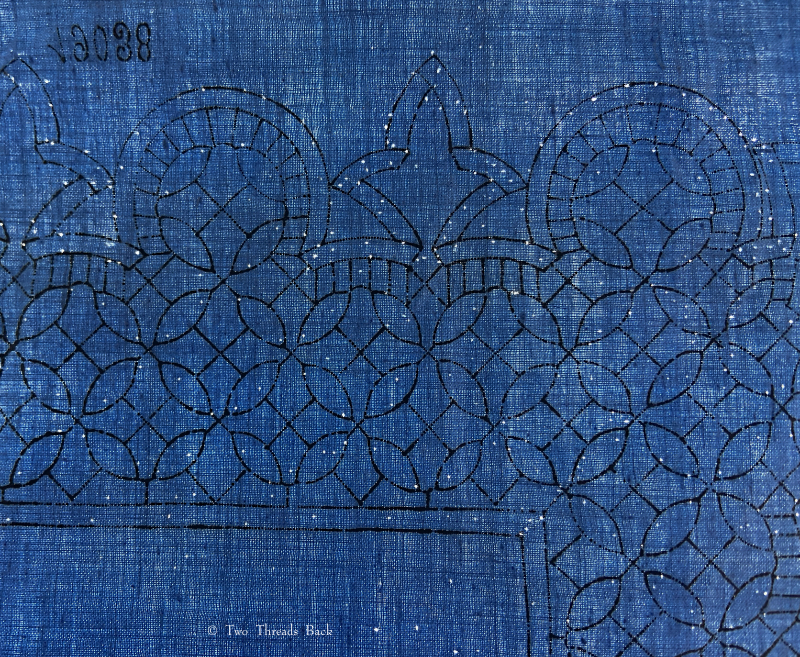
A deep blue pattern with bright points of light shining through the old tacking marks – like a starry night!
The largest piece is made of blue glazed cotton which appears to be stamped with a pattern, probably purchased from a shop. It has a pattern number (reversed) and a crown logo. It’s obviously been used. I wonder if the finished project is still tucked in a drawer somewhere or in a stack of old linens in an antique shop.
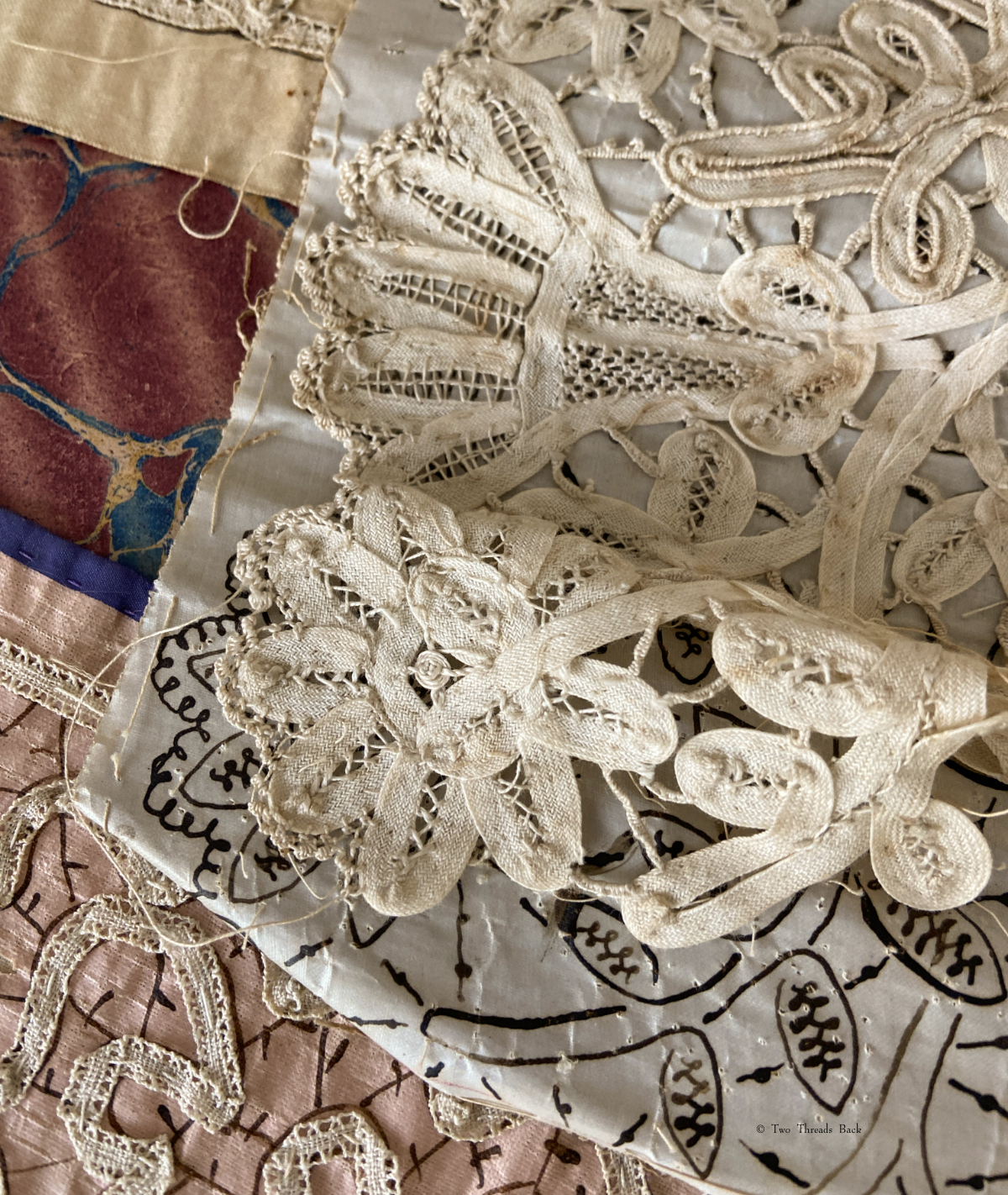
A closeup of the fine work that she did. Apparently the instructions gave her no problems at all!
This last photo shows how pretty the lace is when finished and cut from the backing. It would have made lovely trimming. Some clues about Nanny and her life survived with the collection, showing the path it traveled over a century. The stories are as much a treasure as the relics!
P.S. This collection (along with other “old” things) is ready for a new home, I will be listing it soon! Check my Etsy shop as I downsize, a little at a time!
“About 1849.” Except for the owner’s name, that’s really all I know about the history of this particular little sewing album. It’s bound with marbled paper card stock, edged with silk ribbon, and the colorful pages have the feel (and unfortunately the quality!) of children’s construction paper. Written inside the front cover is “made about 1849 by Mary M. Quiston, later Mrs. Reid, later Mrs. Porter.” (The “M. Quiston” might be “McQuiston.”)
Samplers of cross stitch (marking), embroidery, or darning skills have a long history in Britain, America, and Europe, but the popularity of books containing specimens of plain sewing stitches began in England in the 1810s. They were developed as part of the “monitorial” education system where pupils who had mastered a skill instructed the ones who were just learning it.
This system of “mutual education” was originally applied to basic reading, writing, and arithmetic, then to plain needlework since it was an essential part of female education. Understanding sewing instruction techniques was much easier if you had a small sample to see. Books with samples of hemming, stitching, seaming, marking, etc., were originally intended to help a teacher follow “the system” in her classroom, but also developed into treasured collections preserved by the girls who had worked them in order to demonstrate their accomplishments.
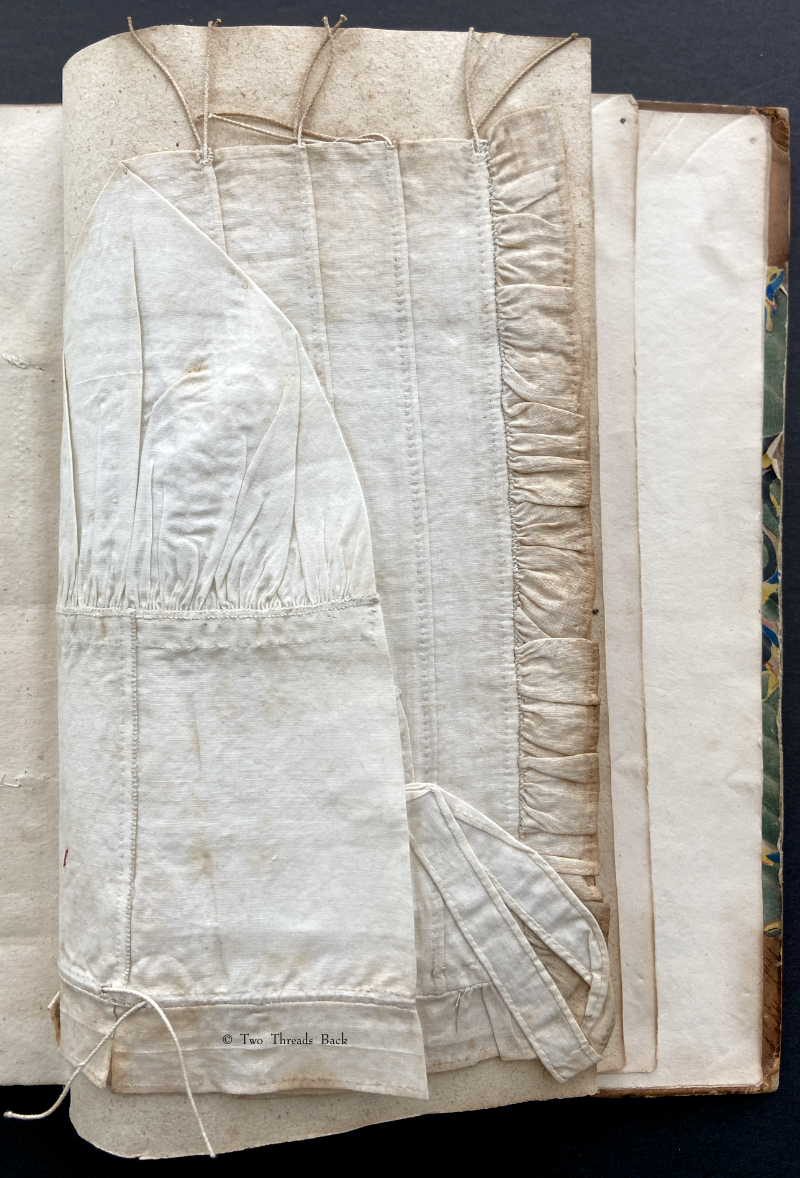
This is one of two caps included in the 1816 British and Foreign School Society manual, a book intended as a guide for educators who were using their monitorial system. It’s attached to the page so I can’t fold it out to show it well, but there’s a tiny number “1” marked in red cotton barely visible on the left. The other cap is marked (surprise!) “2.”
The earliest books might include a miniature shirt, cap, or apron, but it wasn’t long before they added other items like stockings, sleeves, dresses, trims, etc. to the classes. Educators appreciated the savings in time and expense that using small samples offered (and heaven knows charity schools needed to economize!) but maybe they had another reason as well: it was fun making tiny garments that were just like doll clothes! Here are some of my favorite pages from Mary’s book.
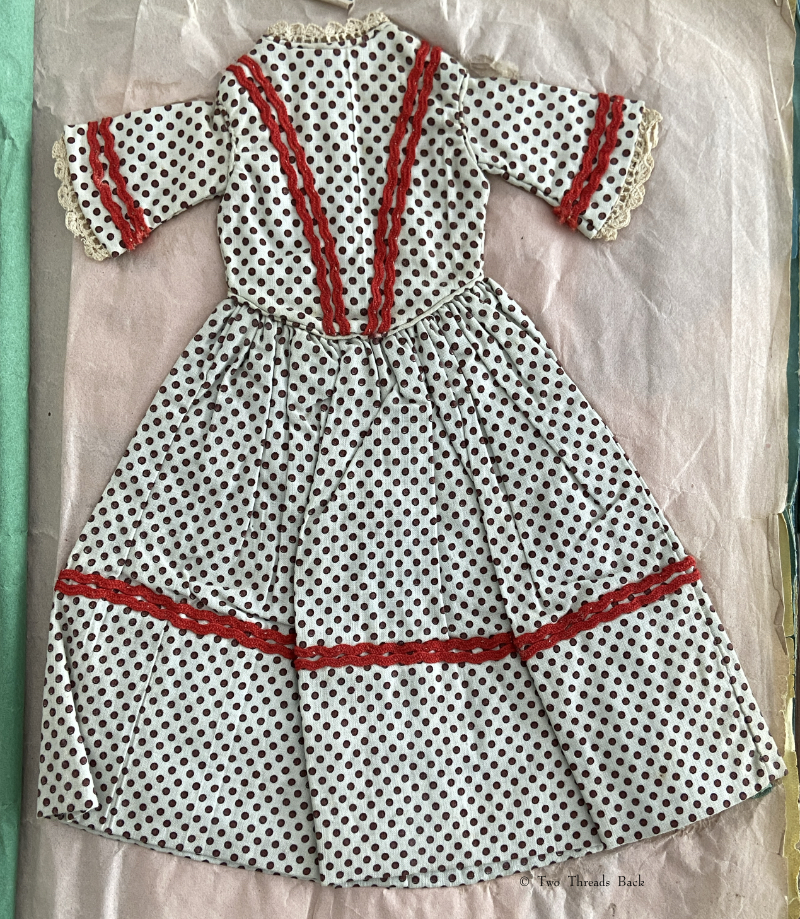
This dress is a simpler style than the sheer one above and it’s made of printed cotton.
Mary sewed this child’s dress with nine tucks in the skirt, gauged gathers, and trim she (probably) made herself.
We can’t forget the MOST important garment in the Plain Sewing repertoire: The Shirt. No course in plain sewing was complete without this accomplishment!
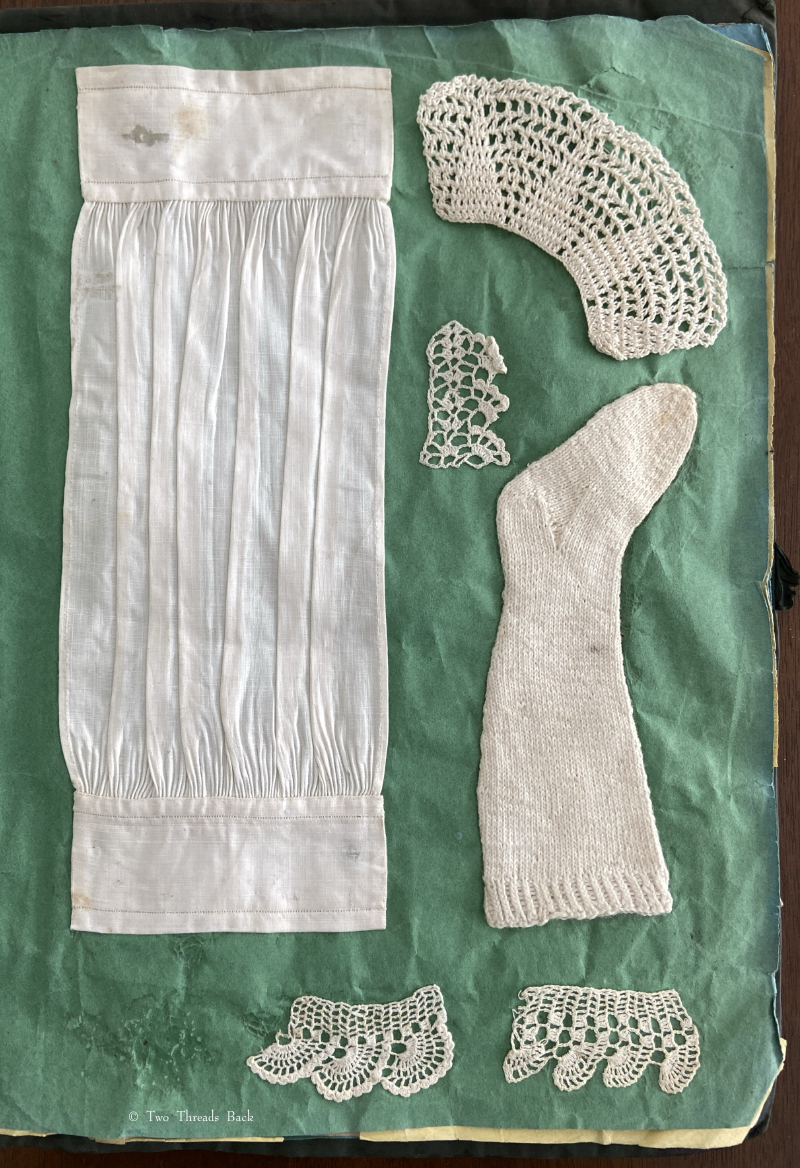
Here’s an example of the practice cuffs or wristbands that would have been worked before she advanced to making the above shirt. Knitting was also an essential needlework skill for women, and most 19th C sample albums included examples. There was a single full-sized stocking tucked into the book also.
Plain and fancy! Mary did all the hemming, seaming, and making buttonholes in her earliest lessons, but she obviously got to learn some fancywork as well. If you get a thrill looking at daguerreotypes of that time (Pinterest is sooo addictive) you might recognize the vandyke collar pattern that was so popular then.
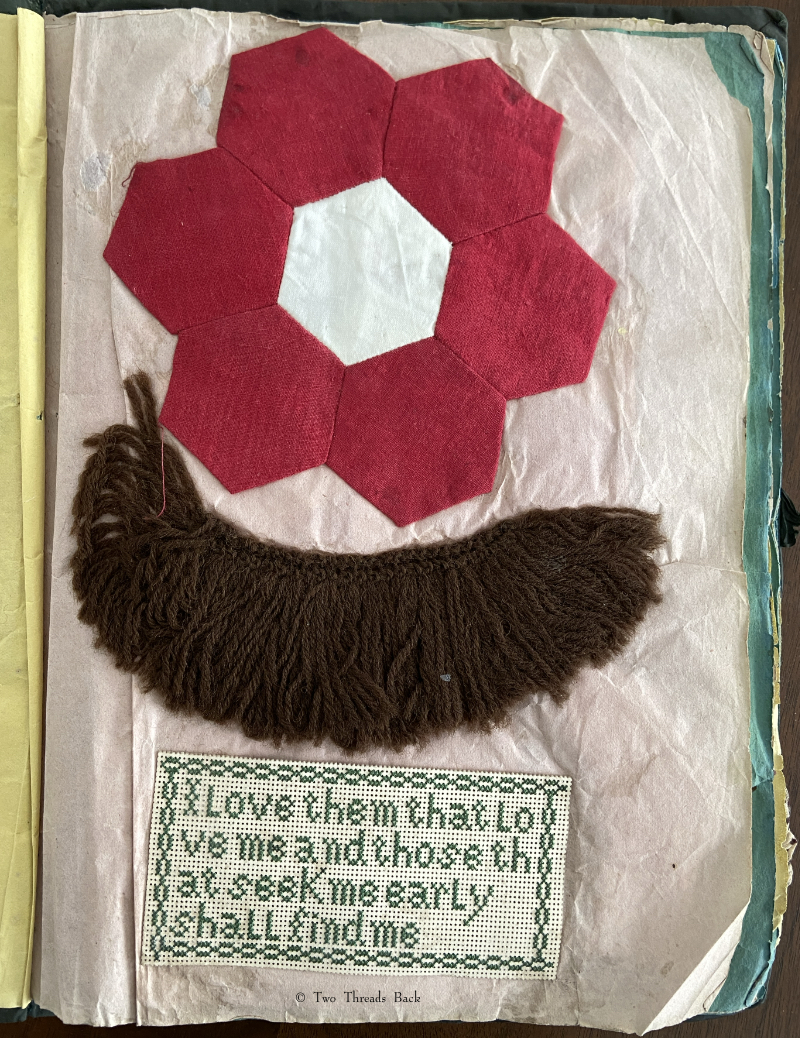
Nope, it’s not a walrus mustache. It’s some pretty (or not!) wool trim, useful for Victorians who didn’t know the meaning of restraint in decor. Mary also made a hexagon quilt patch and worked a scripture verse on punched paper. I don’t understand why 19th C needle workers seem so untroubled by words that run out of roo– m. Why???
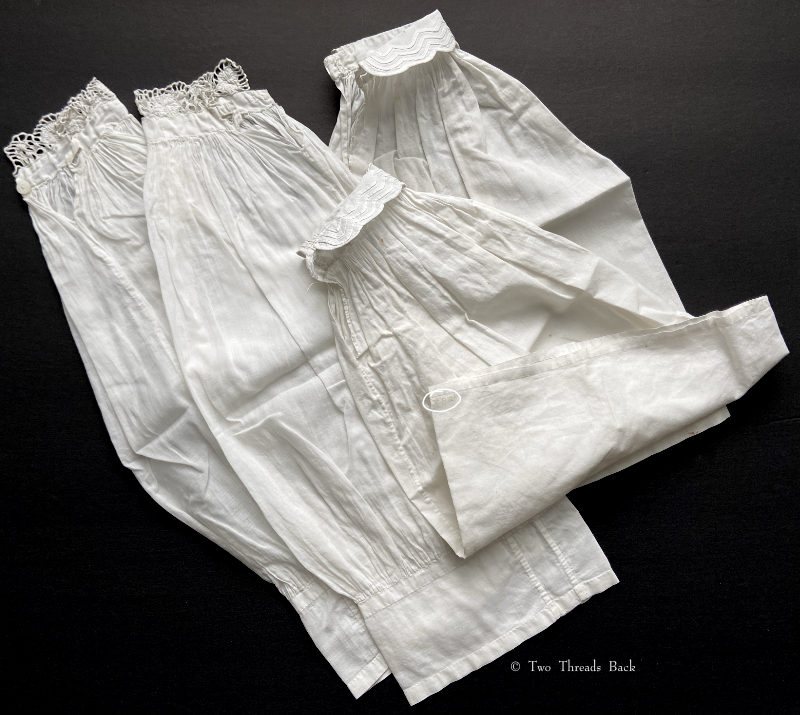
Two pairs of undersleeves were kept with the book. I assume they were Mary’s work because they have her initials marked in cross stitch. I’ve circled them in the photo to show how small they are. The sleeves show wear, so I don’t know if they were part of her sewing instruction or later work that stayed with her album.
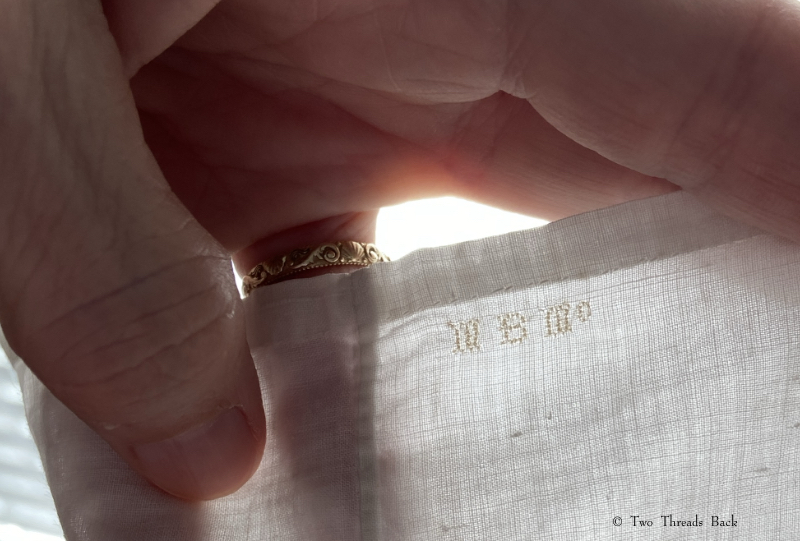
The marked initials are less than 4mm tall. I never cease to be amazed at the tiny stitches they could make. The letters look like M B Mc to me. McQuiston?
I wish I knew more about Mary. How old was she when she learned to sew? Did she have daughters who wanted to take the dresses for their dolls? I would have! Did she use her skills for the rest of her life, or pack them away, back “around 1849”?
Library of Congress, Prints & Photographs Division, FSA/OWI Collection
My dear sister Fannie, As I have just dropped my scissors in the well, have no more sewing cut out, and can conscientiously spare the time, I will write you a few lines. Indeed I would have written you before this, but I have no time at all to do anything for myself. I’m teaching the boys from eight till time for doing my cooking. All of us are quite well, so are all Pa’s folks.
Pa has not settled down steadily to work since Ma’s death. Keeps us uneasy all the time. I have set no hens yet, but intend to raise a lot this year. What luck are you having with your chickens and geese this year?
Can your baby walk yet? Mine is beginning to talk, has eight teeth and four more in sight. He is not much trouble now, only he climbs and can go up the stairs a good deal faster than I can. With much love to yourself, Ben and the children, I am as ever, Yours affectionately, Mollie
1882 Letter to to Fannie Dudley in Florida from her sister in Georgia1
You can’t sew without scissors, right? Seems like a pretty good excuse to me! I haven’t been sewing much lately either, but I’ve managed to entertain a few leisure hours with good books. Here are some I’ve found so interesting that I thought I’d share.
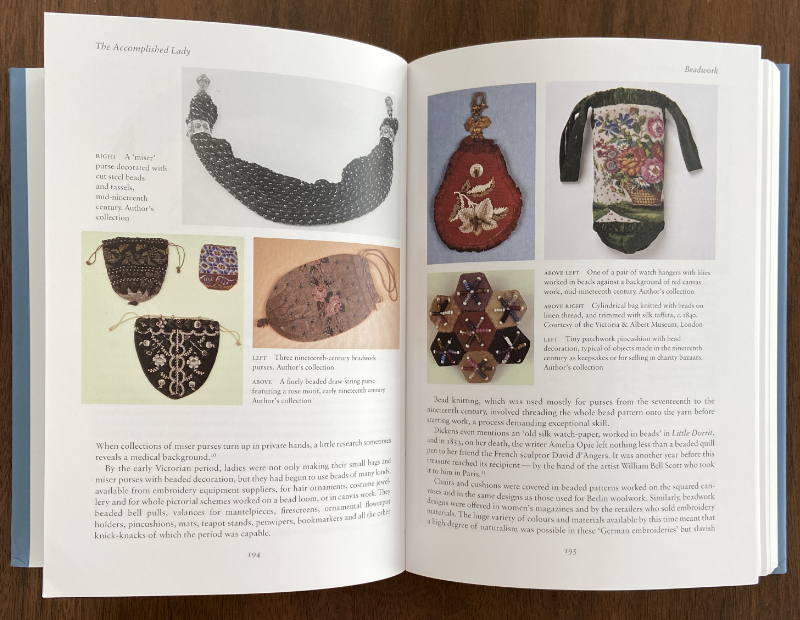
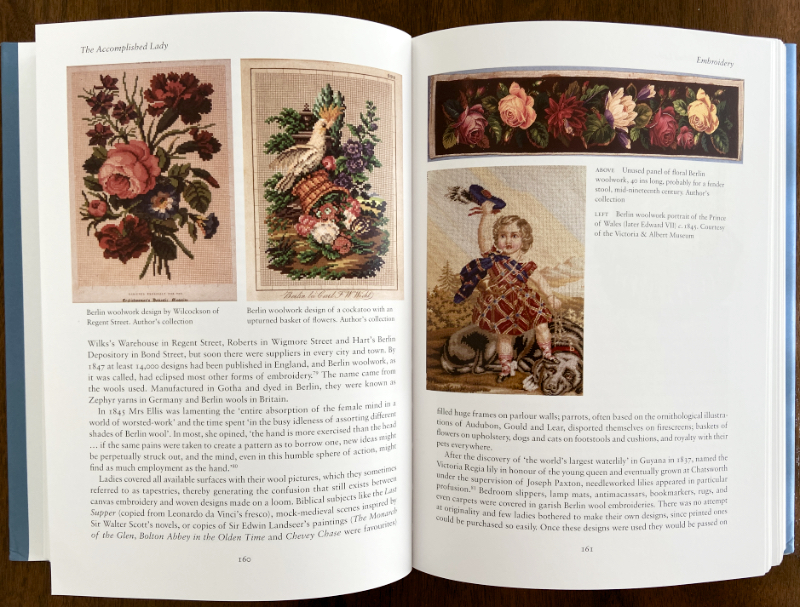
The Accomplished Lady, A History of Genteel Pursuits, c. 1660-1860 by Noël Riley is a guilty pleasure for this plain sewing enthusiast, since it’s far from plain. It’s a fabulous look at the 17th-19th century crafts, hobbies, and amusements that women who could afford leisure pastimes enjoyed. It covers the things you’d expect such as music, dancing, and cards, but I found the chapters on needlework, beadwork, shellwork and other nature crafts especially fascinating. Seaweed pictures, straw work, paper filigree… so many ways to exercise talent and display creativity! There’s even a bit on theorem or “poonah” painting. It’s beautifully illustrated – got to love the eye candy! – but the scholarly research which sets it all in context (without the tedious academese saturating so many similar works today – thank you, Ms. Riley!) makes it a valuable resource. The Accomplished Lady is definitely worth a book search or trip to the library!
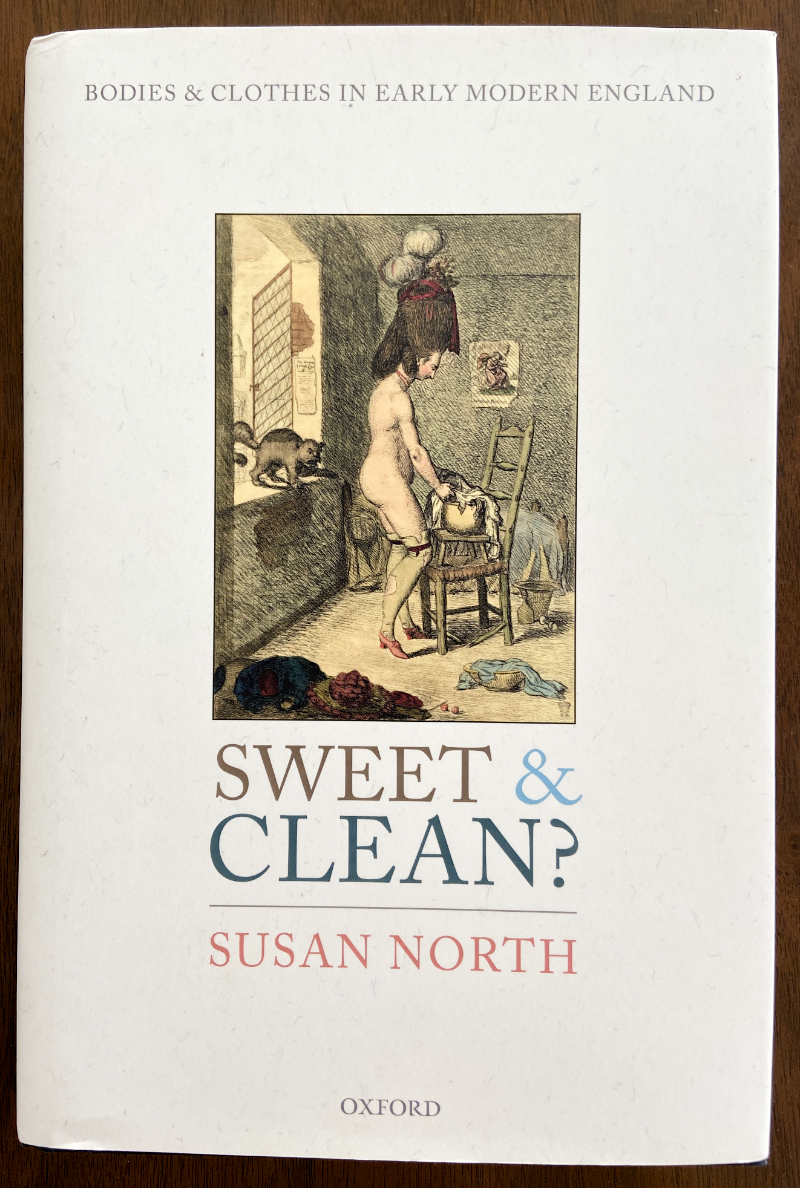
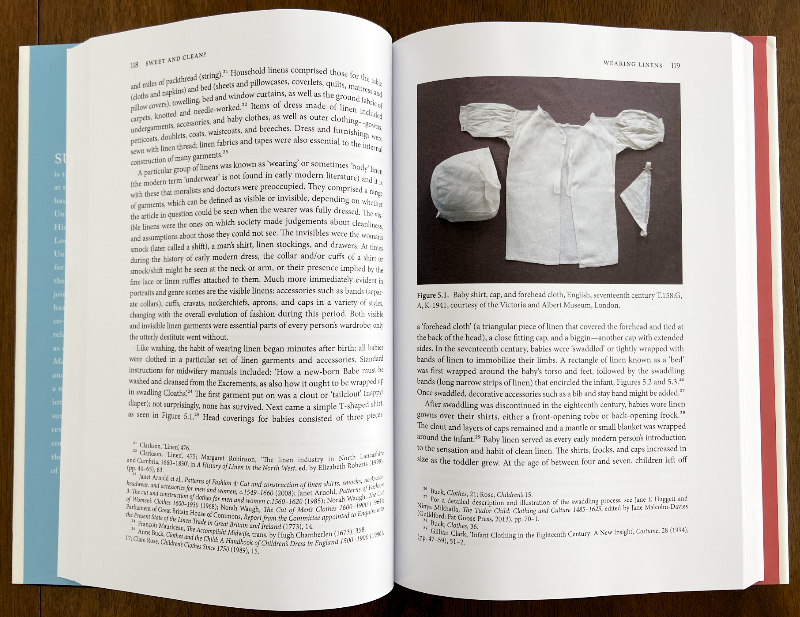
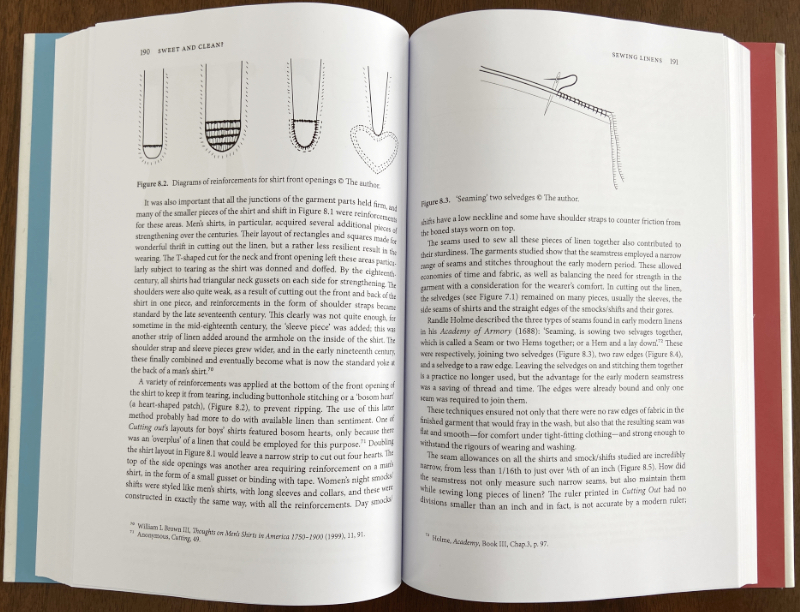
Another happy find is closer to my plain sewing focus. Sweet & Clean?, by Susan North. While the title is the topic, personal cleanliness in early modern England, there is a lot of information on the making, wearing, and washing of underlinen (shirts, shifts, etc.). That, of course, means plain sewing figures prominently!
The exhaustive research on the most private areas of daily life kept me engrossed through every chapter. If you have an interest in clothing, health, and domestic life during those years, you’ll find answers to questions you didn’t even know to ask. Sweet & Clean? might be overwhelming if you like to rush through historic site tours to get to the cafe. But if you’re someone who lingers and wants to explore behind all the closed doors, this one’s for you!
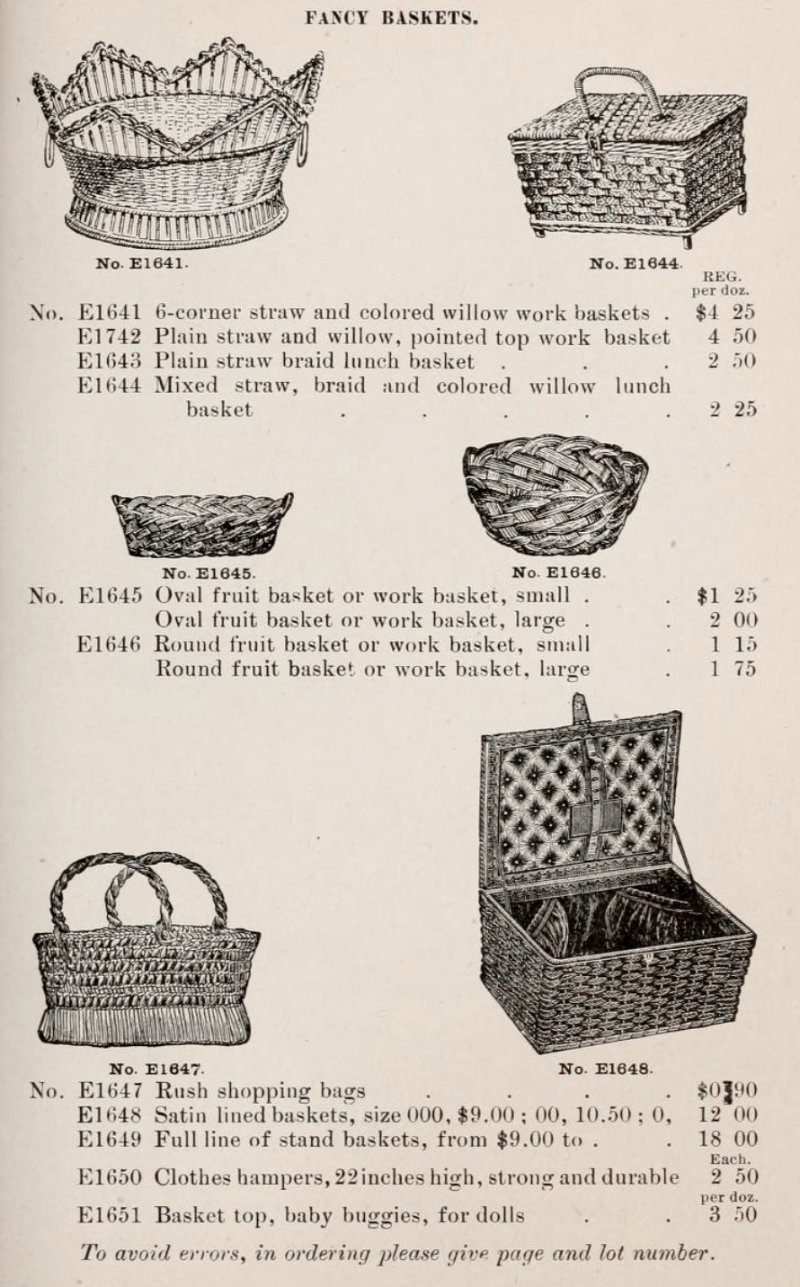
Not all my reading is print – books that are available online can be just as entertaining. Old catalogs are lots of fun to browse, and I’ve found that sewing time can dwindle because of them. Mollie’s lost scissors may have been much like these. Which, no surprise, actually look a lot like those in my sewing basket now. The image below is from Carson, Pirie, Scott & Co. Wholesale Drygoods Catalog, 1893. Have a look, it’s like shopping the past.
1893 wholesale catalog. Note the prices per dozen!
I have one like E1646 – and it’s not antique, just old!
Maybe when you can “conscientiously spare the time,” you will have as much fun reading as sewing. And if you have any good books to share, please do! It may be a while before I retrieve my scissors from the well.
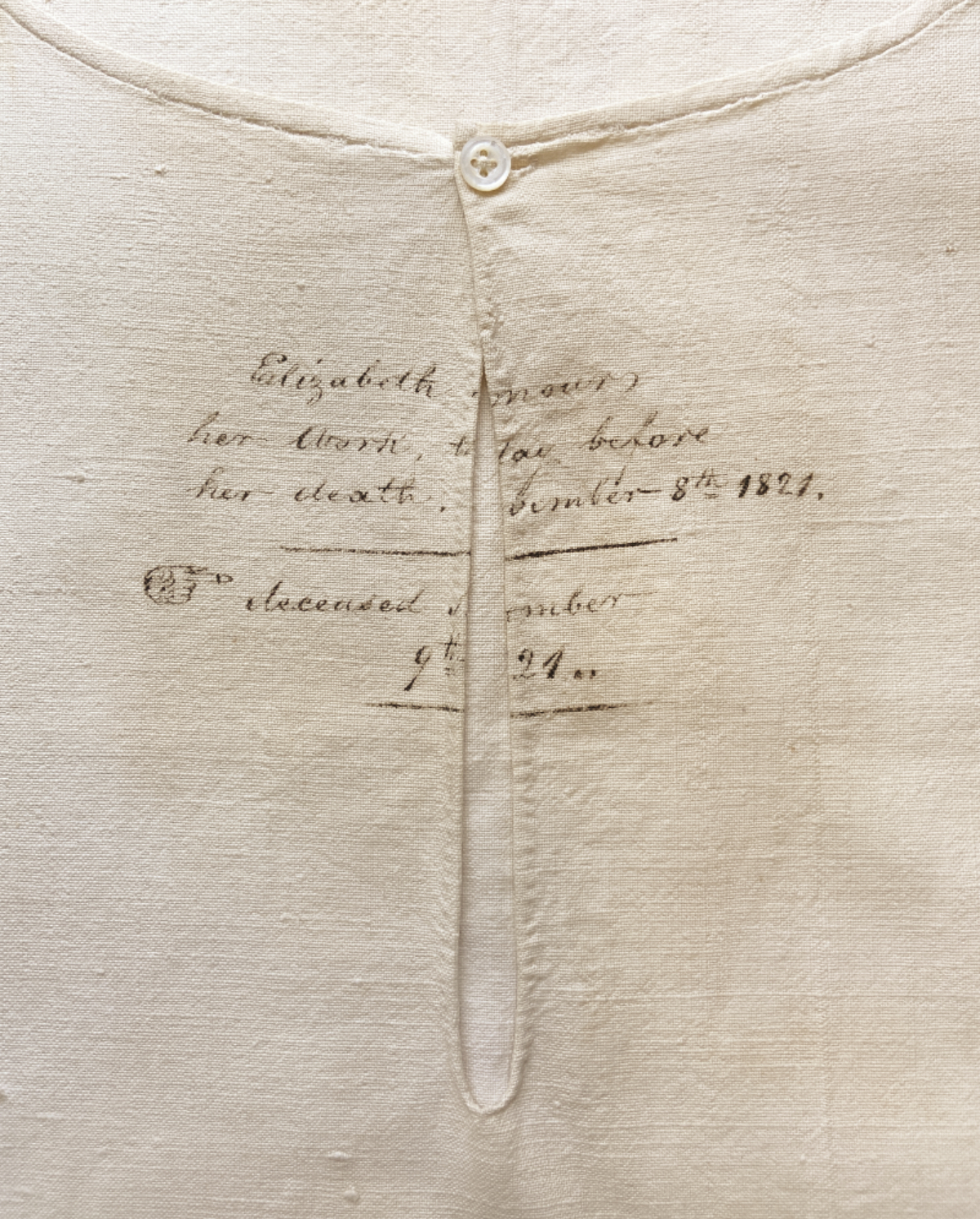
Elizabeth Armour, her work, the day before her death. November 8th, 1821. deceased November 9th, 1821.
Most of the time we never know who wore the antique clothing that we preserve and study, much less who made it and when. So it’s thrilling to find a piece with a story that connects us to a life lived long ago. Her name makes her real.
Shifts and chemises follow closely behind men’s shirts as prime examples of plain sewing. This rare linen shift has its provenance inscribed in ink across the heart. Not only does it give the name of the maker, Elizabeth Armour, but it tells when she made it, November 8, 1821, and when she died – the next day.
Occasionally notes are found attached to clothing, usually intended for family members to pass down, or perhaps when donated to museums. But I’d never seen one quite like this! How could I help but try to find out more about Elizabeth?
Elizabeth Armour’s plain shift, still in excellent condition.
Thanks to the wealth of genealogical data available online now, it was easy to search for a woman with that name and date of death. What a thrill to find her! Of course, I can’t be positive it’s the same person, but the odds seem pretty good.
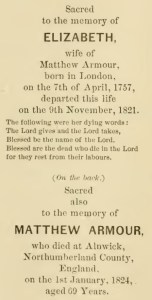
Transcript of Elizabeth’s gravestone.
Elizabeth, wife of Matthew Armour, was born in London on April 7, 1757, and died on November 9th, 1821 in Philadelphia. She was buried there in Christ Church and St. Peter’s Churchyard on November 11, 1821. Her name was entered in the register of burials as “Eliza. Armor.” I don’t know whether the gravestone still exists, but at least a record of it does:
The following were her dying words: The Lord gives and the Lord takes, Blessed be the name of the Lord. Blessed are the dead who die in the Lord for they rest from their labours.
Who was Elizabeth and what was her life like? I found traces. Elizabeth Nesbet married Matthew Armour in the City of London at the church of St. Andrew Holborn on July 2, 1780. She next appeared as the mother of Susannah Nesbitt Armour who was christened at Christ Church and St. Peter’s in Philadelphia on July 3, 1785.
Wait, Philadelphia? 1785? It bargles (as my daughter used to say) the mind! More American history than I can even begin to explore. I suppose there are so many books, essays, and dissertations written on that place and time that they would collectively collapse my little local library. Even the church the Armours attended has a past so rich it makes me dizzy. Benjamin Franklin, George Washington, Betsy Ross, and many of the signers of the Declaration of Independence attended, all during the years the Armours were worshiping there as well.
In 1788, son William was born. Matthew appears on various records during those years as a house carpenter. If there were other children besides Susan and William, I didn’t find a record of them. We know the hazards of illness and accidents in those days, but in 1793 a yellow fever epidemic (here’s a compelling read) struck Philadelphia killing 5,000 of the 45,000 residents, and caused another 17,000 to abandon the city. It struck again in 1797, ’98, and ’99. Did it touch the Armours or their kin? I doubt I’ll ever know.
Matthew continues to appear in the early 1800s on tax, census, or manifest records (he made trips to England) as a carpenter. The family moved several times within the city through the years, and siblings Susan (as she was known) and William apparently never married, but kept house together and owned a dry goods store. In an 1811 affadavit sworn as a super cargo, William (at age 22) states he was 5’9″, fair complexion, blue eyes, with 3 scars on his left forefinger! There’s something eerie about knowing 200-year-old personal details like that. But perhaps no more than slipping my hand in the sleeve of Elizabeth’s chemise?
Elizabeth may have been ailing by 1821, since the cause of death was “dropsy.” We know what she was doing in the days before her death because of the inscription on her shift. More poignantly, we know how much her handwork meant to someone, probably her daughter Susan. I understand how that feels; I have handmade treasures from my late parents that move me to tears when I hold them.
Philadelphia, Nov. 9th, 1821 Died this day of Dropsy Elizabeth Armour aged 64 years.
Matthew returned to England sometime after Elizabeth’s death, where he died at Alnwick on January 1, 1824, aged 69. In 1830, Susan and William’s cousin, Martha Cheesman (b.1818), came from England to live with them in Philadelphia. William died in 1851, and Susan in 1857. She left an estate of $15,000 with bequests to Christ Church Hospital, the Northern Home for Friendless Children, her nieces, and the remainder to her “cousin Martha Cheeseman.” That was a lot of money for the time. It seems that the dry goods business was very profitable! I was getting a little lost and weary of genealogical research at this point, so I let the trail end with cousin Martha’s death in 1906. Perhaps the shift had been left in her care?
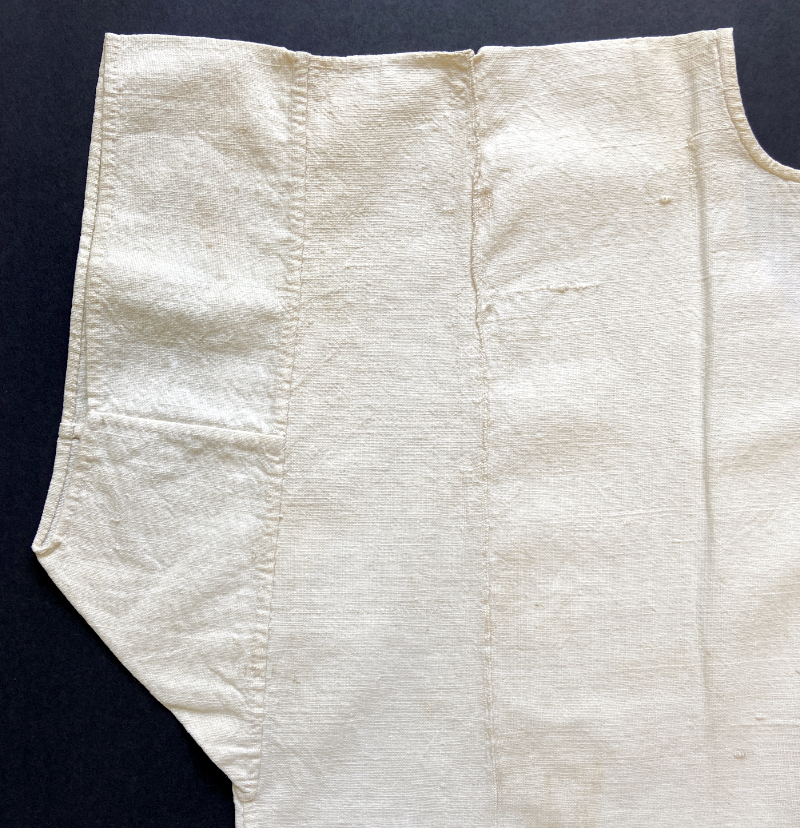
The shift is very simple. The linen is homespun and sewn with linen thread. The economic impact of the War of 1812 and then the Panic of 1819 meant times were still hard, so perhaps homespun was a necessity. The stitching is neat and even, but not particularly fine. The fabric was of insufficient width and so another piece was seamed to it to make the full width of the body, and then folded at the shoulder.
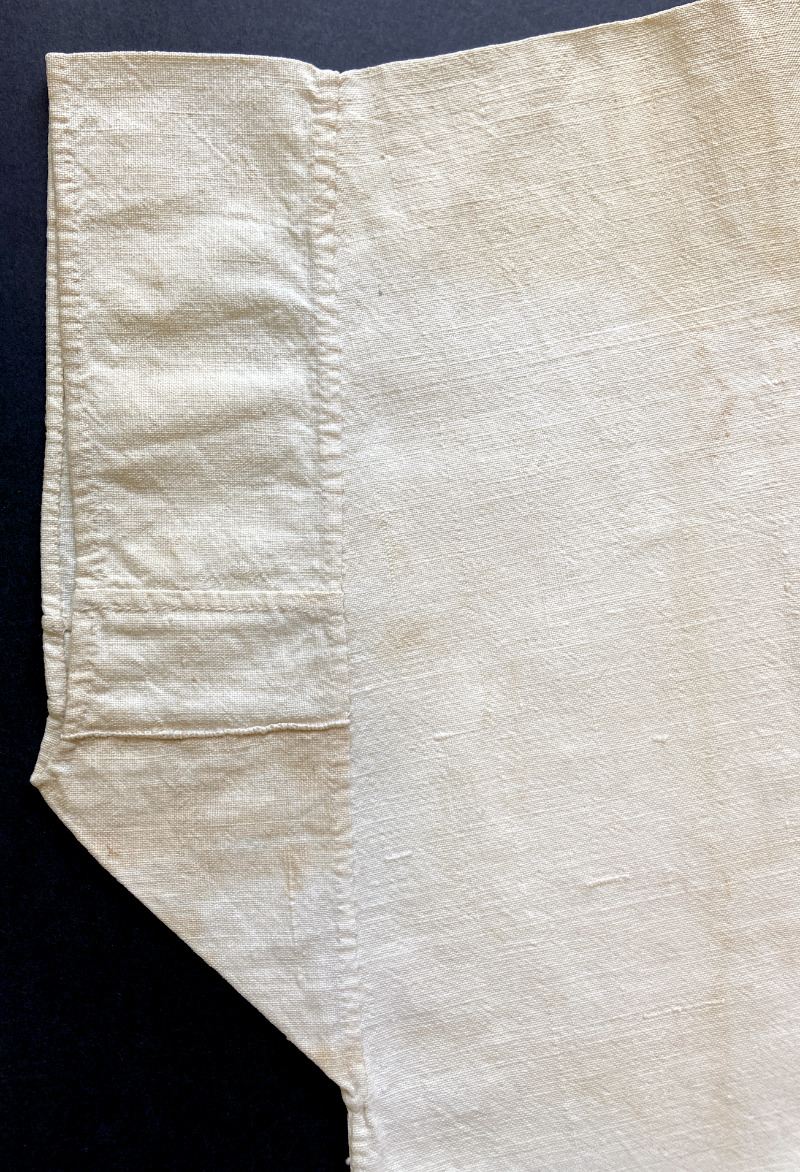
Left sleeve viewed from the back. You can also see the seamed join where fabric was added to a selvedge to make it wide enough.
The sleeves are short, and the right one is pieced. There are gussets under the arms with a small curve at the bottom. It angles slightly wider toward the hem, but has no gores. The seamed join was sewn from the outside, and because the materials were a bit coarse and the stitches a bit deep, it makes a slight ridge. I can see why it’s positioned on the outside, since it would be rather uncomfortable against the body. The inscription was made before the slit was cut for the opening, because the writing is folded under where it’s hemmed. I don’t know if Elizabeth made the shift for herself, her daughter, or a servant, but it could be considered a “comfortable” size more than a petite one.
The right sleeve is pieced, using every scrap of fabric. The left one is whole.
A view of the narrow hem and join. You can see how she “seamed” (narrow overcasting) with wrong sides together. It should make a flat, nearly invisible seam, but the linen and thread are coarse and she took the stitches rather deep.
Elizabeth Armour, maker of the shift, lived from 1757 until 1821 in England and America, through the years of the founding of the United States in a city where the most radical historical events were occurring. And what serendipity! She was there when JOSEPH LANCASTER was living (briefly) in Philadelphia! She learned plain sewing in 18th century England, and was able to make a thrifty shift of homespun linen using a minimum of fabric, in the “old” fashion – just as styles were about to change from “shifts to chemises.”
The majority plain needlework I’ve seen (or drooled over) through the years, whether manuals, samplers, or items of clothing, has been from England, and the rest from here in the U.S. It’s truly remarkable to find “threads” from England, America, world-changing history, endearing family sentiment, Joseph Lancaster, and plain needlework all sewn together with a story in this shift. I’m awed.
A few days ago, my husband and I went for a drive in the mountains of North Carolina to visit a very special lady. She’s a master wood carver with an international reputation and a long-time instructor at the John C. Campbell Folk School. At age 11, she learned wood carving from her mother, as well as other famous folk artists.
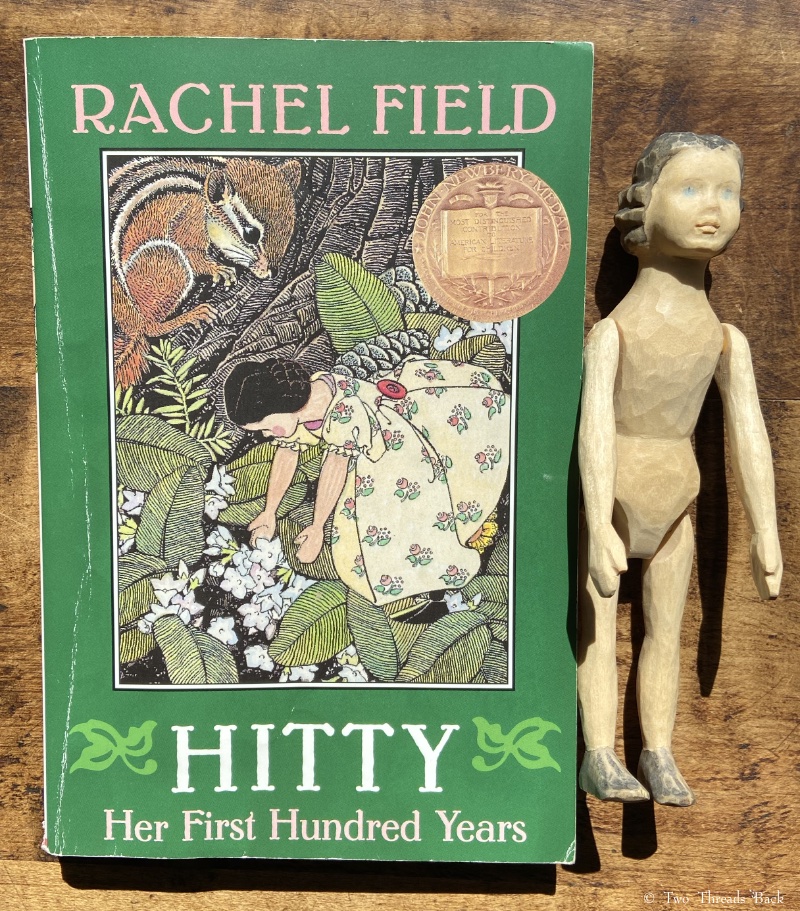
We met several years ago, and I was excited to learn that she had also carved dolls – Hitty dolls – although she wasn’t doing them any more. She promised to let me know me if she ever did, so I was thrilled (maybe you could call it the happy version of a hissy fit!) when she called to say that while clearing out her workshop she’d found a couple, one was the first one she ever carved – and was I interested? Was I? What a question!
Two pretty dolls in the hands of their maker!
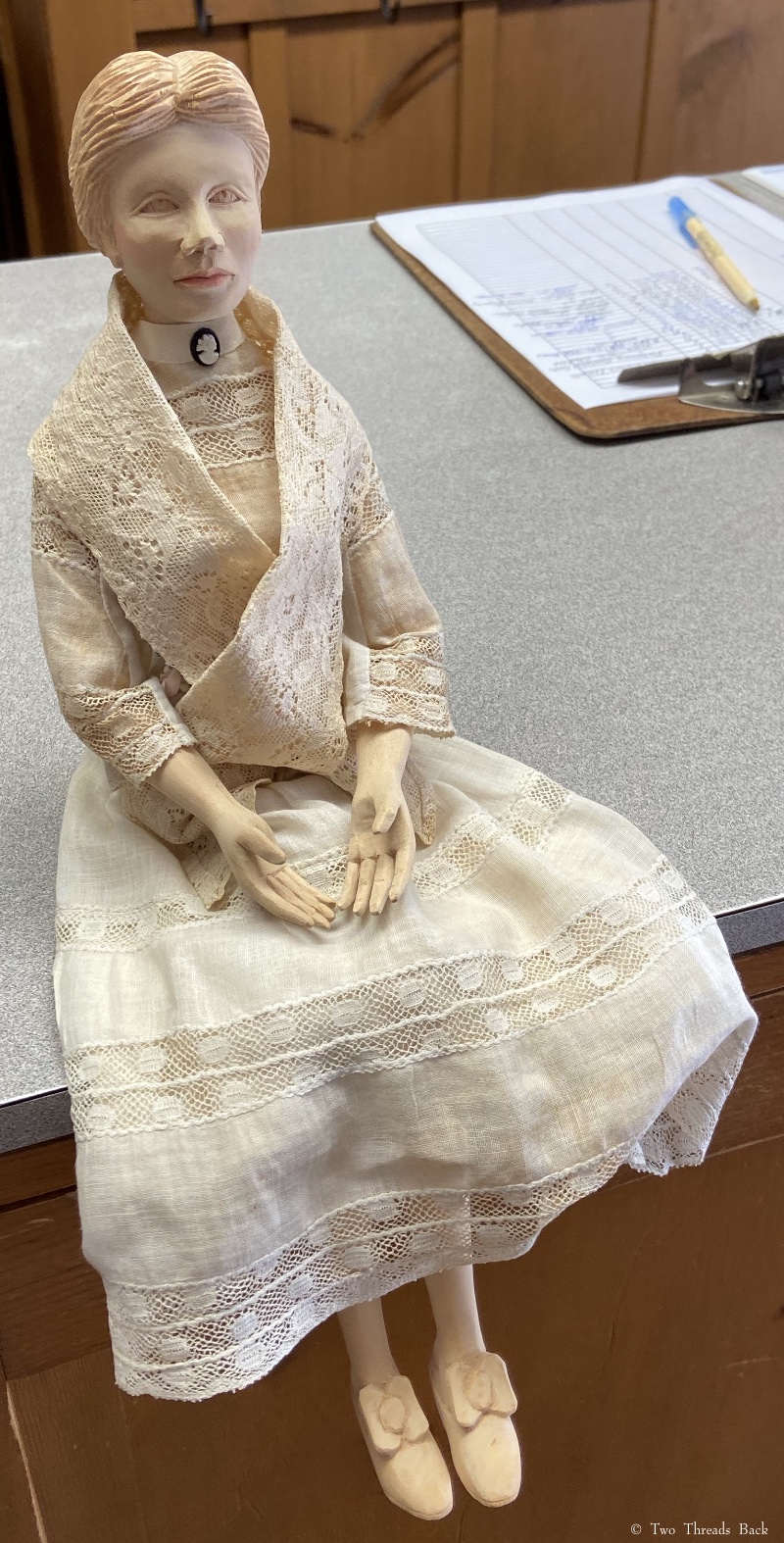
The original doll was only lightly sanded and faintly painted with color, while her later work was more detailed and finished. But it was the first one that stole my heart. So Mehitabel has come home with me and is awaiting her wardrobe. It was delightful to visit and see the artist’s workshop and other examples of her carving. Sadly, she suffered a stroke earlier this year, so she’s not doing as much now. I did have the pleasure of seeing one especially stunning doll (it’s for sale! contact me for her info if you’re interested) which I’ve posted below.
Truly a work of art!
And here’s a glimpse of the beautiful work on a similar one waiting to be dressed.
And one last peek at a project that really took my breath away –
I’m so excited to have a new doll to dress. It’s not easy for me to sew tiny things, so I’ll have to take care that it’s one my Hitty fits!
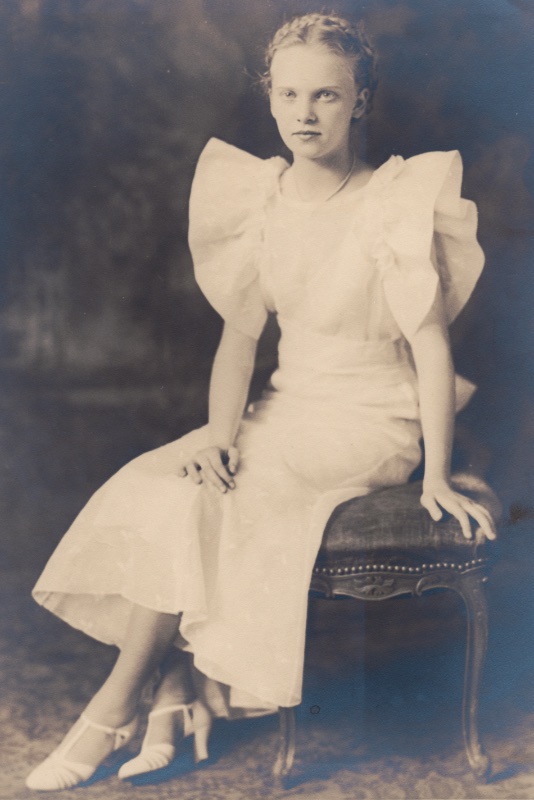
Anna’s graduation photograph, 1934. Isn’t she lovely?
It’s a delight to follow the evolution of hand sewing instruction from its earliest days up to more modern times – at least if you consider the 1930s modern!
Thanks to a friend who wanted to share her mother’s dress, I’ve had another chance to peek into a Domestic Economy class, this time in Brooklyn, New York, in 1934. The teacher was Miss Gimbel, and she must have been a wonderful sewing teacher – she was certainly very good at understanding what kind of project would please a girl of 13. Fluffy ruffles in dainty white, in a lesson she could wear to her graduation!
The dress needed a little TLC before it could show off. Although in excellent condition for its age, a bath was in order.
A good soak works wonders.
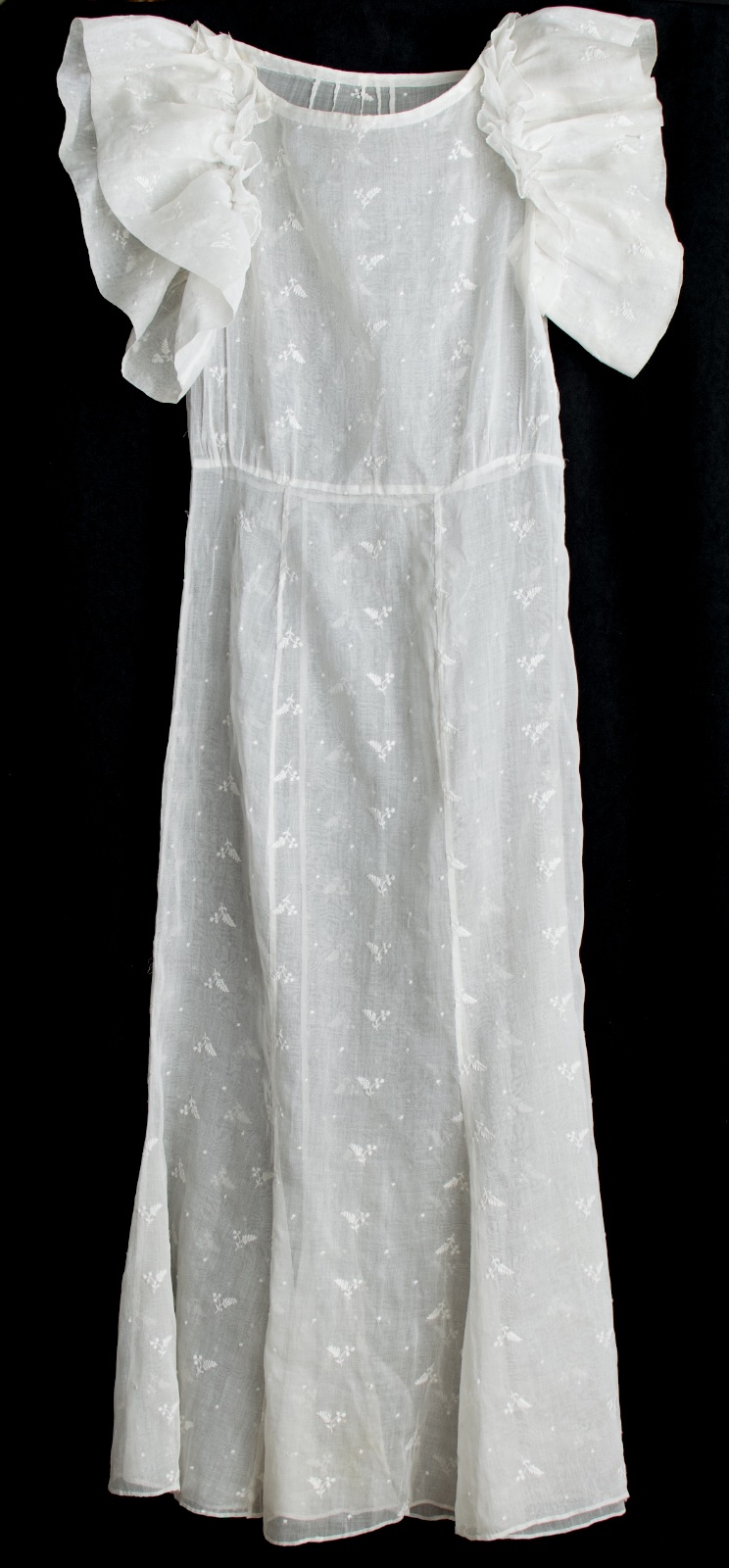
I’ve laundered a lot of cotton and linen over the years, and was hopeful that Anna’s dress could be restored. It was made of embroidered organdy and (of course) had been starched. Starch does not age well, in case you haven’t noticed! But a few days of soaking and a lot of water changes, and the frilly frock was refreshed.
Restored to glory!
Once again I was surprised to see how simple it could be to sew a garment by hand. I’m so accustomed to modern clothing with all the double-stitched and felled seams, finished inside and out, that anything else is startling. I’ve got sportswear so heavily reinforced that the stitches could stand alone if all the fabric were to melt away!
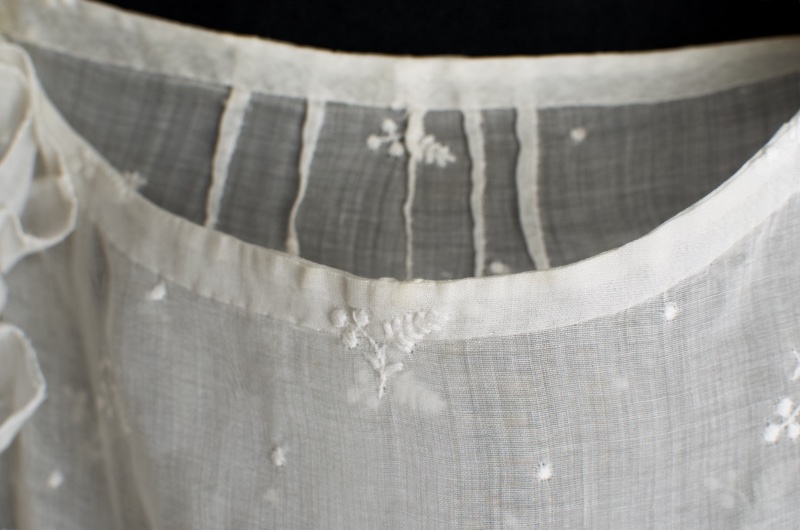
But not here. Anna used very simple basting, running, hemming, and gathering on plain and French seams. The ruffle edge was overcast.
You can see the neatly turned hem, and where she took greater pains with the collar binding than the much longer narrow hem, which I’ve folded up to show.
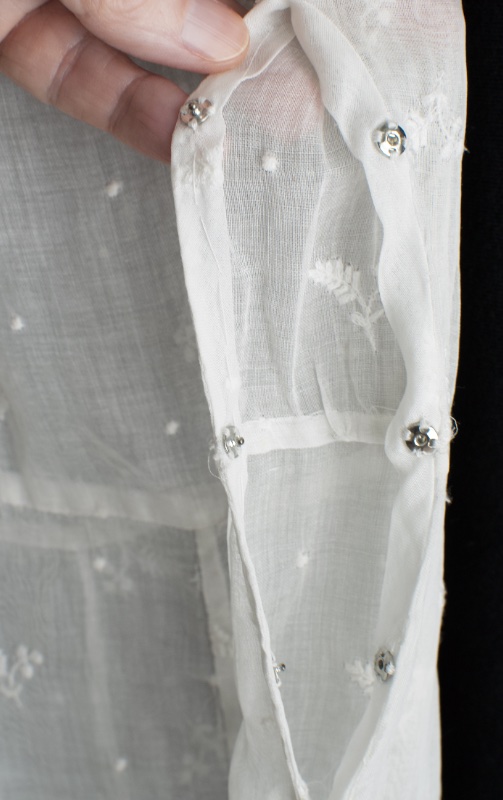
The armholes have a self-fabric binding, and the dress closes on one side with snaps. The basting thread is still present, perhaps serving to hold the placket in place.
Weekly sewing lessons from the first through the eighth grade were part of a public school education for Anna. Her work was neat and elegant, a skill to be proud of. I think she learned well and wore her reward for a very special occasion!
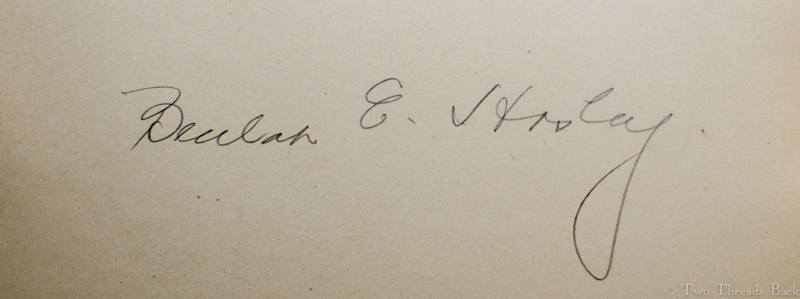
Beulah Hosley did indeed land a job as a sewing instructor – for $30 a month! Her date of assignment was June 17, 1912. But she resigned three days later. What happened to Miss Hosley and why am I curious?
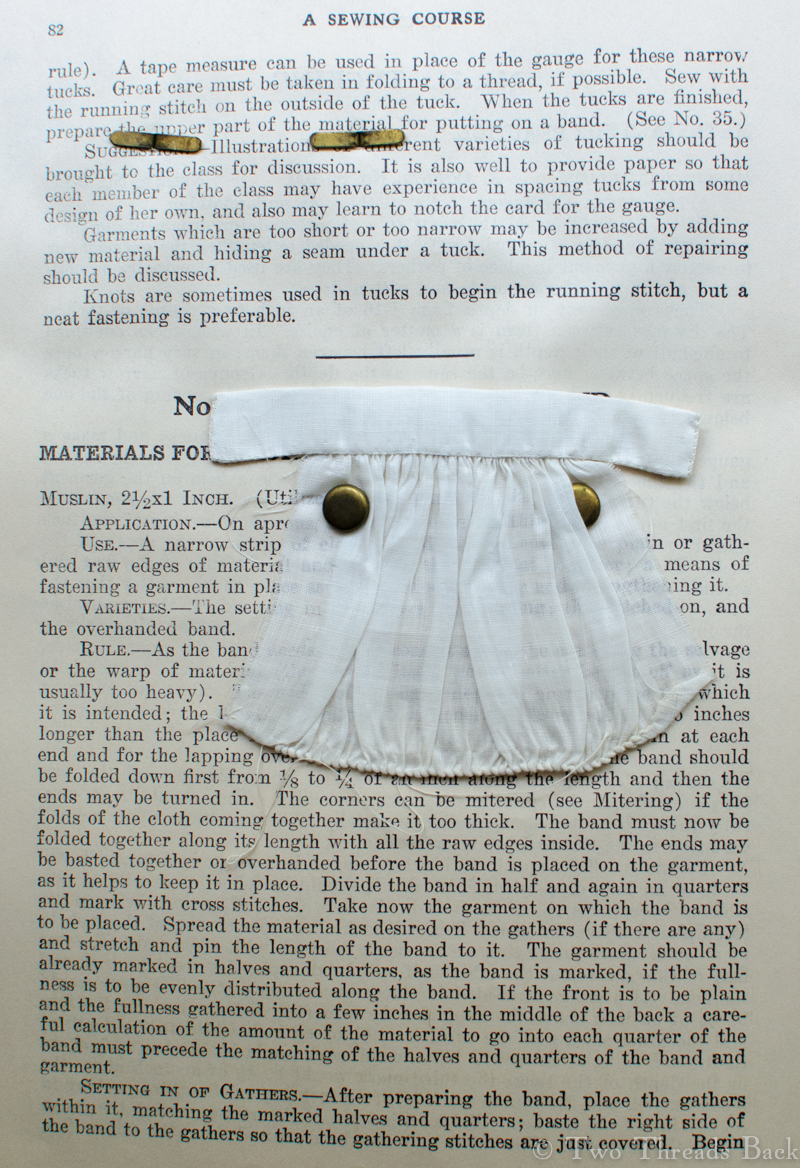
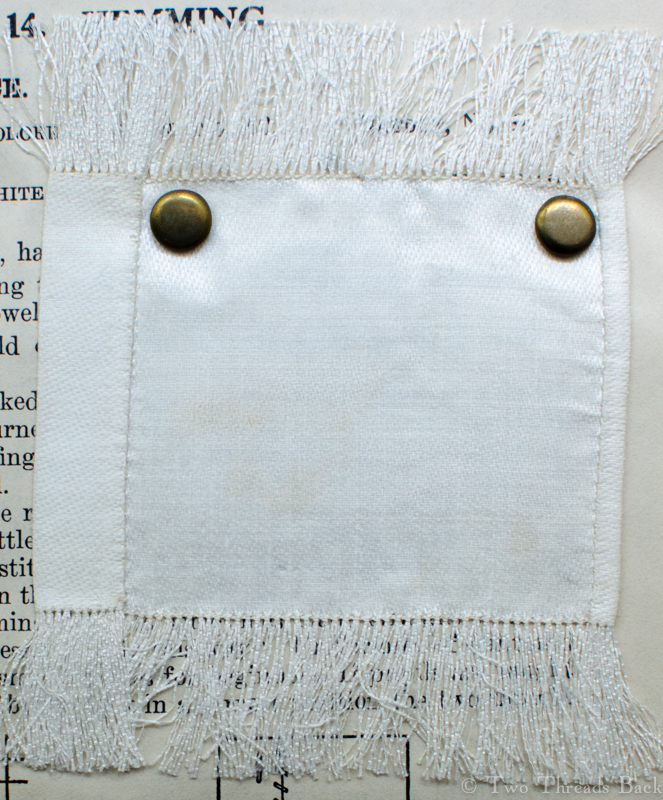
It’s because I found her name inside the cover of a sewing manual from 1911. The textbook is a neat little edition, with all her samples carefully worked and attached to the pages. Most versions of this book that I’ve come across are larger with more samples, but it appears that Beulah learned all that was necessary to become a sewing teacher.
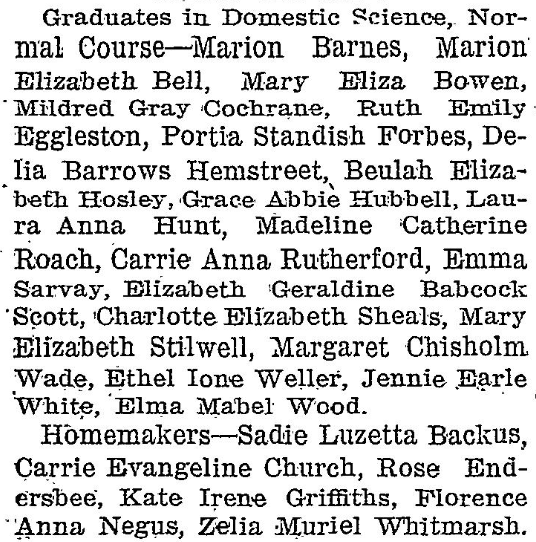
She was, if not exactly ahead of her time, at least up with the times. At age 21, her graduation in Domestic Science from the State School of Agriculture in Canton, New York qualified her to teach or to … keep house very nicely!
“The fourth annual commencement exercises of the State School of Agriculture were held at the opera house yesterday afternoon, and proved intensely interesting. The State School of Agriculture and the Domestic Science department are advancing by leaps and bounds, and the entering class is expected to largely exceed any prior one.” – The Ogdensburg Journal, June 12, 1912.
Don’t you love their names? It’s easy to date the popular ones. But I do wonder about the difference between “Domestic Science” credentials and “Homemakers.”
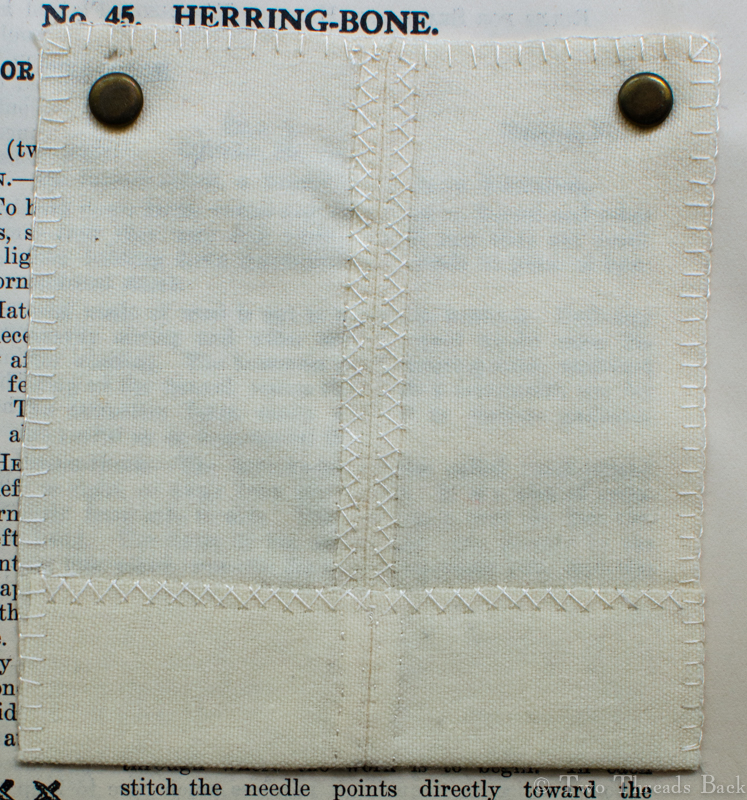
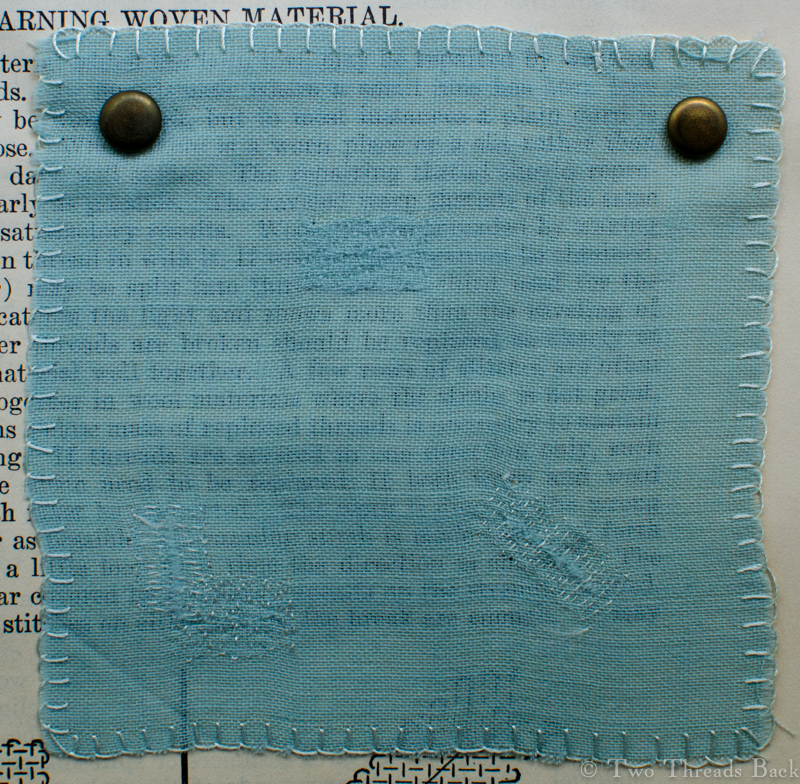
Beulah Hosley learned how to hem, tuck, herring-bone, darn, mend, gather, and do all the other stitches required for handwork. I would guess that she also learned to use a machine and perhaps some basic garment cutting, but I didn’t find any further information on those classes.
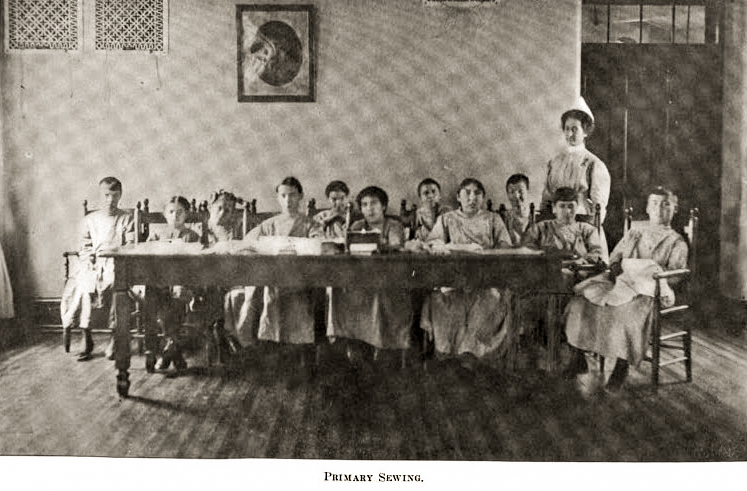
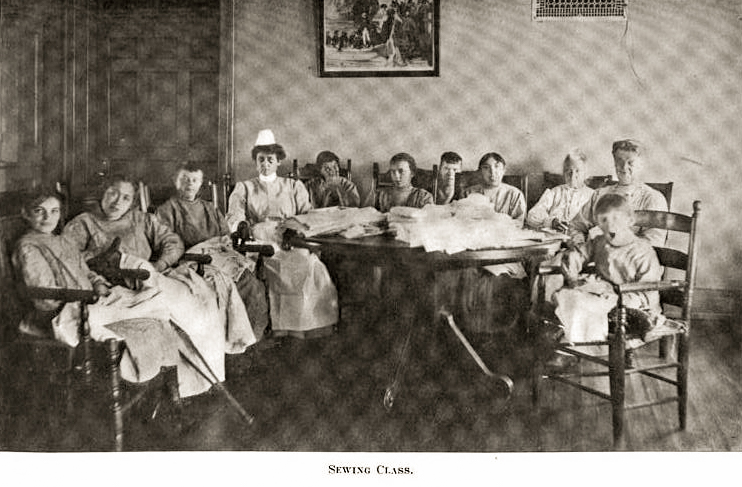
But why so short a tenure at her first job? Homesickness? It was far from her home in St. Lawrence County. Or perhaps it was where she was teaching: the Rome State Custodial Asylum in Oneida County New York. The name conjures Dickensian images of miserable people living in wretched conditions. But when I read more about the early years of the home, I realized that Charles Dickens and Nellie Bly had prejudiced me somewhat. Somewhat.
The institution was founded in 1827 as the Oneida County Poorhouse, and it remained in existence until 1989. As I scanned circa 1910 reports from the Board of Managers, it was evident that much care and effort went into the enormous task of providing for and educating the people who lived there.
They had a dairy, a hennery, a piggery; an orchestra, a baseball team, a choir; a menagerie, fairs, and concerts. Everything was recorded and reported, from the number of cases of tuberculosis to pink eye to syphilis, as well as how many quarts of blackberries and currants were consumed. And of course, sewing classes! Still, to read the reports is to glimpse the struggles, the suffering, and the shame found even in an “enlightened” institution in the early 1900s.
But back to Beulah’s story. I haven’t learned why she didn’t stay there, nor whether she found another teaching job. I do know that she went on to live a comfortable life; she married a couple of years later and had children. Her name appeared in the college alumni publications for many decades after. Did she use her sewing skills at home? Quite possibly. She certainly left a lovely record of the skills she acquired, beautifully preserved for our admiration!



















 Two Threads Back