Paper Flowers

Paper Flowers 1
Mrs. Delany & Her Circle, edited by Mark Laird and Alicia Weisberg-Roberts.

How have I missed this for so long? It’s been reviewed elsewhere – when it was new – but I just can’t resist sharing, even belatedly, whenever I find a gorgeous book.

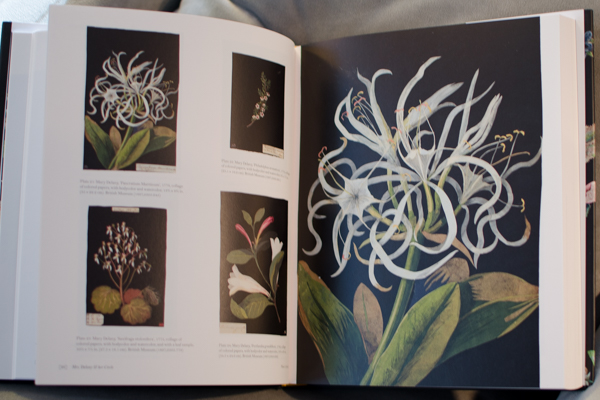
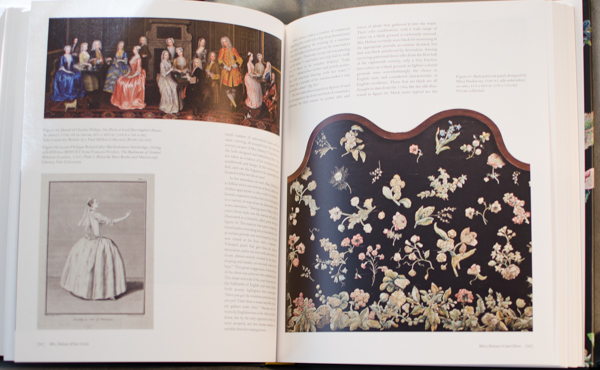
Published in 2009 to accompany an exhibition at the Yale Center for British Art, it was my Christmas present last month and all I want to do is rave about how brilliant, beautiful, and beguiling Mrs. Delaney & Her Circle is. And not just the book, I think Mrs. Delany herself must have been an astonishing woman.

She can’t be considered a polymath, or even an opsimath (don’t you love that one?), but in an 18th century upper-class lady’s world of art, learning, and taste, it seems like she dabbled in it all – at least, all my favorites! From craftwork to costume, needlework to natural philosophy, her interests included everything beautiful.

The image on the front cover and first words of the jacket blurb were enough to get my attention. “At the age of seventy-two, Mary Delany, née Mary Granville (1700-1788), embarked upon a series of nearly a thousand botanical collages” – what, she only started her paper flowers at that age? I can still hope?

Paper Flowers 3Indeed, the book is packed with illustrations of her stunning “mosaicks” of botanical beauty. There is a wealth of information on her floral collages. From an experiment in reproducing them, to an explanation of period paper-making techniques, the text answers all questions that come to mind.

But that’s not all. She had many more interests which are covered in detail in the 12 essays, all written by experts in their fields. She was a member of the Bluestocking circle and lived a rich life in a fascinating era, counting as friends some of the most notable figures in art, science, society.

Paper FLowers 4Oh, did I mention The Dress? Mary Delany lavished her black satin court dress with the most exquisite, scrumptious, dazzlingly beautiful floral embroidery I’ve ever seen. There’s a whole essay devoted to it. Other illustrations include workboxes, tools, patterns, fashion plates, cartoons, etchings, prints, shells and shell art…. In all, enough to keep me fascinated for a long time.

The bad news is that the book is out of print. The good news is that the museum bookstore has (or had before Christmas) copies in stock. Whether you find it in a library, or track down this treasure for your own, I think you’ll fall in love. Opsimathematically, I did!

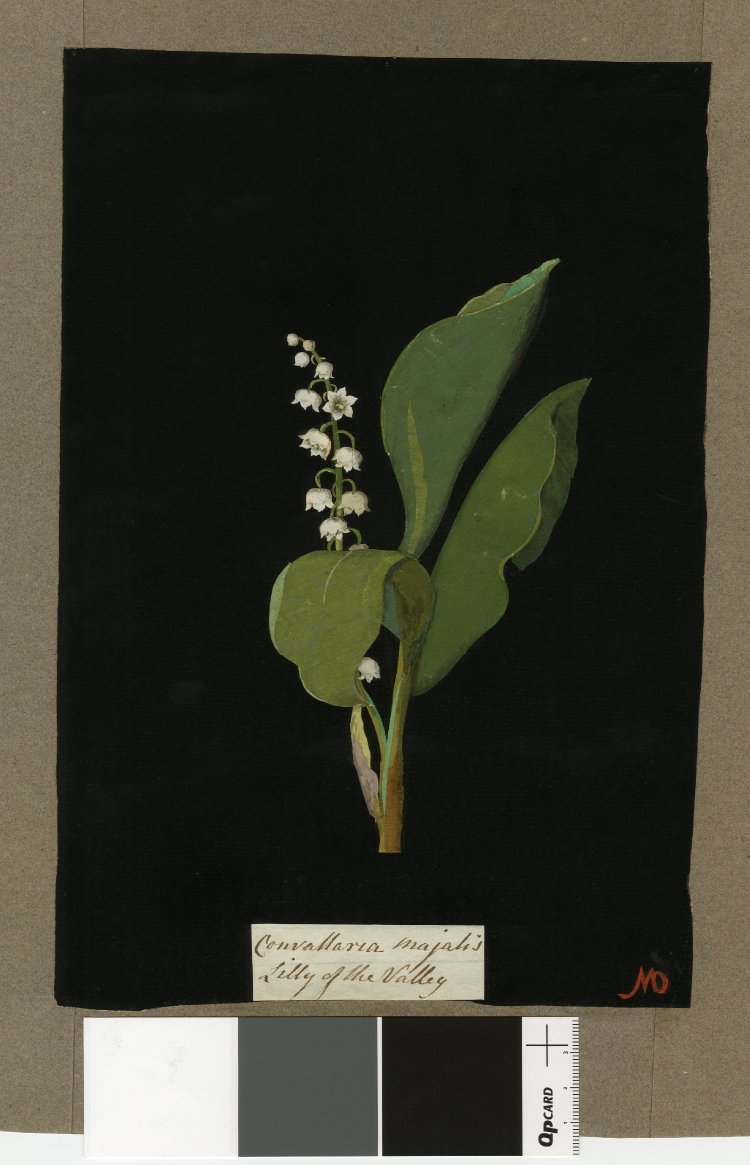
"Convallaria Majalis (Hexandria Monogynia), from an album (Vol.III, 23); Lilly of the Valley. 1776 Collage of coloured papers, with bodycolour and watercolour, on black ink background," British Museum, 1897,0505.224
“Convallaria Majalis (Hexandria Monogynia), from an album (Vol.III, 23); Lilly of the Valley. 1776 Collage of coloured papers, with bodycolour and watercolour, on black ink background,” 1776,  ©Trustees of the British Museum, 1897,0505.224


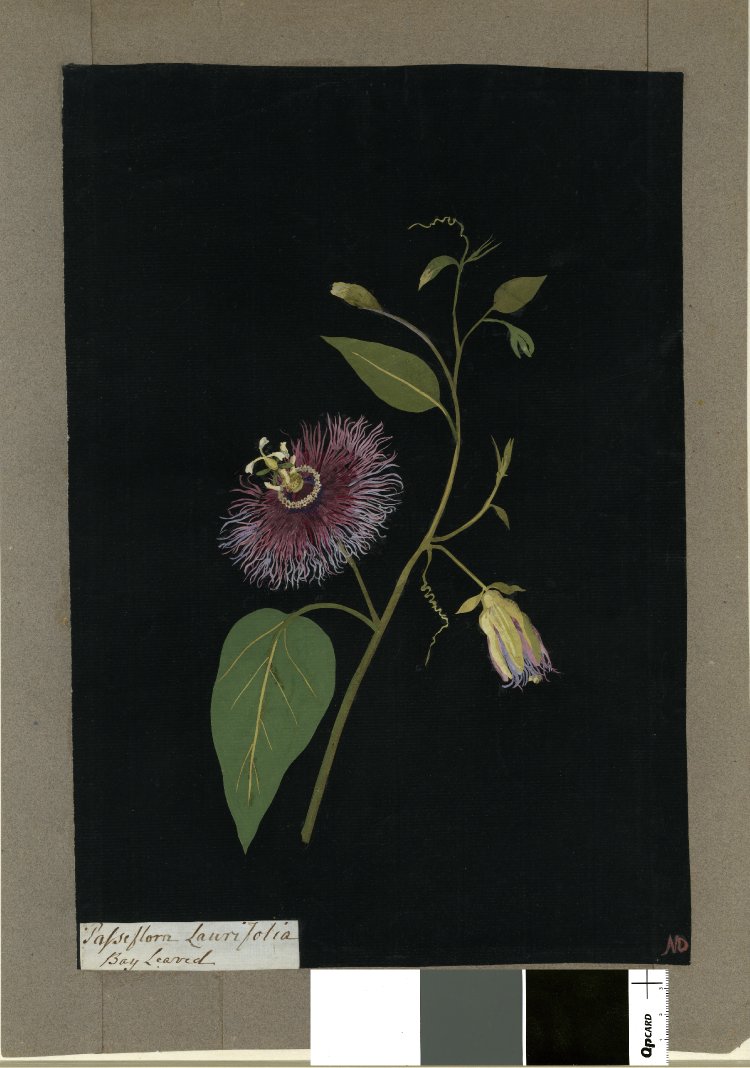
"Passiflora Laurifolia (Gynandria Pentandria), formerly in an album (Vol.VII, 54); Bay Leaved. 1777 Collage of coloured papers, with bodycolour and watercolour, on black ink background," 1777, British Museum, 1897,0505.654
“Passiflora Laurifolia (Gynandria Pentandria), formerly in an album (Vol.VII, 54); Bay Leaved. 1777 Collage of coloured papers, with bodycolour and watercolour, on black ink background,” 1777, ©Trustees of the British Museum, 1897,0505.654

The Shift to Chemise

Shift to Chemise 1
Shifting from shifts to chemises.

Language is a funny thing. I suppose we’re all guilty of following fads in our choice of words, and we all have particular phrases we find irritating or amusing – in other people.  I recently came across an example by Jane Austen, written in 1817, just as the polite name of a woman’s undergarment was changing.

Your Anne is dreadful – . But nothing offends me so much as the absurdity of not being able to pronounce the word Shift. I could forgive her any follies in English, rather than the Mock Modesty of that french word…’

So presumably Miss Austen was still wearing shifts, when other ladies were beginning to wear chemises. She wasn’t alone, however, in her annoyance with linguistic affectations. Pantalogia, a New Cabinet Cyclopaedia, Comprehending a Complete Series of Human Genius, Learning, and Industry, Alphabetically Arranged; with a General Dictionary of Arts, Sciences, and Words (1819) has this to say:

CHEMISE, the French word for that article of linen under dress which when worn by men is called a shirt, by women a shift. Some few modern English ladies, with an affected squeamishness of delicacy, restrict the term always so as to denote the article of female dress chemise de femme; but as every one knows what they mean by the expression, and we see no reason why every one should not know what they mean, we recommend the use of the old English term, and the abandonment of the corresponding French word.

Was there really any difference between a shift and a chemise? Well, yes and no. No, because they both referred to the same lady’s undergarment. Yes, because when the word “shift” was used (up until the early 19th century), the garment was usually made of linen and was simpler in cut.  As the word “chemise” became standard, variations in pattern and trimming were increasing and the chemise was more often made of cotton.

So much for the term; now was there any significant difference in the French and English methods of making this garment? I haven’t found anything consistently, unmistakably,  irrefutably, definitively identifiable. When I examine an old chemise, whether in a book, online, or in person, I can’t raise an eyebrow knowingly and say, Ah yes, English, 1832.

But with the interest and expertise I see popping up in blogs and books, I wouldn’t be surprised if someone has – or will – come up with a list of distinguishing features.

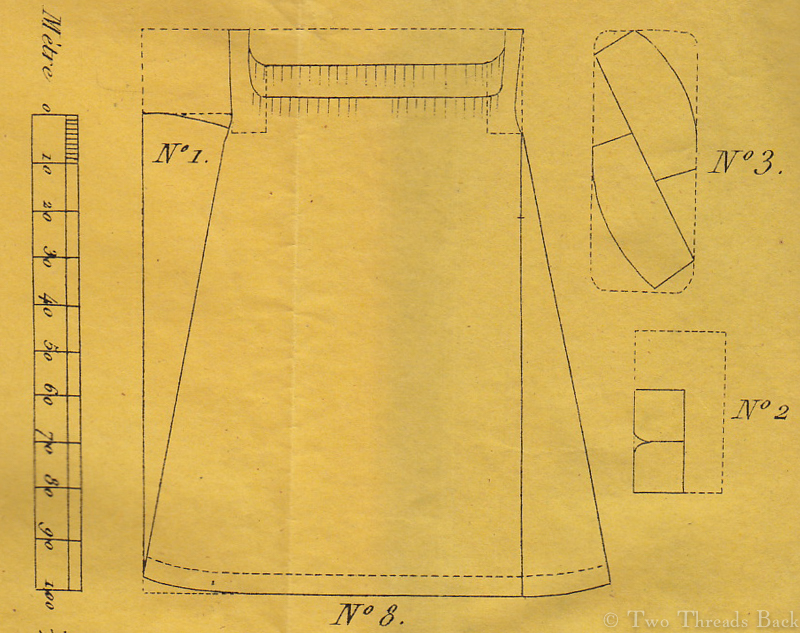
If you are curious (or courageous) and would like to compare for yourself, below is a pattern and description, 1840, from a French periodical. (Please excuse my awkward translation. If you are fluent in French and English, I beg you to let me know and help me correct it!) English patterns and instructions of the same date are available in the Workwoman’s Guide.

Shift to Chemise 2
A pattern for a lady’s chemise, 1840.

No. 8 is a woman’s chemise. For ten chemises, purchase 25 meters of percale; take off a meter, and cut the rest into ten pieces; fold these pieces into two; on side No. 1, cut the gore that you add to the other side, cut by a thread as shown in No. 2; inside cut two gussets; indent around the neck; this is shown in No. 3; the sleeves are cut on the bias. Gather slightly on top of the arm and hem the bottom with backstitching. The armholes have to be a little curved under the arm. Take the remaining meter, measure a narrow band along the edge, then cut twenty pieces for double shoulder straps; these pieces are indicated by dotted lines; place a narrow piece of tape between the shoulder strap and its lining, there you insert the sleeve and backstitch, and you fold the lining over; gather the top of the chemise, as indicated, and insert a narrow tape of a meter in length; then cover this piece of tape with a band of percale; using backstitching and hemming, then fold under. Mark the chemise over the left gusset.

Staying Put

Staying Put G
Pharaby’s new old busk.

It’s been a while since I added anything to Pharaby’s wardrobe, and with heaps of projects competing for my time I decided to tackle the quickest thing: a busk for her stays. Perhaps that might keep her happy until I have a little more leisure? I figured I could take a damaged “bone” from my stash, trim it to fit, and etch her initial. No problem.

Ha! I think the Spirits of Whales Past saw to it that I paid for my callousness towards history and nature. If you are extremely sensitive to the sacredness either, you may want to skip this post. If your curiosity exceeds your delicacy, here is the process in photos.

Staying Put B
The doll stays, pocket sewn in the lining, awaiting a 2-inch long busk.
Staying Put A
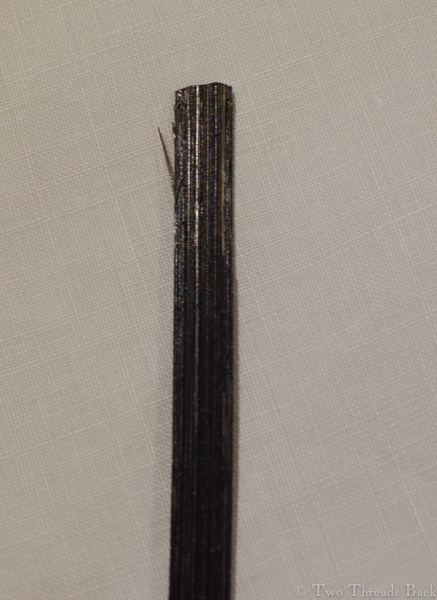
The aged and injured piece of baleen I started with, shredding on one side and blistered on the other.
Staying Put C
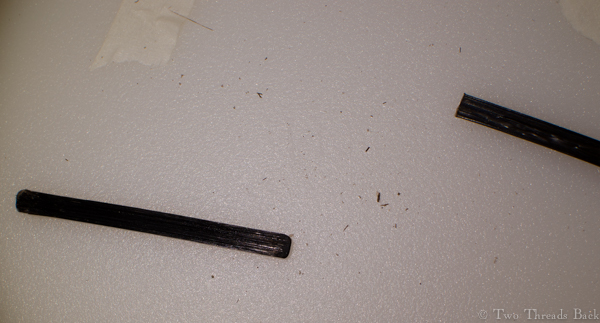
Now it’s taped in place on the cutting board for a quick trim. Not! After sawing and sawing for a while, it was time for Plan B.
Staying Put E
Plan B: I recalled a period domestic guide advising that boning should be soaked in hot water. Here we have baleen soaking. Soaking is not enough.
Staying Put E
Or was that boiling water? Here we have baleen soaking in boiling water. It sufficed, barely.
Staying Put F
Success at last! And for the final touch, a little filing to smooth the edges. What, no etching of her initial? A verse, a heart? After a little discussion, we decided to wait until her sailor sweetheart returns from the sea and let him do it. The busk will keep her stays put for now.


Up Her Sleeve

Shift 1 Sleeve
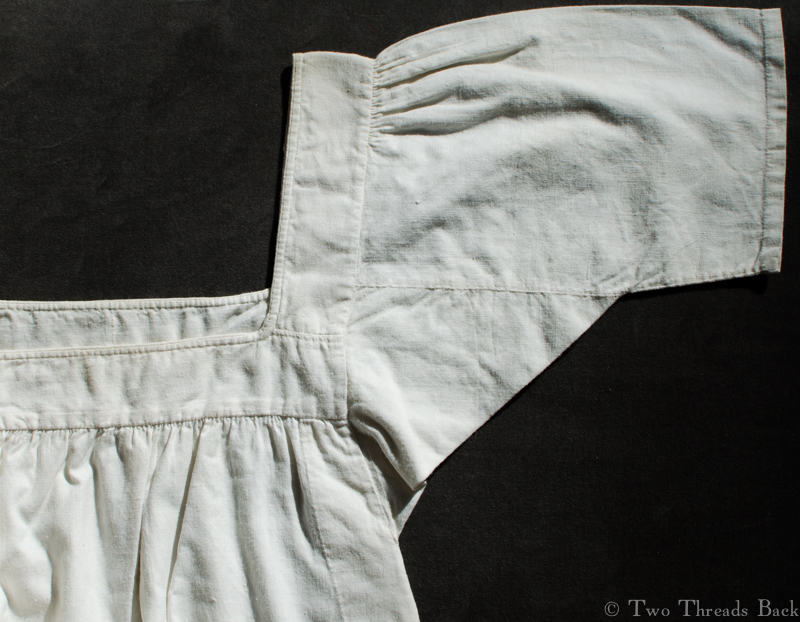
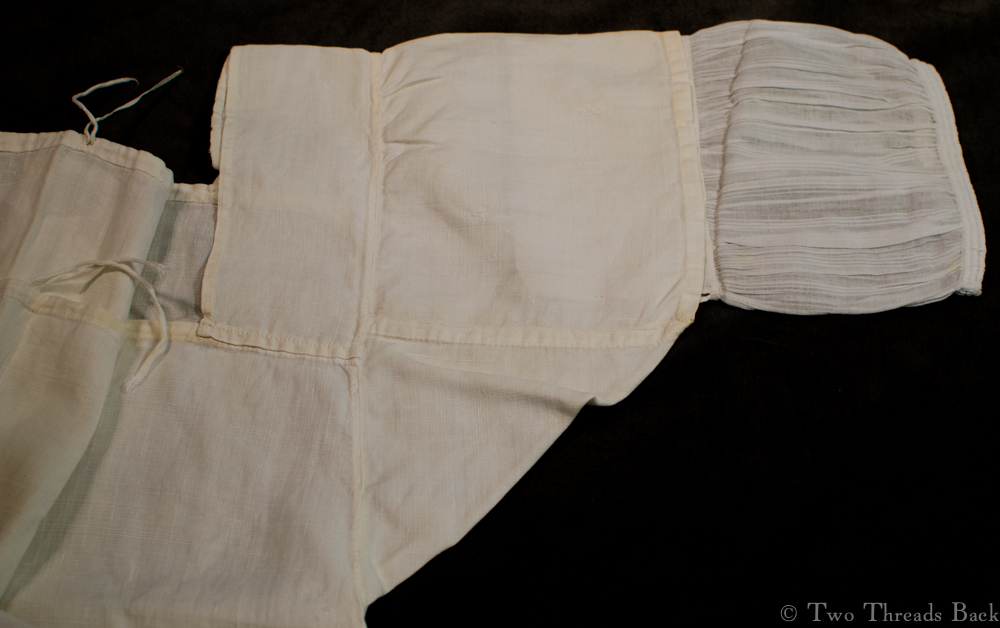
Here is the sleeve slipped into the first shift.

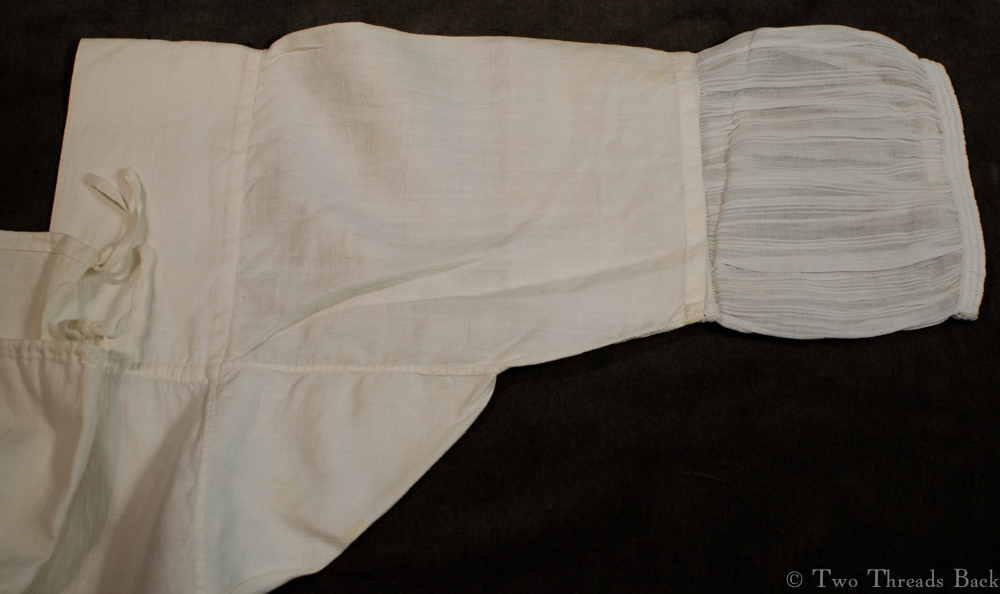
As a follow-up to the previous post – and a helpful comment, thank you! – I’ve tried slipping the sleeve (cuff, undersleeve, engageante?) into the sleeve of a linen shift. Well, three different shifts. Above is the first. Very nice fit!

The next one, below, is an even better fit.

Shift 2 Sleeve
Just about perfect! You’ll notice the sleeve length on this shift, unlike the first one above, extends past the gusset.

The last one I tried just for comparison. It’s obviously a wider sleeve, and I have a feeling that the shift was perhaps of an earlier date, and the sleeve was cut off to fit later fashions. And after looking at a few over the years, I wouldn’t be surprised if that was rather common. Although a shift didn’t require as much work as man’s shirt, the tiny stitches worked on fine linen were very tedious to do, and clothing was valuable!

Shift 3 Sleeve
Sorry Cinderella, it’s not quite right. This last shift is in the original “attic find” condition. Can you tell?

Picking a Pocket

Pocket 1

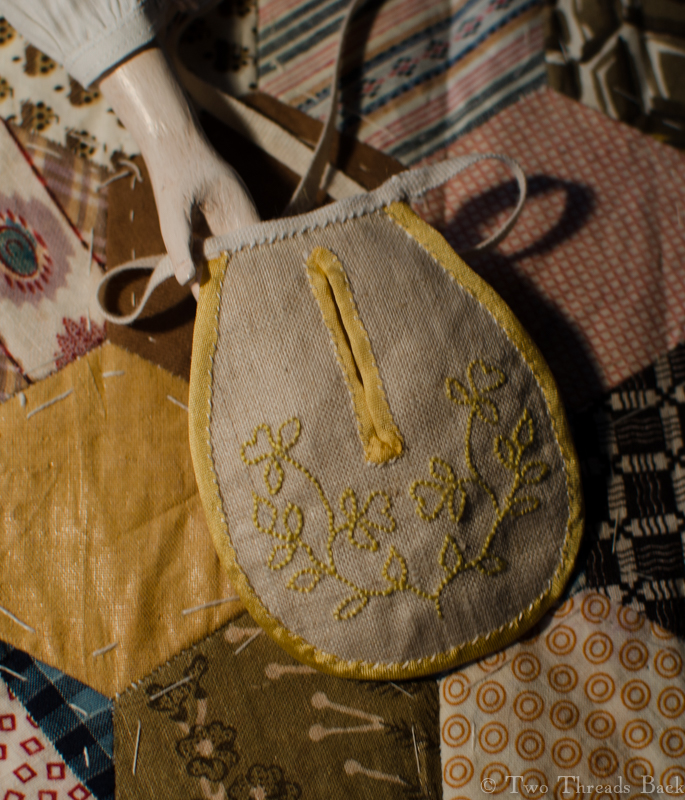
Pharaby’s pocket’s been picked!

(If you expected the Lucy Locket quote on this one, maybe I succeeded in surprising you?)

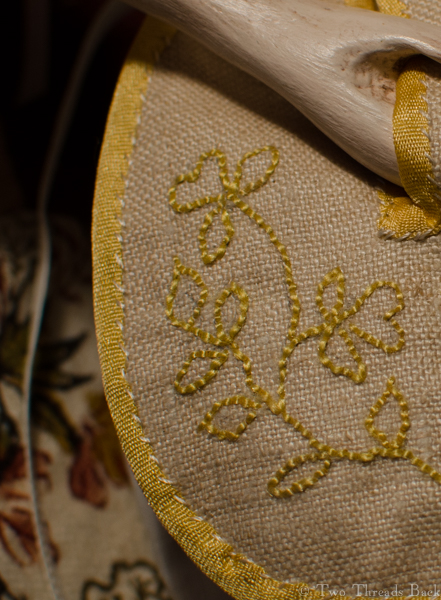
There are so many images available online that it was hard to choose a model for her pocket. I finally settled on “the look” of a sweet little doll version in the online Pockets collection at the VAD. (Click the link and then search for “doll´s pocket Nottingham.”) It resembled a couple of others, also worked in yellow thread, that were made for women rather than dolls. And it only required a backstitch!

The pattern: traced, pricked, and pounced. The fluff of canary-colored silk is the remains of
The pattern: traced, pricked, and pounced. The fluff of canary-colored silk is the remains of my fight with the floss.

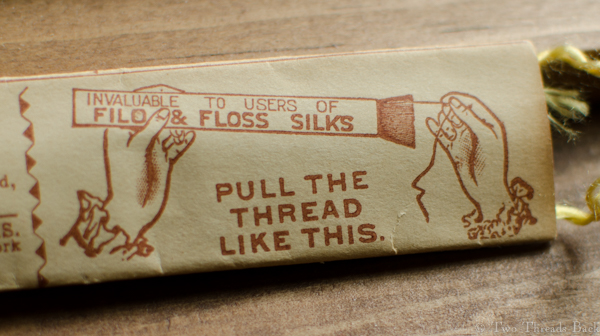
The design I used was loosely based on an 1770s pattern from The Lady’s Magazine. I scanned the original pattern and scaled it down to Pharaby-size. Then I raided a stash of old 1890s embroidery silks. I tried using the thread as it came from the skein, but it was way too thick – using only one ply made it almost small enough. And I can tell you that it did NOT work like the illustration on the wrapper!

Pocket 4As you can see from the remaining yellow fuzz, it was a struggle. But once that was done, it was pretty simple to cut out the front and back, then bind them with some matching yellow silk.

Pocket 6
I tried. It didn’t work like the picture.

To finish the pocket, I added narrow tapes on the ends. Yes, one MORE thing to go around her waist. But now she has a place to carry her handkerchief – when I make her one.

Pocket 5Oh! And while she was showing off her pocket, I took a picture of her wearing her marked shift. I neglected to do that in the last post, and she let me hear about it.

Pharaby's Marked Shift

X Marks the Spot

Pharaby's shift is now marked.
Pharaby’s shift is now marked.

“The art of marking was brought to perfection many years ago, and if our great grandmothers could but see the meagre attempts made by us now-a-days, I fancy they would have some contempt for the system by which our needlework abilities are tested.”

– A. K. Smith, 1892

They would certainly have some contempt for how long it took me to mark Pharaby’s shift, regardless of the quality of my work! I should have tended to this little essential when I first made it, but better late than never. We can’t have her single shift getting lost in the laundry, can we?

X Marking 2
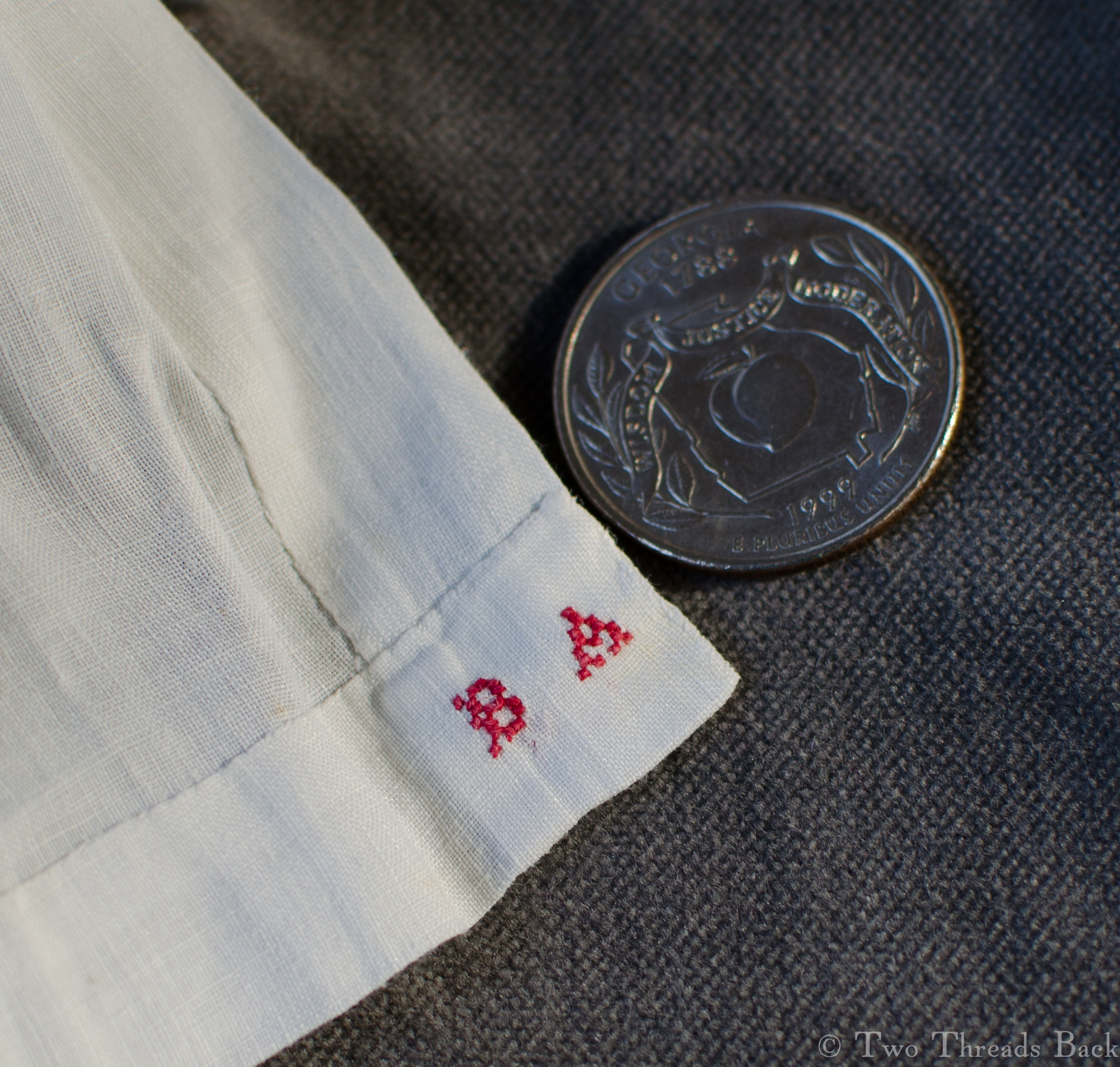
A lovely linen baby shirt marked with Turkey red cotton; note the quarter next to it for size. I’ve kept the image full size, for anyone who wants to view beautifully done original marking up close – just click the image.

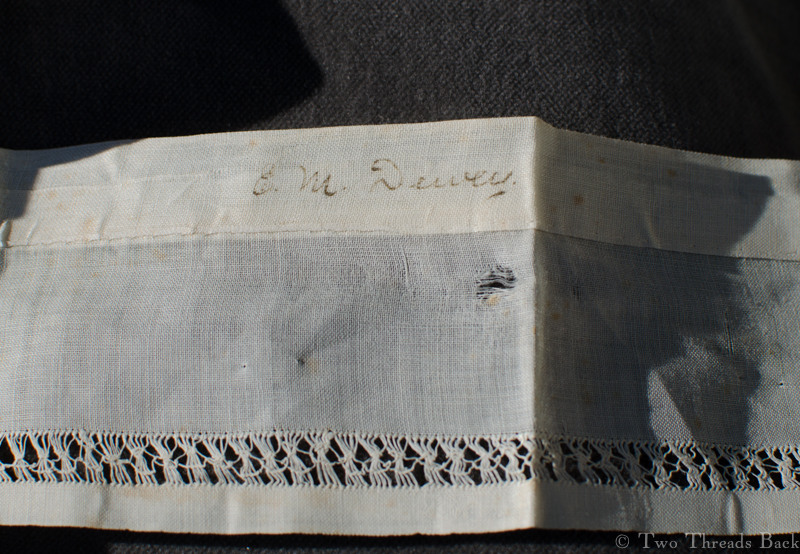
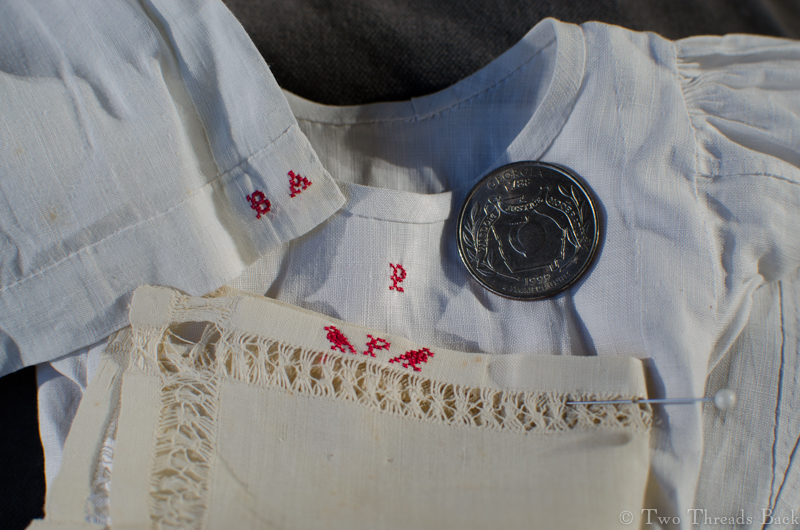
First I had to do some practice stitching. Sampler collectors and makers would laugh at how astonished – and intimidated – I am by the miniscule cross-stitches made during the past 200 years. You can see from this little baby shirt (last quarter 19th C) how blithely they marked countless linens. I’m guessing at the “blithely” part, but since I have many shirts from this baby, somebody was doing a lot of marking!

Making it to Pharaby’s scale would be impossible, since barely matching ordinary period work would be the best I could hope for.

I used a pretty little c1900 linen collar to experiment on (damaged – I wouldn’t inflict my needle on it otherwise), as you can see in the picture.

X Marking 3
A linen collar marked with ink that I used for practice. “No textiles were harmed during the making of this experiment.”

Since the threads in linen are not all exactly the same size, my stitches over two threads looked a bit messy. I tried sewing over four (too big) or over however many made a perfect square (too awkward). By this time I was just about ready to use ink, like the collar owner! But hey, I’m all about plain sewing, right?

A lot of trial and error showed that to be small enough, I’d have to work over two threads, no matter how lumpy my letters looked. I found that just like many projects, things that look pretty awful as I’m working, look a little better when I’m done. Or maybe I’m just cross-eyed by then!

X Marking 5
The baby shirt, Pharaby’s shift, and the practice piece, all together. The little birds I tried were from a pattern by the most knowledgeable sampler collector I’ve ever met. Maybe Pharaby will make a sampler one day….


Tick Tack Tocking, No Clocking on Her Stocking

Stockings
“A Lady’s Leg is a dangerous Sight in whatever Colour it appears; but shewing us your Legs in White, is next to shewing us them naked.”

It’s fun how a search for one thing can lead to other quirky discoveries. That’s what happened when I looked for information on stockings for Pharaby. Who knew that clocked stockings were the subject of a racy little song in 1902? (Will F. Denny, on archive.org)

I’m sure ornamented stockings were worth a peep in the 18th century as well! And did you know that wearing silk stockings could be hazardous to your health? At least during a thunderstorm.

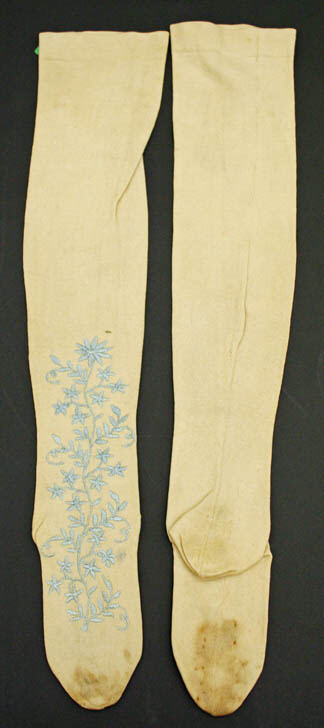
Met Stocking
A late 18th century stocking, metmuseum.org.

According to the Scots Magazine in 1773, a lady in Switzerland nearly suffered a shocking fate:

Her disease, like all others which the doctors can make nothing of, was decided to be a nervous one; but it was afterwards discovered to be owing to her wearing silk stockings, and wires in her cap. How little do our ladies imagine, when they surround their heads with wire, the most powerful of all conductors, and at the same time wear stockings, shoes, and gowns, of silk, one of the most powerful repellents, that they prepare their bodies in the same manner, and according to the same principles, as electricians prepare their Conductors for attracting the fire of lightning.

Ladies may laugh at all this, but it is too serious a matter to be made a joke of. A very amiable lady, a Mrs Douglas of Kelso, had nearly lost her life by one of those caps mounted on wire. She was standing at an open window during a thunder-storm: the lightning was attracted by the wire, and the cap was burnt to ashes. Happily her hair was in its natural state, without powder, pomatum, or pins, and prevented the fire from being conducted to her head.

A good strong head of hair, if it is kept perfectly clean, and dry, is probably one of the best preservatives against the fire of lightning. But so soon as it is stuffed full of powder and pomatum, and bound together with pins, its repellent force is lost, and it becomes a conductor.

Hmm… personally (and modern-tastefully) I find the “loaded” hairstyle more repellent!

But I digress. Pharaby most certainly wanted stockings, and I wanted to make them. Well, I wanted her to have them. To be honest, I was at a loss for how to make stockings, so first I spent some time searching for ready-made.

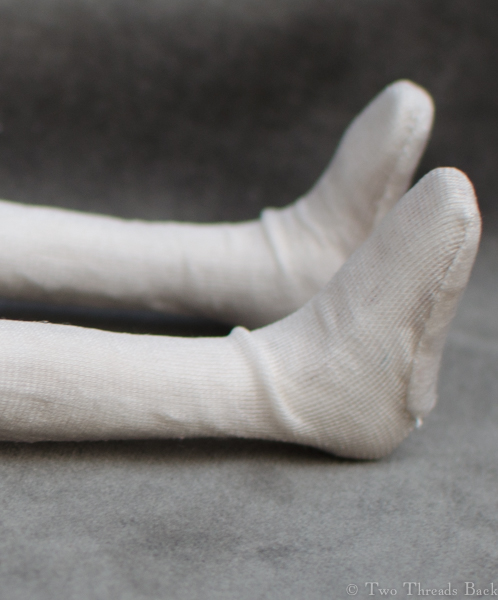
What would fit her? Her limbs are not exactly the same size and shape (well neither are mine), and her feet are shaped to stand flat on the ground. Or table. So off-the-rack doll stockings, unless I was willing to accept nylon tubes, were not an option.

Stocking Foot
I know what it’s like to have baggy socks around my ankles.

I decided I’d have to make them after all. Knitting was out of the question since I don’t know how. The stockings would have to be cut and sewn. Pondering a source for slightly-aged stretchy silk one day, I experienced a flash of brilliant resourcefulness. Gloves! With silk lining! Ebay! I found a worn vintage pair that were just right and managed to extricate the lining from the leather.

Next I found and adapted a pattern on this lovely site and practiced fitting it, using an old t-shirt so I wouldn’t waste the silk. That took a while, but once I settled on the size, I had another idea. Why not embroider clocks on her stockings? My brilliant ideas are often followed by some real flops, and so this one proved.  I made three attempts to embroider a half-inch design on thin stretchy silk. It looked horrible, no matter what thread or stitch I tried. There would be no clocks this time.

Fortunately Pharaby didn’t know I was even trying, so she suffered no disappointment; she was pleased to have any stockings at all. They may be her only pair. We have a lot of thunderstorms.

Operation Petticoat

Petticoat1

Pharaby has been following me with a reproachful gaze for a few weeks now. I promised her a petticoat (an “under” petticoat) and I’ve been awfully slow in making one.

I finally got around to it this past week. It was pretty simple really, just a length of ribbed linen stitched up the side and pleated into a band. Making the pleats match was the hardest part. No, wait – finding a band to fit the doll “scale” was the hardest part!

Petticoat2
Just enough room for her to reach a pocket inside. When she has one, that is.

I only had a small assortment of cotton and linen tapes to choose from. None was the exact size and weave I wanted, but, well, that’s how it is with dolls and costuming. You have to compromise!

So now she’s got a petticoat. The next question is, does she wear it over, or under, the bum roll? We’ve tried it both ways and are hoping for some expert advice. But what really concerns me is the direction we’re headed: exactly how many ties, bands and layers of gathering can the female form support at the equatorial line?

Because we’re not done yet…

Petticoat3
Pharaby modeling her petticoat, a last photo shoot before the freeze tonight. No more flowers till spring, I fear. She may start hinting for a wool petticoat!