Early 19th century cotton print, a hexagon in Christmas colors.
Time for a short post before Christmas! Here is a patch in Christmas red and green, with a little black accent. Once again it has the peculiar (to my eyes anyway) mouse-squiggle-alien creature-seed pod-flower design. Buti? Boteh? “Shawl pattern”? Indian import or English version? I don’t know. But I do know these patterns on calico show up a lot in the first decade or so of the 19th century. If you search for Ackermann’s Repository, the plates with fabric swatches attached, you’ll see them in many dress prints.
Here’s the view from the back, which clearly shows the closely “seamed” stitches and a bit of copybook writing.
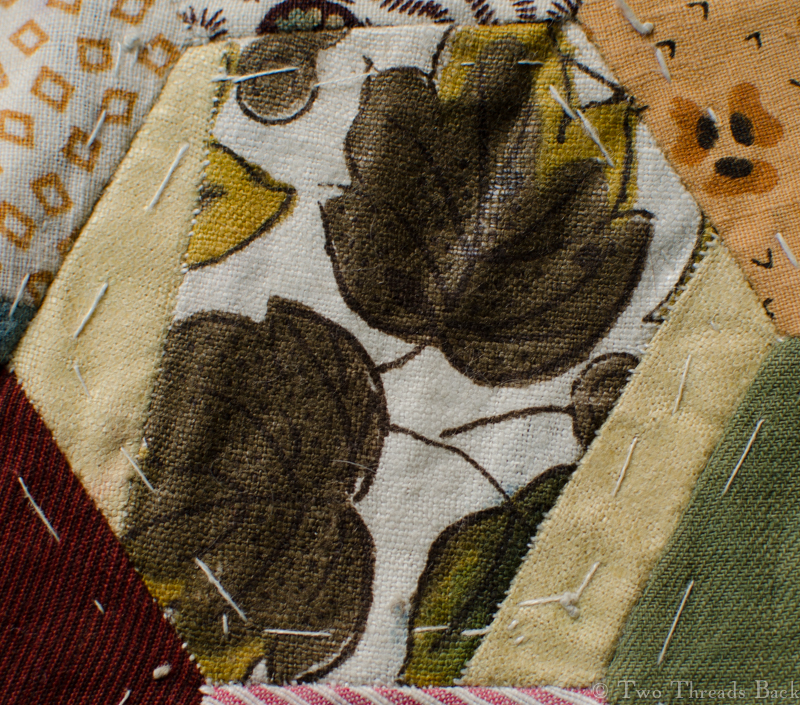
Early 19th century English paper pieced patch – with ugly leaves.
I chose another pattern for the season, and in honor of Thanksgiving week, it’s one with leaves! But to be quite frank, it’s pretty much… not pretty. Perhaps the whole pattern was nicer, and it’s only this snippet that is less than attractive to me.
The maker was certainly wanting to use it though, because she had to piece the piece. You can see just how tiny the scraps were, and it amazes me that she made the effort. Keep in mind the whole hexagon is only 2 inches across!
A view from the back, showing part of an old copybook page that was used for the pattern.
Something else that I find surprising in these sections is just how many of them have their original glazed finish, or sizing. Perhaps they were only cutting scraps, not from worn out garments. Even though times were changing, fabric itself still had more value than the average worker’s time. And it’s not just the fact that the scraps retain their glazing, I’m really surprised that so many of the pieces have it at all, enough to make them very shiny. I have to angle the photo “just so” to limit the reflection. Hmm… something to reflect on….
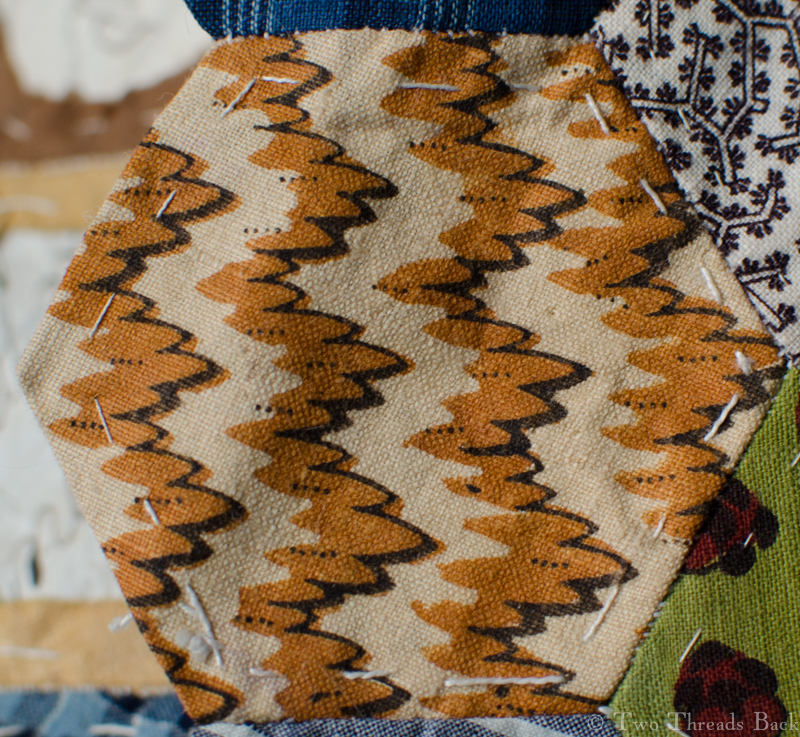
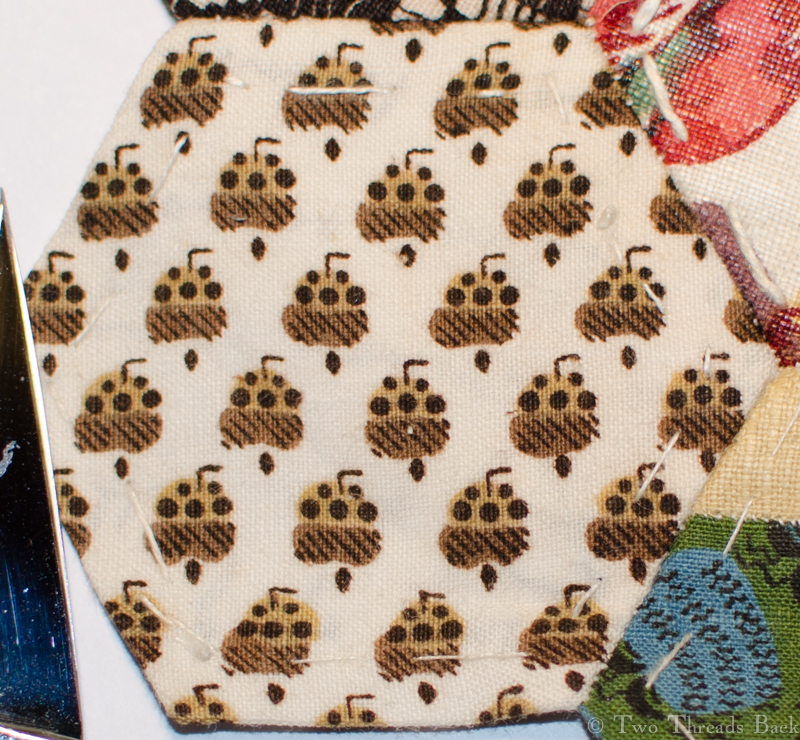
Early 19th century calico pattern in fall colors: deep rusty orange and brown on a beige background.
It’s time for another bit of calico, and in keeping with the season I chose one with fall colors. I’m afraid the close-up photo doesn’t convey just how smooth, crisp and tight the fabric is – but if you’re like me, you’d rather see it larger!
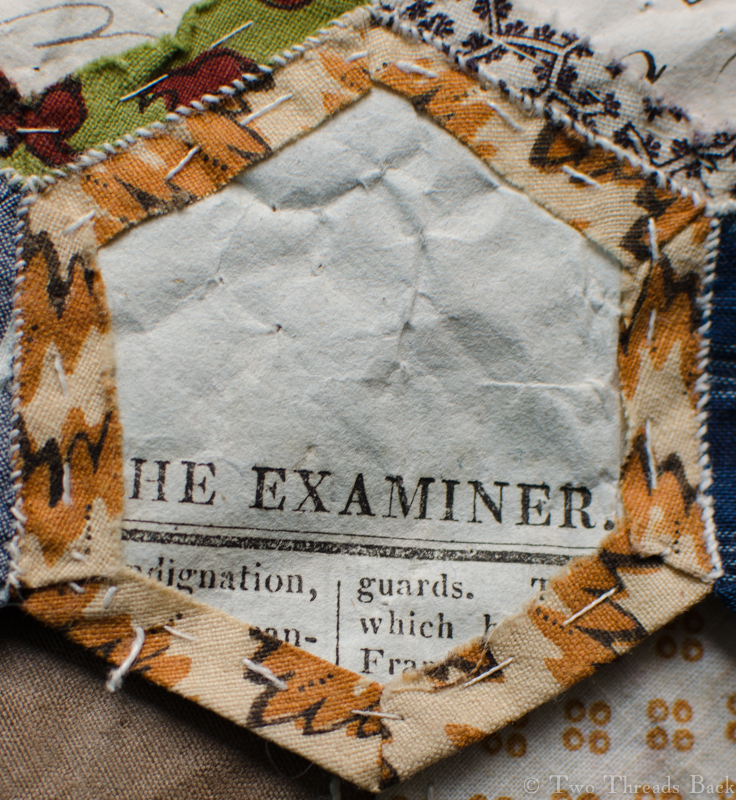
This time I’m also including the back, with “The Examiner” now being used by the lady of the house. But who knows? Perhaps she was the subscriber as well. I like that thought.
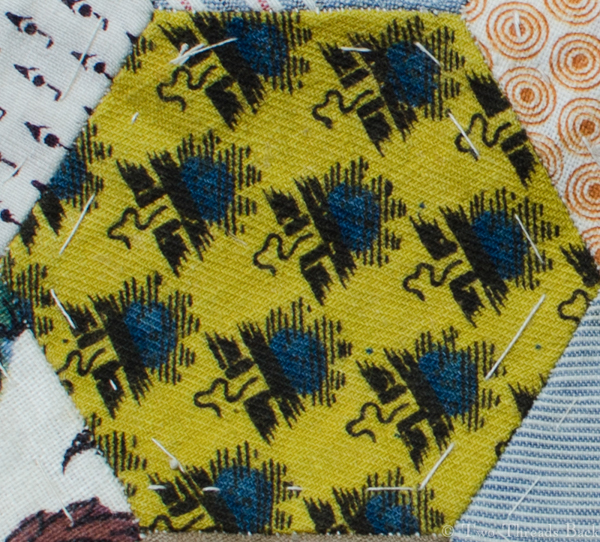
A bright yellow and blue calico patch, early 19th century.
Here we are with another patch from the same collection. There are a LOT of them, so I’ll probably not even mention that in future posts, but simply add the photo.
This one is bright and cheery in yellow and blue, with an absolutely bizarre design. It’s also reminiscent of Mousey Mousey – but perhaps when he was feeling blue on a bad hair day.
An early cotton calico from English Paper Pieced Patchwork. (Say that really fast.) It measures 2×2 inches. The odd thing on the left is my embroidery scissors holding down the edge.
Welcome to the Flower Patch! Back in the olden days when I was a child, my sister and I would sometimes take our afternoon naps on “pallets.” These were great-grandma-made quilts, all soft and worn, laid on the floor in front of an electric box fan (we lived in The South). Compelled to be still and quiet, we’d make a game of picking out our favorite patterns. Of course it sometimes degenerated into squabbles: “You can’t have that first favorite, ’cause it’s my first favorite!” We’d usually fall asleep and wake up best friends again.
I’ve recently come across a few little quilt bits – can’t afford whole garments or quilts – from my favorite era, the early 19th century, and thought I’d post a picture of a patch now and then. I wanted to record all the patterns anyway, and this seems like a good way to share them at the same time. If you happen to recognize a print, or are blessed enough to have the whole garment (which might give me the vapours), I’d love it if you’d let me know!
These patches are from an “English Paper Piecing” set. I believe it dates to the early 1800s, not only because of the patterns but because some of the paper that’s used on the back is c1808-1812. There are a few pages from English newspapers (London National Register, Monthly Magazine, etc.), private letters, and a whole lot of pages from an old copybook. Of course that doesn’t make a certain date; some fabrics could be earlier or later and it all could have been pieced later. But I’ll leave that to the experts.
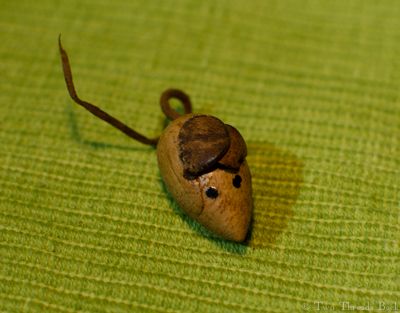
Mousey Mousey: a survivor.
The first patch I selected has a peculiar pattern. It reminds me of poor old Mousey Mousey. Mousey Mousey was a beloved toy that I still treasure, though heaven knows how anything so small (less than an inch) could survive the many decades and almost two dozen moves he has (we have) been through.
Pictured above is Flower Patch #1. By the way, it’s not my first favorite.
I’ve always loved order and simplicity. That sounds awfully smug, but I shouldn’t commend myself since it’s probably because my brain can’t handle very much at one time. This craving for minimalism is getting worse as I get older. Try googling the minimalist lifestyle and maybe you’ll see the attraction! Or not.
A conversation the other day started me thinking about simplicity in plain sewing. Hmm. What was the most basic stitch? Well, anyone who uses old sewing machines knows you can do just about anything with a straight stitch, which is closest to a backstitch in hand sewing.
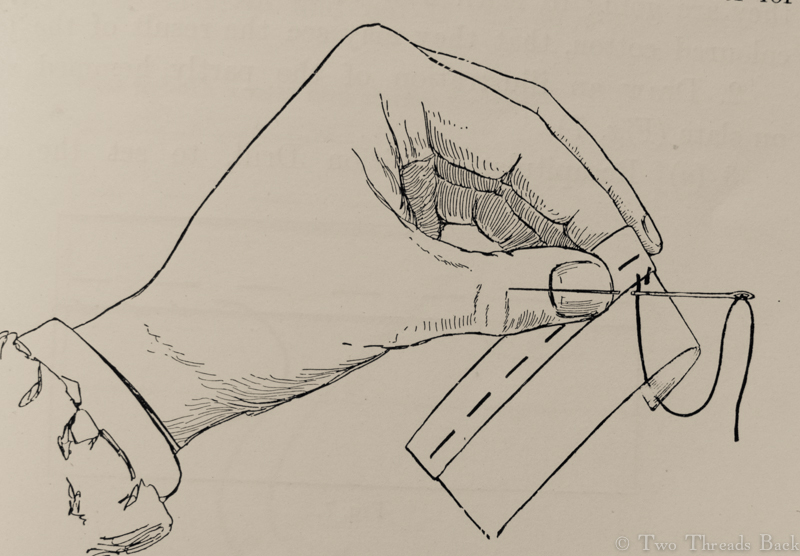
But backstitching wasn’t the primary stitch in 19th century sewing manuals, nor was running, as I learned when I studied plain needlework instruction. It was hemming. That’s the little slanted stitch that you would use to (surprise!) hem something. Once your hemming was neat enough, you could learn to work other stitches.
“Simple hemming is the first step on the road to proficiency in needlework.”
By the way, I’ve noticed that most costume historians, or at least ones I’ve heard and read, call this same stitch “whip” instead of “hem.” For example, “the edge is folded back and whip stitched in place.” But then, why shouldn’t they? I understand perfectly what they mean. If you’ve seen my post on muslin you’ll know I’ve come to terms with terms!
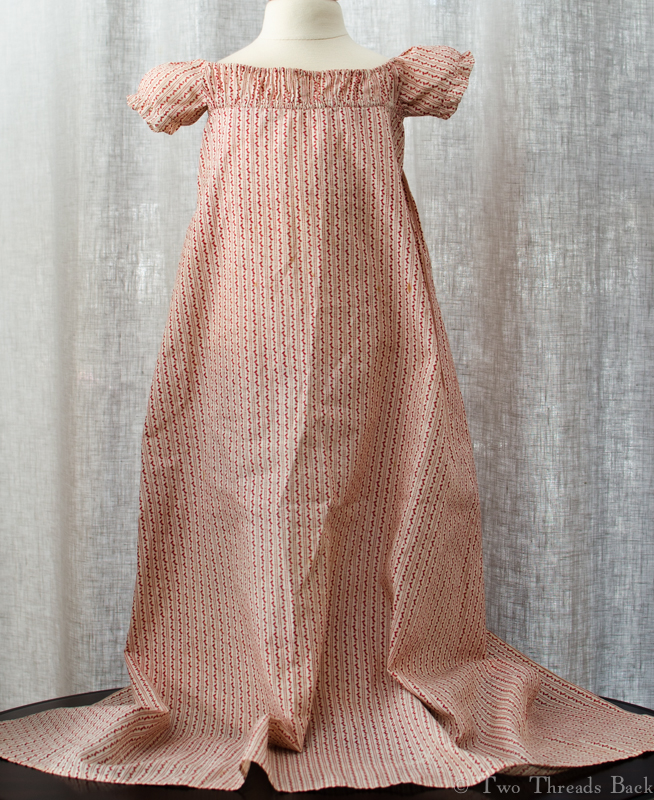
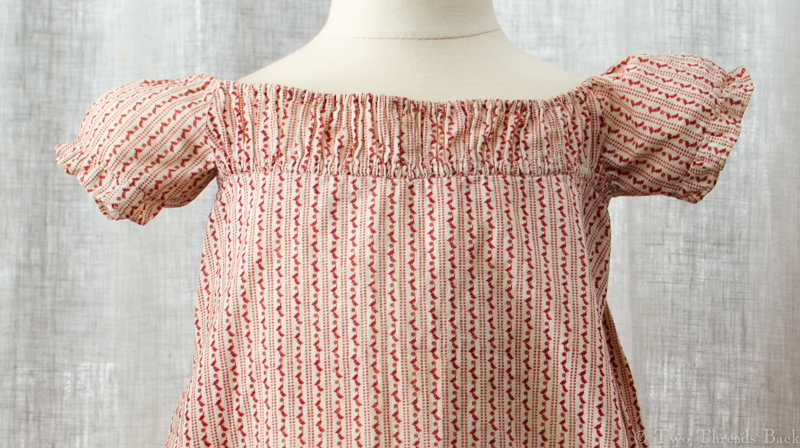
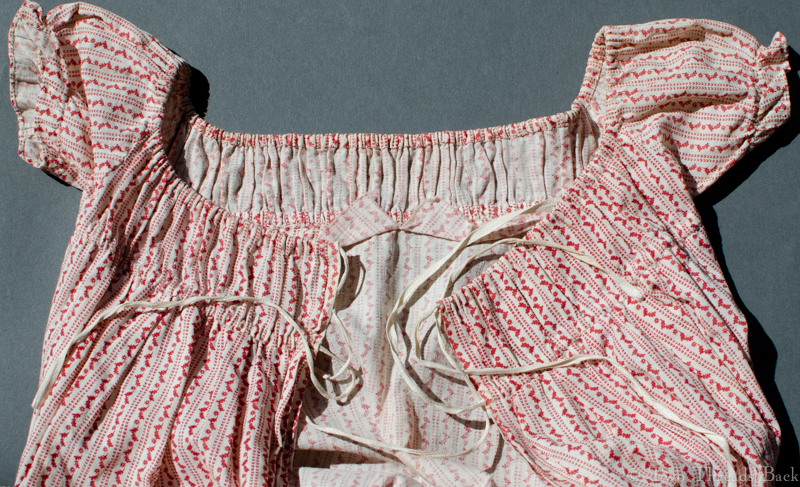
Getting back to simplicity. I decided to go closet diving for something that used only that one stitch, hemming, to construct a garment. And I found it! A Regency era calico baby dress. Granted, it didn’t have enough pattern pieces to warrant many stitches. But the whole gown was made by hemming!
Calico Baby Gown, c 1815.
Or was it? Well, in my eagerness to find what I was looking for, I didn’t look close enough, and I didn’t think it through.
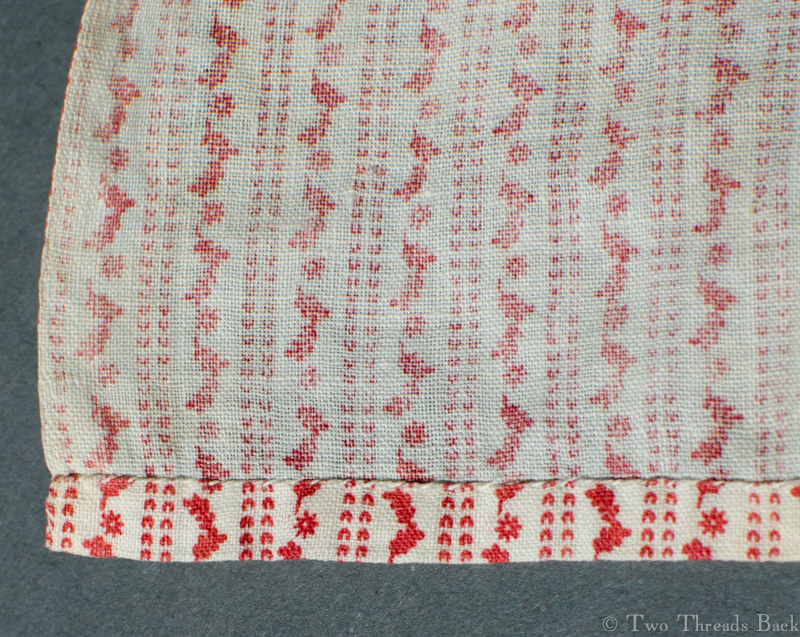
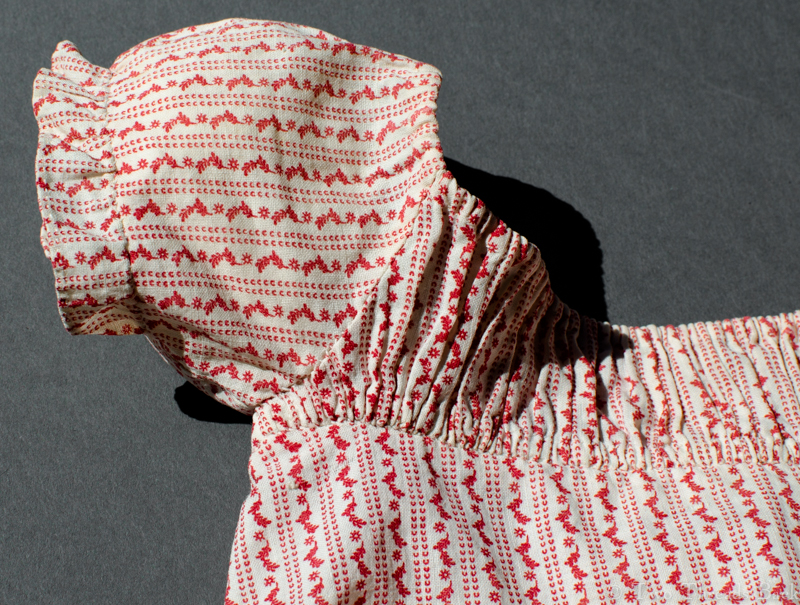
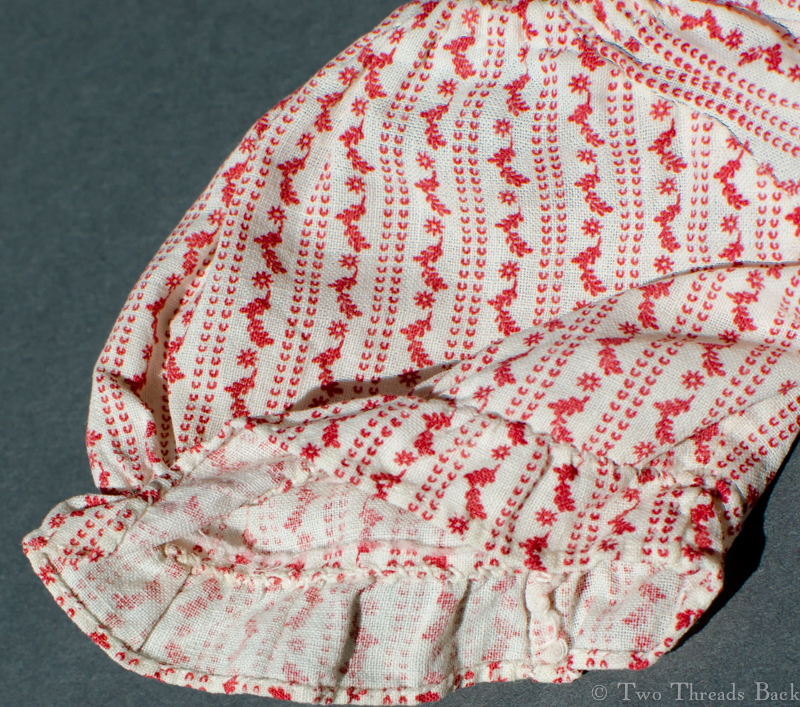
The skirt was made of one piece and hemmed, check. The casings for the strings were hemmed, check. The tiny ruffles on the sleeves were hemmed, check.
Hem.Casings for drawstrings.Sleeve ruffles.Back opening.
The bodice was hemmed to the skirt – whoa! Wait a minute. That wasn’t right. Things were unraveling. I mean my clever discovery, not the little frock.
Yes, the stitches looked the same at first glance, but any experience (or a practical mind) would tell you that you have to hold those two pieces face to face and sew them together. That makes it seaming, as they would have said, or overcasting, as we’d say today. Same thing for the ruffles attached to the sleeves.
And there was more. The tiny bodice sides, all three-quarter inch of them, were running stitch. As were the sleeves to the body – and then overcast!
So much for that, no single stitch here. I confess it doesn’t really bother me too much that it’s not pure minimalist stitching. I’m learning to slow down and look closer. And it’s still a wonder of simplicity!
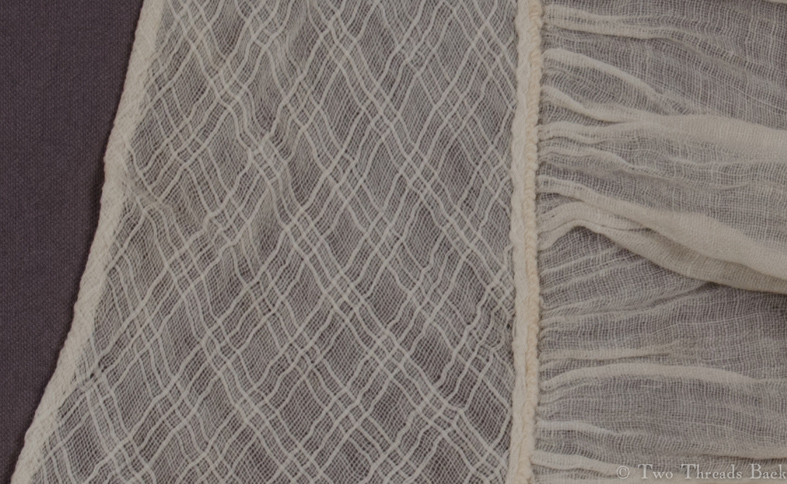
Ah, the quest to identify the delicate fabric! So many surviving caps, collars, aprons, and gowns. Mull, book, or clear muslin; longcloth, cambric, nainsook, lawn, batiste. Not to mention spotted, sprigged, flowered, figured, checked, worked, striped, and embroidered!
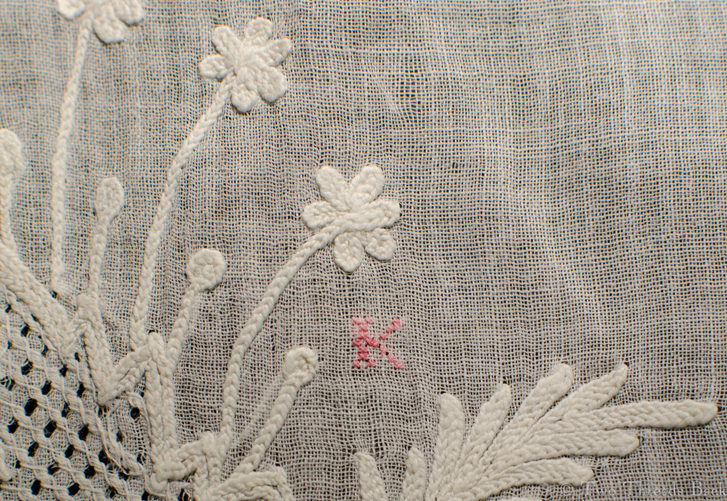
Gossamer-thin collar of cross-barred muslin with a sheer muslin frill.
Because so many of the textiles that fascinate me are white cotton or linen, my inquiring mind wanted to know what to call that pretty little antique baby gown – mull? Cambric or jaconet? Swiss, Indian, or Scottish manufacture? Surely something more than white cotton!
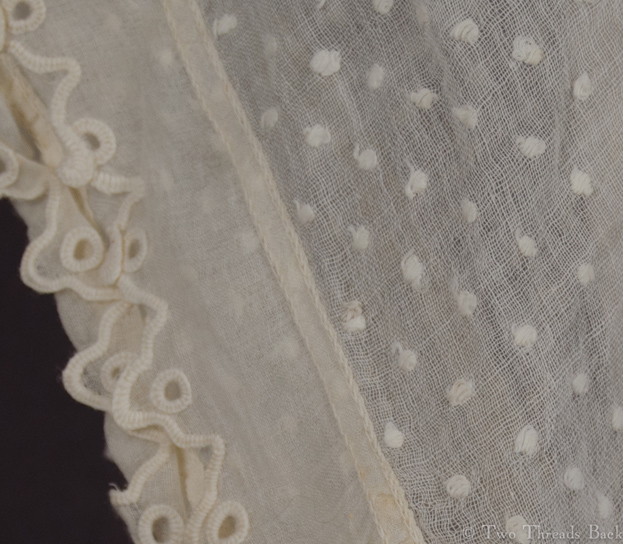
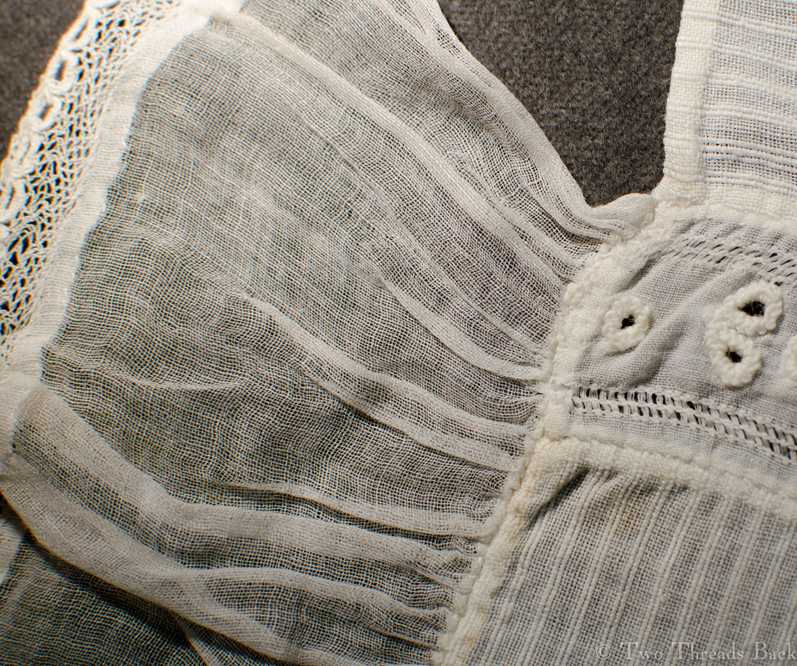
Infant gown of pink spotted muslin.Cap of spotted muslin with edging of plain muslin embroidered with scallops and eyelets.Three different types of cotton in one piece: airy frill, ribbed body, and a sturdier foundation for the embroidered insertion.Apron of thin cotton, Dresden embroidery.
So many names show up in period writing. Some of the adjectives are unambiguous: spots are spots, then and now. But for years I puzzled over terms and asked any textile historian I came across (ok, there weren’t many) to explain how to identify each kind. Silly me.
I searched novels and dictionaries, magazines and swatch books, sewing textbooks and inventories galore. And guess what? Even more confusion. My eyes became as “glazed muslin.” There was no consistency or authoritative answer to what was what. Or at least not enough for me to astonish my friends with my blindfold fabric naming tricks.
Yes, lawn and cambric were once only linen, names denoting origin; voile came rather late for my area of interest. And often the context of the term (especially when it was attached to a dated sample!) was extremely useful. But I was looking for an answer that wasn’t. I mean, there isn’t one definitive answer, consistent for all times and places. The evolution of the stuff, as well as language, has seen to that!
After all, a maker who calls a fabric by one name, the wearer half a world away who calls it something else, and the lucky one who finds it in an attic 200 years later and doesn’t know what to call it – may all refer to the same thing. It all depends on Who, Where, and When. So I guess I’ll just call it all muslin!
Muslin, by Sonia Ashmore, image courtesy V&A
Speaking of books and muslin … the V&A published a book last year, Muslin, by Sonia Ashmore, and it’s my latest chair-side companion. Superb research, gorgeous photos – a must-have for any historic costume/textile enthusiast.
And anyone who wants more information on period textiles will find Florence Montgomery’s Textiles in America, 1650-1870, Sally Queen’s Textiles for Colonial Clothing, Textiles for Clothing of the Early Republic by Lynne Basset (the whole series, actually), and All About Cotton by Julie Parker to be excellent resources – and all but the first have samples!
From The New Encyclopaedia, 1807, a hint of how muslin compared, Cotton Goods are divided into different classes, each proportionally lighter than the other. The heaviest of these are, 1st. Shirtings, 2d. Cambrics, 3d. Cossias, 4th. Jaconetts, 5th. Lawn grounds, 6th. Mulls, 7th. Books.





 Two Threads Back