Little Biggin Three

18th C Cap 3a
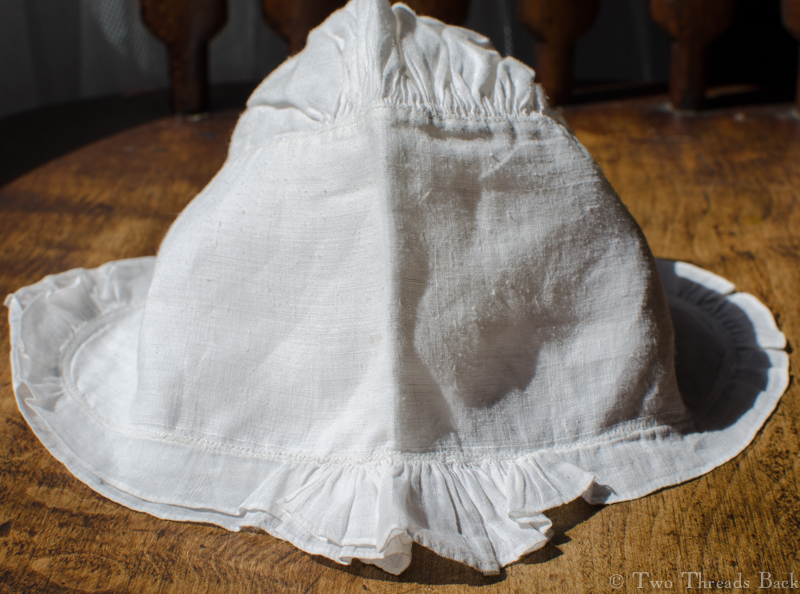
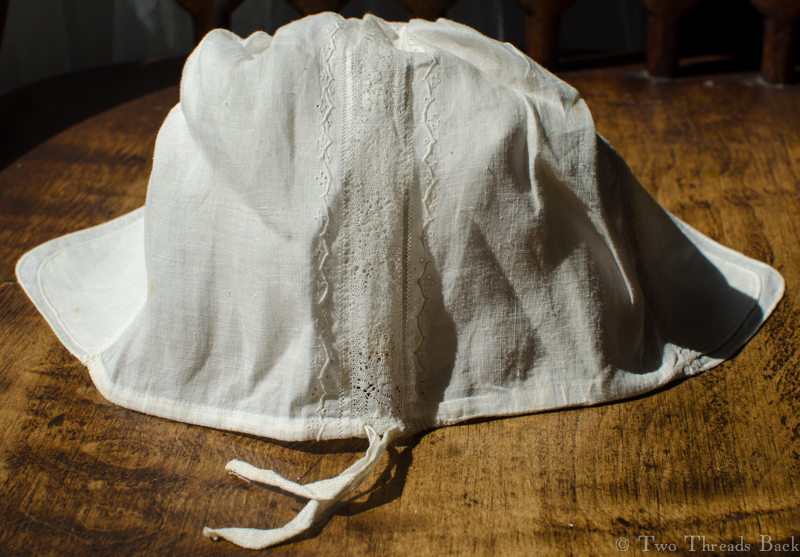
An 18th century cap for a baby, made of fine linen.

If it’s fair to judge from the advice books of days gone by, enlightened physicians had an uphill battle trying to convince mothers to dress their children sensibly. The following quote is from William Cadogan in his Essay Upon Nursing and the Management of Children, 1750.

I would recommend the following Dress : A little Flannel Waistcoat without Sleeves, made to fit the Body, and tie loosely behind; to which there should be a Petticoat sew’d, and over this a kind of Gown of the same Material, or any other, that is light, thin and flimsy. The Petticoat should not be quite so long as the Child, the Gown a few Inches longer; with one Cap only on the Head, which may be made double, if it be thought not warm enough. What I mean is, that the whole Coiffure should be so contrived, that it might be put on at once, and neither bind nor press the Head at all: The Linnen as usual. This I think would be abundantly sufficient for the Day; laying aside all those Swathes, Bandages, Stays and Contrivances, that are most ridiculously used to close and keep the Head in its Place, and support the Body. As if Nature, exact Nature, had produced her chief Work, a human Creature, so carelessly unfinish’d, as to want those idle Aids to make it perfect.

Out of all the clothing that has survived over the past couple of centuries, it seems like the finer baby garments are some of the most numerous. I guess that makes sense: they possess great sentimental value, exquisite handwork, and hey – they don’t take up much space!
18th C Cap 3b
Baby cap, back view with ties.

This little cap is a classic of 18th century style. It’s made of extremely fine linen (I know it looks coarse in the photos but it’s really not) with a double brim and a narrow linen tape to draw it up to fit at the neckline. There are no ties to fasten it under the chin, nor signs that there ever were.

18th C Cap 3c
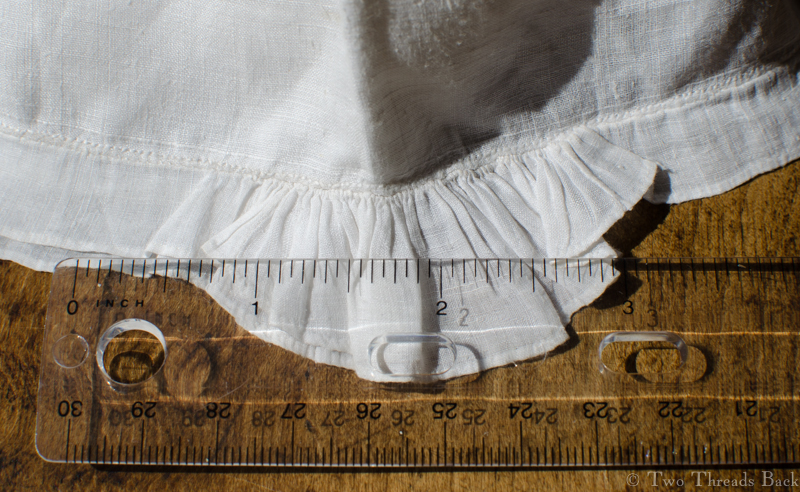
Close-up of lace and embroidery.

Even though I’ve laid a ruler across the needlework, the photo doesn’t really show just how minute the embroidery is. And the plain sewing is a staggering 48 backstitches per inch!

The pattern of buttonholed scallops and dots is very common on baby caps and shirts of this era. It also appears on the first “Little Biggin” I wrote about, although this one has tiny eyelets as well as dots. The lace is handmade, but not being a lace person, I can’t identify it. Help??

The brim is about 2 1/2 inches deep, front to back, and 11 inches from side to side. The two layers have been tacked together and the crown gathered and sandwiched between them.

18th C Cap 3d
A “closer”-up of the cap from the inside. Can you make eyelets that measure 1/16″ across? I can’t even SEE them without squinting!

I think this little “Coiffure” is so contrived that it may, indeed, meet with even Dr. Cadogan’s approval!

18th C Cap 3f

18th C Cap 3e


Aprons, No Strings

Apron 1854
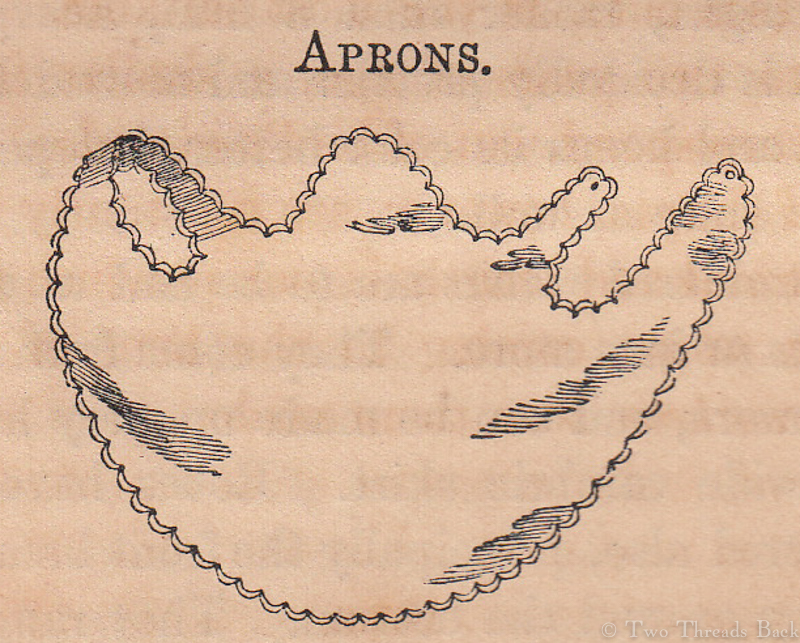
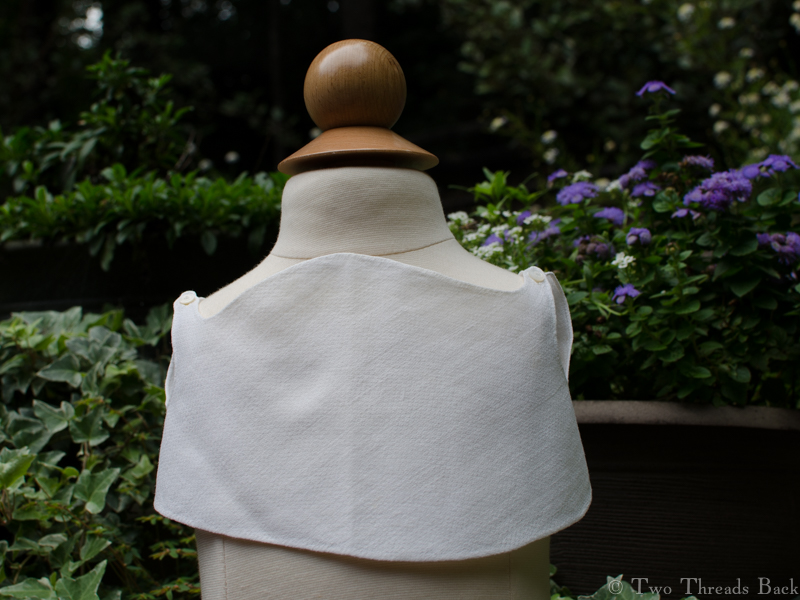
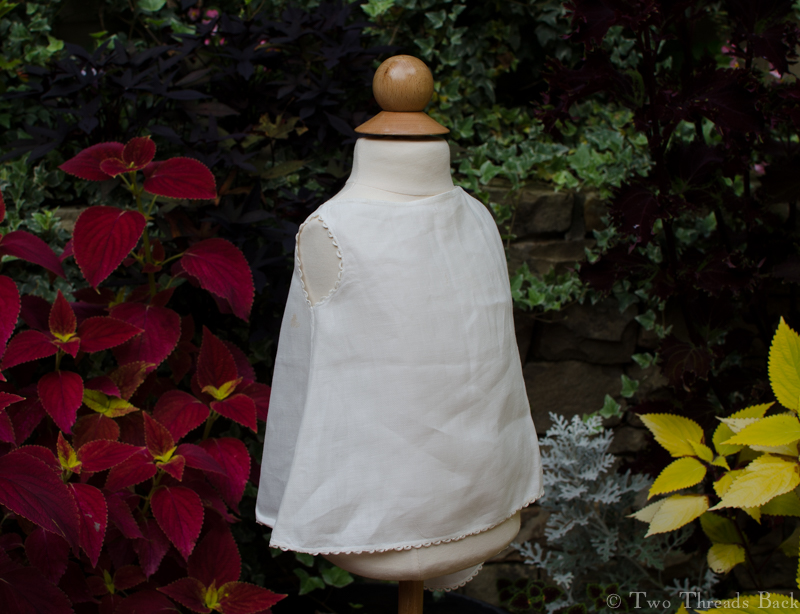
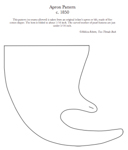
An apron pattern, c.1850 for the 19th century layette.

At three months old, it is usual to commence the use of aprons, which are made of bird’s-eye diaper, or, just now, brilliante, a firm, close-figured cambric, which will wear nearly as long. These last are bound with cambric, in solid colors, as pink, blue, buff, &tc. Bird’s-eye linen is usually trimmed with tatting or anything that wears well. At present, button-hole scollops, either plain or filled with dots, eyelets, &tc., are much used; they are made in this way ornamental, as well as useful. For an infant, the “bib-apron,” round front, coming a little below the waist, with a little shoulder strap buttoning around the arm (see cut), is the most suitable. From six months to two years of age, a similar front, with back to correspond, cut of bird’s-eye also. A large variety of shapes, however, are constantly to be had. The material and length is our province; no child needs an apron coming to the end of the dress skirt, as we have seen them made.

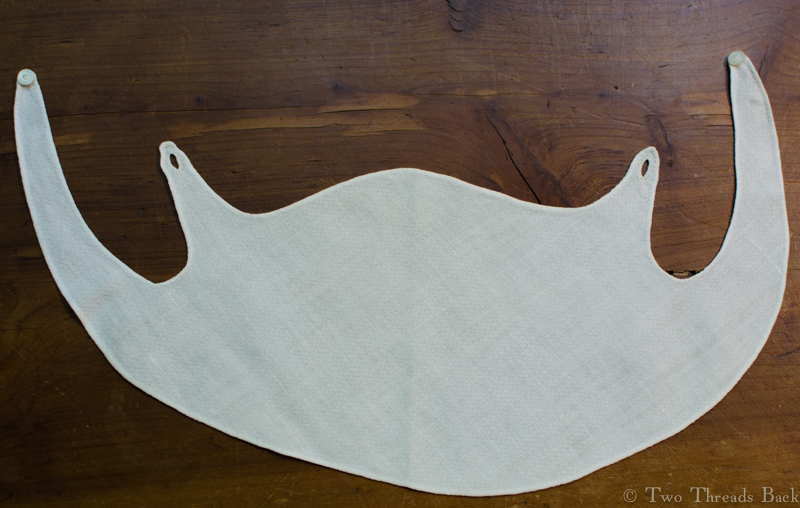
So says Sarah Hale, in a little instruction book written for new mothers in 1854. It amazes me that such a functional item could survive 150 plus years, but I come across them from time to time.  If you’d like an actual-size pattern of the one below, send an email to me, m at twothreadsback dot com, and I’ll send you a pdf – free. Gratis. No strings attached!

Apron 1A
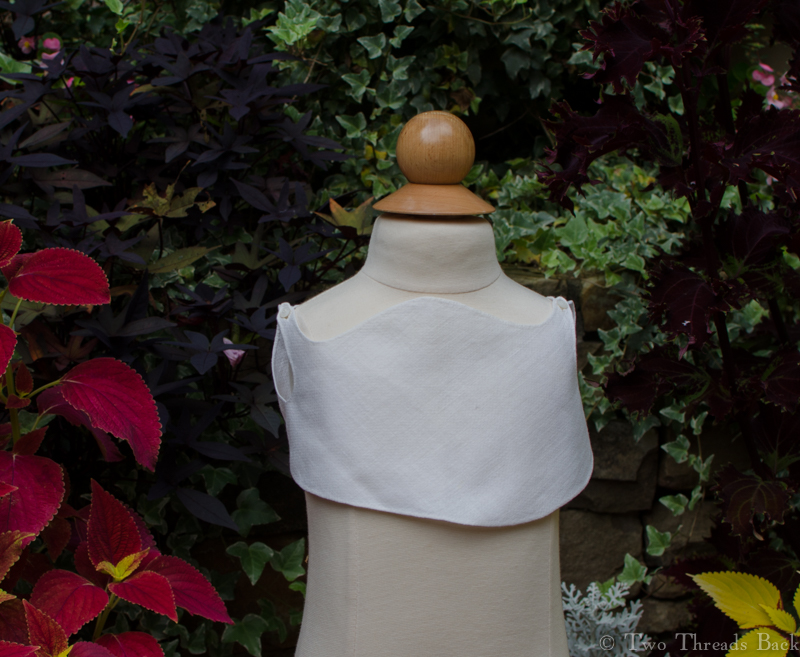
An apron for a very small baby, made of cotton diaper by a mother who was cutting the pattern with one hand and holding the baby with the other.

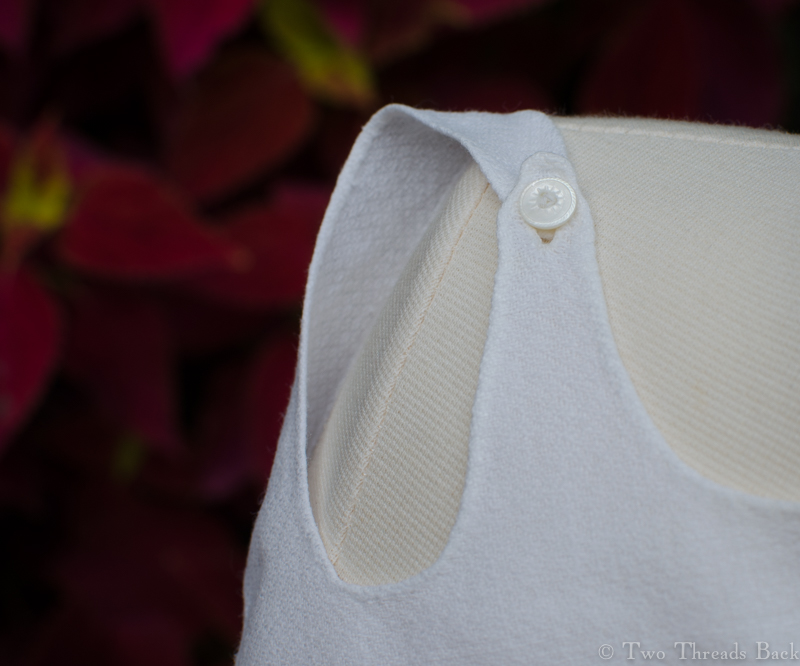
The hems are almost invisible, so I assume Mother was able to use both hands for that. The tiny buttons are made of delicately carved mother of pearl.

You can see the tiny mother of pearl buttons.
A close-up of the buttons and narrow hem.
The photo(s) are slightly underexposed because the apron is so white it's hard to see.
The photo(s) are slightly underexposed because the apron is so white it’s hard to see.
Apron 1D
The fabric is still so strong that the fold-down part in the front refuses to fold down – and I refuse to press it that way. Not a good idea for preserving old textiles!

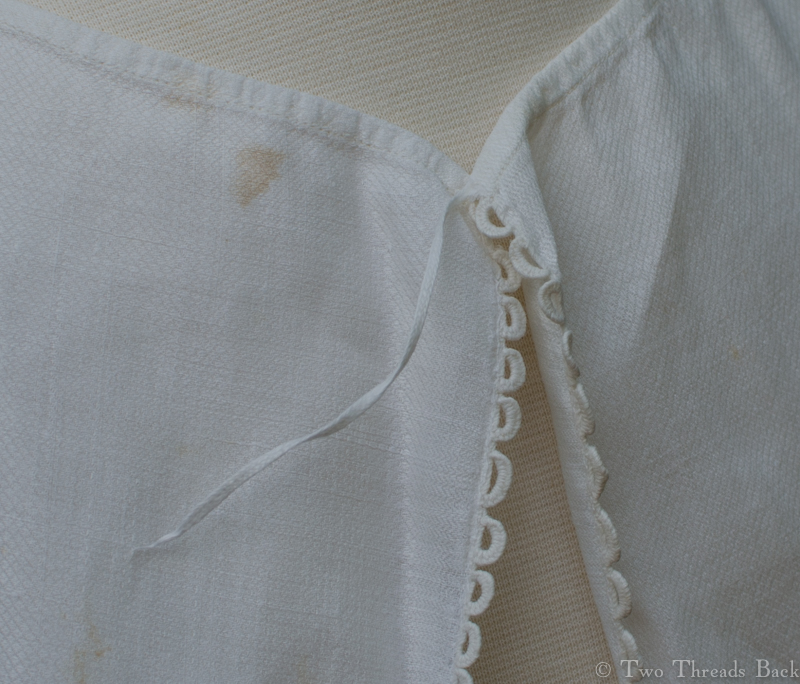
Another common pattern, made for an older child, is like the one pictured below. It’s also made of diaper – but in linen – and trimmed at the armscyes and hem.

Apron 2A
This one is less like a bib and more like what we’d call a pinafore today.
Apron 2B
A view of the back to show the tape threaded through the neckline and the pretty buttonholed trim.

Apron 1854 Thumb

Flower Patch 2

Flower Patch 02
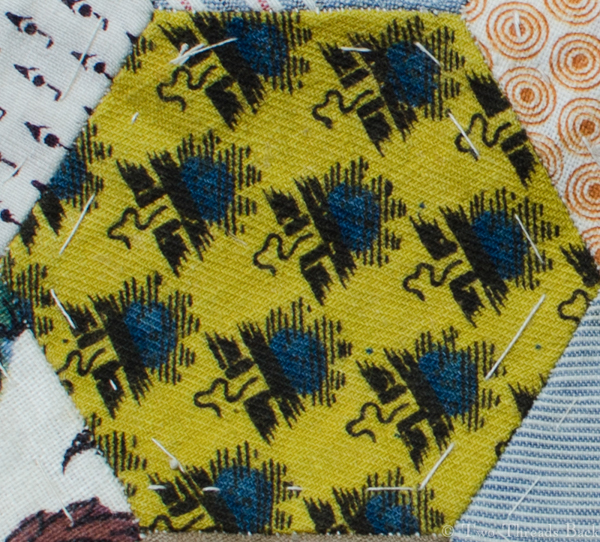
A bright yellow and blue calico patch, early 19th century.

Here we are with another patch from the same collection. There are a LOT of them, so I’ll probably not even mention that in future posts, but simply add the photo.

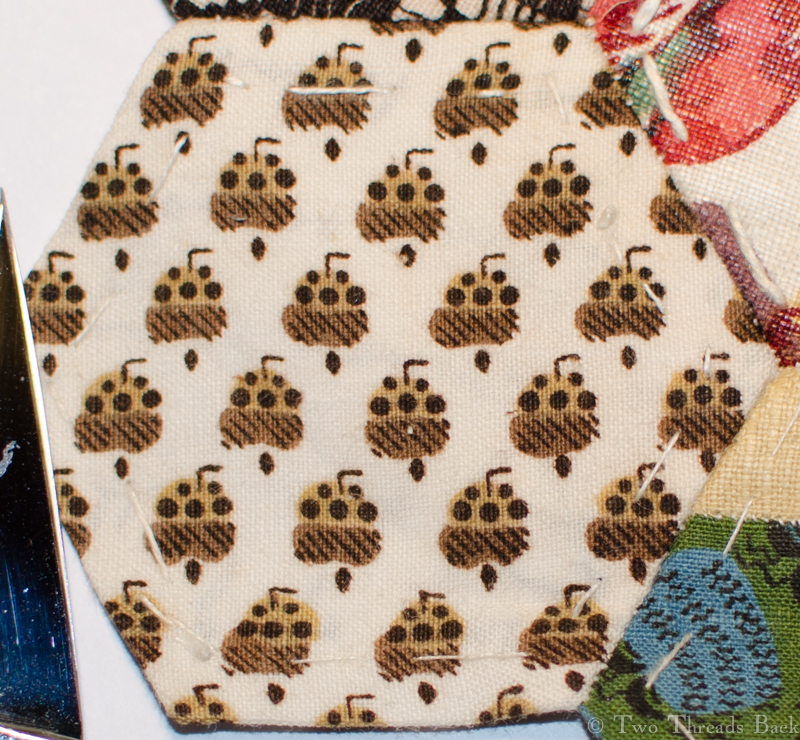
This one is bright and cheery in yellow and blue, with an absolutely bizarre design. It’s also reminiscent of Mousey Mousey – but perhaps when he was feeling blue on a bad hair day.


Fluffy Ruffles

Fluffy Ruffles 1
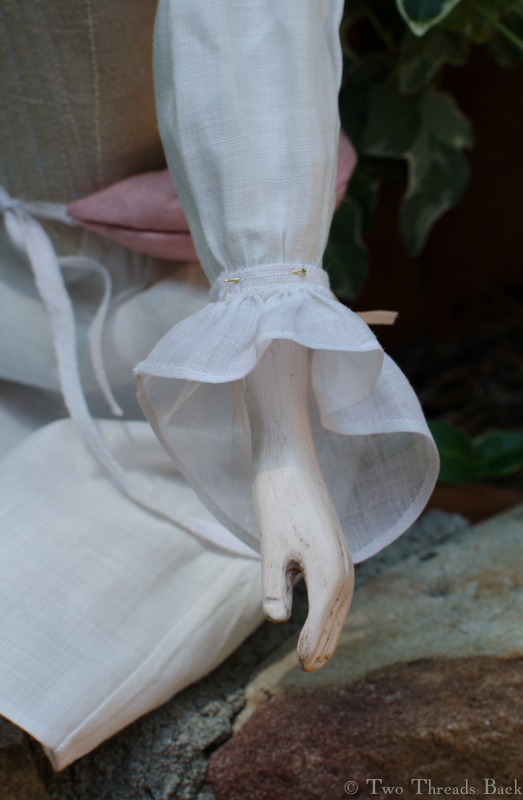
Engaging engageantes for Pharaby.

I’m not sure how I got distracted and neglected to let Pharaby show off her new sleeve ruffles, but we shall make amends. Here they are!

Fluffy Ruffles 2

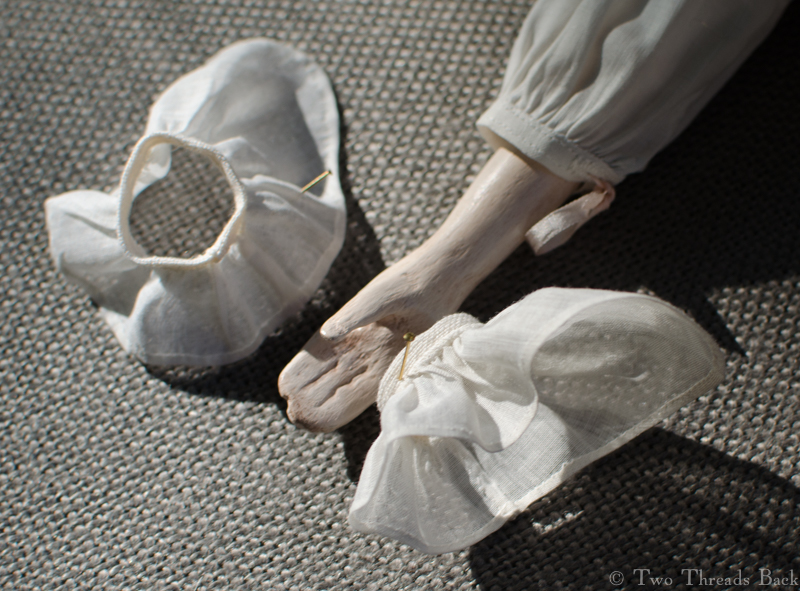
From that same stash of unsold ebay scraps I selected a pretty little bit of muslin. Now I admit I’ve handled a lot of fine muslin and can usually tell when it’s wearing Sizing of the Ages. But this piece had me stumped. It was originally an unfinished embroidery project with a homemade pattern marked in blue ink, a typical edging design, and I’m pretty certain it was mid-19th century. But washing – a lot – didn’t affect the nice bounce at all. So we got the effect of nicely starched ruffles without any stickiness.

Fluffy Ruffles 3

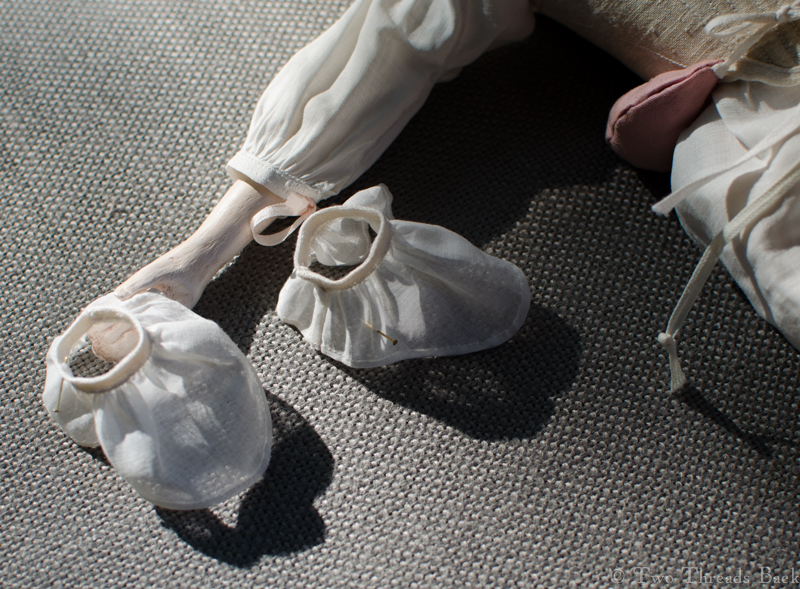
Fortunately, it was also forgiving. I managed to whip the edges with no problem, but one little ruffle had to be attached three times before I was satisfied with the linen band.

Fluffy Sheet Music
Fluffy Ruffles, 1907.

So now Pharaby has some fluffy ruffles. By the way, it was a family joke that my aunt named every pet she had Fluffy Ruffles. A little googling showed me why!

Fluffy was born in 1906, the creation of artist Wes Morgan, and featured in stories with verse by Carolyn Wells. Pretty, stylish, and spunky, she became a heroine of her era and the next few decades (that’s longevity for a fad!) saw her as a paper doll, a book, in music, on the stage, and yes, her catchy name was shared with crochet patterns and flower hybrids – and pets.

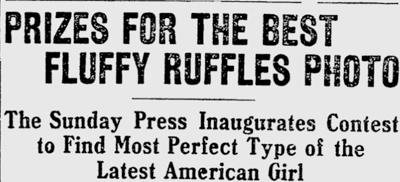
Fluffy Ruffles Contest
Fluffy Ruffles, the Perfect American Girl.


Drum Roll for the Bum Roll

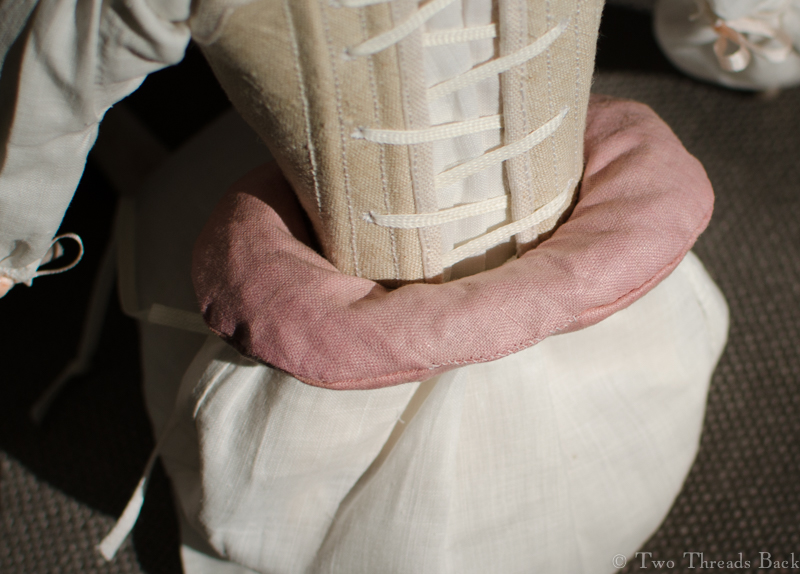
Bum Roll Front
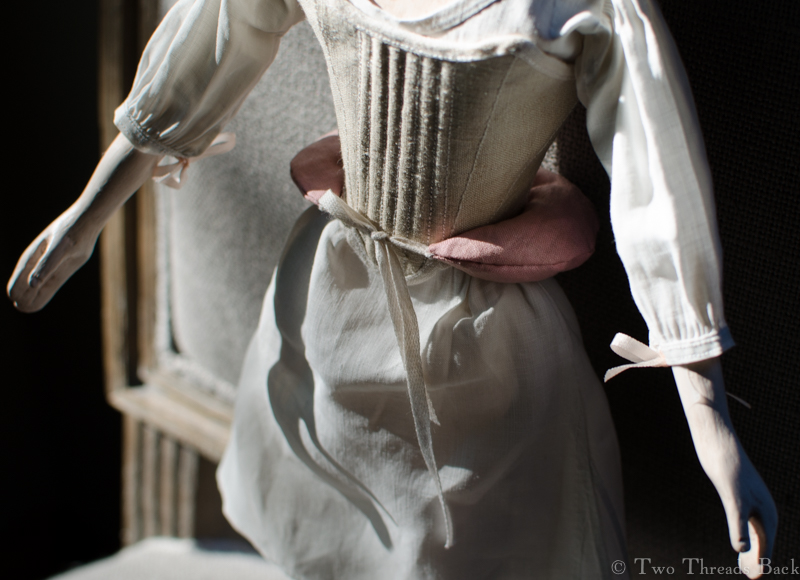
Fashionable Pharaby’s new cork bum.

Yes, Pharaby insisted on having this article in her wardrobe, the euphoniously termed BUM ROLL. The “cork bum” was subject to ridicule at the time, but goodness knows ridicule and fashion have always been comfortable together. Magazines of the day enjoyed satirizing high style:

“Nature appears to have been but a kind of bungler, We mortals are obliged to alter every piece of her works, before it can be fit to be seen…

And after all this being done, a Lady was supposed to be quite finished—

No such thing—

What was wanting?

What was wanting ? Blockhead! Don’t thee know?

A BUM was wanting !!

A BUM ! —

Mercy on us ! Who would have thought Nature could have made such a mistake as to create Ladies without bums.

Nothing is more certain. —

Bum-shops are opened in many parts of Westminster for the sale of cork bums, and report says they go swimmingly on.

Tall ladies, and short ladies — fat ladies and lean ladies, must have bums —

And this is what they call getting up behind.

So that in fact, a fashionable female, if she lay on her face, or creep on all fours, would exactly resemble a camel with a hunch in the middle of the back….

Let it be recorded, that in the auspicious year 1785, BUMS FOR LADIES, were made, cleaned, and repaired, so as far to exceed nature in size, or convenience.

When researching this little artifice, I was intrigued by the references to cork. Farthingales, panniers, etc. had been around for ages and were effective in supporting heavy skirts. So why cork, and what did they look like? I found a website that provided the most amazingly extensive research on the subject of skirt supports ever — with excellent images. And another site by a brilliant costumer who experimented with using cork blocks for the same purpose.

But I couldn’t find any images of extant cork “bums” to go by. So would Pharaby be happy with wool stuffing? Or would she insist on cork?

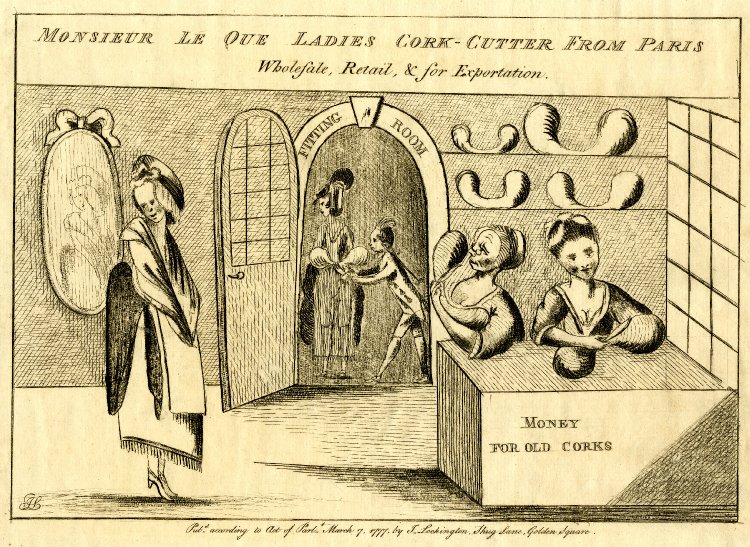
Cork-Cutter Cartoon
Ladies Cork-Cutter, 1777. Gives a whole new meaning to “put a cork in it.”

You know the answer. The next question being, what kind of cork?  The advantage, like the disadvantage, of dressing dolls is the scale. I could use a cork coaster to try carving a shape and then covering it, but the tiny size required was more than I wanted to tackle.

What if I used cork “crumbs”? One period satire implied that cork pieces were used: “Money for your old corks.” Ergo, they were cut, shaved, crumbled, etc., and used like stuffing. Well ok, maybe not. Maybe “corks” was short for “cork bums” and they wanted them for resale or recycling. I’m speculating in an attempt to defend my choice. Whatever, we went with cork granules.

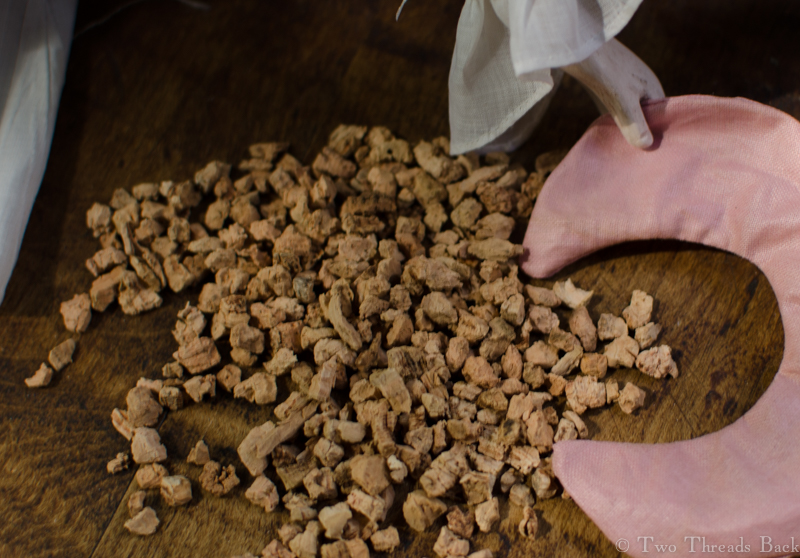
Bum Roll CorkNow, my husband makes wonderful wine (as a hobby — woohoo!) so why not crumble some corks we already have? Or chop up that trivet? Cheap, easy, and immediate, so of course I didn’t do it that way. My life is pretty tame and I was craving a touch of the exotic, so Pharaby and I sent for a package of cork from Portugal. I figured I could use the leftovers later for stuffing some vintage toys, to give them that authentic lumpy look.

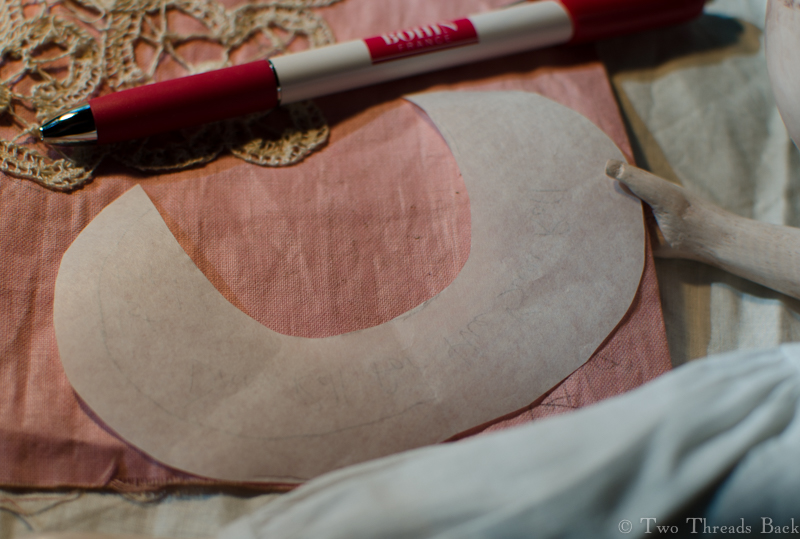
Bum Roll Pattern
First freehand try for a pattern, yay!

I drew a pattern (and used the first attempt, I’ll have you know). I found some grubby pink glazed cotton which I’d unsucessfully, thank goodness, tried to sell on ebay. And then I stitched and stuffed and added ties.

Let it be recorded that in the auspicious year 2014, Pharaby’s figure was enhanced.

And she did need it. Most wooden dolls are not noted for their shapely behinds.


The tricky part was getting cork from
The tricky part was getting cork from the outside to the inside.
Bum roll back.
Her rear from the rear. What a corker!


The Flower Patch

Flower Patch 01
An early cotton calico from English Paper Pieced Patchwork. (Say that really fast.) It measures 2×2 inches. The odd thing on the left is my embroidery scissors holding down the edge.

Welcome to the Flower Patch! Back in the olden days when I was a child, my sister and I would sometimes take our afternoon naps on “pallets.” These were great-grandma-made quilts, all soft and worn, laid on the floor in front of an electric box fan (we lived in The South). Compelled to be still and quiet, we’d make a game of picking out our favorite patterns. Of course it sometimes degenerated into squabbles: “You can’t have that first favorite, ’cause it’s my first favorite!” We’d usually fall asleep and wake up best friends again.

I’ve recently come across a few little quilt bits – can’t afford whole garments or quilts – from my favorite era, the early 19th century, and thought I’d post a picture of a patch now and then. I wanted to record all the patterns anyway, and this seems like a good way to share them at the same time. If you happen to recognize a print, or are blessed enough to have the whole garment (which might give me the vapours), I’d love it if you’d let me know!

These patches are from an “English Paper Piecing” set. I believe it dates to the early 1800s, not only because of the patterns but because some of the paper that’s used on the back is c1808-1812. There are a few pages from English newspapers (London National Register, Monthly Magazine, etc.), private letters, and a whole lot of pages from an old copybook. Of course that doesn’t make a certain date; some fabrics could be earlier or later and it all could have been pieced later. But I’ll leave that to the experts.

Mousy Mousy
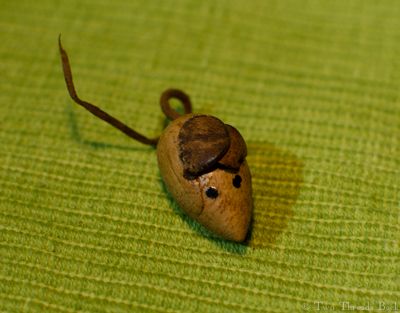
Mousey Mousey: a survivor.

The first patch I selected has a peculiar pattern. It reminds me of poor old Mousey Mousey. Mousey Mousey was a beloved toy that I still treasure, though heaven knows how anything so small (less than an inch) could survive the many decades and almost two dozen moves he has (we have) been through.

Pictured above is Flower Patch #1. By the way, it’s not my first favorite.


All Dressed Up & Nowhere to Sew

Sewing in the Parlor
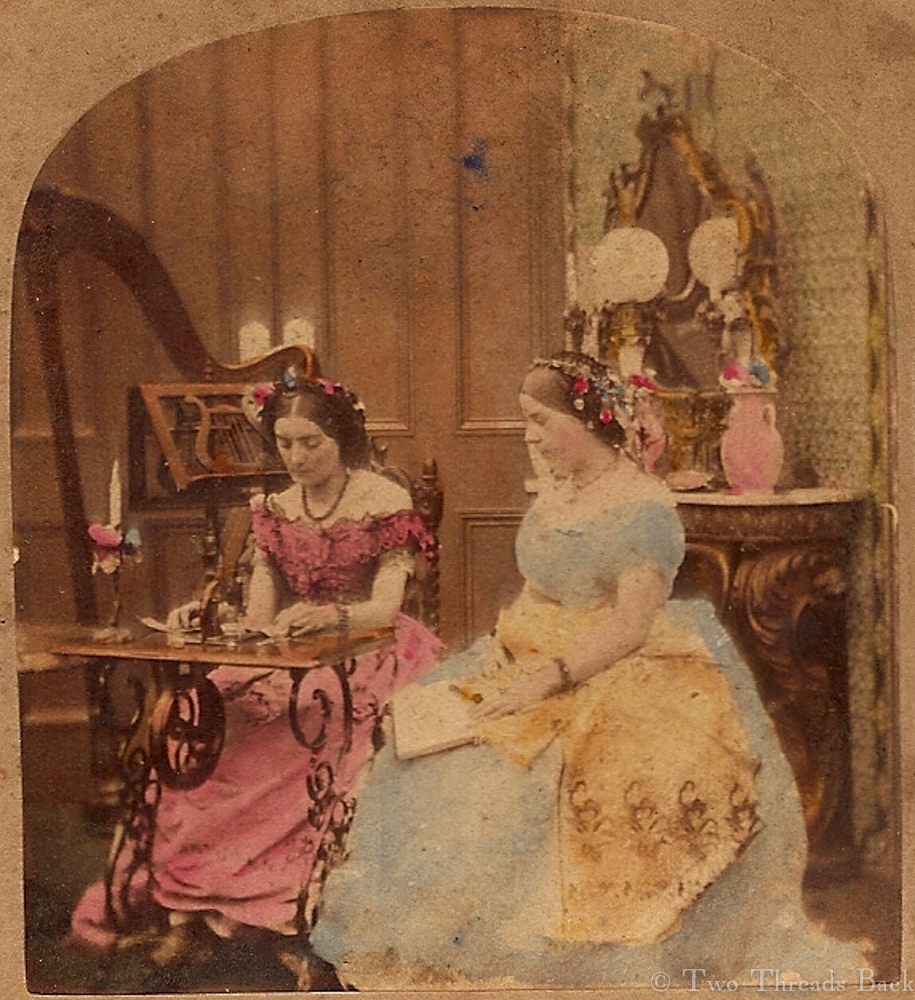
Sewing after dinner.

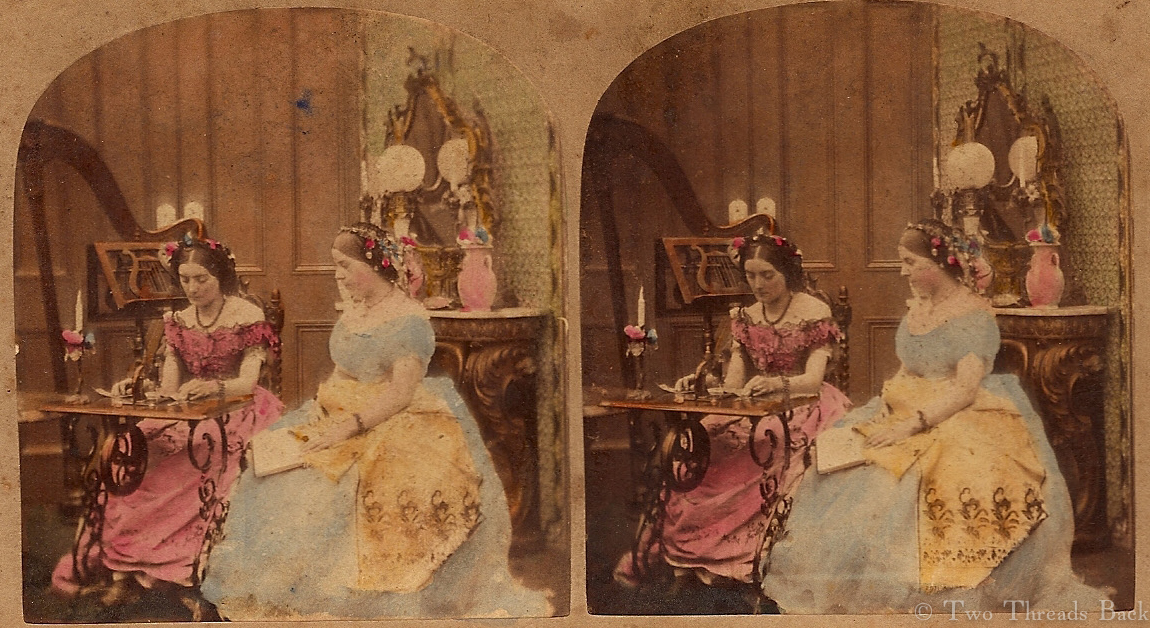
Except the parlor, perhaps? Well, it’s identified on the back as the boudoir, but the meaning of words changes according to time, place, and whim, so we’ll accept her terms. This is a charming stereoview image of two circa 1860s ladies in full dinner dress, sitting down to play with their new sewing machine.

I can’t identify the machine, but I see the seamstress has a music stand and harp close to hand, just in case she wearies of needlework. And a friend with a manual close by to instruct and advise. (Ok, it’s not a manual – what could it be?) A picture-perfect postprandial occupation while the gentlemen are smoking: a lamp, vases of flowers, elegant furnishings, and a congenial companion – what more could you ask?

Sewing in the Parlor Stereo
Full stereoview of the new sewing machine.

Little Biggin Two

18th C Cap 2a
Another 18th century baby’s cap – with frills.

This little cap is a favorite. Yes, the linen is coarser than the lovely smooth cambric in most of the other really old baby things I’ve found. The slubs are noticeable, and they show even more due to washing and wearing. But there’s just something about that little ruffle around the brim. And the extra gathers right in the center – can’t you just see them sticking up, stiff with starch? Rather like a little plume or crest!

18th C Cap 2b
A perfect frame for a baby’s face.

The measurement around the brim, including the ruffle, is about 12 inches; the center front to the back is about 9 inches.

18th C Cap 2f
Baby’s cap with the two-part brim folded open.

It seems like every time I examine a garment to write about it or list it for sale, I find something I’d overlooked before. And sometimes it’s unusual, a feature I haven’t seen before. That happened here, too.

The little crown was stroked and gathered and attached to the upper brim with backstitches, the same way cuffs or collars were attached to shirts. Then the under-layer-brim was hemmed to the crown from beneath. That does make the technique look like “setting in,” a construction process taught from (at least) the 18th to the early 20th centuries – if you’re one of the rare people who’ve seen my book Plain Needlework, you know what I’m talking about.

The strangest thing though, is how the upper layer is hemmed. It’s backstitched! But not securely on the folded hem itself; instead the stitching rests along the very edge. In fact, I really don’t see how it holds. I’ve looked at it with magnification because it’s so different from what I’m used to seeing. But that’s right. The hem is barely caught with the backstitches.

The under layer is normal – if you can call a 1/16 inch hem normal; it’s simply hemmed. Then the ruffle is whipped and gathered on both. The back of the cap is gathered and set in a narrow band, also with backstitching.

18th C Cap 2c
A closer view of the “plume” – and you can see the backstitched hem.

Like last cap I wrote about, this one is in remarkably fine condition and there are no vestiges of ties. Unlike many other fine linen bits, it’s lost its starch. I think the wearer would have approved. Floppy ruffles are more comfortable.

18th C Cap 2e
A back view of the cap.

18th C Cap 2d