In honor of Mother’s Day, I thought I’d share one of my happiest memories. I don’t have many things saved from my childhood, but I do have this beloved dress made by my mother. Barbie was the doll when I was growing up, and oh how my sister and I loved playing with ours!
We put them through the tortures and triumphs of every book or TV plot we knew – and invented even more. They pioneered across raging rivers, got lost in space, and escaped drowning in birdbaths. Once we discovered that flour paste hardened into the perfect cast for a broken limb, our poor Barbies fell out of so many trees that they looked like mummies on crutches.
But best of all was dressing them. You hadn’t really played Barbies until you’d changed their clothes at least a dozen times. One special Christmas my mother made Barbie clothes for us – and if you have two little girls close in age, you don’t make a few different ones for each child. You make two of everything, both alike.
To a seven year old, surprises just happen. I never wondered how the splendid array of doll costumes came to be under the tree. But my mother told me later that she had to sew late at night, after we were asleep. Two. Of. Everything.
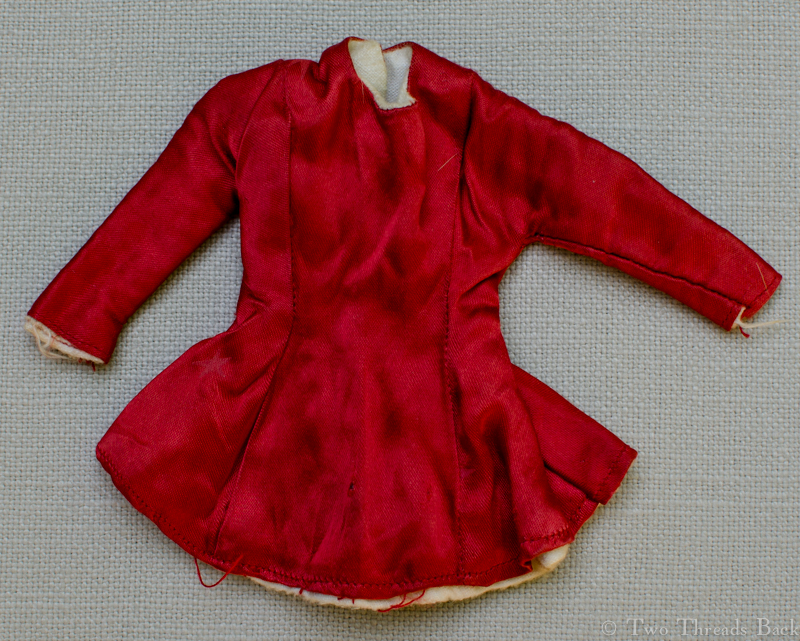
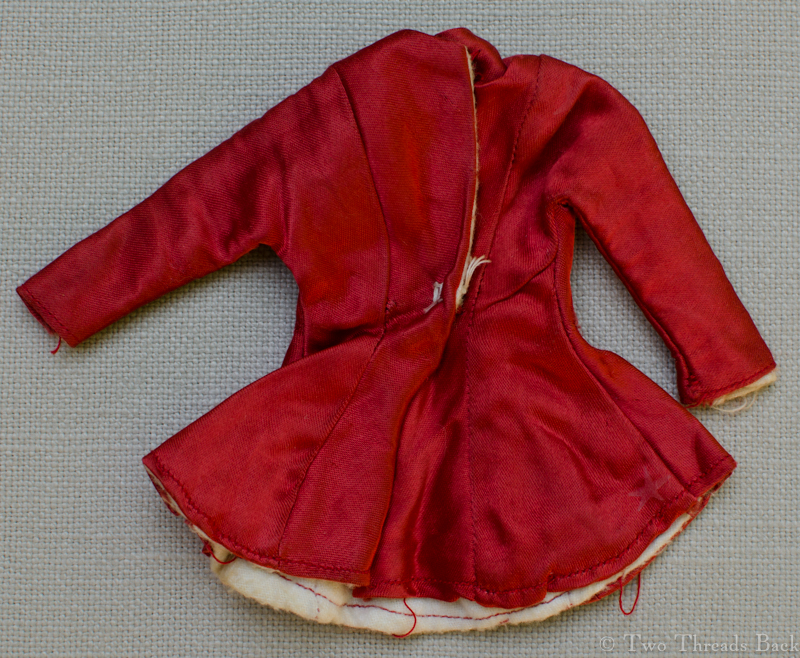
Here’s the skating costume that she made out of red satin, lined with white flannel. She couldn’t have known the night she sewed this that her work would still mean so much, so many years later. I’ll be sure to tell her today.
Actually, that should be “Pharaby Sets Her Cap Aside” – for now, anyway. I haven’t completely neglected Pharaby all these months, but sometimes remembering to take photos, and then remembering where I saved them, delay my writing about her wardrobe’s progress.
This project also took longer than I thought it would. It was hard figuring out what I wanted her to wear. Most surviving Queen Anne dolls just have little bits of lace and silk gathered and stuck atop their heads, or if they’re wearing more constructed caps, the photos don’t show sufficient details for me to copy. And sometimes the surviving headwear is not original to the doll, being so obviously 19th century that even I can tell!
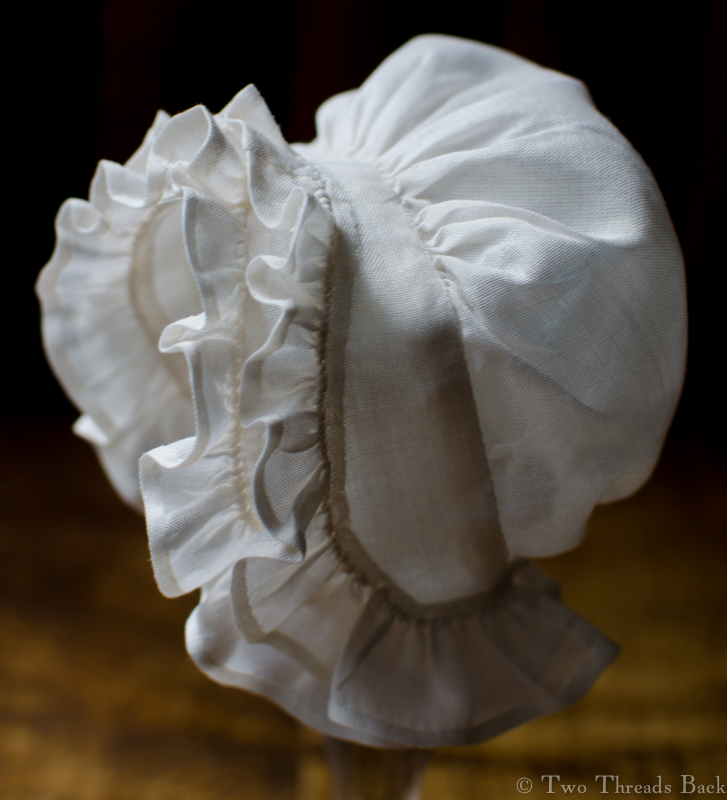
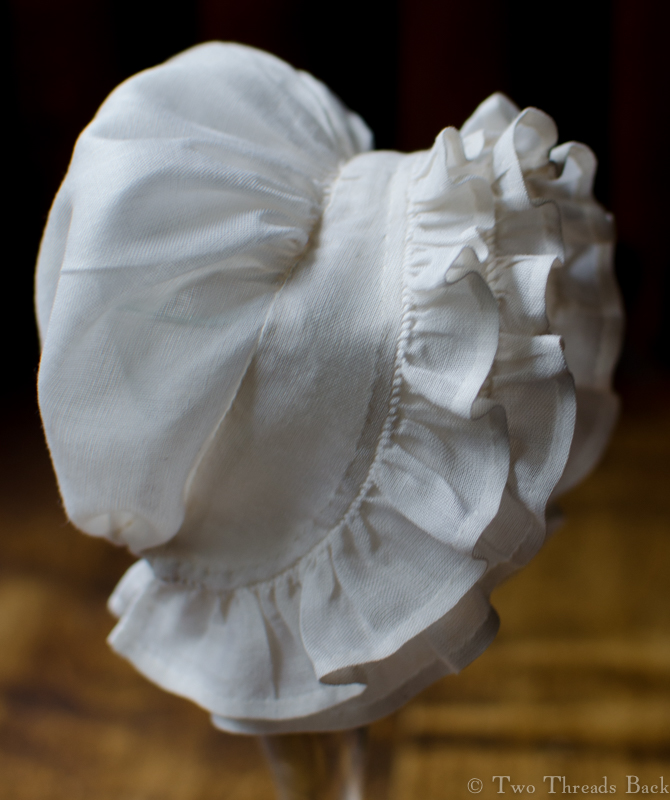
In the end I decided on this style, because it was easy to make a pattern and I’m familiar with the sewing techniques. The cap is formed from a simple half circle gathered at the base of the neck and the crown and trimmed with plain frills.
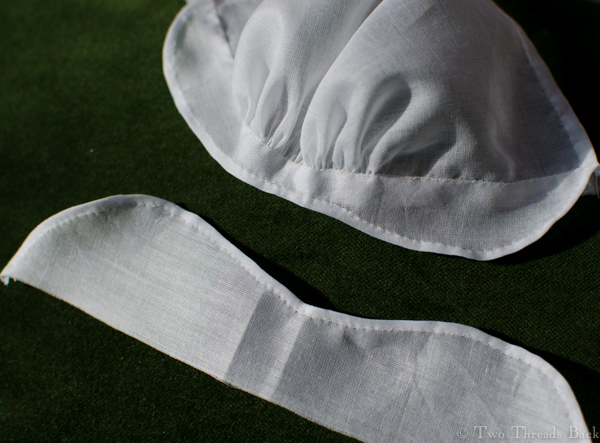
I did experience one of those aha moments when attaching the headpiece/band/brim to the crown. It was easy to “set in” the little gathers on the top thanks to the fact that the band was double. It worked just the same way as setting a gathered sleeve into a cuff! Maybe that’s why they so often had double brims?
My attempt at narrow hems was a flop, at least compared to what 18th century women could do. But I did manage a very nice tiny eyelet for the back drawstring. It would have been nicer if I’d also remembered to put in the strings and tack them in place before I hemmed the casing down! Did you know that you can thread a large needle and retro-fit a string into a casing?
Perhaps you’ve noticed none of these pictures show Pharaby wearing the cap? That’s due to my inadequacies as a perruquier. Every time I place something on her wig and then remove it, a few mo-hairs (groan) come loose from the carefully arranged style. In order to keep it all together until her final dressing, I had to limit the try-on’s. Pharaby won’t be modeling her cap for a while, so I let a wineglass serve as a mannequin – and then serve to celebrate one more project done!
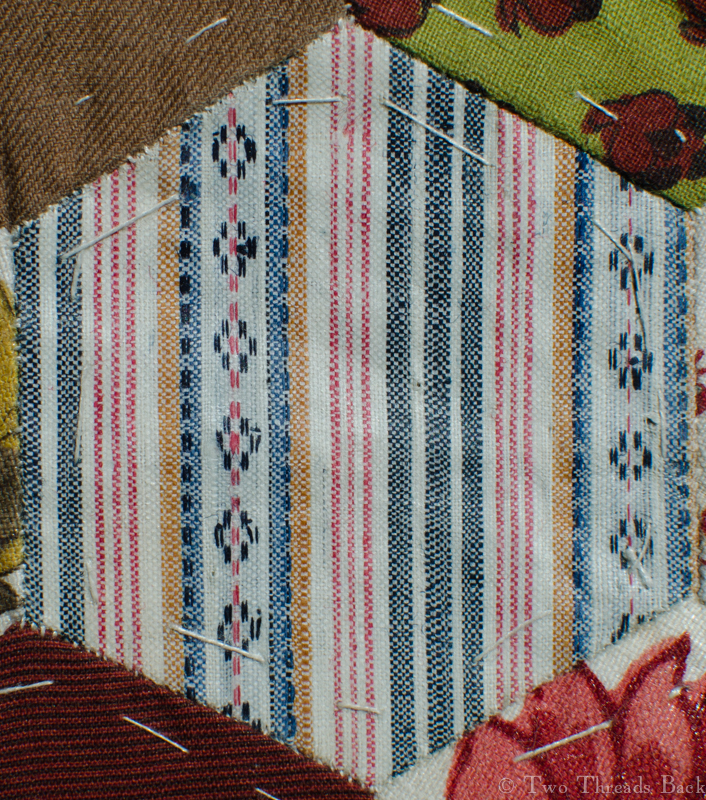
Perhaps I should have titled this “What Do You Do When Old Looks New?” These stripes are from the same early 19th century quilt as all the other Flower Patch samples, but they look so modern to me that if I weren’t completely sure about their age, I’d think someone was sneaking in new fabric. However, I’m convinced that all the different fabrics date to within the same few years. (Any fabric experts passing this way are welcome to call and opine!)
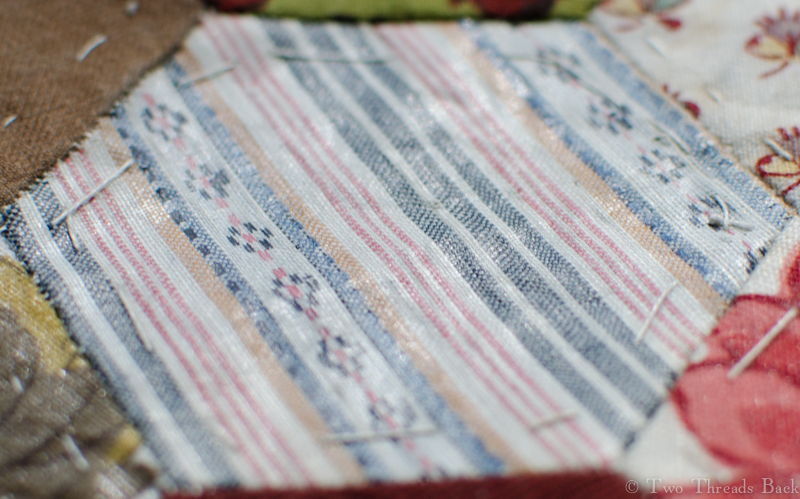
I could easily see this pattern on a man’s shirt today. But what would it have been used for then – gowns, aprons, children’s clothes? These have the same glazed finish that many of the others do, and I’ve added the very last picture to try to show that.
The same piece from the back.Another very contemporary looking pattern.How appropriate for a blog: Opinion Opinion Opinion…I’ve tried to show how shiny the sizing is, but you may only see a really bad photo.
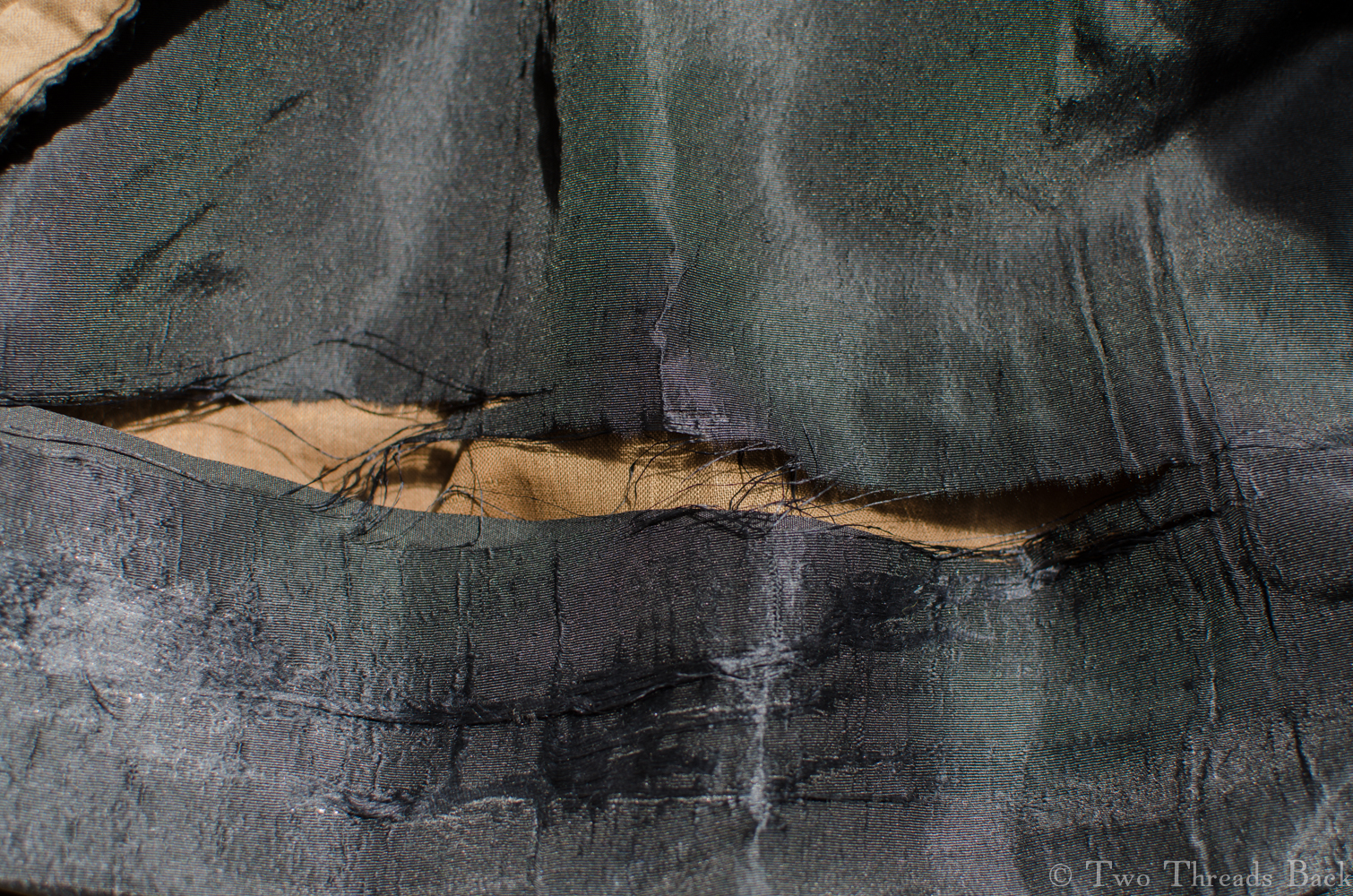
No, I’m not delving into postmodernism here, I’m talking about sewing – and unsewing! I was sitting on my porch last week, relishing the warm spring breezes and taking advantage of the bright afternoon light to salvage a sad old black silk skirt. As I worked, I realized that most of the sewing had been done by hand, and that I might pay tribute to those hands by sharing pictures before it was gone forever.
Silk damaged beyond repair.
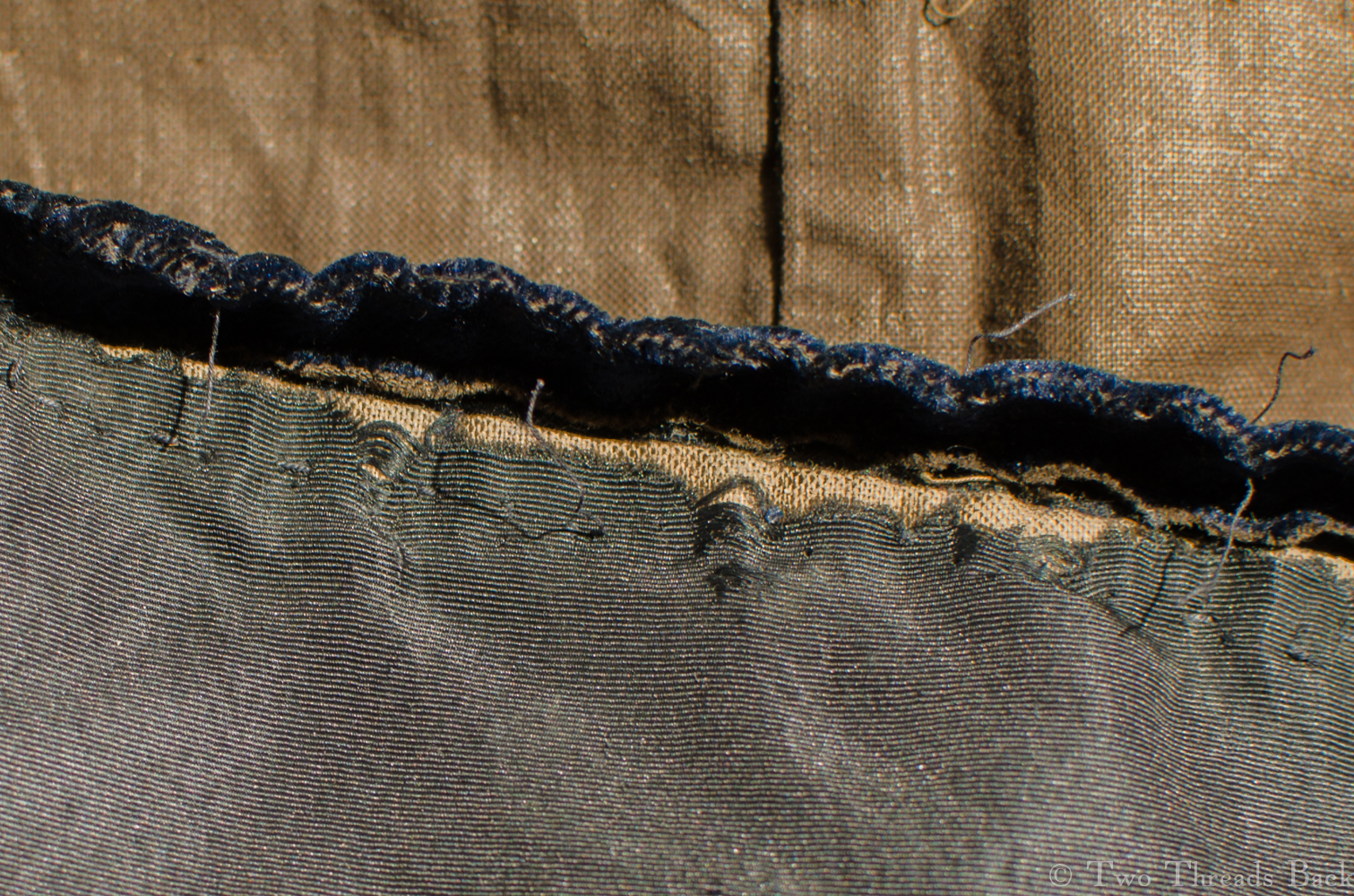
Lest you think I cannibalize antique textiles lightly, let me assure you there was no saving this piece. It was a silk faille gored skirt – of such a generic cut that I hesitate even to date it – which had begun to shred and shatter all over. The lining was in excellent condition though, so I wanted to preserve that for reuse.
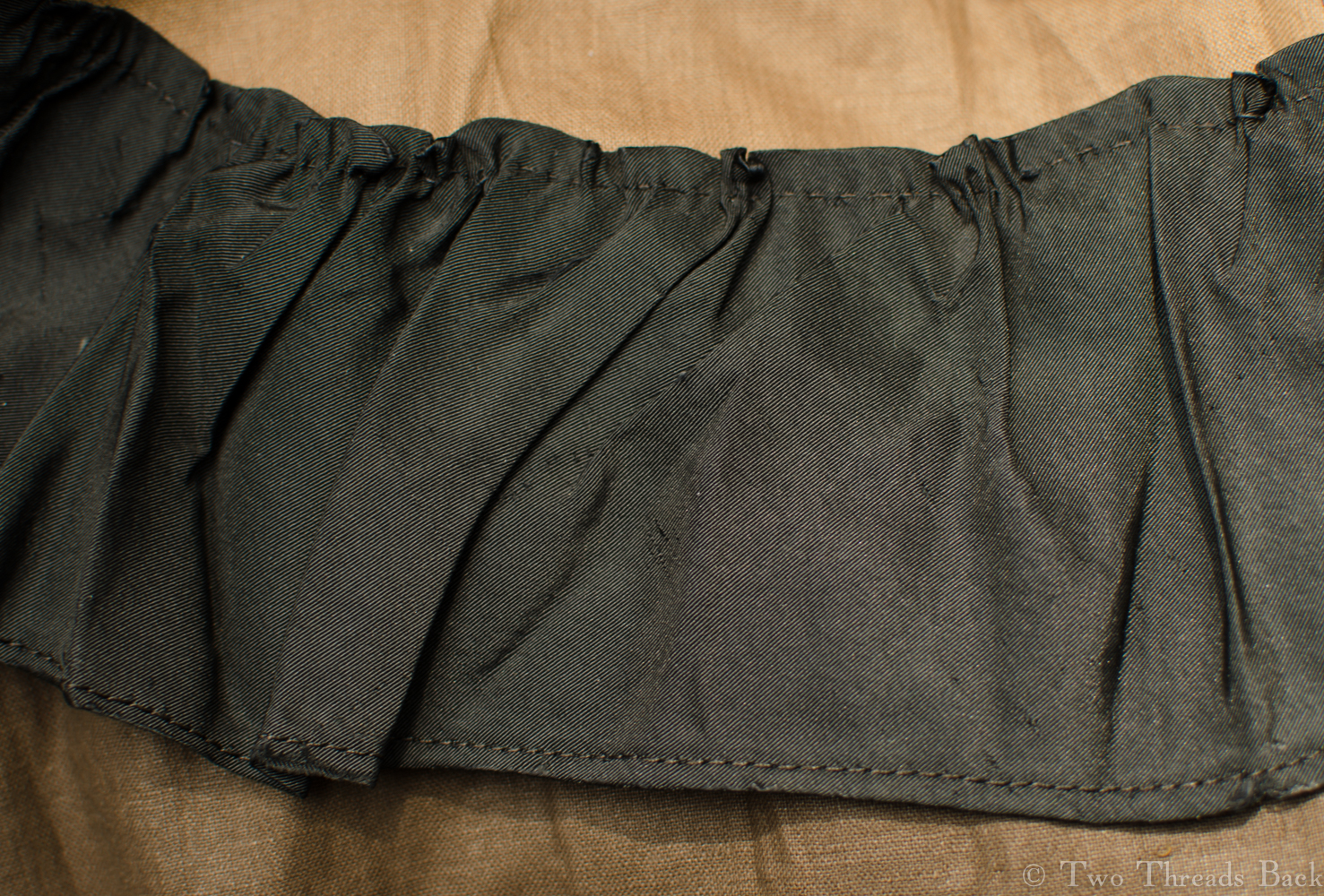
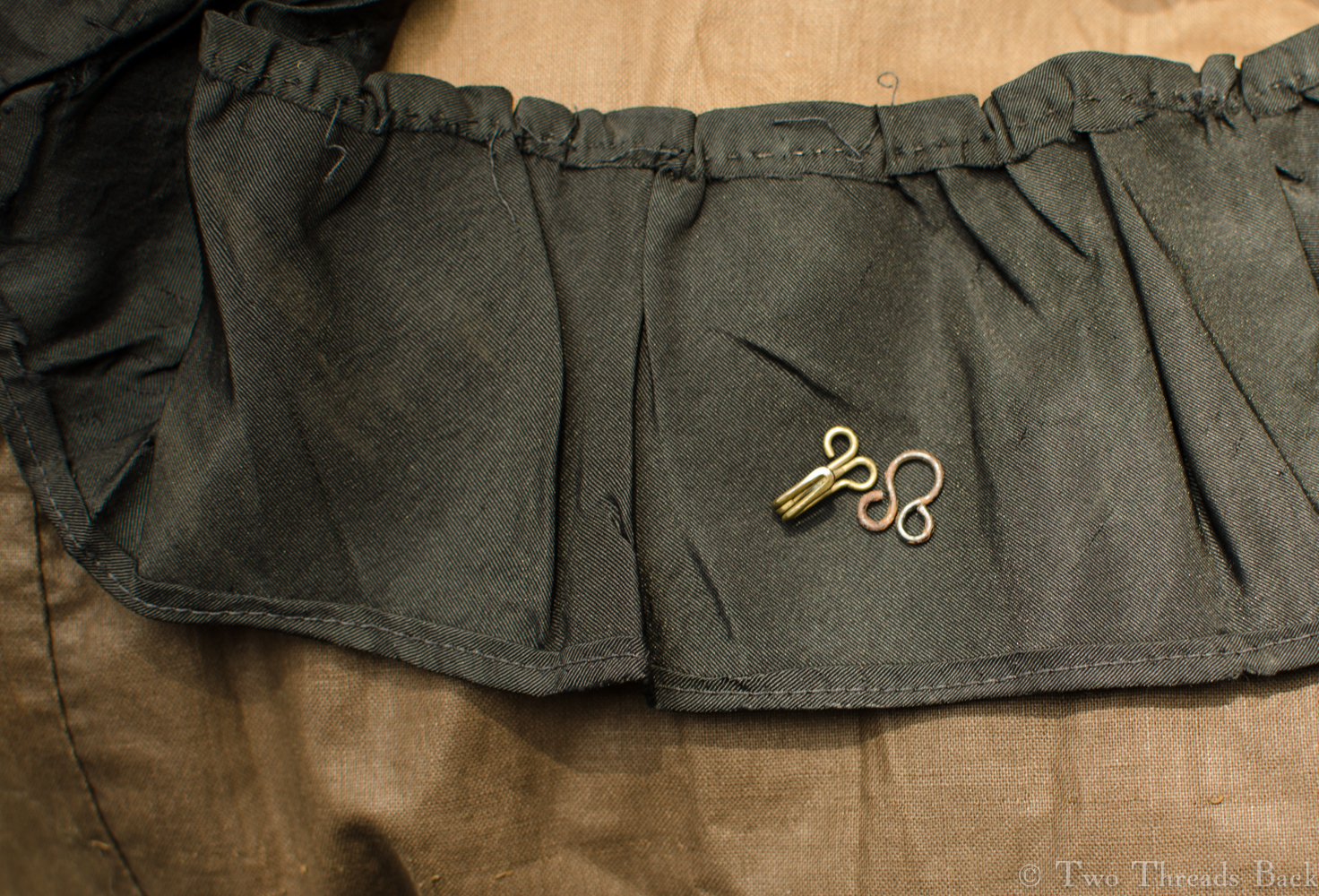
Unfortunately, I didn’t think to take a picture of the whole skirt before I began. Although it might not have added much to this post since solid shiny black is notoriously hard to photograph! The cut was smooth and somewhat fitted across the front, tapering slightly toward an “A-line” silhouette, with tight gathers in the back. It had a narrow waistband, and two tiers of ruffles trimmed the hem.
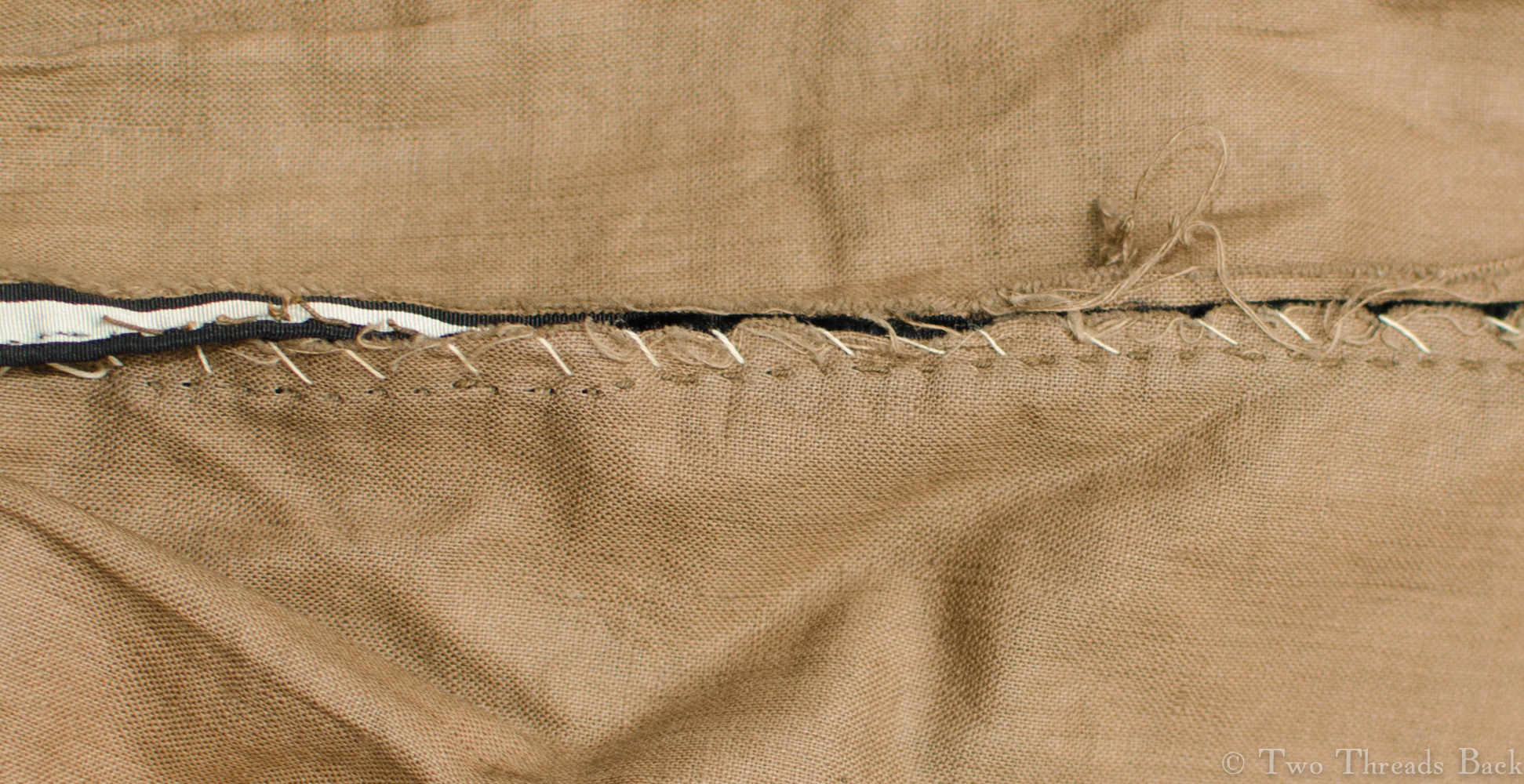
Side seam of skirt, running stitches with a few backstitches piled on for good measure.
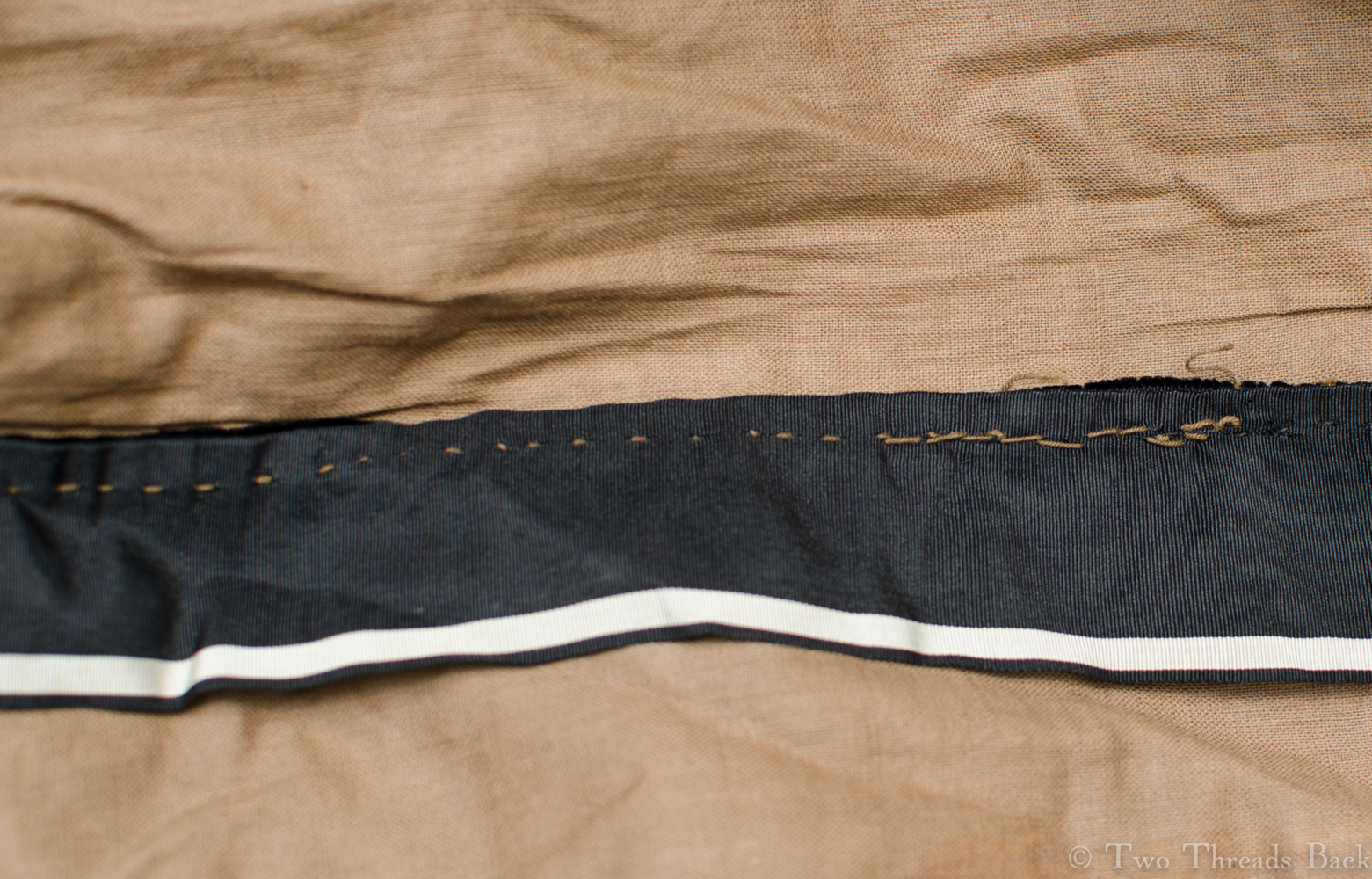
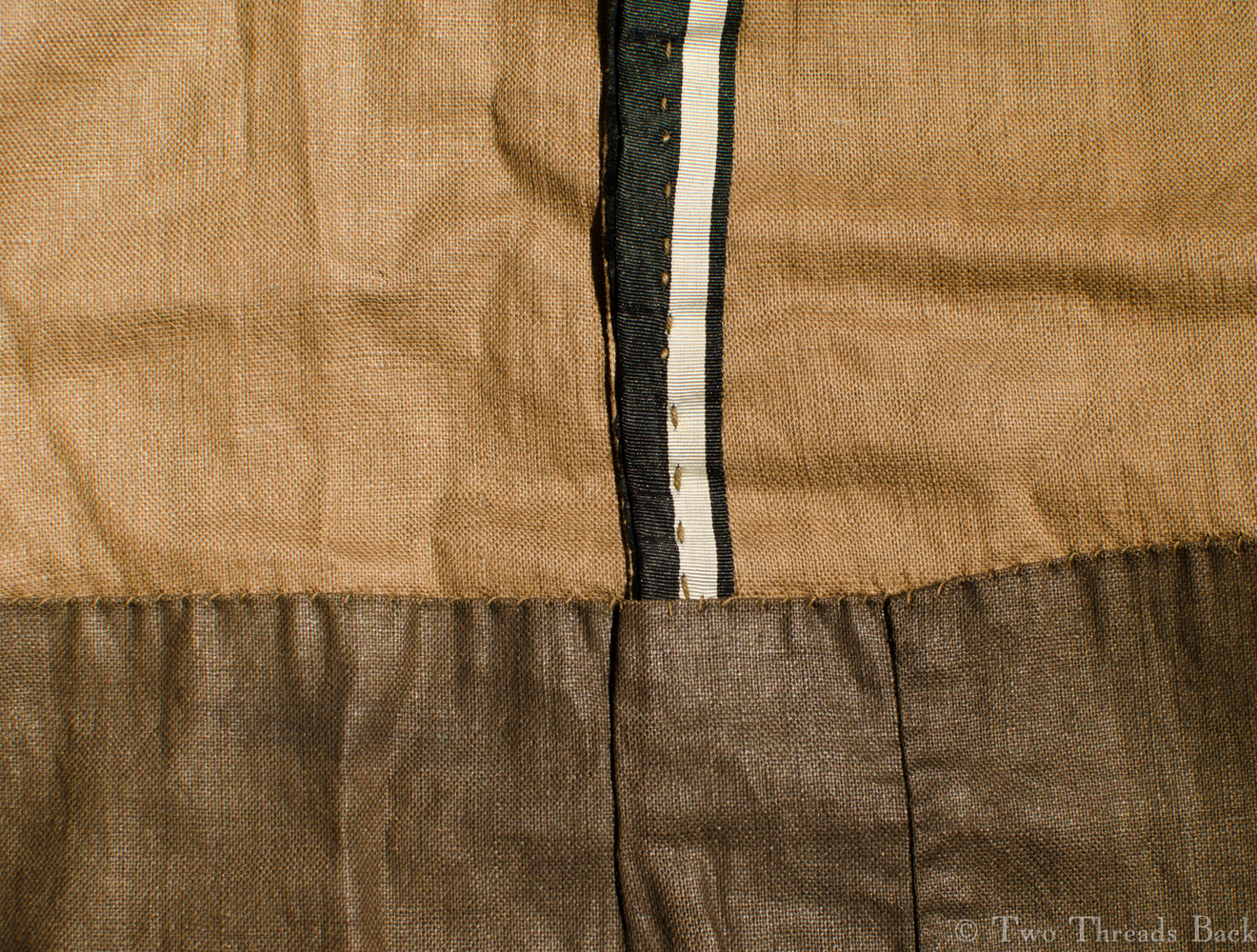
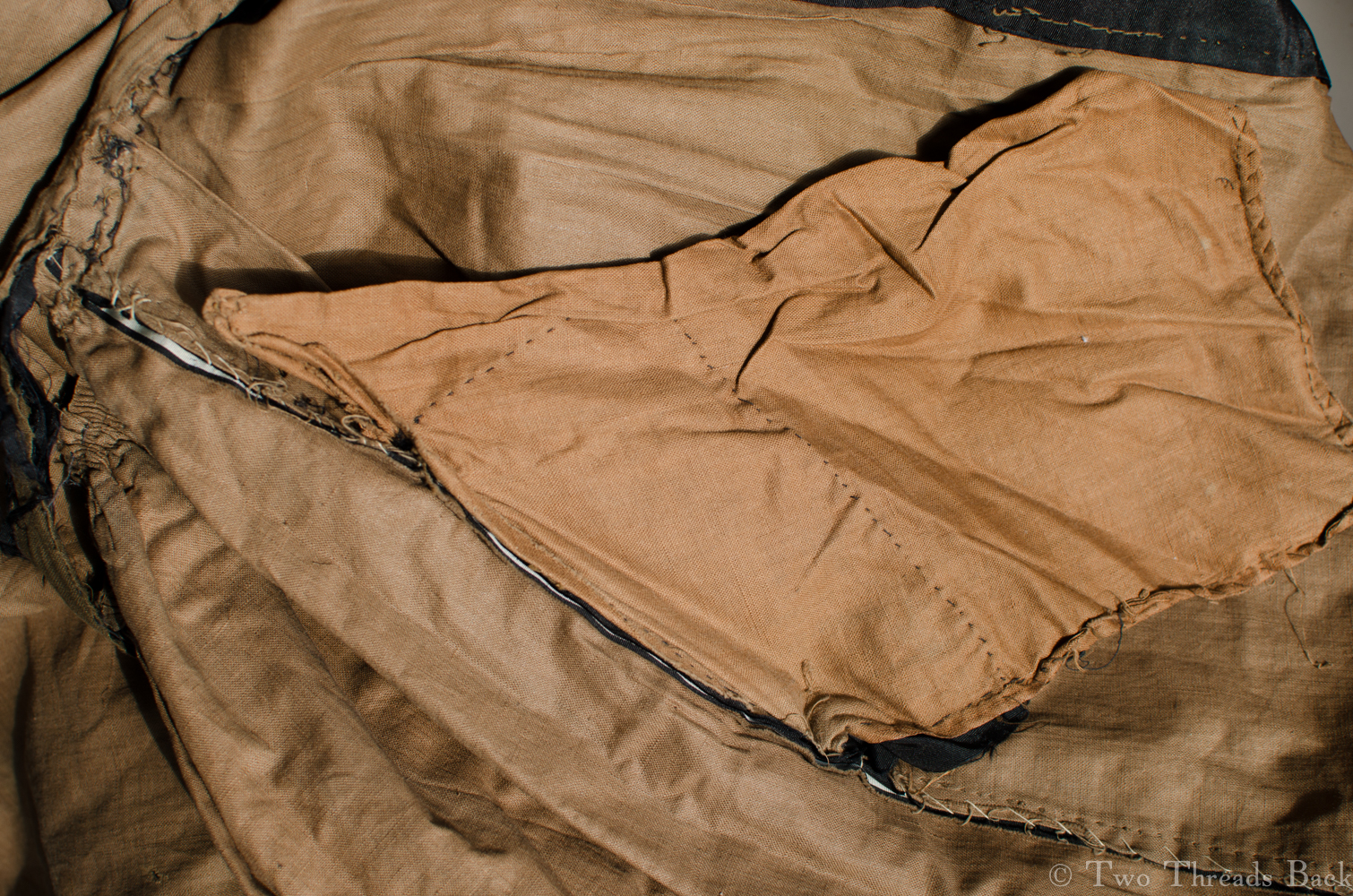
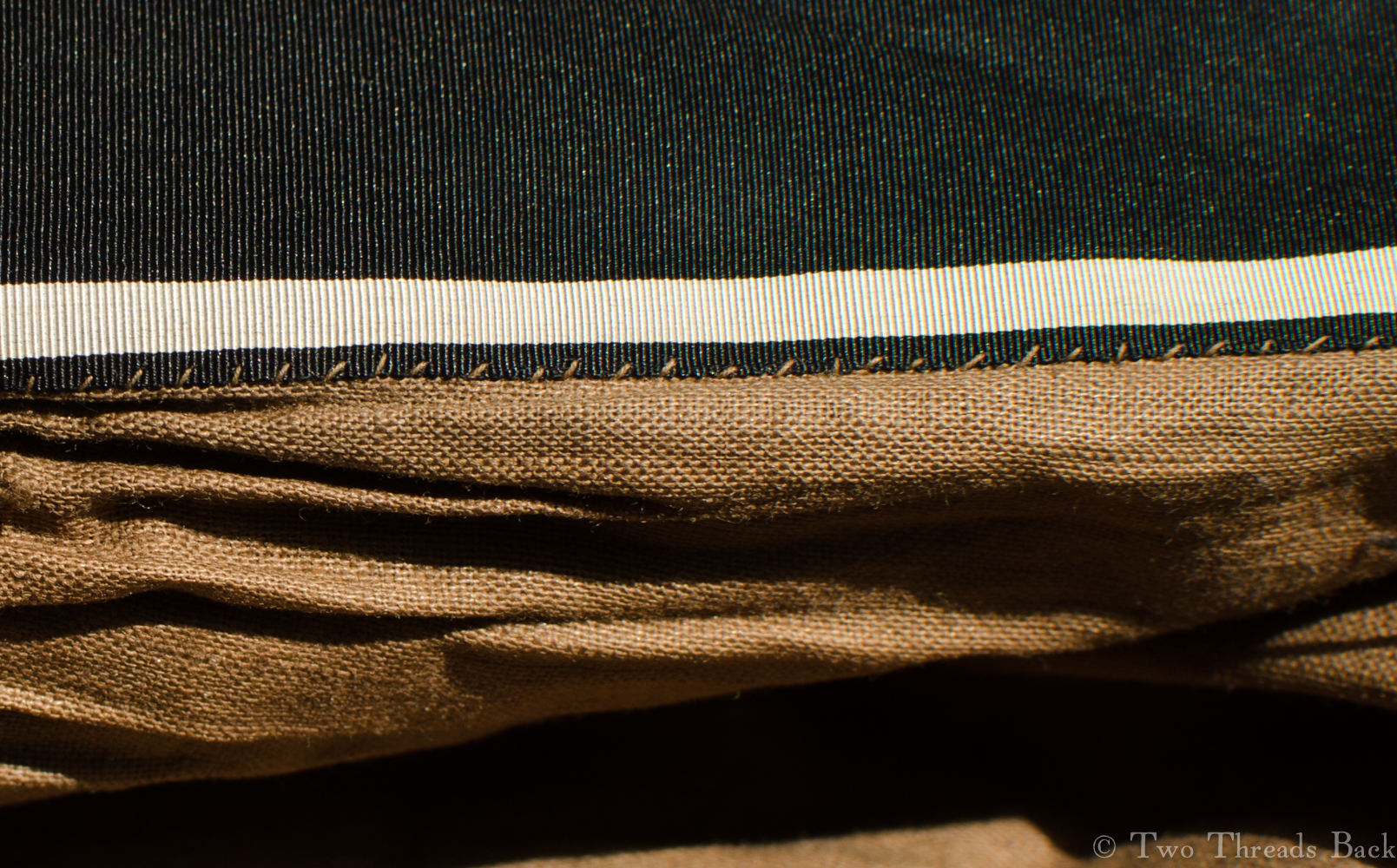
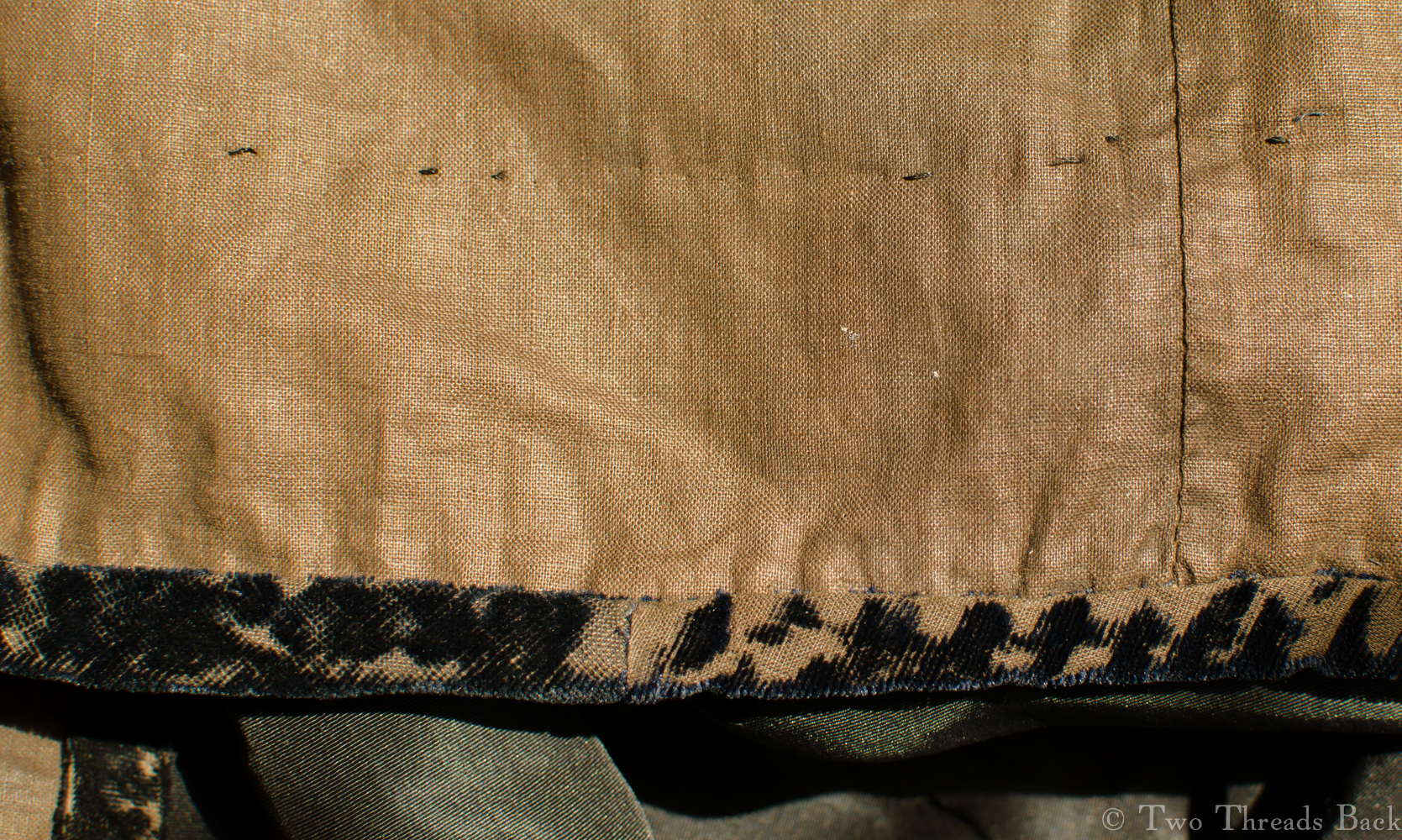
The silk fabric was about 21″ wide with white stripes along each selvage. The skirt was completely lined with the standard brown cotton, and then an extra piece of darker glazed cotton was added to the bottom ten inches. A velvet binding strip protected the edge of the hem. There was one deep pocket which looked like a later, rather clumsy, addition.
The extra lining along the lower part of the skirt is neatly hemmed down.A view of the pocket from inside. Maybe added later?
I hadn’t expected to find hand sewing in this piece, so I was intrigued to note the different types of stitching and thread. The long side seams used a basic running stitch made with a heavy brown cotton thread. Although the finished skirt was nice and sturdy, some of the stitches weren’t particularly neat or even.
The only seam finishing, overcasting, was done where the lining edge was raw. I don’t think the maker was too worried about raveling.
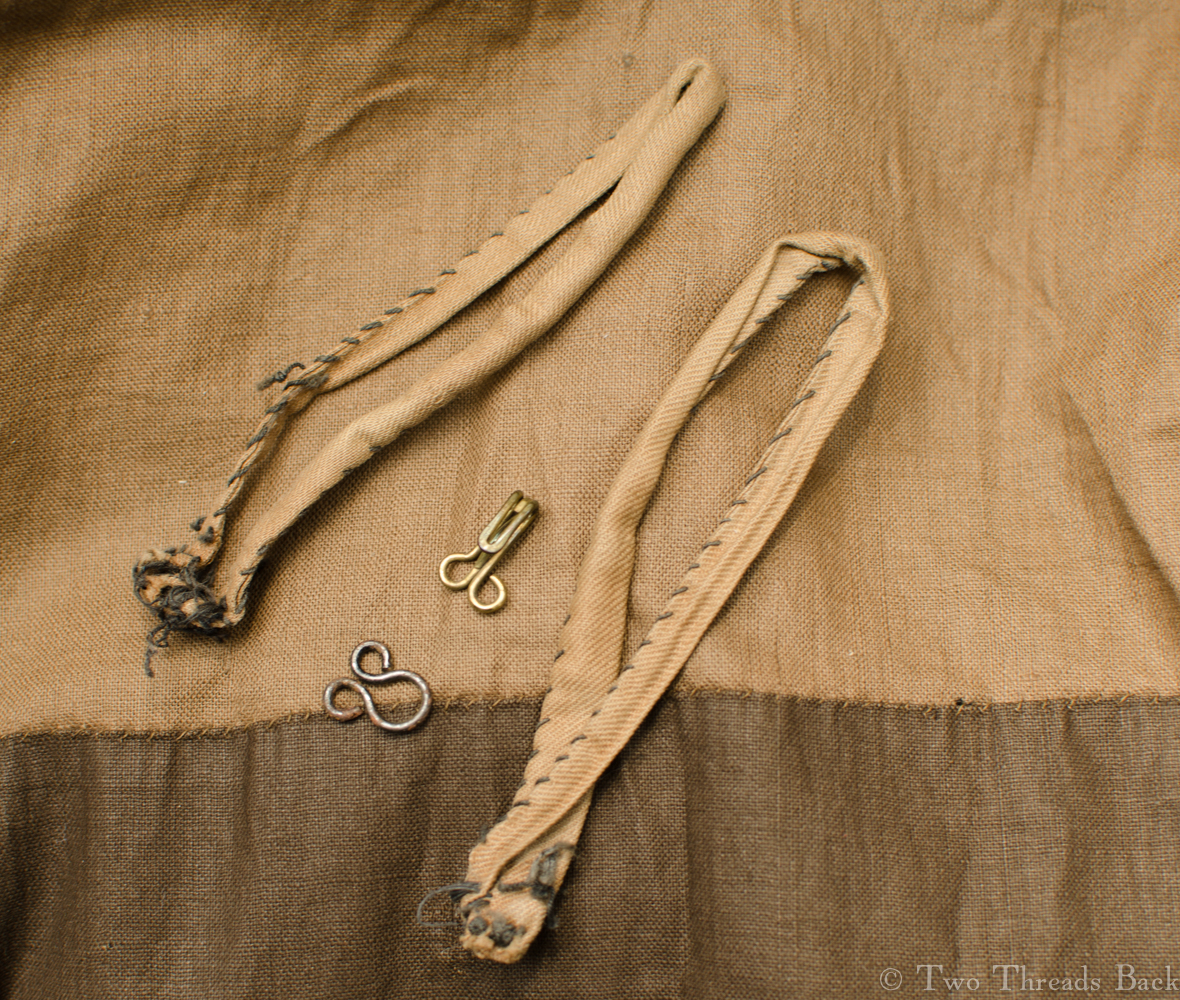
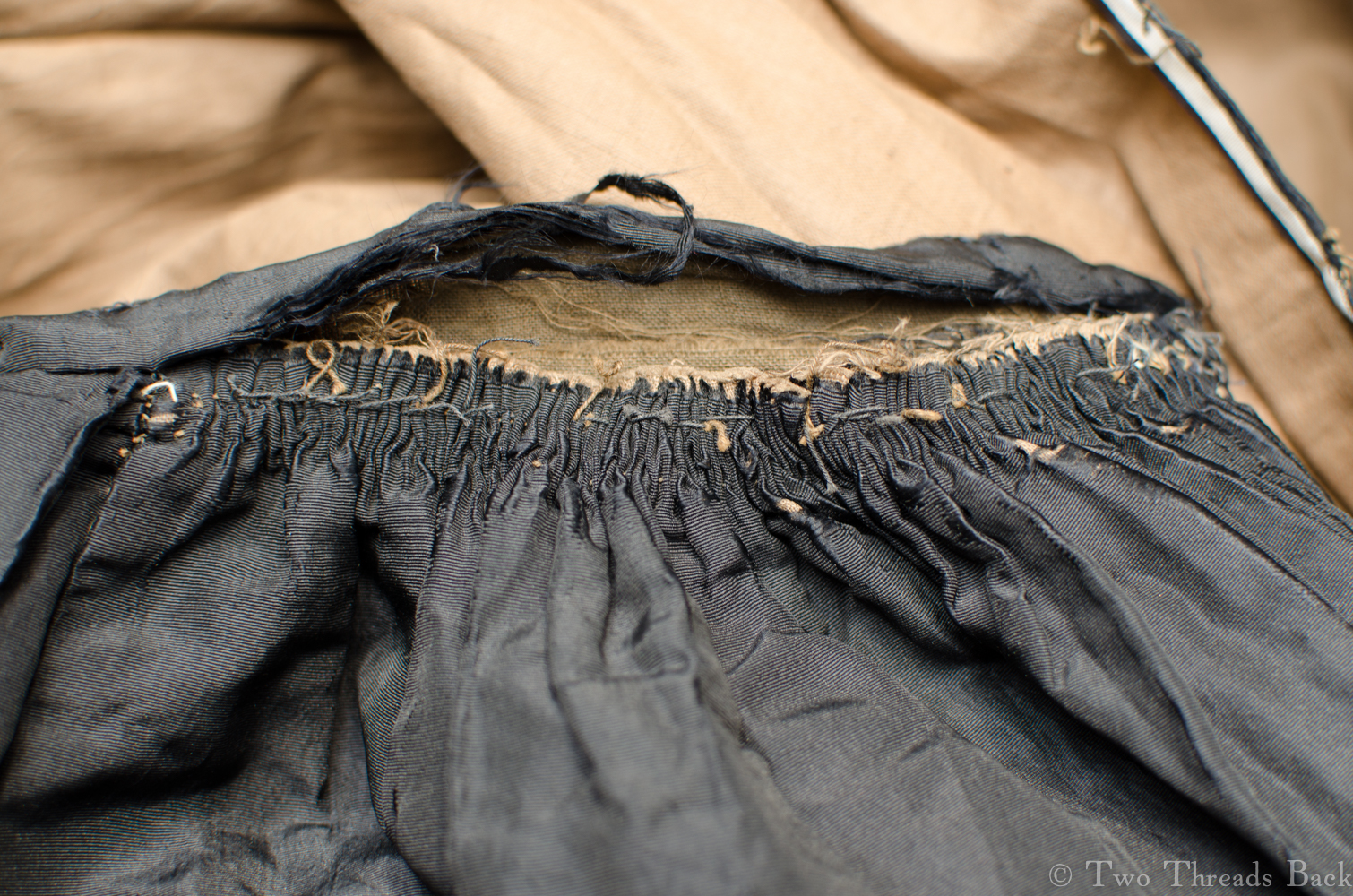
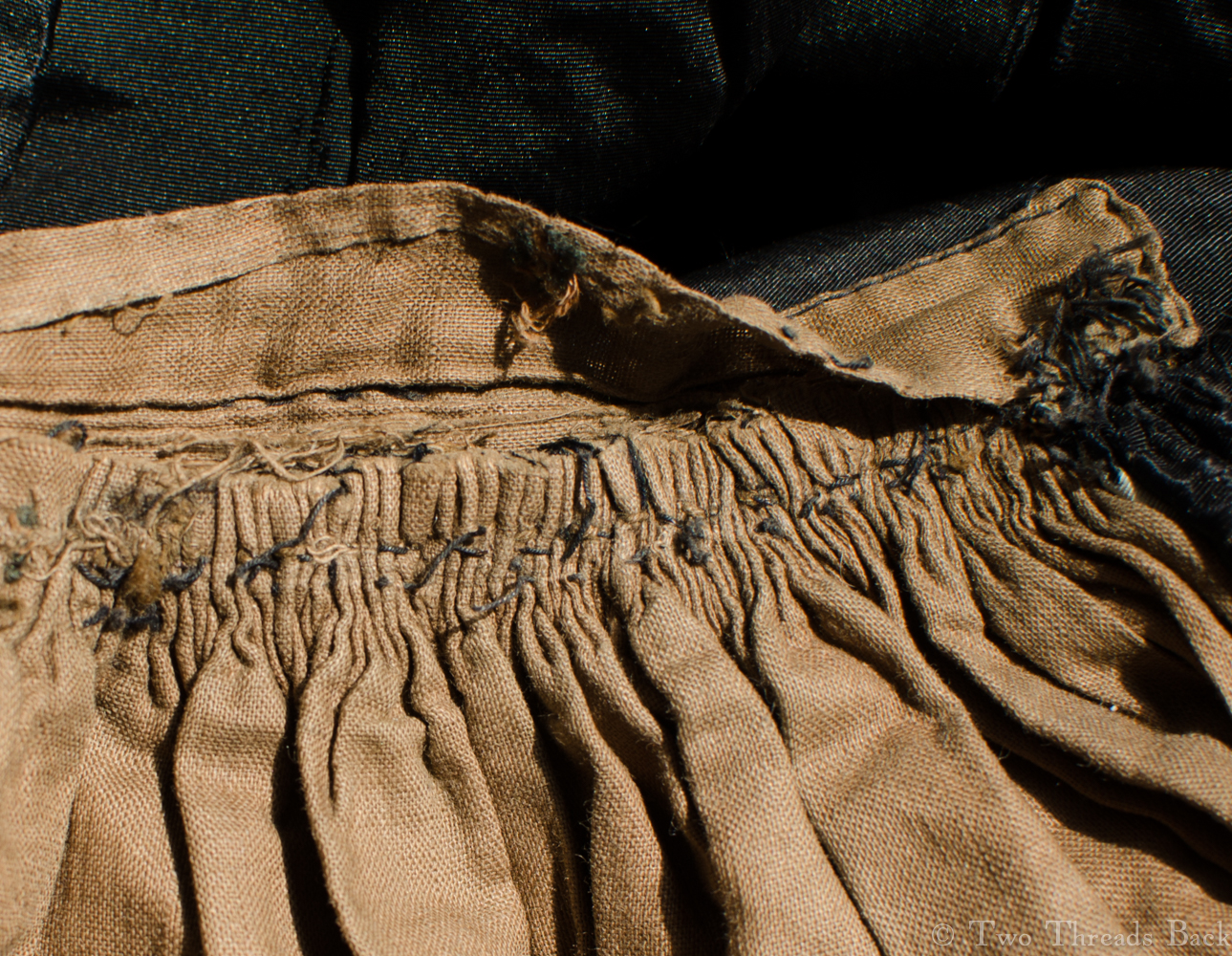
Raw edges of lining were roughly overcast with a light colored thread. The waist was “gauged” in the back. Machine work was limited to the top stitching of the waistband and the hems of the bias-cut ruffles. The only careful handwork was the finishing in some places on the lining. A brass hook and eye were the only fastening, and two loops were attached inside for hanging.
The skirt back was tightly gathered using the gauging technique.Here’s a view of the gathers from the inside.The ruffle was hemmed by machine, but gathering stitches were made by hand.And it looks like they were done at high speed!The seamstress took extra pains when hemming down the inside of the placket opening with a finer weight thread.It was common in the 19th century to finish skirt hems with a sturdy braid, wool or velvet, to protect them from wear. It could be purchased ready-made, but this velvet strip appeared homemade.
The deconstruction process was predictably tedious, but there was one moment that’s hard to describe. I was working on the old velvet at the hem when out spilled sand and bits of twigs. The debris had obviously been locked inside for a more than a century. It was as if a shadow passed by while I worked. Who was the woman who wore this skirt? Where was she walking, what was she doing, what was she thinking on the day when her shoes kicked up that sand? I don’t suppose I’ll ever know. But I hope her afternoon was as lovely as the one I enjoyed.
I tried to offer a peek inside the velvet, but it’s too dark to see. I couldn’t hold the crease open with one hand and take a picture with the other!
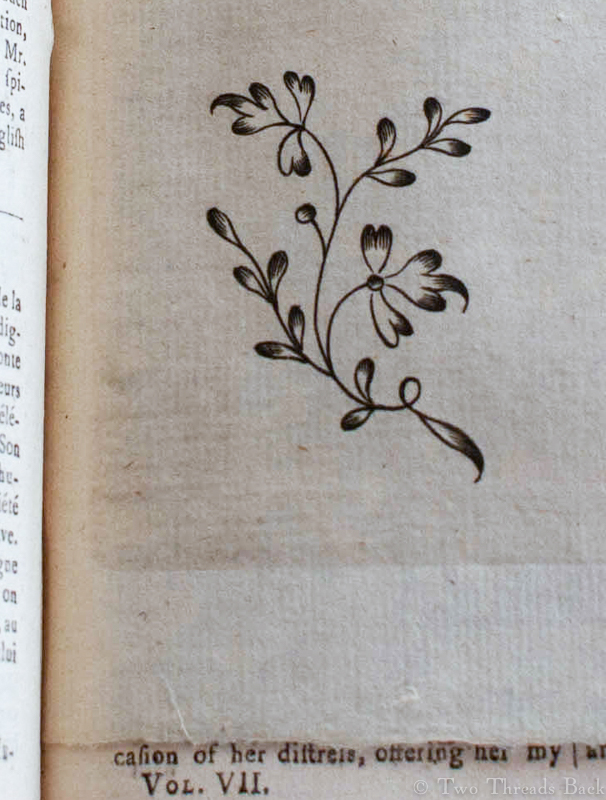
And in this corner we have the challenger: an 18th century pattern of a floral sprig from the Lady’s Magazine, 1776!
When I read about the Great Lady’s Magazine Stitch Off a few weeks ago, I knew it was something I wanted to do. Firstly, because I love early women’s magazines; secondly, because of the Jane Austen connection; and finally, because I could suit my project to my skill level – dabbler seems fitting.
A two-inch flower on a plain muslin pocket handkerchief, worked in a simple chainstitch with some wonderful Au Ver à Soie, would be just right. And perhaps some historical touches to set the mood.
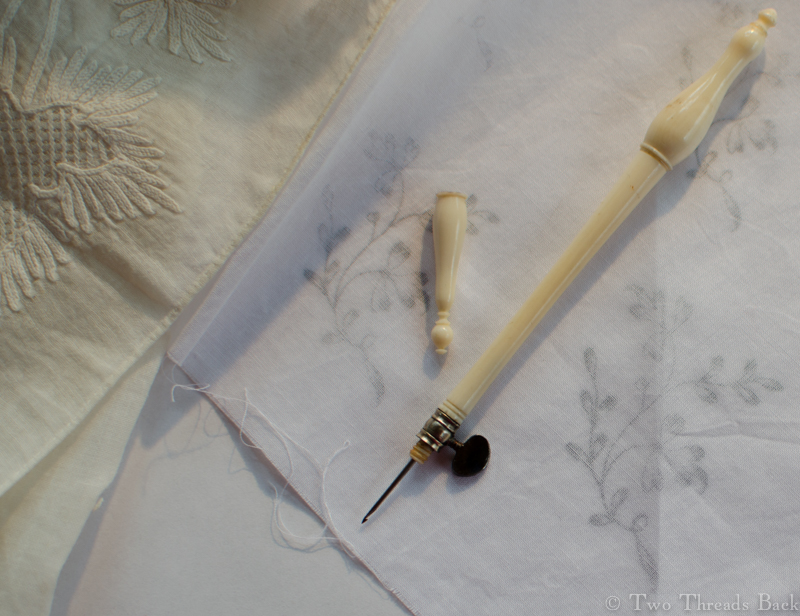
I had visions of myself sitting at my worktable to pounce the pattern, then deftly working the little sprig with an elderly tambour hook. That might occupy me for an hour or two, then I’d pop it in the mail to the Chawton House Library “Emma at 200” exhibit. How hard could it be?
Here’s my fantasy, what I wanted to happen. Note the 18th century embroidery I was looking at for inspiration – carefully folded so the damaged areas don’t spoil the effect.
Well, Fantasy was introduced to Reality fairly soon. I realized that the pouncing powder I’ve had (unopened) for 20 years required a little more research and practice to use than I wanted for such a small project. What’s so bad about using a disappearing marking pen after all?
Here’s the reality, modern day all the way. Notice anything glaringly wrong here?
So next came the tambour hook I’d been dying to try. It seems there’s more to using one than just picking it up and poking it in and out. Not to mention that the ancient point had a tendency to shred a few threads along the way. What’s wrong with using a needle?
Ok, I started with the needle and made it about halfway before I thought: ick! No two chainstitches were alike. I picked it out and decided to try a sort of running/darning stitch, also common on period pieces. Bleh. It looked worse than the first attempt, so I picked all that out and decided it would have to be chainstitch after all.
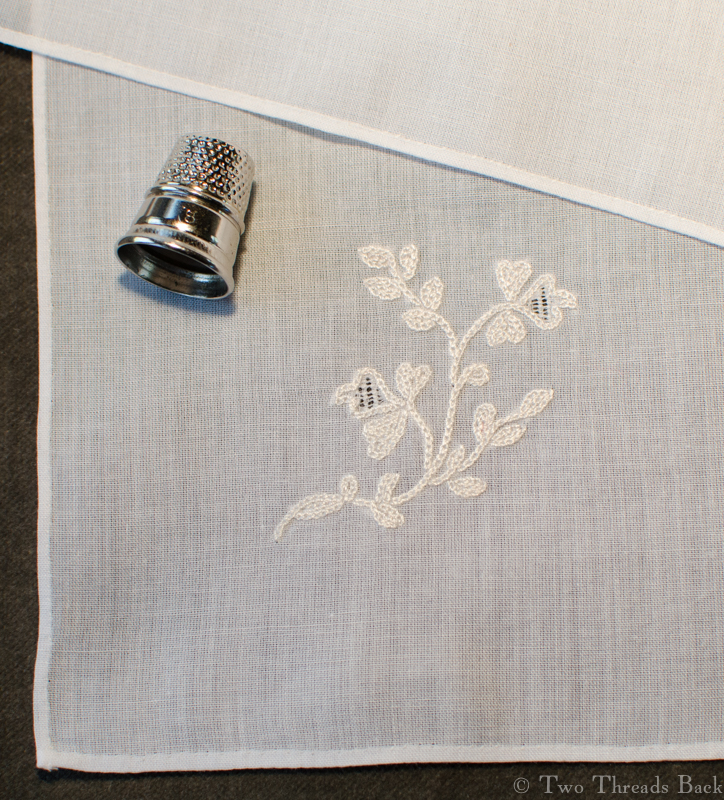
Well, I did better on the third try. But when I was almost done, I felt something didn’t look right. Maybe you spotted it already? I had put the muslin back in the hoop underside up. And there it would remain. Six hours into this two-inch project, I was not doing it over.
The hemming went better than the embroidery. I didn’t really mind that one side had a wider hem than the other three. But the flower centers looked a little plain. I thought I’d try some microscopic drawn thread work. Isn’t it amazing how fearless ignorance can be?
You can barely see the drawnwork in the flower centers. At least I hope you can barely see it!
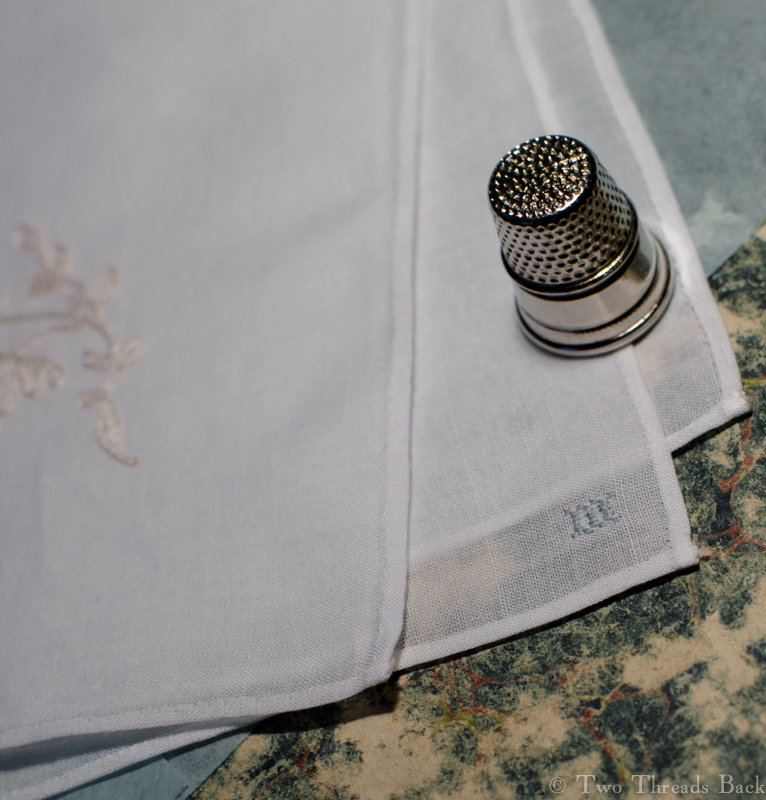
Another six hours later I was done. Then I remembered my calling. Plain needlework! I could not send this handkerchief out into the world without marking it. A silk monogram was beyond my ability, and turkey red thread would be out of place on this mouchoir de poche. So I used blue cotton (I’ve seen real examples) and started on my initials in the opposite corner.
A mono-(in the most literal sense)-gram letter “M” worked in cotton from a period pattern. Most early marking charts I’ve seen had letters seven X’s tall.
It hurt. Not just squinting to see the threads, but to realize I’d placed the “M” too close to the corner to add my other initial. It kind of looks like I meant it to be that way, so I won’t tell anyone.
P.S. Check out the Stitch Off Facebook page too, you’ll see some gorgeous examples of embroidery by people who really know how. In color, no less! Maybe you’ll be inspired to participate?
Yesterday a friend sent me a link to the most exciting news I’ve seen all year. Mr. Darcy’s Shirt is coming to the U.S.! Yes, you can forget Tutankhamun’s treasures or the Beauty of Xiaohe. Mr. Darcy’s shirt outranks them all.
Who can forget the (totally not in the book) scene from the 1995 Pride and Prejudice film where Mr. Darcy rises from the lake at Pemberley after his swim, only to run into the startled and stunned Miss Elizabeth Bennett? Be still my heart.
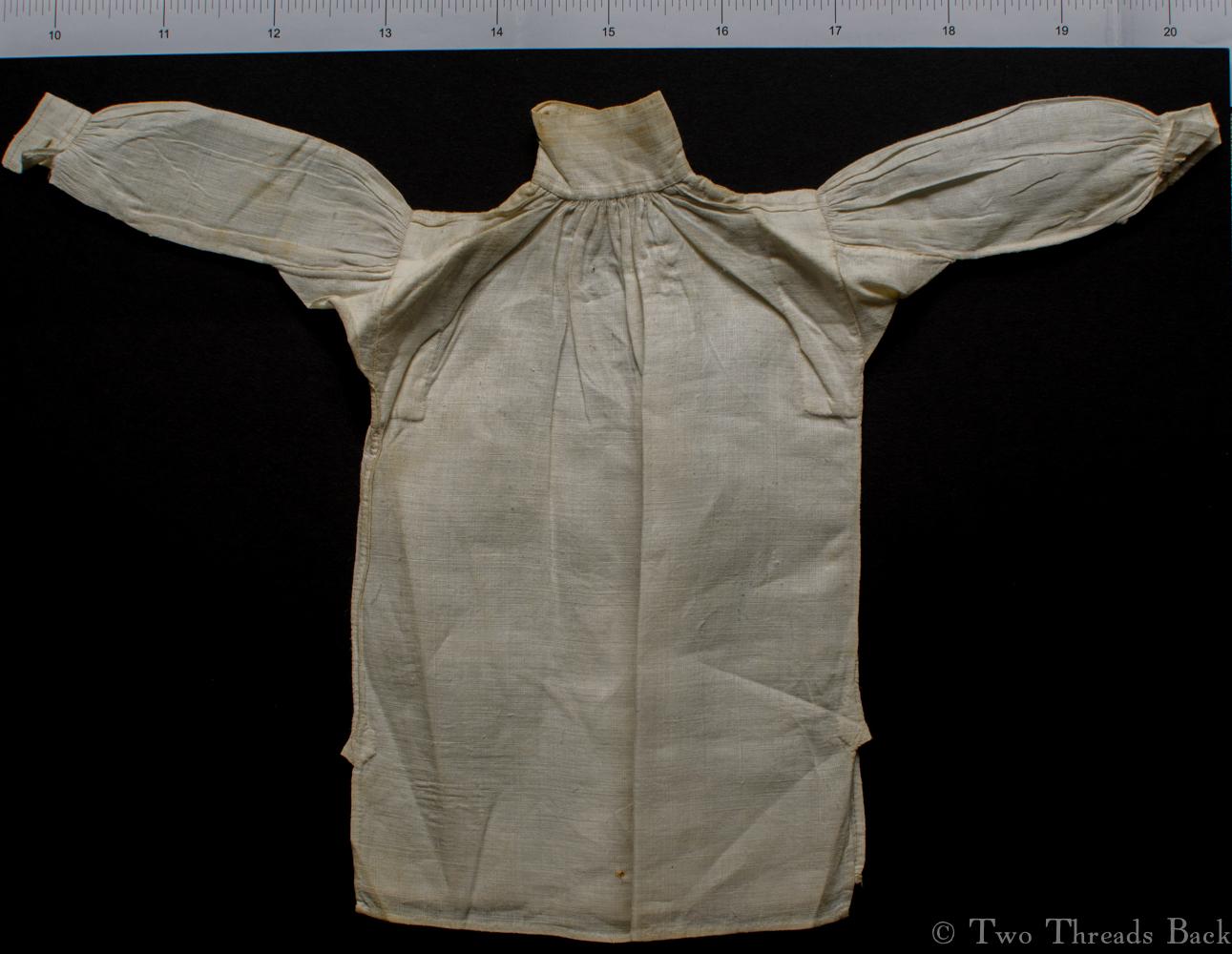
Unfortunately I won’t get to see the celebrity shirt on display, so I’ll have to content myself with a miniature version. This is a tiny “sampler” shirt dated 1838, very much like the square-cut linen one that embarrassed the soggy Colin Firth and melted the rest of us.
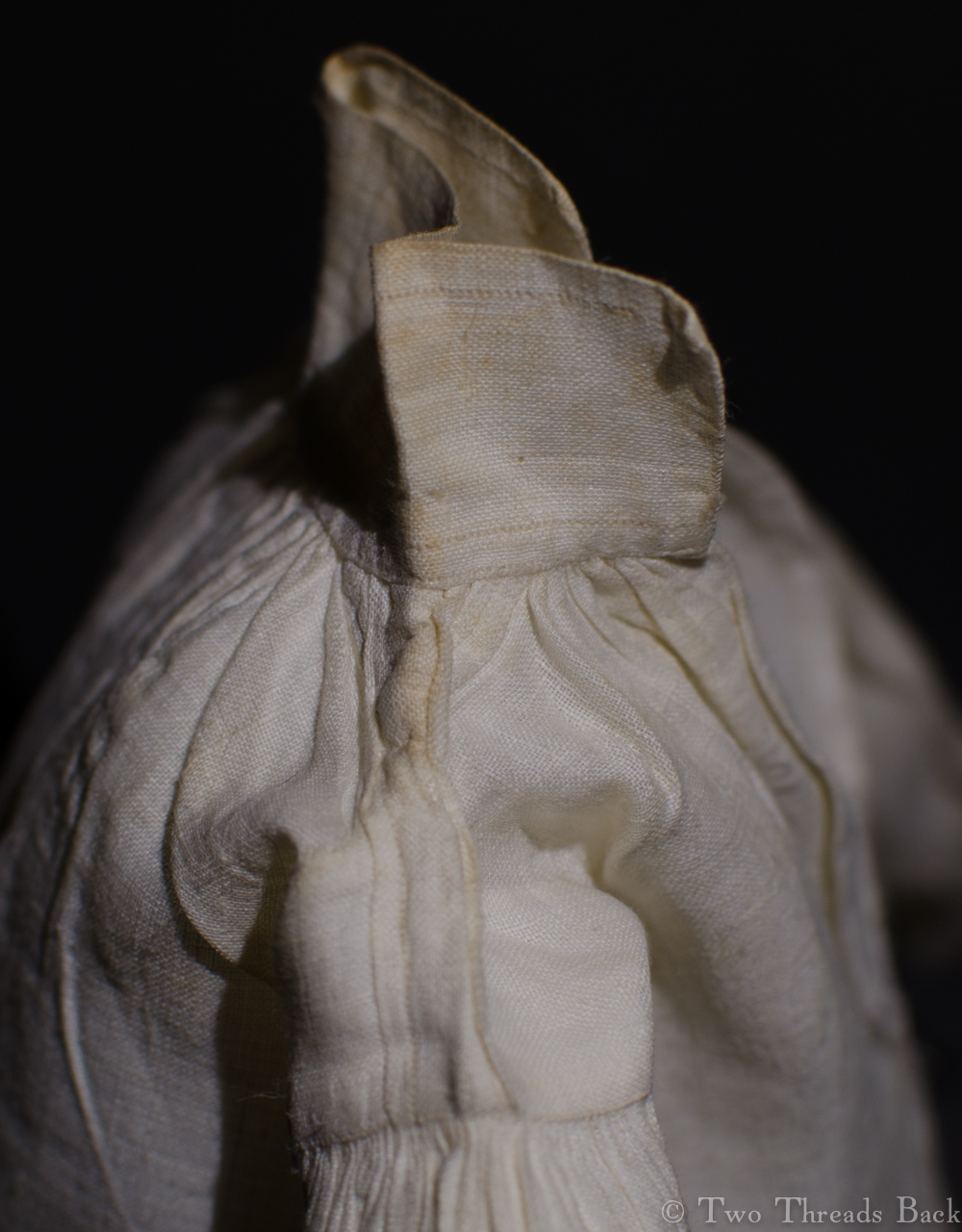
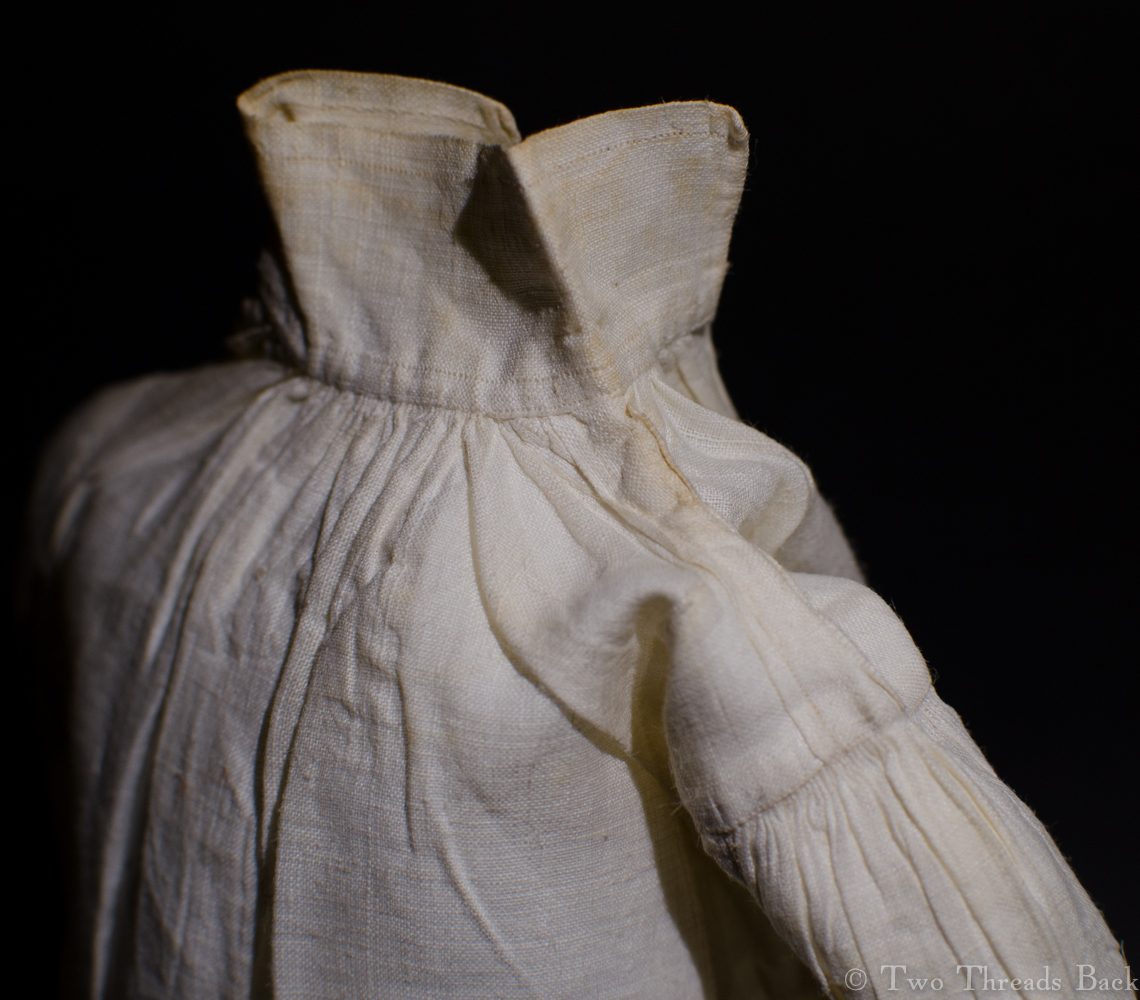
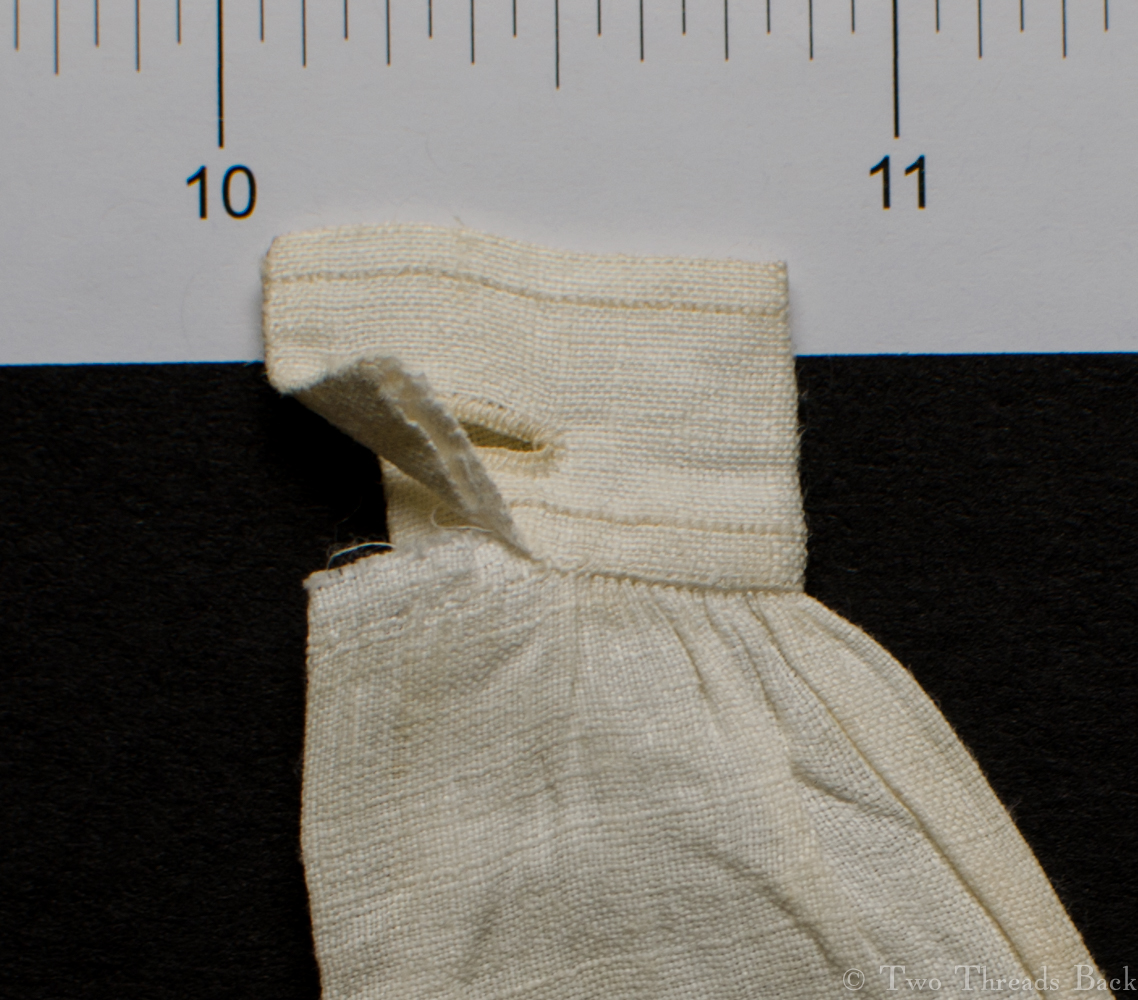
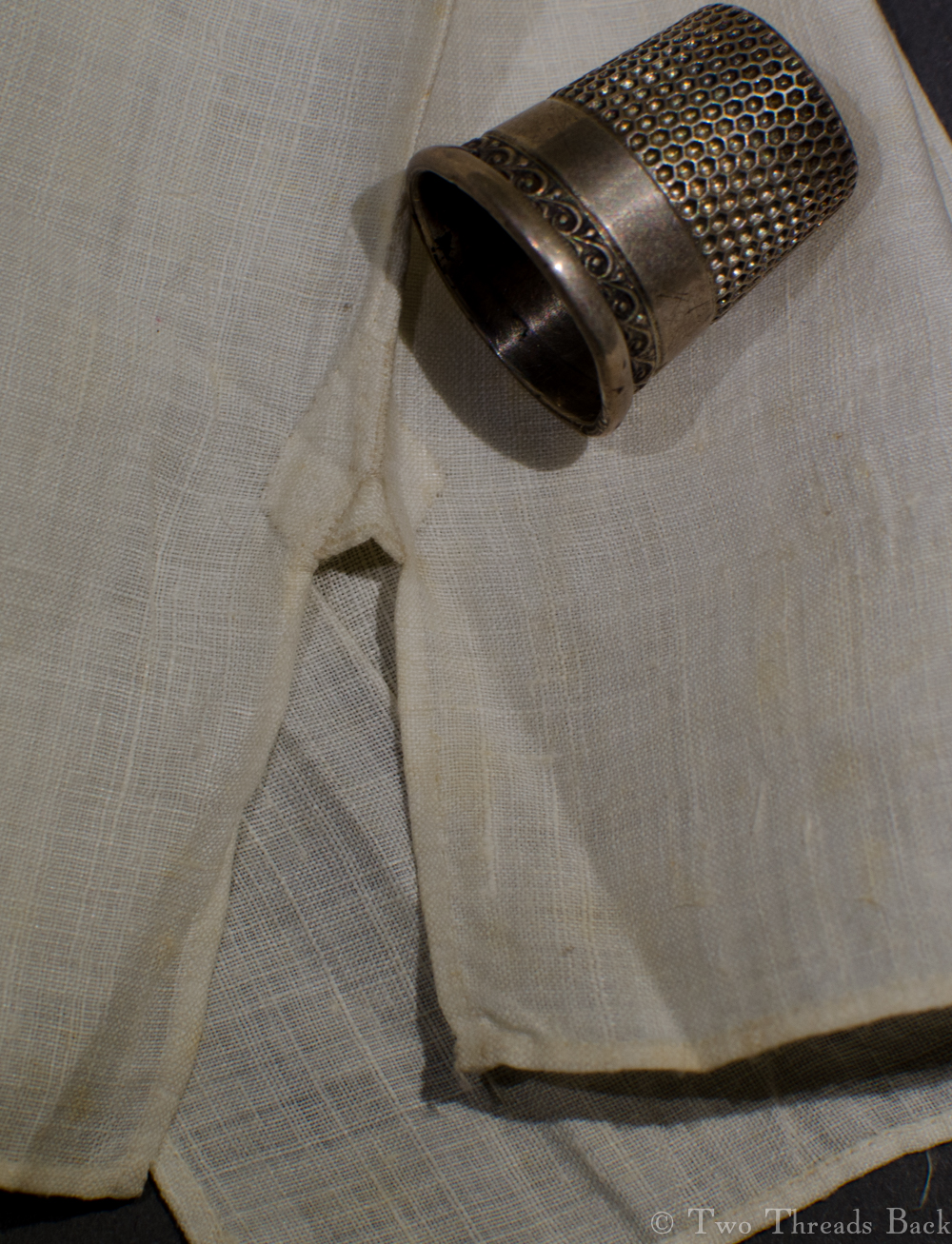
It measures 7 inches from the top of the tall collar to the hem. The cuff is 1 and 3/8 by 1/2 inch. The backstitches per inch are so small that I cannot count them. There are microscopic gussets on the collar, the sleeve openings at the wrists, and the side flaps. Oh, and of course there are the underarm gussets that are a whopping 1 inch long.
The back – notice the “binders” which line the armscyes inside the shirt.Here you can see the tiny collar gusset, over which the “shoulder strap” lies.A view of the shoulder strap which is backstitched on both edges.
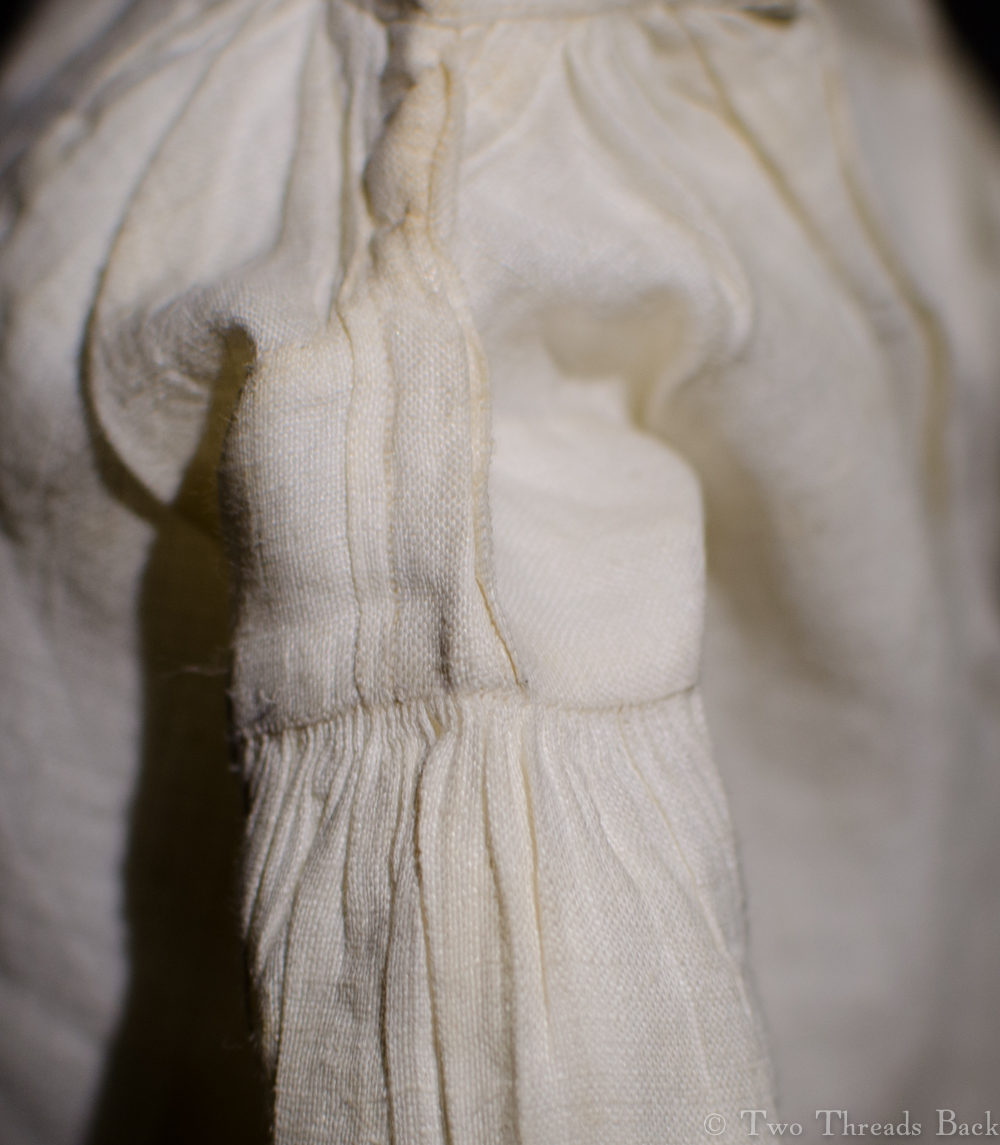
The sleeves are set into the body with gathering and stroking.You can barely see the diminutive gusset at the end of the sleeve opening. Its purpose was to allow ease, so the shirt would be less likely to tear at that joined seam.This cuff has come unstitched, and you can see how tiny the sewn gathers are.Here is a view of the gusset for the side flaps of the shirt, also meant to reduce tearing and the seam.
Colin Firth in a wet linen shirt, or a sampler made by tiny fingers in days long gone? I don’t know which one makes my heart beat faster: the man-sized or the miniature. But who would shrink from a closer examination of either?
PIN MONEY – money allowed by a man to his wife to spend for her own personal comforts. When pin money is given to, but not spent by the wife, on his death it belongs to his estate. ~A Law Dictionary: Adapted to the Constitution and Laws of the United States, 1843. (You may detect some irony here.)
Most of us are familiar with the important social justice issues of the 19th century, causes like abolition and child labor. But there was another one that became quite fashionable to champion: the plight of workers who fashioned fashions. Women who worked as seamstresses, dressmakers, and milliners were vulnerable to exploitation, and as the pathos and romance of their situation caught public fancy, there was a flurry of response in literature, art, “committees,” laws, private philanthropy and even investigative journalism.
The seamstress who sewed shirts was the poster-child for the cause; you can see one period image I used in a post a few years ago here. Shirt-making was tedious and poorly paid, but the pattern was simple and most of the women who could sew knew how to make one. There was also a steady market for the product, at least until the sewing machine and mass production made hand sewn shirts obsolete.
Dressmaking was different. It required greater skill and was more susceptible to the whim of the patron (and employer if a woman worked for a dressmaking establishment) and vagaries of the trade. But it retained some shreds of respectability as a way to earn a living for those women who were not born to the working class, and yet found themselves with no means of support.
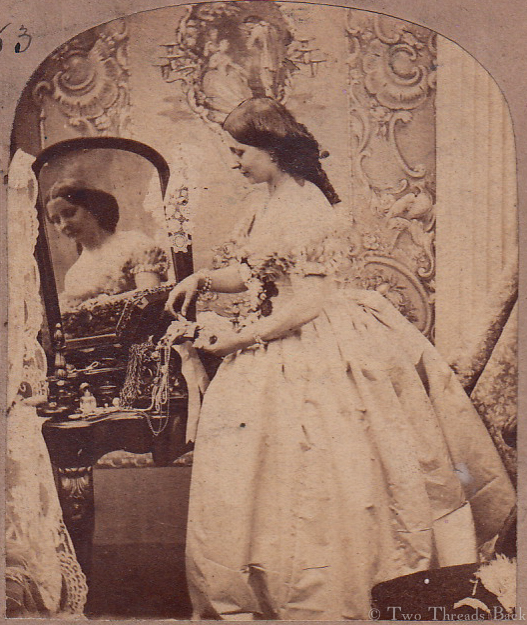
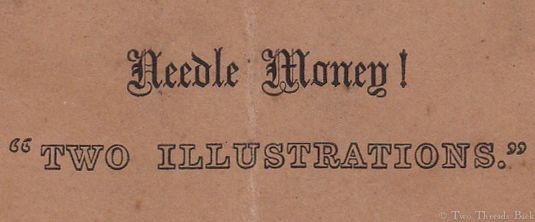
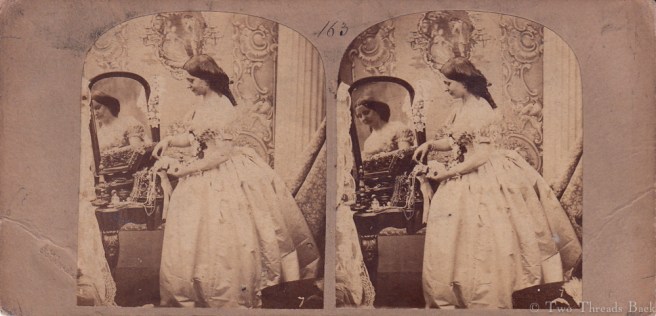
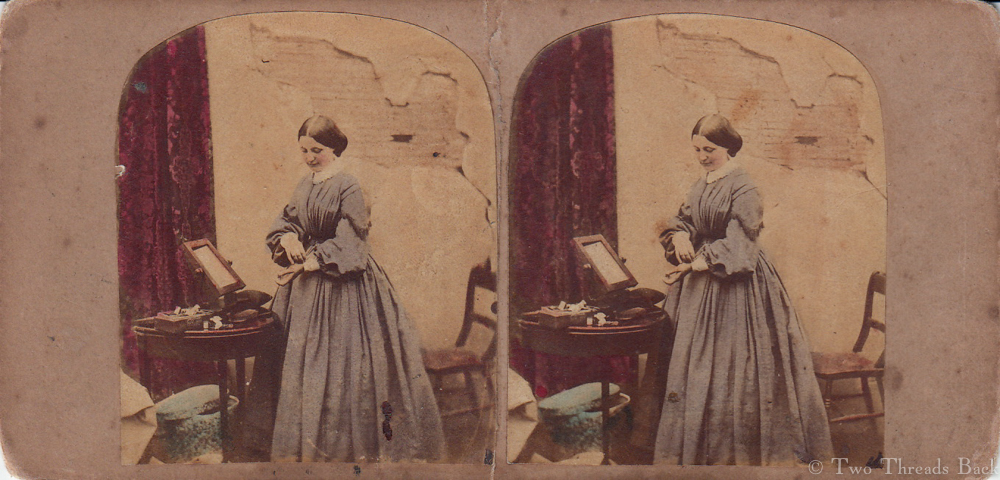
The images here are from a set of stereoviews, the one above titled “Pin Money,” with the model carelessly displaying her wealth of finery. The other is called “Needle Money,” implying that the plainly dressed lady in shabby surroundings must be earning her bread with her needle.
Apparently public sympathy didn’t quite translate into action – or not enough to bring about significant change. A decade or two after Thomas Hood’s famous poem The Song of the Shirt appeared, the image of the genteel but impoverished worker persisted. The poem below was by Francis Charles Weeden, c1860s. It was republished with the explanation:
* These two poems are printed, as written by the author, in juxtaposition, to make the contrast more striking.
I haven’t copied the whole poem, since the point and tone are pretty obvious. Victoria was reigning, but so was sentimentality!
Many bloggers have covered the subject, so if you’re interested try a search for “song of the shirt” – it will get you started. If you prefer the old-fashioned-read-a-book way, try The Ghost in the Looking Glass, by Christina Walker – not recent, but fascinating!
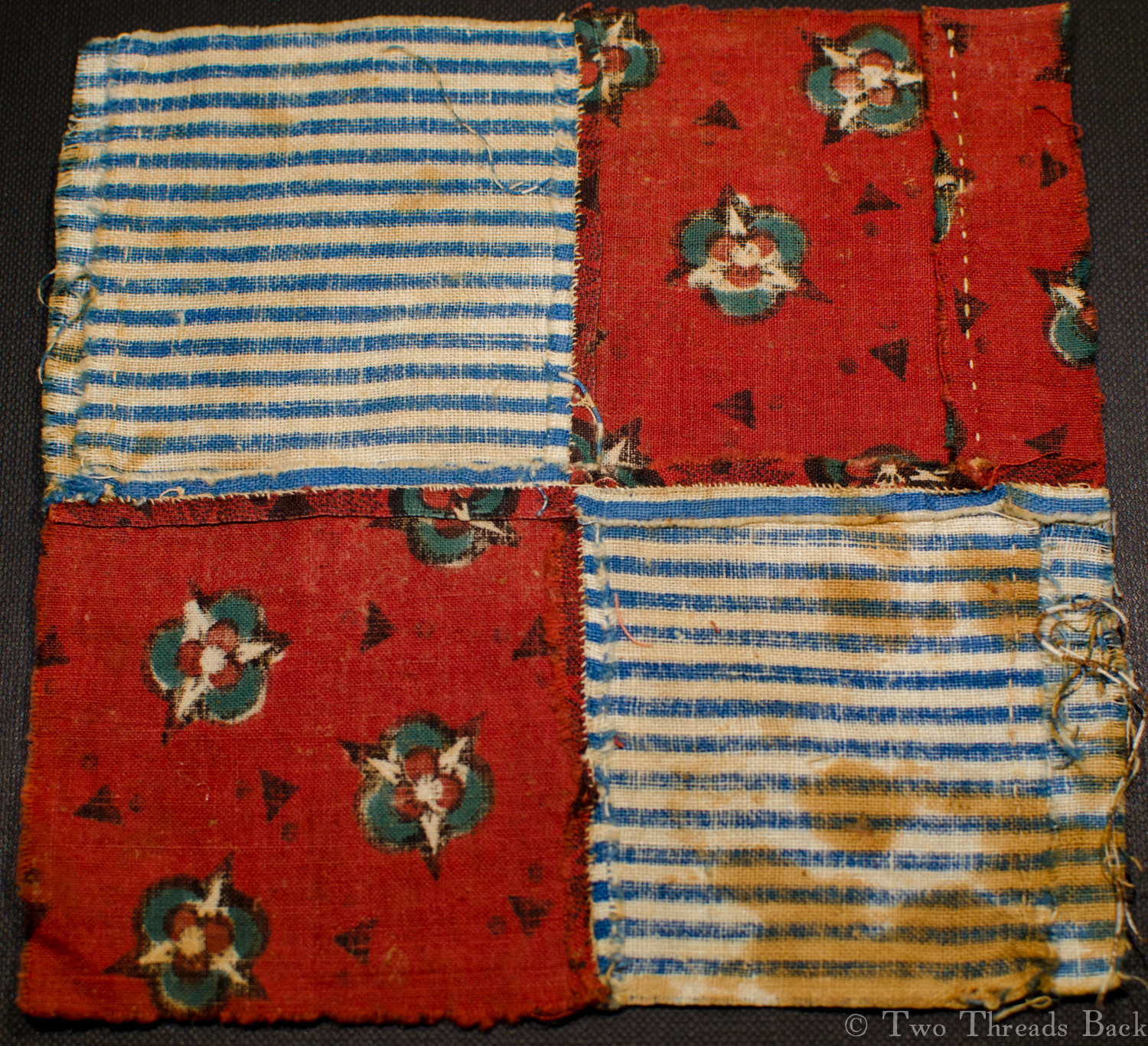
Mary’s neat sewing, with the squares joined by “seaming.” The finished block measures 5 1/2 inches square.
There once was a lady who lived and sewed in New England, way back around 1810. She had a little girl who wanted to help, and so she taught her how.
This lady (I’ll call her Mary because there’s a 27.4% chance that was her real name) was making a simple quilt out of four patch squares. Calico was dear, so she used every teensy scrap she had to make the patches.
This is a view of the back showing Mary’s careful piecing. The narrowest blue striped bit measures 3/8″ inch, not including the seam allowance.
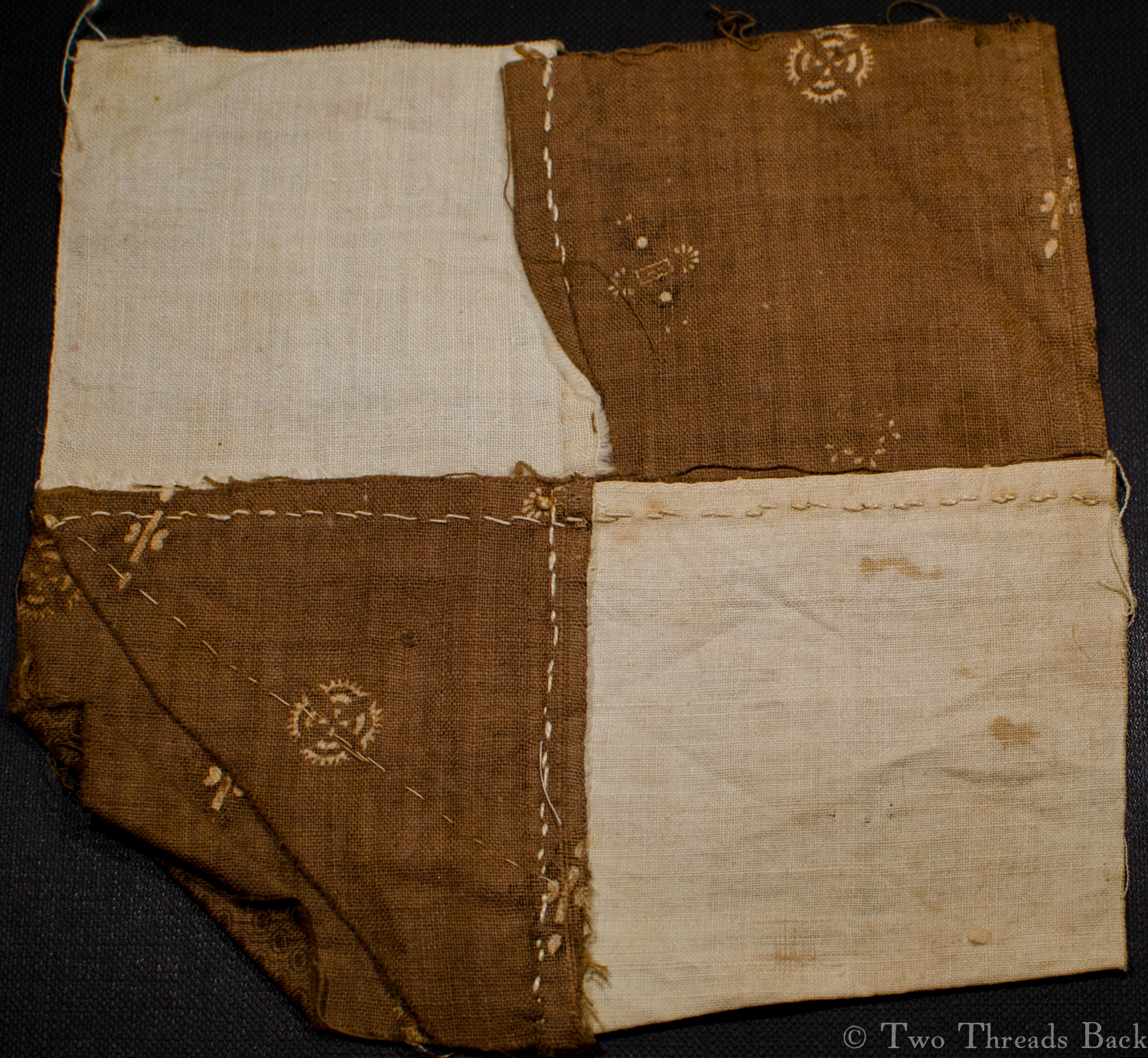
She gave Betsy (I’ll call Mary’s daughter Elizabeth because there’s a 14.3% chance that was her real name) some squares to practice on. Betsy wanted the pretty patterns to work with, but Mary was reluctant to use those for lessons, so she compromised. One print, one plain.
Betsy’s finished square. Do you notice something a little odd here?
Well, Betsy finished her block, and Mary finished 89 others. Then she packed them all away. They were never made up, but remained in a box in the attic for 200 years. Don’t you wonder why?
Betsy’s work from the back. Yes, her stitches are a little clumsier than Mary’s, but she was learning. And they’re straighter than mine – go Betsy!















 Two Threads Back