Heart-bit? No, I don’t mean smitten with love, phrased in a folksy sort of way. I mean a little bit, or piece, in the shape of a heart! Worn right over the heart.
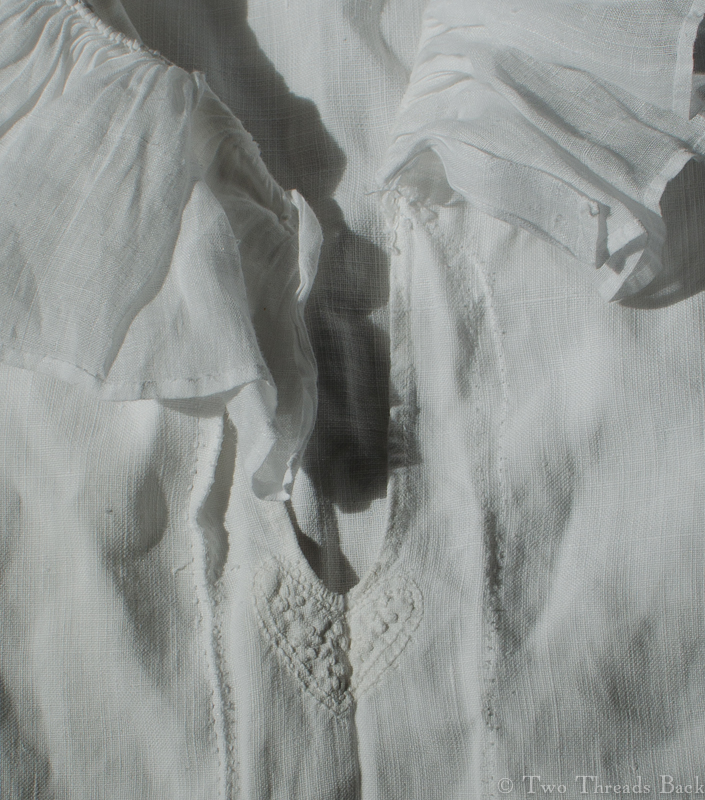
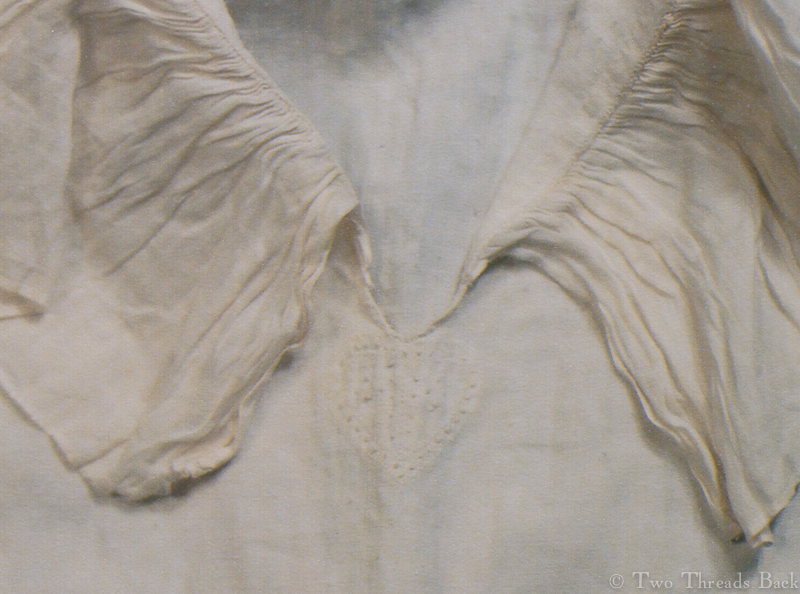
Heart-bit with decorative knots on an early 19th century man’s fine linen shirt. The shirt was rescued from captivity where it had been altered and abused with scissors, sewing machines, and synthetic trim!
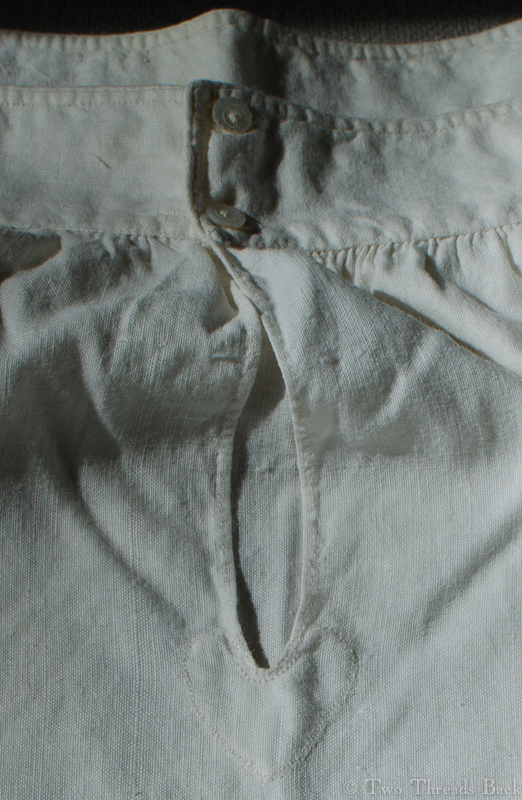
That perfect specimen of plain sewing, The Shirt, has a romantic soul. Back in days when shirts were only slit down the front, and not buttoned closed the full length, that end of the opening was vulnerable to tearing. There were various ways to prevent it, and I came across references to this lovely way when researching early sewing instructions. For example, Instructions for Cutting Out Apparel for the Poor, 1789, givesa description of cutting linen for shirts:
This half overplus being a quarter of a yard in length, serves to cut out hearts for the bosoms.
Or a sewing manual from 1833:
HEART-BIT
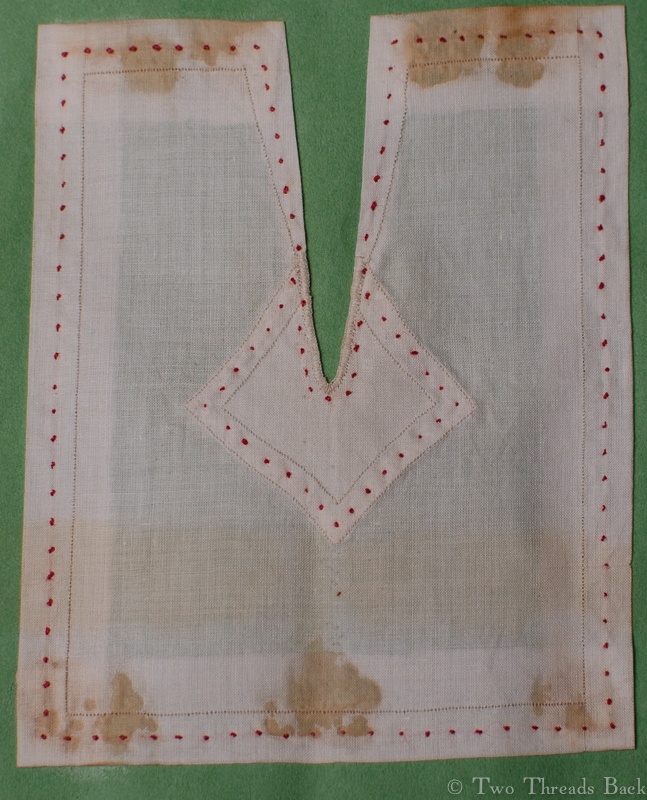
Before commencing the shirt, small pieces of muslin are given to each girl, for the purpose of learning to settle in, and work the breast-gusset.
Of course not all shirts had them. Some had a triangular gussets, or a buttonholed reinforcement, or a tiny rectangular piece to prevent a tear, and some had nothing at all. But you have to love linen with a heart!
Another early 19th century man’s fine linen shirt, with a beautifully worked heart-bit. Unlike the shirt above, this lucky gentleman spent his retirement carefully packed away.An early 19th century woman’s chemise made of muslin, showing she had a heart, too.A girl’s sewing manual from the mid-19th century displays an alternative shape for the gusset, but still called in the instructions a Heart-piece.
In spite of my plain shirt obsession, it took me forever to finally reproduce one myself. I have a tendency to procrastinate, and it doesn’t seem to matter if it’s something I really love or not.
I’ll start with enthusiasm, and then the motivation fizzles and the project goes on the UFO shelf. So it’s been with the fine linen shirt I’ve been playing with for the proverbial seven years.
But then last year I had to make one for a local history event, and a Deadline With People Waiting On Me provided the necessary spark.
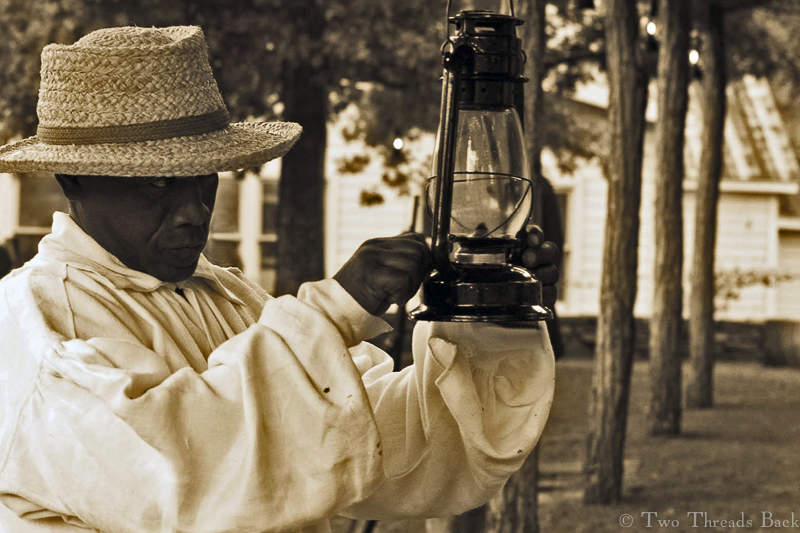
This square-cut shirt wasn’t made of fine fabric, but of worn-out linen, since it was to dress an interpreter at a historic slave cabin. It was easier to do since I was replicating an old and tattered garment: all my stitches didn’t have to be perfect, thread could be mismatched, patches were expected.
The hard part was working on a heavier material that still contained prehistoric starch, as well as making the shabby parts fit the pattern in the right places. Working over two threads on lumpy and uneven material made the finished product look a bit coarse. Um, not my fault… right. However, I made the deadline although both the shirt and I were worn out!
Exhausted from an all-night binge of shirt-making.
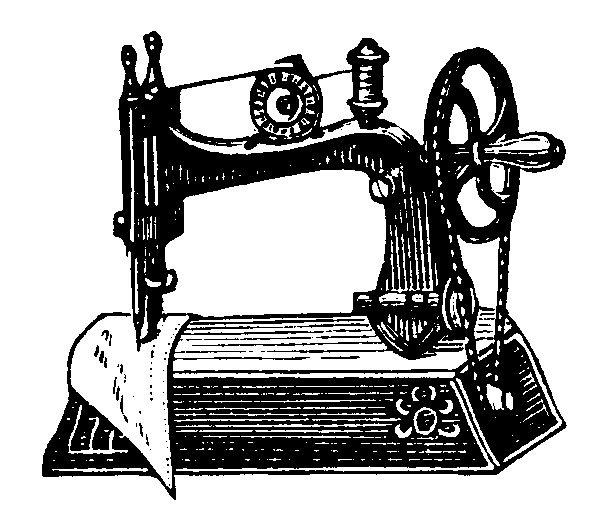
Just when I get complacent, thinking I’ve found a bit of information and can safely pack it away, something comes along to surprise me. As Seen on TV advertising is not new to our generation. Well, maybe the TV part, but not the advertising! About 150 years ago readers of Godey’s Lady’s Book were told how much easier their lives would be if they only had that new invention, The Sewing Machine.
Value Of A Sewing-machine.—The following curious calculation of the number of stitches required in making a man’s shirt, gives us a realizing idea, as a Yankee would say, of the value of the sewing-machine in one single branch of needlework. As a household aid this invention is invaluable to women. Is it not pitiful that more than twenty thousand stitches have often been required to make one single shirt, for which the poor seamstress received, probably, not over seventy-five cents or one dollar:—
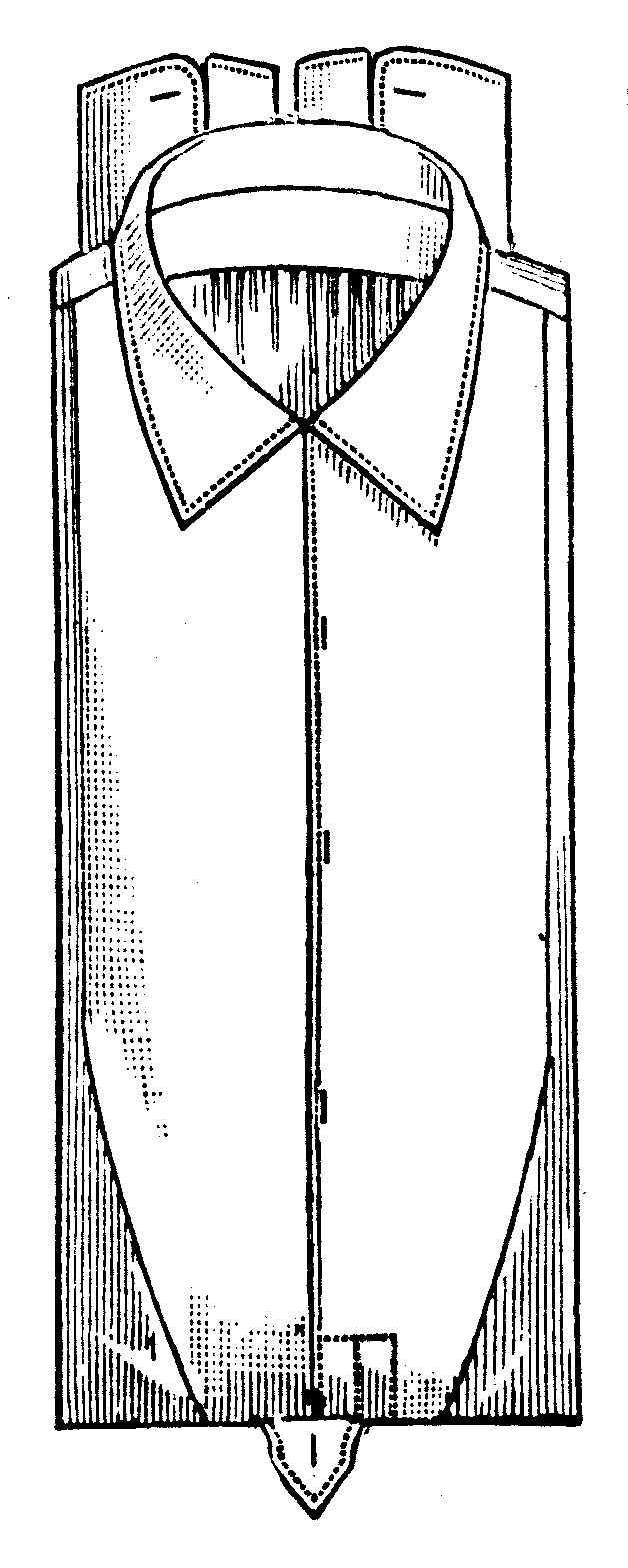
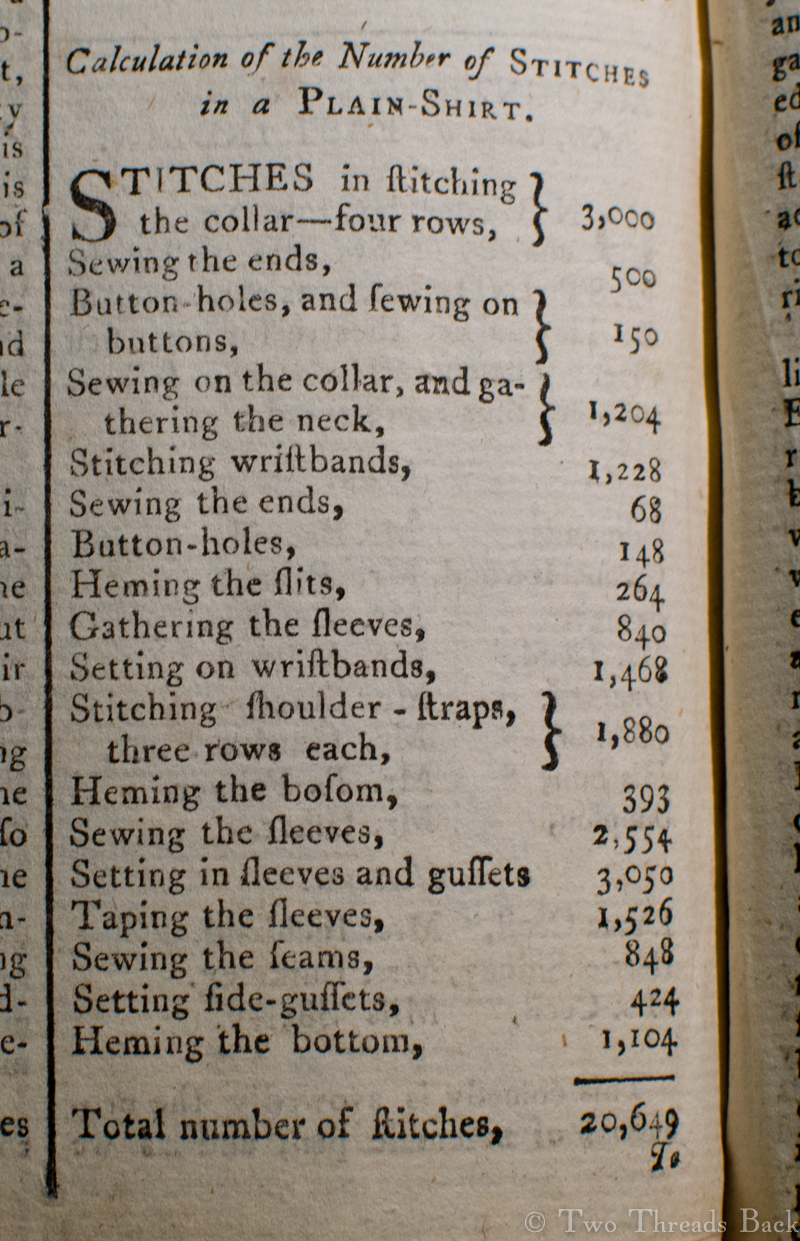
“Stitching the collar, four rows, 3,000; sewing the ends, 500; button-holes, and sewing on buttons, 150; sewing the collar and gathering the neck, 1,204; stitching wristbands, 1,228; sewing the ends, 68; button-holes, 148; hemming the slits, 264; gathering the sleeves, 840 ; setting on wristbands. 1.468; stitching on shoulder-straps, three rows each. 1880; hemming the bosom, 393; sewing the sleeves, 2,532; setting in sleeves and gussets, 3,050; tappiug the sleeves, 1,526; sewing the seams, 841; setting side gussets in, 424; hemming the bottom, 1,104. Total number of stitches, 20,620.”
In true journalistic tradition, Harper’s presented, almost word for word, the same thing in 1869. Only their math was a little different.
The following curious calculation of the number of stitches in a shirt, which somebody has had the patience to make, we mean the calculation, not the shirt, by any means, may induce some gentleman to present his wife with a good sewing machine.Stitching the collar, four rows, 3000; sewing the ends, 500; buttonholes and sewing on buttons, 150; sewing the collar and gathering the neck, 1204; stitching wristbands, 1228; sewing the ends, 68; buttonholes, 48; hemming the slits, 264; gathering the sleeves, 840; setting on wristbands, 1468; stitching on shoulder straps, three rows each, 1880; hemming the bosom, 393; sewing the sleeves 2335; setting in sleeves and gussets, 3050; tapping the sleeves, 1526; sewing the seams, 848; setting side gussets in, 424; hemming the bottom, 1104. Total number of stitches 20,530.
Apparently this “curious calculation” didn’t begin life as a sewing machine ad. It appeared in the years after, but also in the years before the sewing machine. Note how the article was borrowed and adapted (just like the blogs we’re writing now – ha!)
Now come the long evenings with devices for amusing them. In the intervals of recreation there is “work to do.” This word “work” is significant of an employment which astonishes men, and seems never to tire the fingers of their industrious helpmates and daughters; except that, with an expression which we are at a loss to take for either jest or earnest, because it partakes of each, they now and then exclaim, “women’s work is never done!” The assertion is not exactly the fact, but it is not a great way from it. What “man of woman born” ever considered the quantity of stitches in a shirt without fear that a general mutiny among females might leave him” without a shirt to his back?” Cannot an ingenious spinner devise a seamless shirt, with its gussets, and wristbands, and collar, and selvages as durable as hemming? These inquiries are occasioned by the following Letter from a Lady:— “To the Editor of the Every Day Book.—
Sir, I assure you the Every Day Book is a great favourite among the ladies, and therefore I send for insertion a calculation, furnished me by a maiden aunt, of the number of stitches in a plain shirt made for her grandfather: —Stitching the collar, four rows, 3,000; sewing the ends, 500; button-holes, and sewing on buttons, 150; sewing on the collar and gathering the neck, 1,204; attaching wristbands, 1,228; sewing the ends, 68; button-holes, 148; hemming the slits, 264; gathering the sleeves, 840; setting on wristbands, 1,468; stitching shoulder-straps, three rows each, 1880; hemming the neck, 390; sewing the sleeves, 2,554; setting in sleeves and gussets, 3,050; taping the sleeves, 1,526; sewing the seams, 848; setting side gussets, 424; hemming the bottom, 1,104—Total number of stitches 20,646 in my aunt’s grandfather’s plain shirt, as witness my hand, —Gertrude Grizenhoofe.—Cottenham, near Cambridge, Sept. 1825.”
It was great fun tracing the path of these “curious and significant” calculations, although a bit confusing because sometimes a publisher would acknowledge the source (quite helpful), sometimes not (greater challenge), and sometimes it was a reprint from their own magazine (I got lost). Not to mention, their math could be as wobbly as mine! The trail of the tale was pretty typical for 19th century publishing.
However, I was astonished to finally come across the same calculation in another magazine – from 1782! So this stitchery factoid was much older than I had supposed, even more exciting!
As a plain-sewing-square-cut-shirt devotee, I’m fairly familiar with the terms used in their construction. I know about the “nineteen pieces in a shirt, twenty in a trimmed one.” But I was puzzled by “tapping the sleeves.” After finding the other versions I assumed it was a typo for “taping.” And behold! In The Lady’s Magazine, the word was clearly ‘taping’ – but what did it mean? Tapes in the early garments were usually what we call drawstrings today. Hmm… Ideas, anyone?


 Two Threads Back