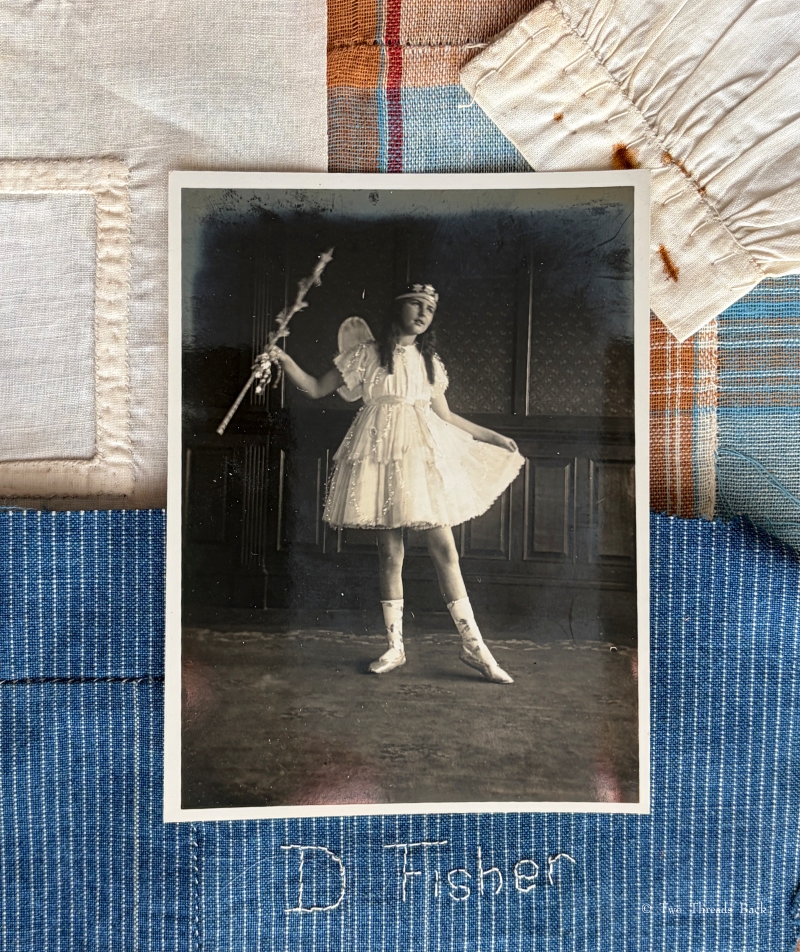
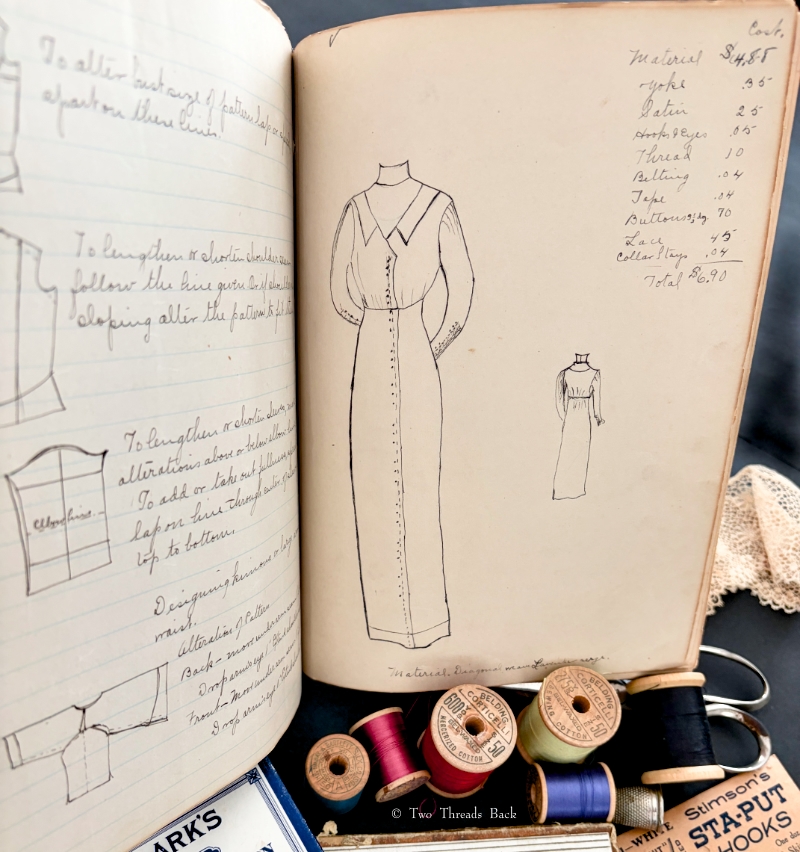
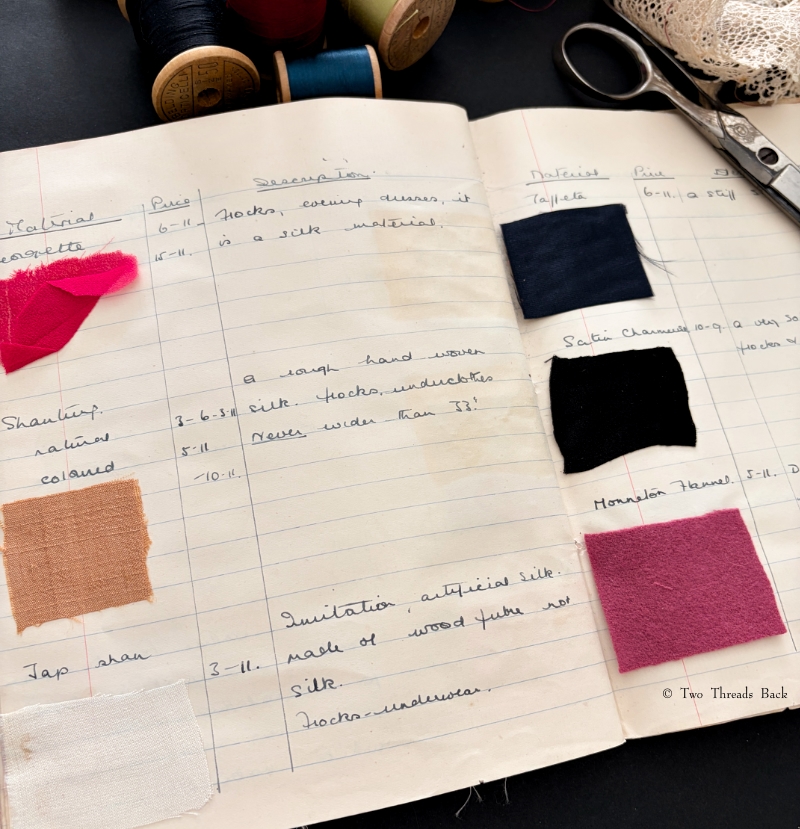
Well, one never was in Kansas and the other isn’t now! Here are two sweet sewing books. The one made by Eliza is American, from Kansas. The one made by Dorothy, who reminds me more of Glinda the Good, is from England. Besides the Wizard of Oz connection (I admit that was a stretch) they have other things in common.
TIME. Eliza’s book is dated 1912-1913, and was compiled during her Home Economics Housekeeper’s Course at Kansas State Agricultural College. Dorothy’s book isn’t dated, but assuming the photo is of her and taken around the time she attended the class, it was probably made soon after Eliza’s. It seems they studied sewing at different ages, however. Dorothy was obviously still a young girl, while Eliza was over 30 when she completed her course, as census records show she was born in 1881.
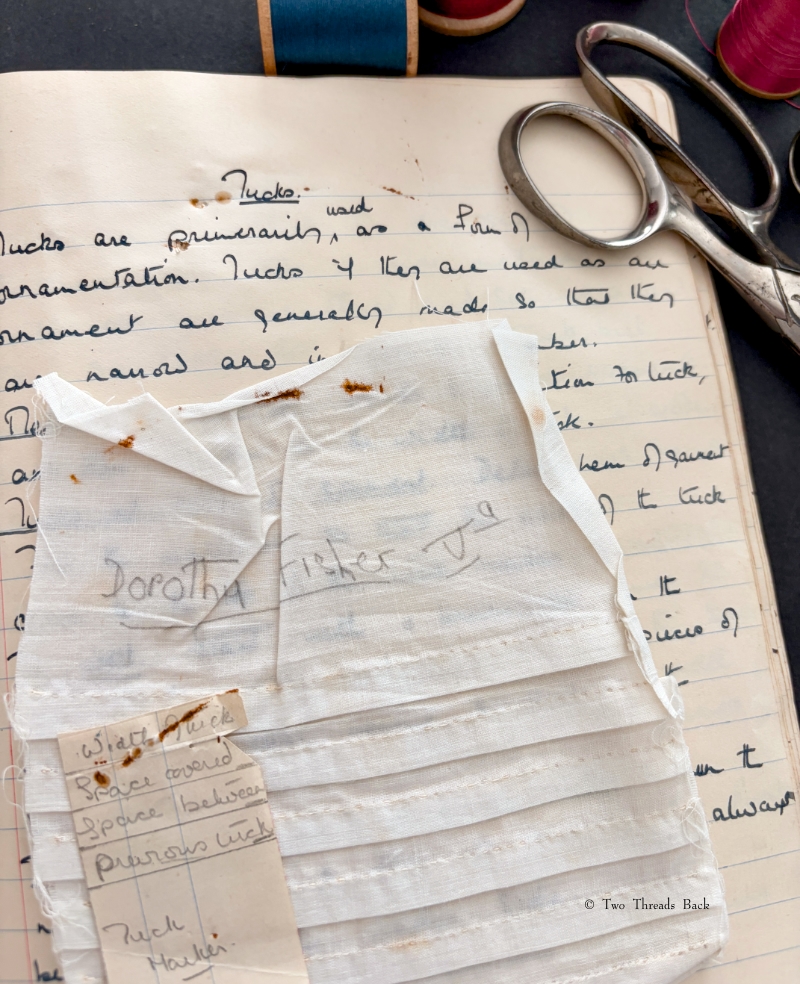
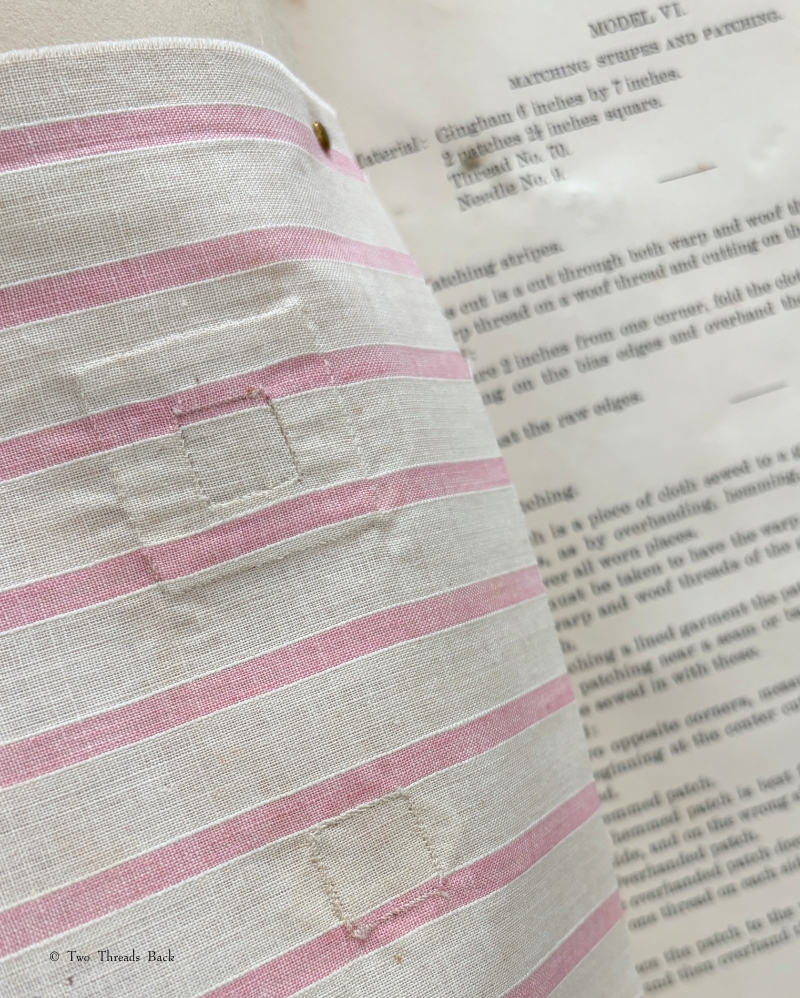
TECHNIQUES. Both cover the basic hand sewing stitches and seams, and they included samples of them in their books. They also learned patching, darning, and making plackets. Dorothy’s work is all done by hand, but Eliza has samples made by hand and machine.
Dorothy obviously put effort into her work, but compared to others I’ve seen, I don’t think sewing was her favorite subject.
Eliza’s work is more precise. However, she was older and likely more experienced when she took her course.
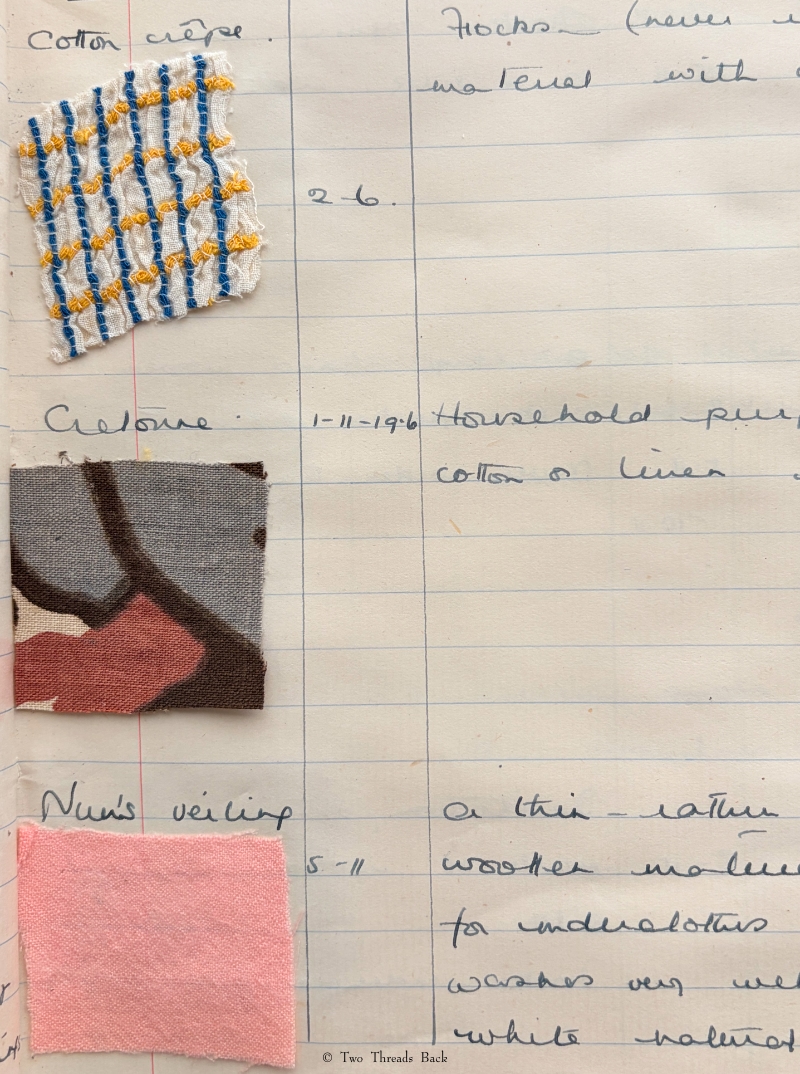
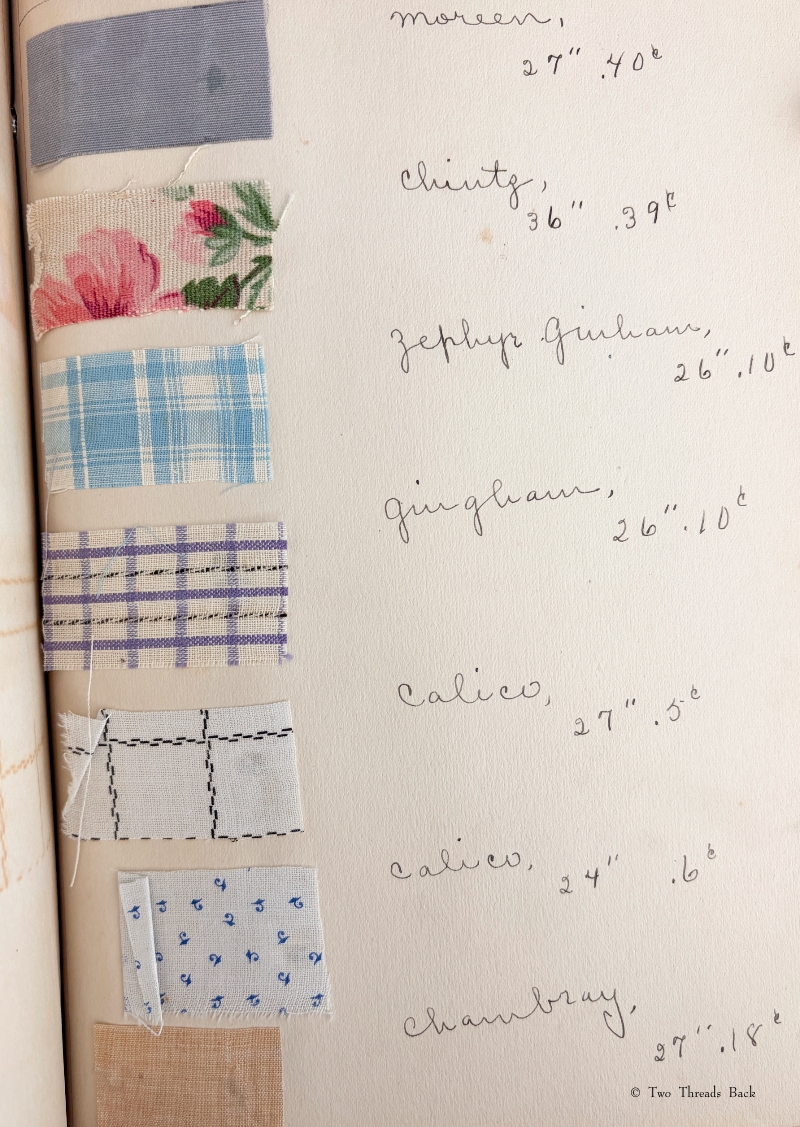
TEXTILES. Thrift was a virtue! Learning to make clothing economically was considered an important part of their education. Students needed to be familiar with fabric types and know which ones were appropriate for different garments. Truth in advertising could often be … well, elusive. And illusive. (For how to promote sales the right way, you can see some extravagant 1892 marketing here.) Textbooks practically encouraged suspicious shopping, and gave hints on how to distinguish good goods from bad goods. Both Eliza and Dorothy included swatches of fabrics in their books, a feature that became common after 1900.
Dorothy noted prices and purpose. Some of the fabrics are the same, or at least they go by the same name, today: georgette, shantung, taffeta.
I wonder if Dorothy was allowed to sew with any of these? I suspect not.
Eliza’s book has 3 pages of cottons, in addition to wool and silk!
The fabric samples are my favorite part of early 1900s-era sewing books. “Extinct” (or nearly) names appear in catalogs, journals, and books from those days, and while research and historians provide helpful descriptions, there’s nothing quite like seeing and touching a tiny bit of the textile for myself. Tarantulle is longcloth – who knew? Not me. A dictionary defines nun’s veiling, and yes, you can still buy it today (I checked), but it’s so much more fun to see a pink snippet from 1915. Textbooks tell me that albatross was wool, but Eliza had a nice cotton specimen. I can’t imagine asking for albatross at a fabric shop today! Well, if there were any fabric shops left today. There aren’t any near me. Maybe they’re still in Kansas?
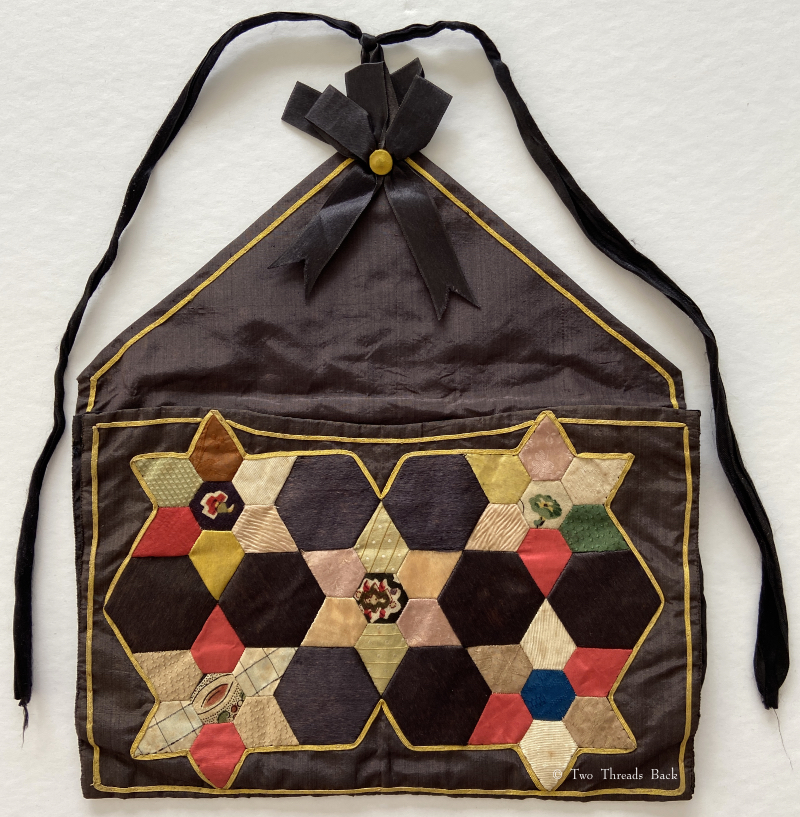
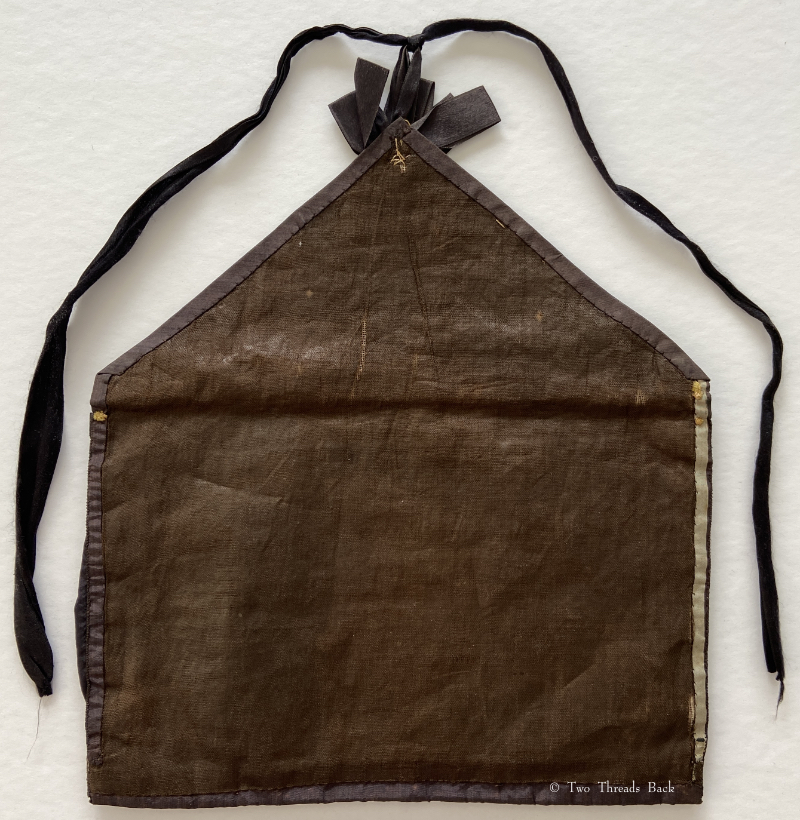
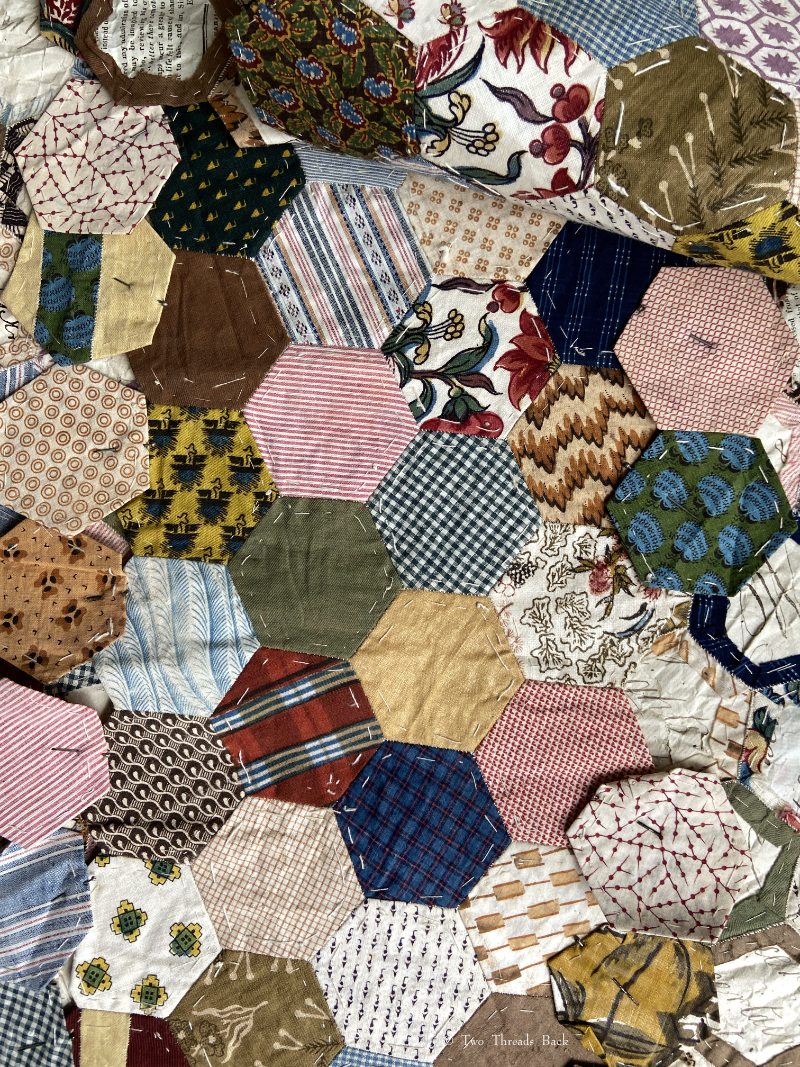
Patchwork projects, c1820. English paper piecing: an elegant silk “pocket” or case – perhaps for letters or needlework? – resting on unfinished panels of utilitarian cotton remnants (more pics below).
Patchwork quilting has earned a lofty place among the textile arts today, but 200 years ago a few writers felt inclined to poke fun at it. I was happily following rabbit trails, chasing plain sewing nuggets, when I came across some entertaining words on patchwork. A sketch written in 1821 found fault with the work AND the worker:
PATCH-WORK.
I have an old female cousin, who has passed a quarter of a century in rags, or rather amidst patches, destined to a most marvellous arrangement, for the furniture of a suite of apartments–a saloon, a boudoir, and a bed chamber. She began her paltry collection by begging of all her acquaintance, and wearing out every one by messages, notes, and applications for odd bits and patterns [i.e., printed fabrics].
She also told two score of lies, in order to obtain samples of different linen-drapers, but upon a very unwelcome observation of mine, she changed her operations.
Asking me one day if I did not think that the window curtains, ottomans, sopha-covers, et cætera, of her bow-windowed saloon would have a very novel, tasteful, and fantastic appearance, if composed of patch work judiciously arranged and bordered by a vandyke pattern worked by herself? I replied, “that the best patch-work which I ever saw had but a beggarly appearance, and that it would take her half her life, and lose her half her acquaintance, to collect the materials; that I always looked upon a patch-work curtain, or quilt to be fit only for a servant’s bed at an inn; that it was a complete make-shift, nay, that if she would make shifts for herself, or for the poor, she would be much more laudably employed. For I consider this patch-working something like lady-shoemaker’s work, below the dignity of the performer, and of little use when done.
All my observations would inevitably have been disregarded, for my cousin Cassandra is like many other old maids–she constantly asks advice with a predetermination to take her own way, but the term beggarly hurt her pride, and the thought of loss of company, to one who could not live without a morning gossip, and an evening casino, was very alarming; so she determined on buying remnants and small pieces of a thousand patterns; and in the long period above mentioned, she completed her patch-work hangings and furniture, which every one praised before her face, and treated with contempt behind her back. This chef-d’oeuvre of useless toil, was, however, shown to all her acquaintance, and furnished the subject of a hundred morning and tea-table conversations. –The Hermit in London, 1821
Well, that was pretty harsh! And I daresay a few million quilters today would agree. I’d rather he’d directed the fun toward installation art, but oddly enough it wasn’t around then. Satire could be brutal back in those insensitive days, and of course anything that hinted of vulgarity (patches!) was fair game. Knowing that the author was writing to entertain made me think perhaps it was a one-off, and the prevailing attitude was more favorable.
However, Lydia Maria Child (not one for tepid opinions), author of the Girl’s Own Book, was rather condescending as well when she said “we do not want young ladies to emulate their grandmothers in making patch-work quilts, or covering their apartments with hexagon- or octagon-starred carpets,” although in an earlier edition she admitted it to be a tolerable alternative to boredom:
PATCH-WORK. This is old-fashioned too; and I must allow it is very silly to tear up large pieces of cloth, for the sake of sewing them together again. But little girls often have a great many small bits of cloth, and large remnants of time, which they don’t know what to do with; and I think it is better for them to make cradle-quilts for their dolls, or their baby brothers, than to be standing round, wishing they had something to do. The pieces are arranged in a great variety of forms; squares, diamonds, stars, blocks, octagon pieces placed in circles, &c. A little girl should examine whatever kind she wishes to imitate, and cut a paper pattern, with great care and exactness. –The Girl’s Own Book, 1833
Perhaps she had a point about tearing cloth just to sew it back together! But to balance out the disparaging remarks, I found a sweet essay about a patchwork quilt written in 1845 –and it mentions PLAIN SEWING! True, the author ranks a beloved patchwork quilt below a snowy counterpane, but the following excerpt glows with the warmest nostalgia. (Other textile historians have referenced it, but here’s a link to the original if you’d like to read the whole piece without my edits for brevity.)
THE PATCHWORK QUILT.
There it is! in the inner sanctum of my “old-maid’s hall”–as cosy a little room as any lady need wish to see attached to her boudoir….
Yes, there is the Patchwork Quilt! looking to the uninterested observer like a miscellaneous collection of odd bits and ends of calico, but to me it is a precious reliquary of past treasures…. Gentle Friends! it contains a piece of each of my childhood’s calico gowns, and of my mother’s and sisters’; and that is not all.
I learned of the world’s generosity in rewarding the efforts of the industrious and enterprising…. What predictions that I should be a noted sempstress; that I should soon be able to make shirts for my father, sheets for my mother…. What legends were told me of little girls who had learned patchwork at three years of age, and could put a shirt together at six. What magical words were gusset, felling, button-hole stitch, and so forth, each a Sesame, opening into an arcana of workmanship… and a host of magical beauties!
Here is a piece of the first dress I ever saw, cut with what were called “mutton-leg” sleeves. Here, too, is a remnant of the first “bishop sleeve” my mother wore; and here is a fragment of the first gown that was ever cut for me with a bodice waist… and, oh, down in this corner a piece of that in which I first felt myself a woman- that is, when I first discarded pantalettes.
Here is a fragment of the beautiful gingham of which I had so scanty a pattern, and thus taxed my dress-maker’s wits; and here a piece of that of which mother and all my sisters had one with me. Here is a piece of that mourning dress in which I thought my mother looked so graceful; and here one of that which should have been warranted “not to wash,” or to wash all white. Here is a fragment of the pink apron which was pointed all around. Here is a token of kindness in the shape of a square of the old brocade-looking calico, presented by a venerable friend; and here a piece given by the naughty little girl with whom I broke friendship, and then wished to take it out of its place…. Here is a fragment of the first dress which baby brother wore when he left off long clothes; and here are relics of the long clothes themselves. Here a piece of that pink gingham frock so splendidly decked with pearl buttons. Here is a piece of that calico which so admirably imitated vesting, economical, bought to make “waistcoats” for the boys. Here are pieces of that to set off my quilt with, and bought strips of it by the cent’s worth – strips more in accordance with the good dealer’s benevolence than her usual price for the calico. Here is a piece of the first dress which was earned by my own exertions! And here are patterns presented by kind friends, and illustrative of their tastes.
Then there was another era in the history of my quilt. My sister–three years younger than myself–was in want of patchwork, while mine lay undisturbed. Yes, she was to be married; and I not spoken for! I gave her the patchwork.
Then came the quilting, a party not soon to be forgotten, with its jokes and merriment. Here is the memento of a mischievous brother, who was determined to assist otherwise than rolling up the quilt as it was finished, snapping the chalk-line, passing thread, wax and scissors, and shaking hands across the quilt for all girls with short arms. He must take the needle and thread. Well, we gave him white thread, and appointed him to a very dark piece of calico, so that we might pick it out the easier; but to spite us, he did it so nicely that it still remains, a memento of his skill with the needle.
And why did the young bride exchange her snowy counterpane for the patchwork quilt? These dark stains at the top of it will tell–stains left by the night medicines, taken in silence and darkness. The patchwork quilt rose and fell with the heavings of her breast as she sighed over the departing joys of life. Through the bridal chamber rang the knell-like cough which told us that we must prepare her for an early grave. The patchwork quilt shrouded her wasted form as she sweetly resigned herself to the arms of Death.
And back to me, with all its memories of childhood, youth, and maturer years; its associations of joy, and sorrow; of smiles and tears; of life and death, has returned to me The Patchwork Quilt. The Lowell Offering, 1845
Did you notice the reference to plain sewing? And making shirts? She’s singing my favorite song! An “arcana of workmanship.” Now there’s a title for a future post. Of course I don’t really think most people disparaged patchwork. There are too many survivors that show just how artistic, skillfully worked, and beloved pieced fabric was. I probably admire it more than most because I have no “pattern sense,” I can’t work with measures, shapes, design layout without a mental meltdown.
I’m happy simply to share the sentiments of the “Old Maid” above whose patchwork looked
to the uninterested observer like a miscellaneous collection of odd bits and ends of calico, but to me it is a precious reliquary of past treasures; a storehouse of valuables, almost destitute of intrinsic worth; a herbarium of withered flowers; a bound volume of hieroglyphics, each of which is a key to some painful or pleasant remembrance, a symbol of—but, ah, I am poetizing and spiritualizing over my ” patchwork quilt.”
The points of the stars are all silk, and the centers are linen.
The back is made of brown glazed linen, and the stripe on the edge is a selvedge on the silk binding.
It’s made to allow room to for holding contents (whatever they might have been!), and the decorative button is handmade of silk over a wire ring.
More of the unfinished panels. You can see closeups of the patches in the Flower Patch posts.
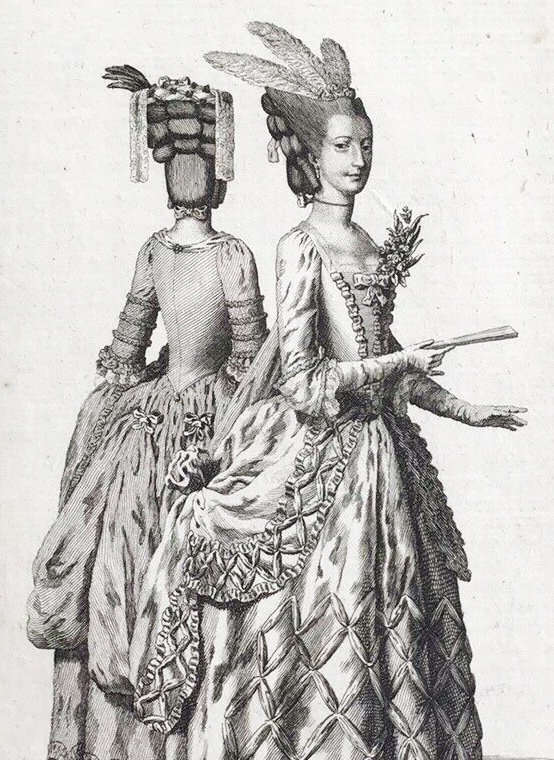
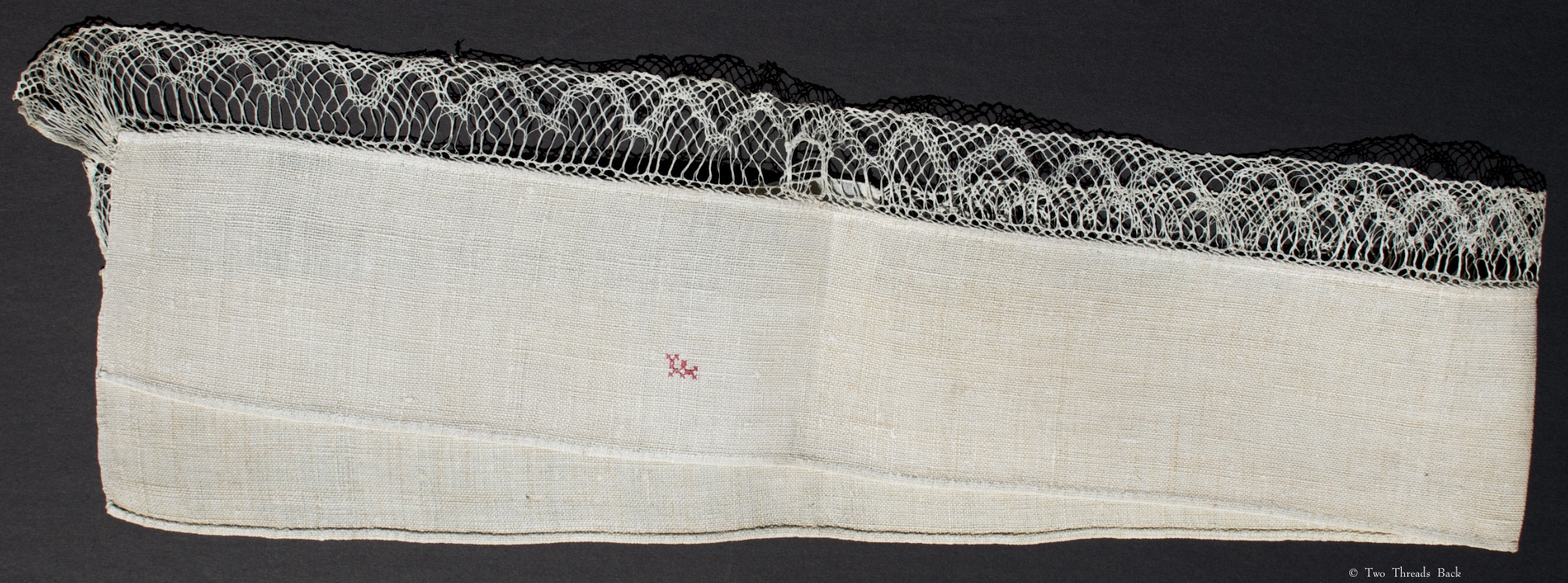
I know what lappets are, costumely speaking, and with regard to women’s millinery. They’re those long, lacy, streamer things that hang down from a headdress. The fanciest ones were made of fine lace and could be terribly expensive. They were popular in the 18th century but seemed to fade by 1800 when the classical look was in vogue, and then regained favor, at least with “mature” ladies, in the middle to late 19th century. Early ones were usually found in pairs, or occasionally joined slightly shaped in the middle, while 19th century ones could be . . . more creative.
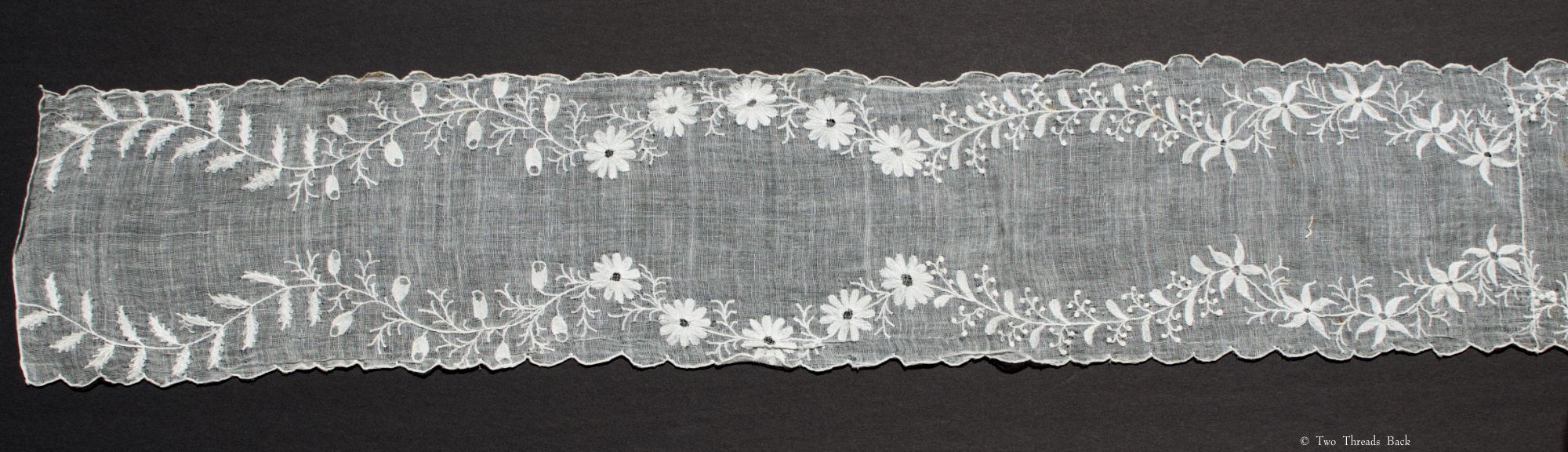
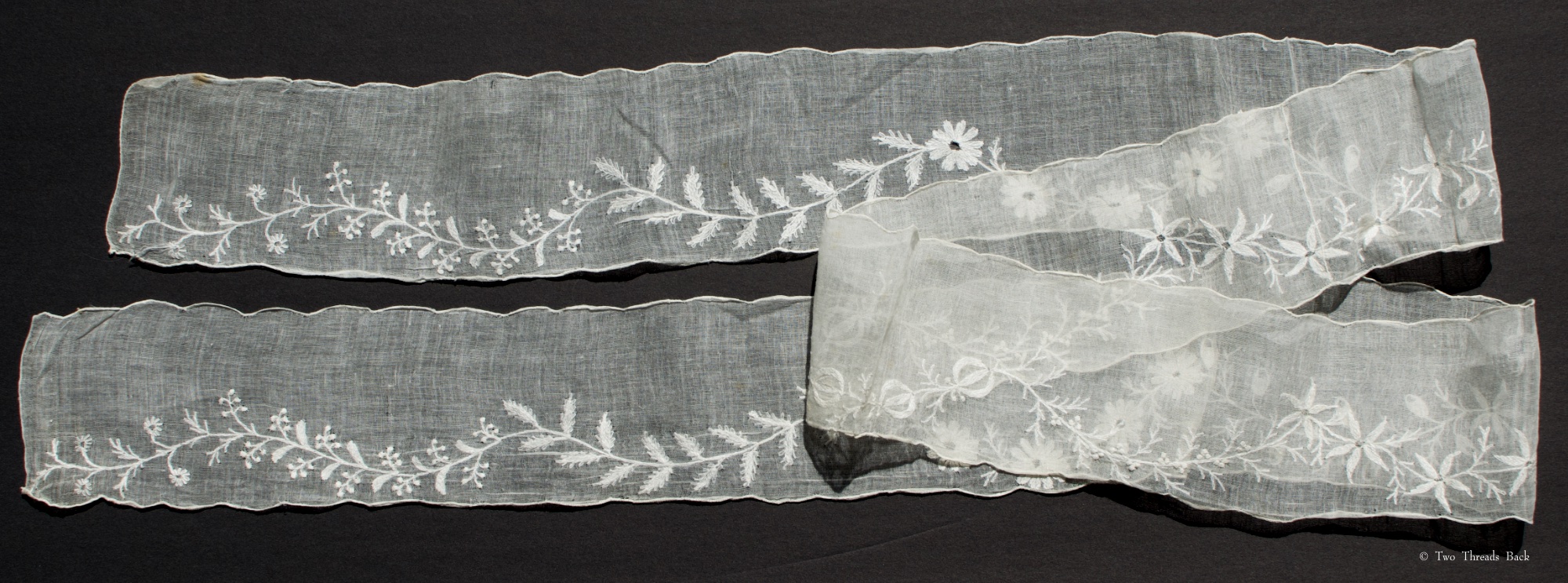
But what have I got here? Two different long strips of fine white muslin, neatly (but probably not professionally) embroidered with whitework. Are they one-piece lappets, or something else?
They appear to date to the late 1700s or early 1800s, judging by the materials and floral patterns. One is 58″ x 4″ and the other is 63″ x 3.” The design on the wider one is mirrored on both edges, while the other is worked along one edge only. All edges are scalloped, and there’s a join on both at 20 inches (not the middle) from one end which the embroidery carries right across. Found together + like patterns + like materials = same maker? The design was embroidered to fit, which indicates they weren’t cut from another garment. They seem too fragile for a sash and too narrow for a scarf.
So how in the world would you wear them? It seems like draping across the top of your head would be a bit awkward. I’d feel about as graceful wearing a length of toilet paper.
The most fabulous book on accessories of this era is Heather Toomer’s Embroidered with White, and I searched it for clues. It has beautiful photos of lappets. In pairs. With dense embroidery. Sigh. In her book on the next time period (just as brilliant), lappets appear as extensions of other accessories, such as fichus and pelerines. So I’m still wondering what these were for. Help!
The fabric is joined about 20″ from one end (not centered) on both pieces.
The darning is finer than the embroidery!
While on the subject of long narrow textiles, I’ll present my next puzzle: tuckers. I’m wandering into dangerous territory when discoursing on 18th century costume, since I know so little. However, I had no trouble finding period references to tuckers. Their wearing location on female anatomy guaranteed attention, one way or another.
Tuckers, as defined in 18th century dictionaries:
TUCKER, tuk’-ur. f. A small piece of linen that shades the breasts of women.
-A Slip of Linen or Lace, pinned along the Top of Women’s Stays -A border of linen or lace on the bosom of a shift -A fine piece of lace, cambrick, &c. pinned or sewed round the neck of a woman’s shift, gown -A shred of linen &c., about the neck of a woman’s shift -A slip of fine linnen, run in a small kind of ruffle, around the uppermost verge of the women’s stays -A strip or ornament of linen worn by women at the uppermost verge of the stays
Then we have Garsault’s 1771 L’art de la lingère, where I’m up to my tucker in speculation:
Tour de gorge en mousseline festonnée. Il se fait d’une aune de long sur un seizieme de large. Painfully translated: Scalloped muslin tucker. It is made one [≈yard] long by one sixteenth wide. A 1788 French-English dictionary defines “tour de gorge” as “tucker,” and “tour de dentelle” as a lace tucker.
This post is already too long to include Joseph Addison’s slightly naughty essay on the tucker – although if you’re curious, you can find one of many reprints here.
There’s no lack of period illustrations of tuckers, but it’s the logistics that have me baffled. Sure, you can tuck a straight band of fabric around the top of your stays – but then all but a few inches in front is hidden under a gown. You can tuck a straight length around the neckline of your gown – but then you have to negotiate the curves, and my mystery pieces seem awfully wide to do it without looking rumpled.
A Lady’s Maid Soaping Linen c.1765-82 Henry Robert Morland 1716-1797 CC-BY-NC-ND 3.0 I don’t presume to know if she wearing a “separate” tucker, or if that’s trimming on her shift. Or neither. But it’s a good illustration of the trickiness of turning corners!
A Laundry Maid Ironing c.1765-82 Henry Robert Morland 1716-1797 CC-BY-NC-ND 3.0 Her frill seems to be a little fuller.
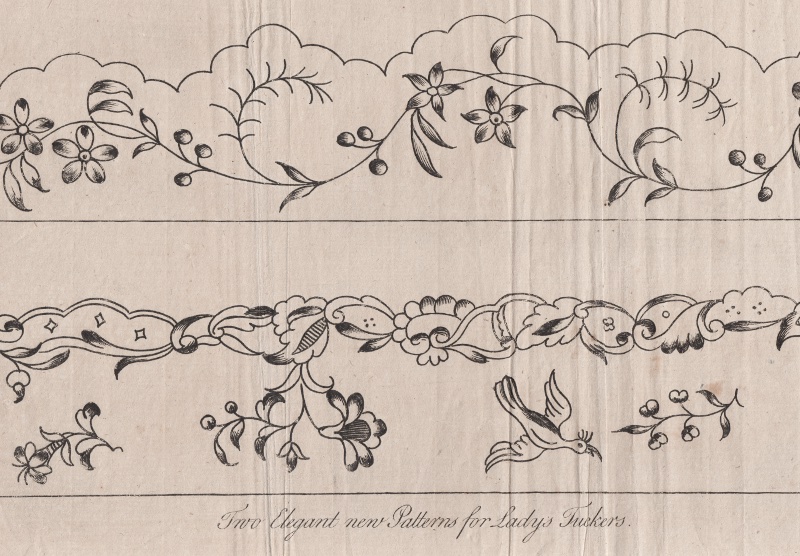
Many paintings show gathered ruffles at the neckline, whether lace or embroidery, although the Lady’s Maid Soaping doesn’t look very frilly. Of course you could always adorn your own tucker, if you were good with a needle.
A pretty pattern from 1772.
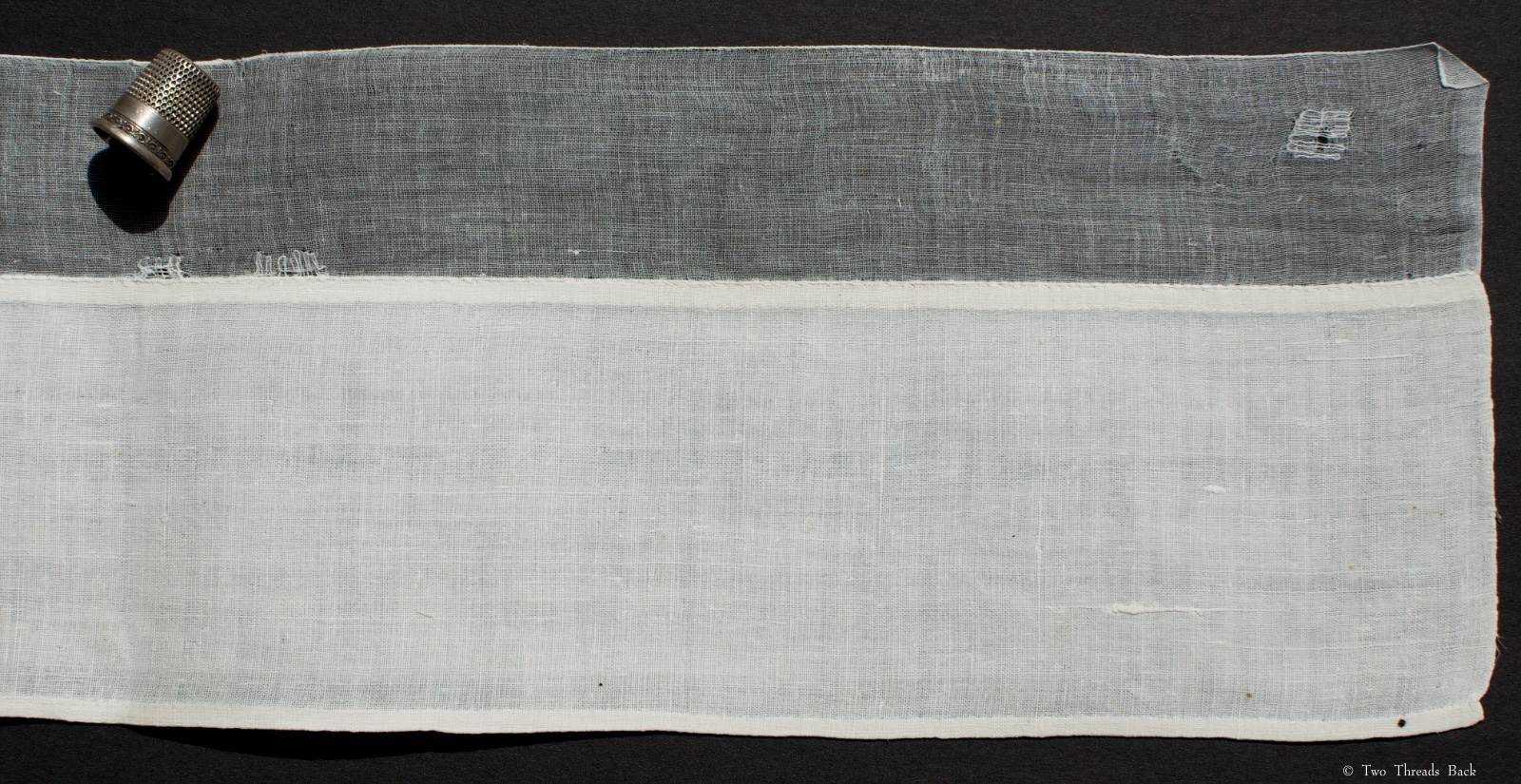
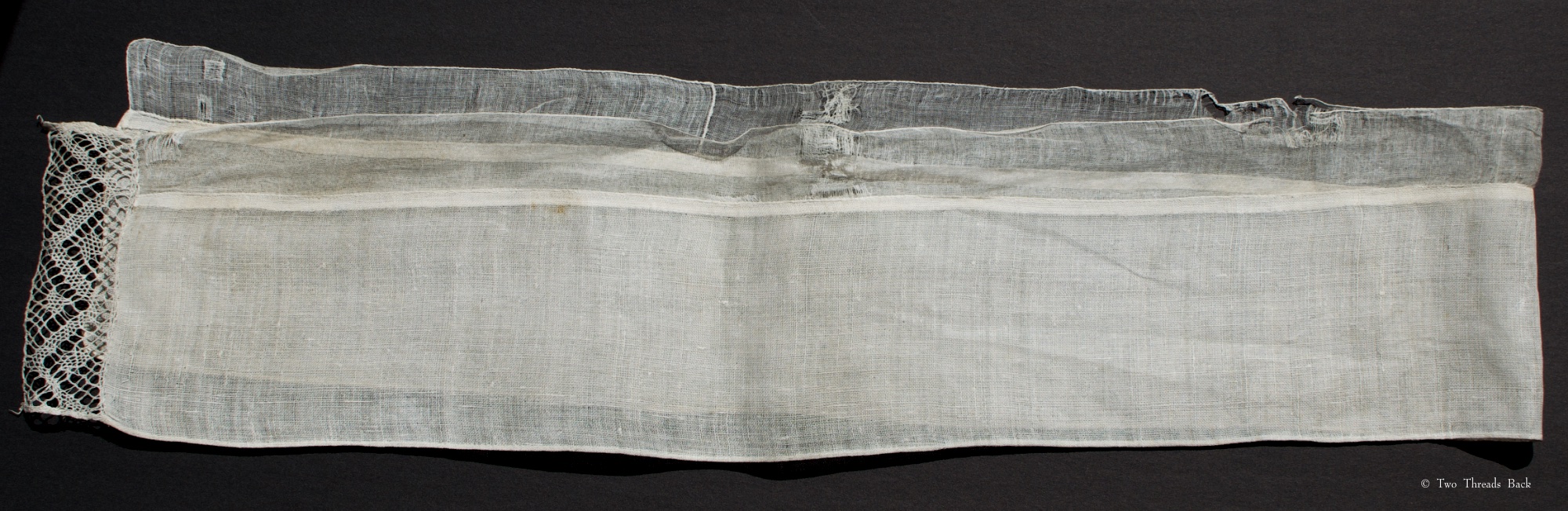
Now here are the four long strips of linen that perplex me, ornamented along one edge, all owned by a woman who lived from 1760-1805, in France. They measure a bit over 40″ long and the linen is @3.5″ wide. If they’re not tuckers, what the heck are they and how did she wear them? Maybe they were part of a headdress. Folk costume. Dresser scarf. Tourniquet with feminine flair.
A closeup of the careful mending. The darns are as fine as the other plain sewing.
There’s a bit of lace on one end only, and a cambric border on one edge. You can see there’s also a good bit of wear.
This one is in better shape, has lace along the edge, no trim on the ends. And her “marked” monogram.
A beautifully simple one, marked with both initials, although the cambric trim on this one didn’t fare so well.
I’ve called these pieces lappets and tuckers, but I truly don’t know. Research didn’t settle anything for me this time, so any help is welcome. Maybe someday in the future our descendants will ask the same questions about our garments. I know I’ve shopped for workout clothes and been just as confounded – these strappy scraps of spandex go how?!
The first part of the book is the reference section, 400+ pages of information on textiles, right down to illustrations of the looms used to manufacture them. But the last sections are the most fun to read.
Appendix “A” has charts with sizes: home linens, gloves, buttons, corset covers, thimbles, and whalebones. There’s even a chart with yardage suggestions for most garments, rather like the back of pattern envelopes today. “B” has yardage, weight, and thread count. “C” is an appendix of tariffs, not particularly interesting except that it’s really cool to see what was being imported: human hair (unmanufactured), cotton quilts, artificial flowers, and hair of hogs for mattresses! “D” was, of all things, a German pronouncing dictionary – included because sales clerks who spoke German could command a higher salary!
But the best was last: Window Trimming (or How to Attract Women). The author sizes up his target.
“There are two classes of feminine buyers to whom the trimmed window appeals most strongly: the lady who has nothing to do looks round at the store windows through mere womanly curiosity; the lady who wants a dress or other article looks round for something to take her fancy: both are certain to be attracted by goods prettily displayed.”
I feel like I should feel offended. But I’m not. Sometimes I really do shop the first way, and sometimes the second! Cole advises on basic design elements and techniques, starting with conventional color theory. His comments are practical and pithy, “Red and orange are not pleasant companions.” Perfectly tasteful when arranging a shop window in 1890, right? However… “Divorce blue and violet forever.” Seriously? This time I am offended!
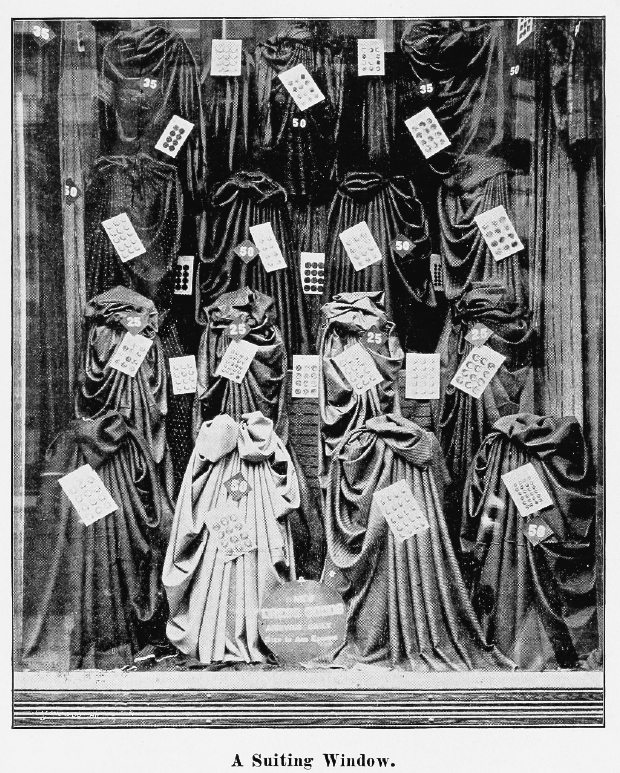
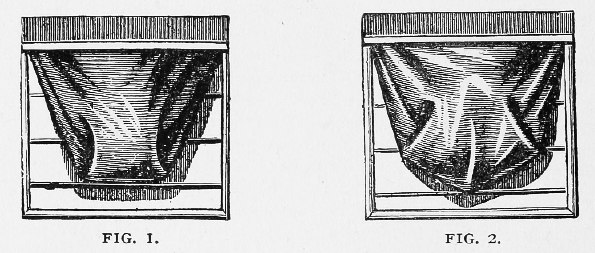
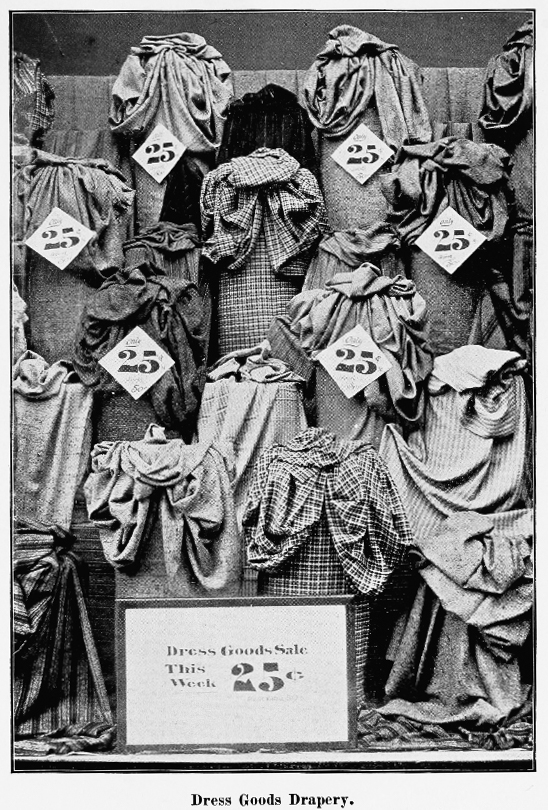
He continues with advice on the background of the window, and then goes on to arrangement. Time for some puffery! Did you know that heavy silk makes lovely displays when puffed just right? Window artists are directed to move their arms like exuberant conductors, raising armfuls of fabric and hammering down on the counter, jerking the selvedges outward and hitting the floating folds a sharp cut with the hand. But woe unto the artist who attempts to puff a flimsy silk “as it generally caves in, and so discloses the poverty of the fabric!” I hate it when that happens.
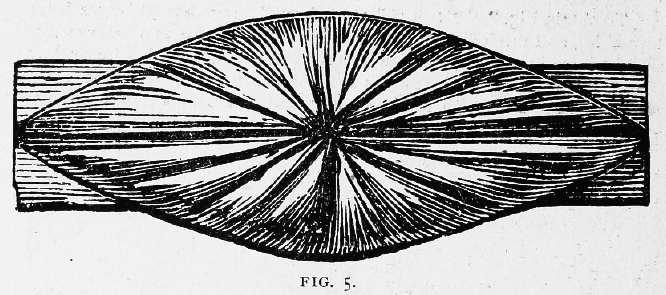
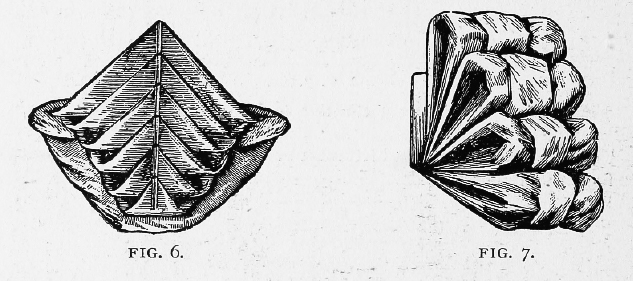
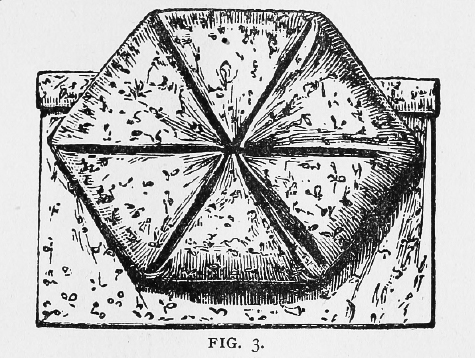
Methods of puffing, draping, folding, and fanning the goods, to make an artistic display.
Printed cottons require different arrangement than silks. Modes must vary according to the finish in vogue!
This design is for a 3 tier window. You can see that the window dresser has mastered puffing and draping. I’ll take 8 yards of each. And I’ll need lining, buttons, hem tape….
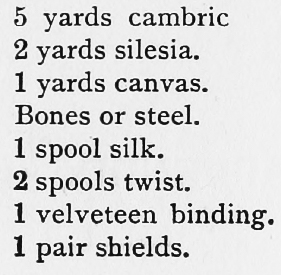
That reminds me, did I mention the free gifts with every purchase? Well, these extras (see left) are “usually given away with dress patterns of expensive materials.” I don’t suppose there are any new marketing tricks left. However, there are some old ones that have been forgotten. When was the last time you saw a Canning Apron Window? What, never?
Well, that was one suggestion for a theme window. “Many a lady who seldom finds time to enter into the hardships of housekeeping, just ‘pitches in’ during the canning season. It is taking time by the forelock simply to suggest that in this feature there is a grand opportunity for a realistic window display… A display of aprons, which are proper for such a time, and the arrangement of fruit in baskets and about the floor will be a change from old ways.” It certainly will.
But what about special events? This one’s a kicker: A Grand Army Window. “For occasions of Grand Army encampments or re-unions a window devoted to a representation of camp life is very appropriate.” By the time you’ve sodded the floor, added a tent complete with faux legs encased in army boots sticking out from it, knapsacks, and a coffee kettle over the fire, well, there you are in the good old days. But the description ends there, and I’m still trying to figure out – how the heck are you supposed to display any dress goods with that?
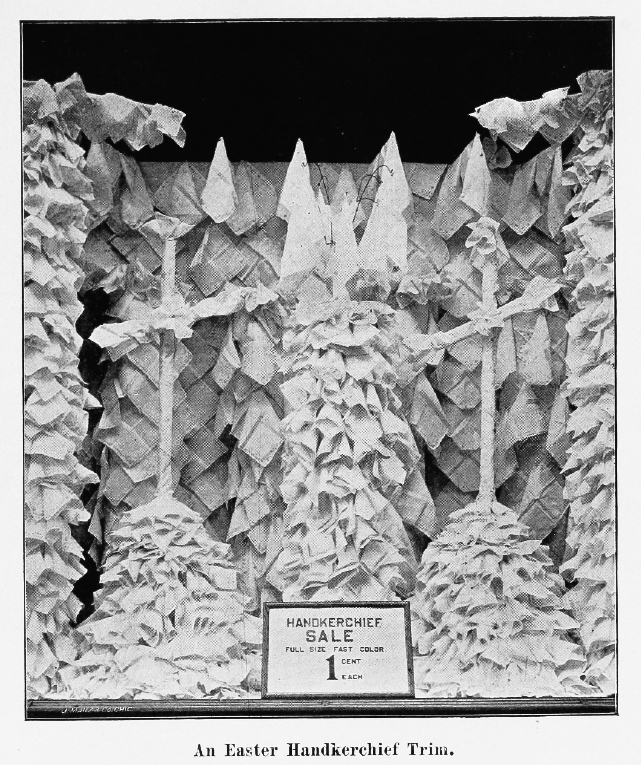
Wait, there’s more! Here are some illustrations of themes used to decorate windows. Let’s start with handkerchiefs.
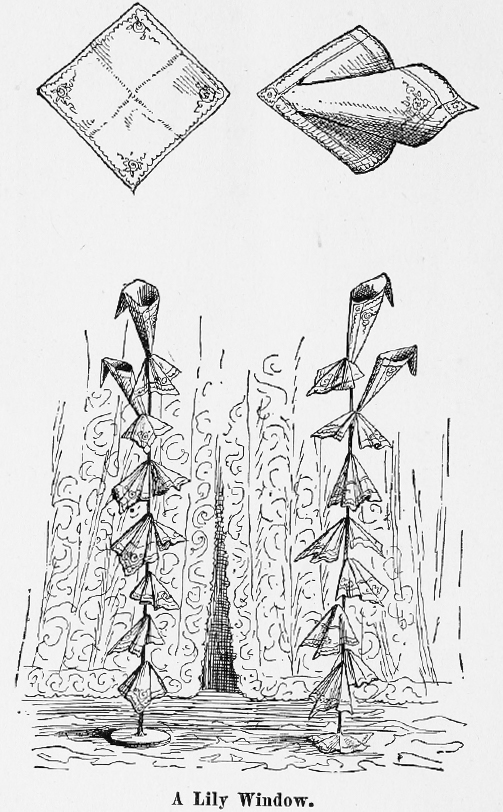
And if you only want to do a few Easter lilies instead of a whole window, try this one.
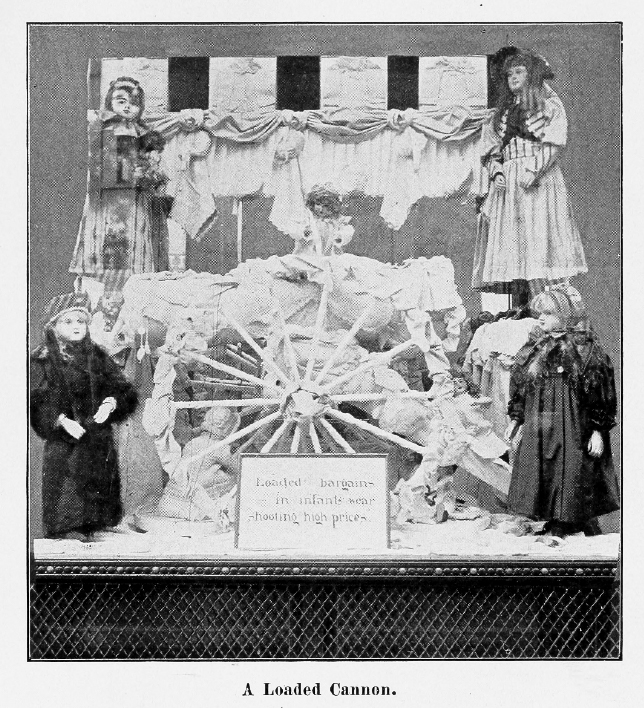
What about something a little more creative, something to inspire thoughts of dressing children? Try a Loaded Cannon for infant’s wear. (If you’ve ever tried to dress a resistant toddler, this might not be so inappropriate.)
“Loaded bargains in infants’ wear shooting high prices.”
Now if you have a whole lot of prints that you want to showcase, here’s the perfect solution. Quilt shops, take note of these columns. This one “can be carried out with no more expense than that of a few hours labor.”
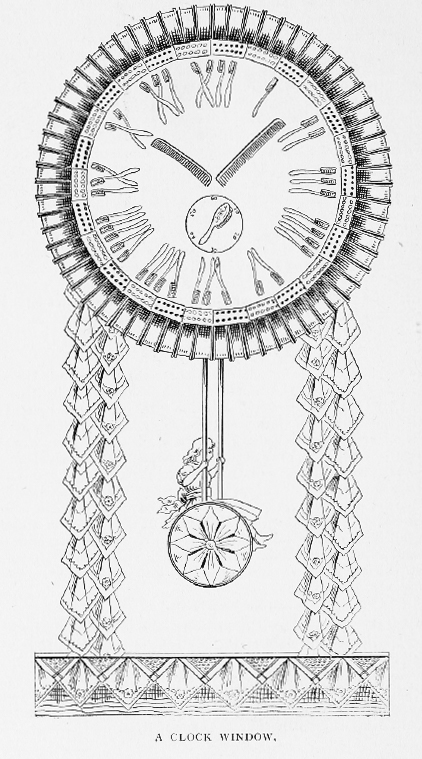
We all need reminding that it’s time to brush our teeth and comb our hair. And blow our noses.
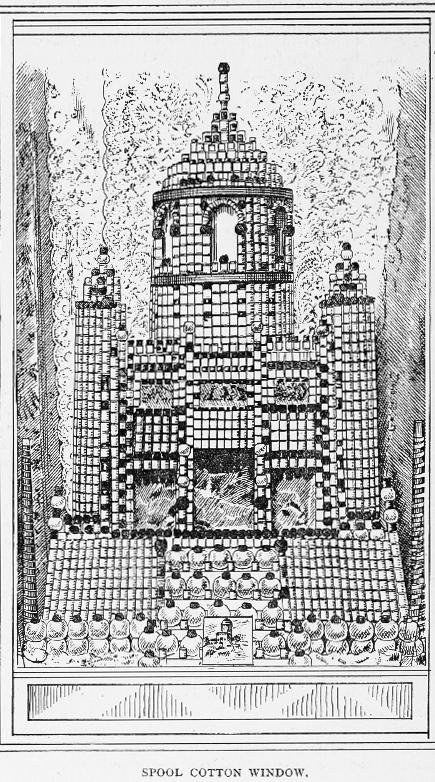
And now to wind it all down, we have a spool display of gargantuan proportions. I want one.
More ideas include a May-pole, Toboggan Slide, Button Wheel, Parasol, Lace Fountain, and – are you ready? – a Bridge made of cuffs, 5-plaited shirts, canes and umbrellas, narrow black ties and white ones, carded cuff buttons, and pongee handkerchiefs. Mr. Cole would have loved decorating floats for parades!
He finishes with some excellent advice for the sales clerk, just as applicable today as it was then.
1. Be ready to receive customers with a gracious, cordial, and friendly address.
2. Never, under any circumstances, assume to know the business of your customers better than they do.
3. Treat your customer with respect, in fact, honor him in every way possible, since he has honored you by calling.
4. Use diligence and perseverance in showing goods and their merits in a scientific manner.
5. The crowning point is to fill the bill with a true artist’s eye, and sober, candid judgment… for future sales are at stake.
Thus with frankness, honesty and uprightness in every particular… the ambitious salesman will have lasting, satisfied customers, and have sold far more than anticipated.
Always remember that you needn’t be big to excel. “Don’t be discouraged if your window is small or badly constructed. Make the best of it, and carefully think out what kind of display will best suit the circumstances. You need a very small space to prove your taste and originality, and to make a show which people will cross the street to look at.”
I think we could apply that moral to a lot more than a shop window.
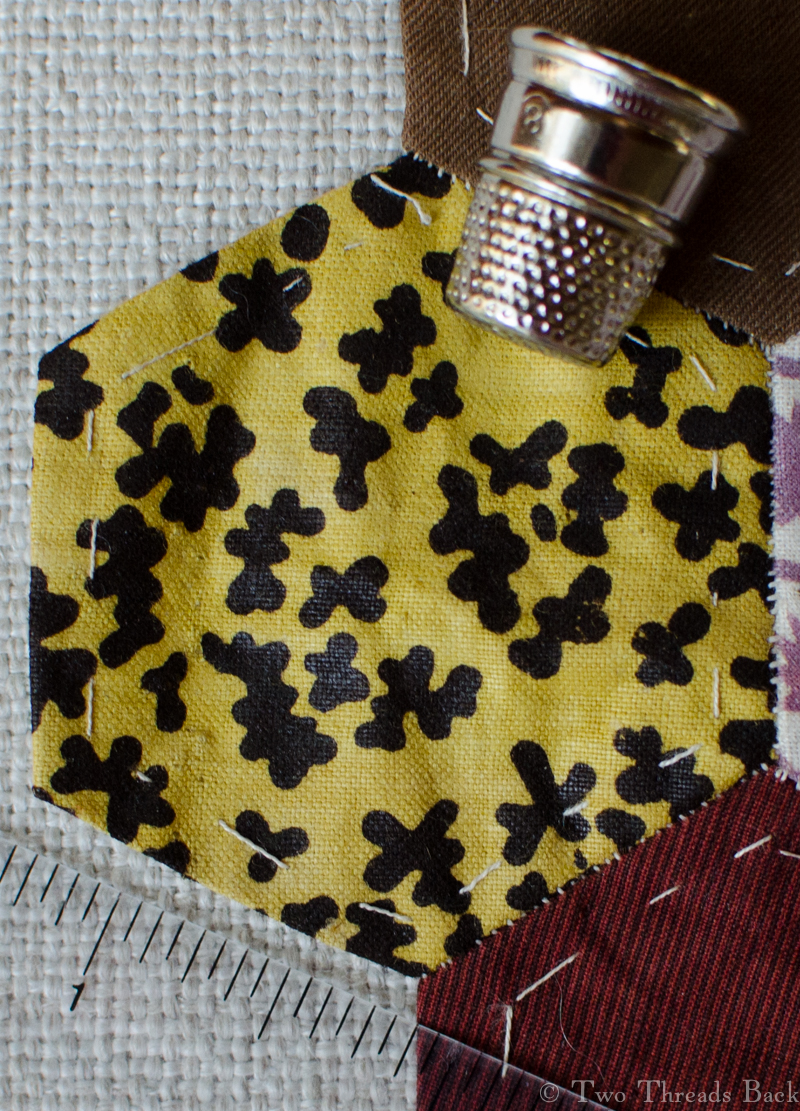
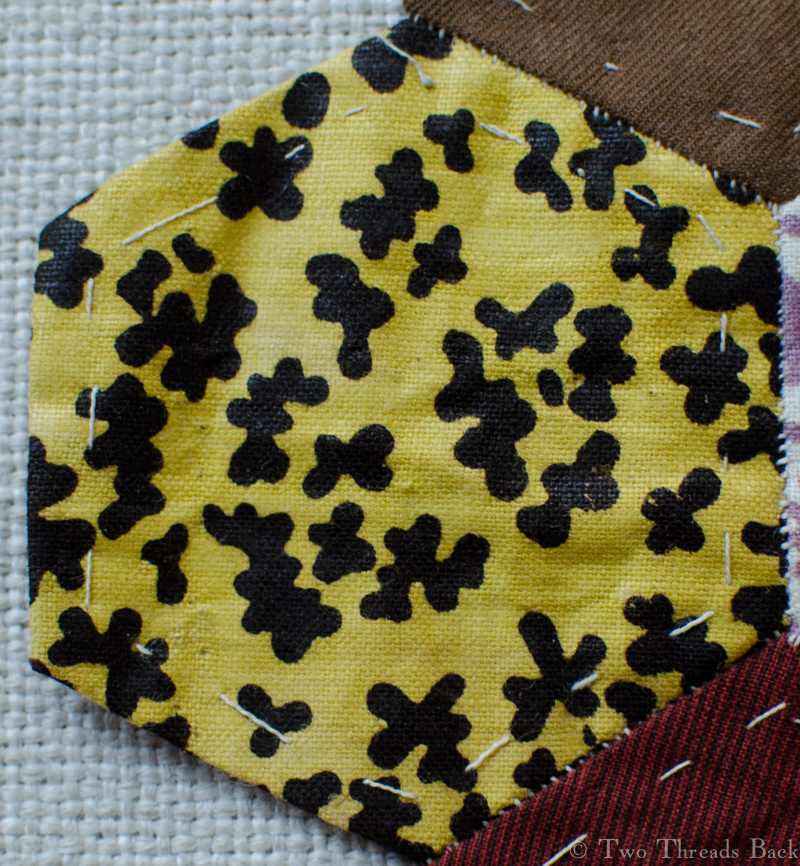
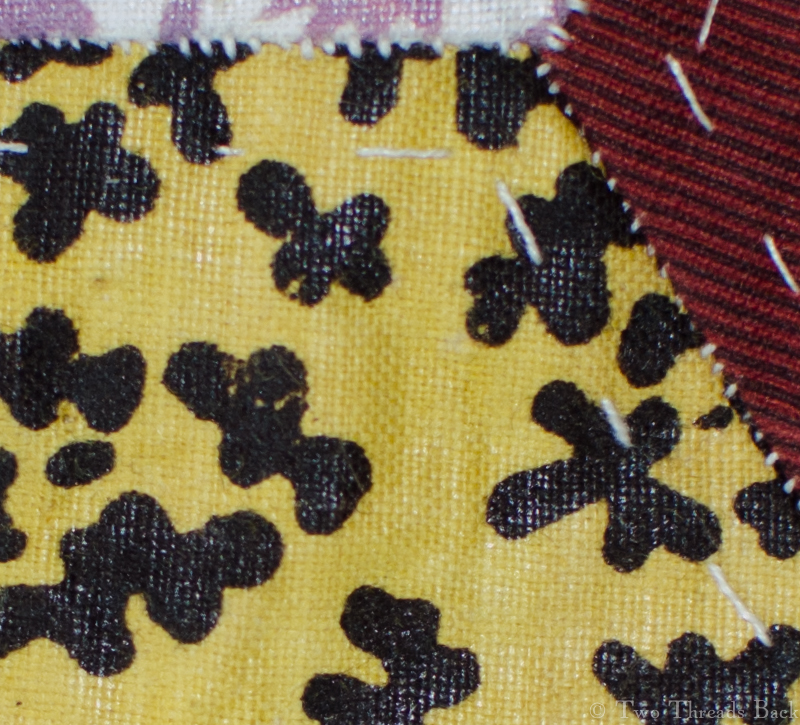
This flower patch is all dressed up as a leopard for Halloween, shown with a thimble and a ruler (inches) for scale. The edge by the ruler is about 1.25″ long. Like the others in the quilt, it dates to the early 19th century.
I haven’t forgotten the plan to keep adding early prints to the Flower Patch collection here at Two Threads Back. I just lost sight of it for a little while. Literally.
Occasionally I get hit by a frantic cleaning frenzy and start to clear out and organize everything, almost compulsively. Yet every time I do, I forget where I’ve moved stuff. Out of sight, out of mind. The “out of mind” part is especially fitting.
Anyway, I opened a box today and there they were, the quilt pieces, waiting reproachfully for some attention. So I selected a wild little print, an early calico reminiscent of an animal pattern: leopard, amoeba, tortoiseshell? Hmm. I prefer the feline. Like the others, it dates to the first quarter of the 19th century, probably c.1810.
But really, what Regency lady would dare to wear it? It’s certainly not for the fainthearted, a milk-and-water miss. Or am I being too…catty?
Happy Halloween!
Front view – very vivid colors!
From the back.
And a close up with flash to show the heavy glaze.
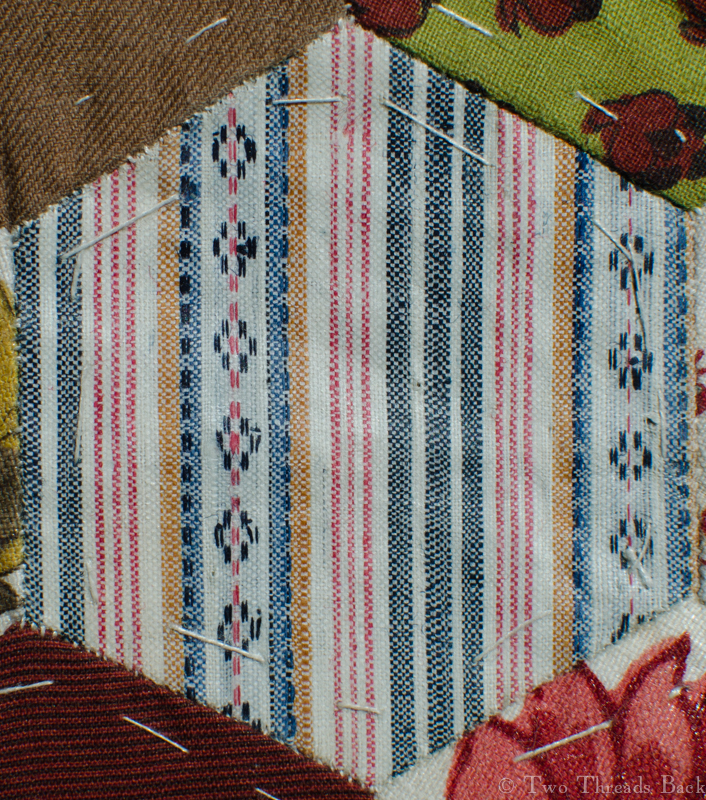
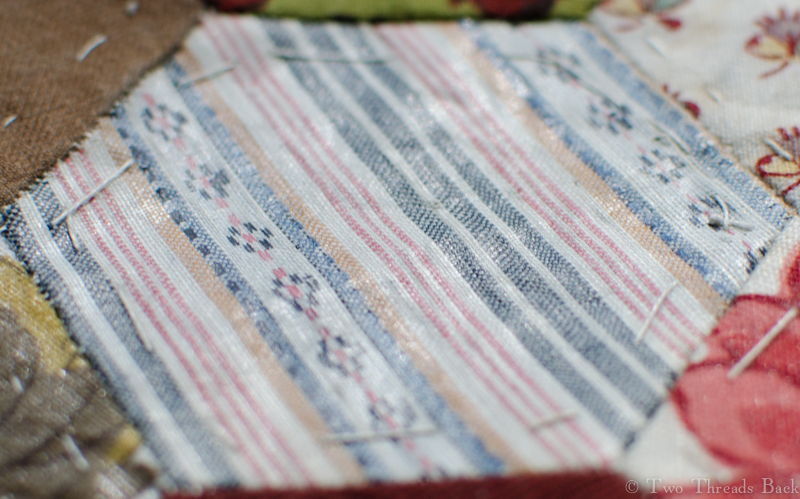
Perhaps I should have titled this “What Do You Do When Old Looks New?” These stripes are from the same early 19th century quilt as all the other Flower Patch samples, but they look so modern to me that if I weren’t completely sure about their age, I’d think someone was sneaking in new fabric. However, I’m convinced that all the different fabrics date to within the same few years. (Any fabric experts passing this way are welcome to call and opine!)
I could easily see this pattern on a man’s shirt today. But what would it have been used for then – gowns, aprons, children’s clothes? These have the same glazed finish that many of the others do, and I’ve added the very last picture to try to show that.
The same piece from the back.
Another very contemporary looking pattern.
How appropriate for a blog: Opinion Opinion Opinion…
I’ve tried to show how shiny the sizing is, but you may only see a really bad photo.
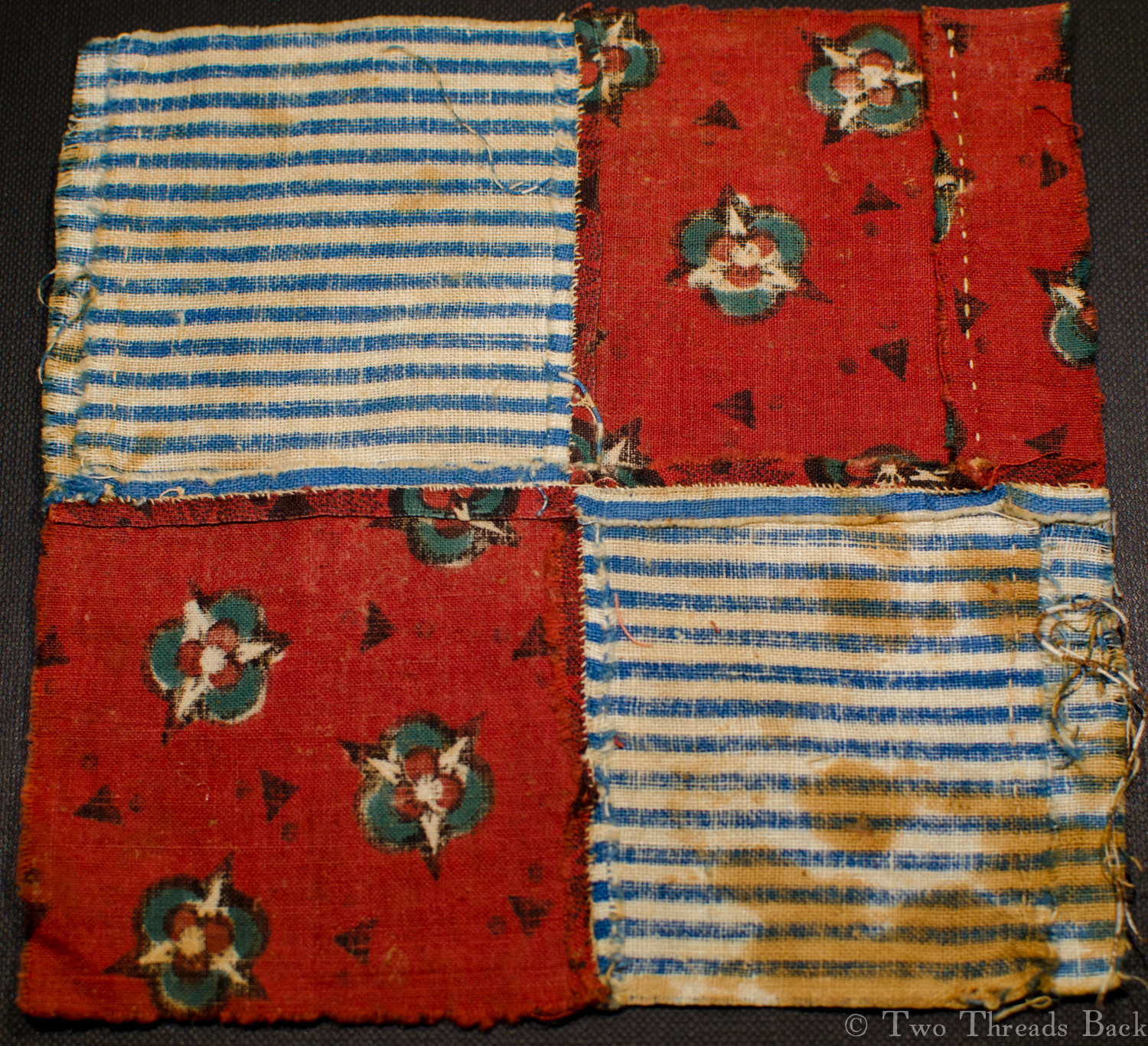
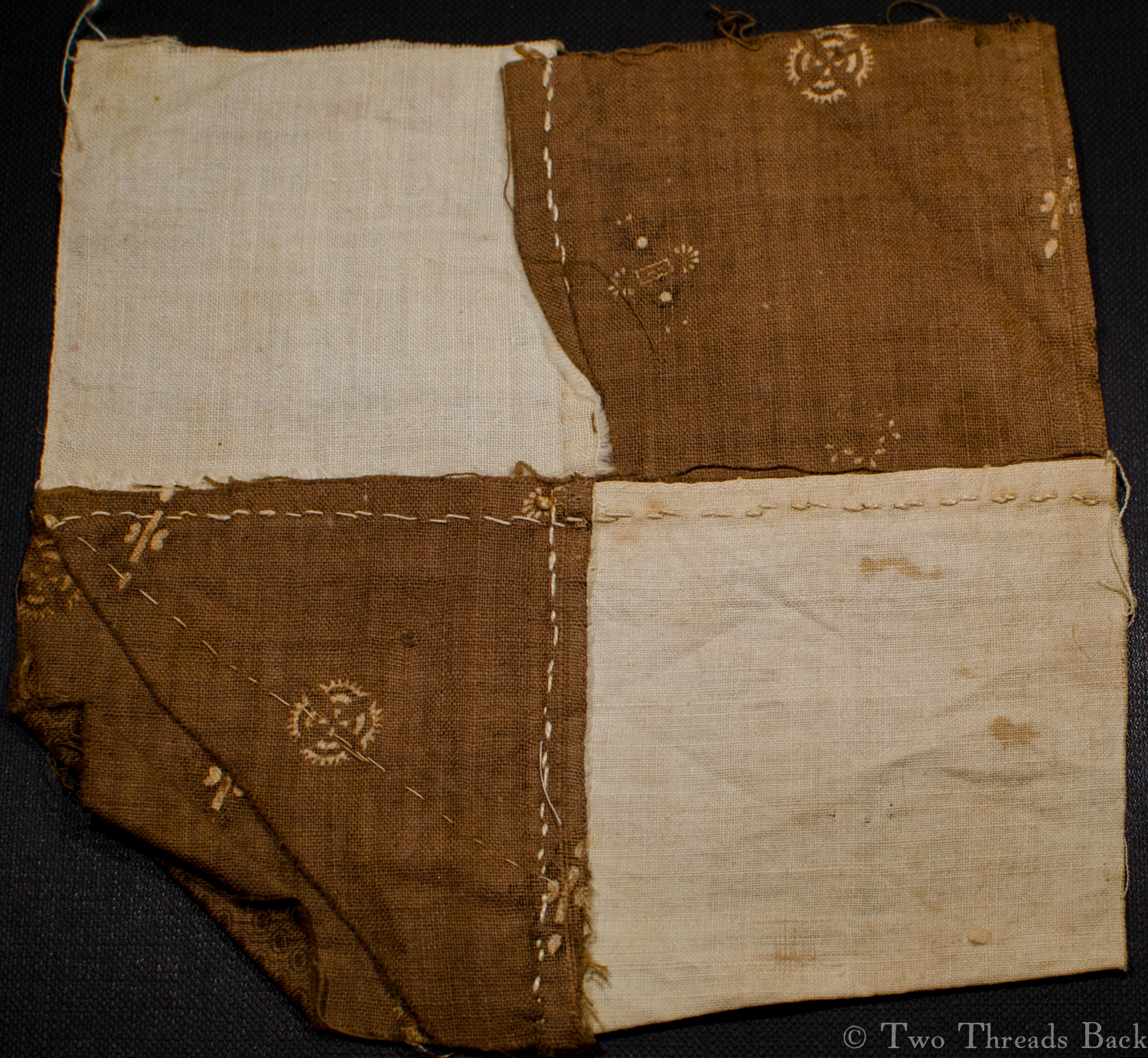
Mary’s neat sewing, with the squares joined by “seaming.” The finished block measures 5 1/2 inches square.
There once was a lady who lived and sewed in New England, way back around 1810. She had a little girl who wanted to help, and so she taught her how.
This lady (I’ll call her Mary because there’s a 27.4% chance that was her real name) was making a simple quilt out of four patch squares. Calico was dear, so she used every teensy scrap she had to make the patches.
This is a view of the back showing Mary’s careful piecing. The narrowest blue striped bit measures 3/8″ inch, not including the seam allowance.
She gave Betsy (I’ll call Mary’s daughter Elizabeth because there’s a 14.3% chance that was her real name) some squares to practice on. Betsy wanted the pretty patterns to work with, but Mary was reluctant to use those for lessons, so she compromised. One print, one plain.
Betsy’s finished square. Do you notice something a little odd here?
Well, Betsy finished her block, and Mary finished 89 others. Then she packed them all away. They were never made up, but remained in a box in the attic for 200 years. Don’t you wonder why?
Betsy’s work from the back. Yes, her stitches are a little clumsier than Mary’s, but she was learning. And they’re straighter than mine – go Betsy!
That “aha” moment, when a photo in a book bears a resemblance to a quilt patch.
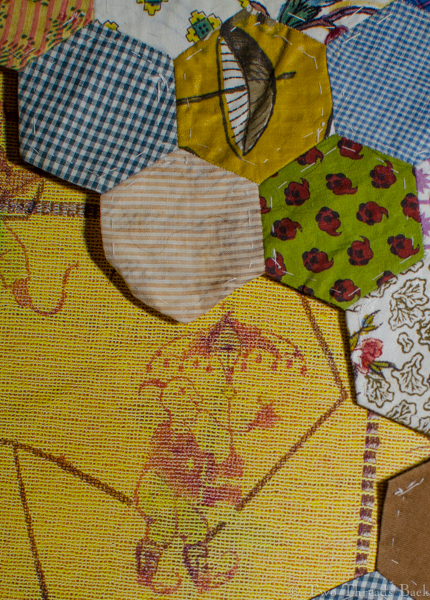
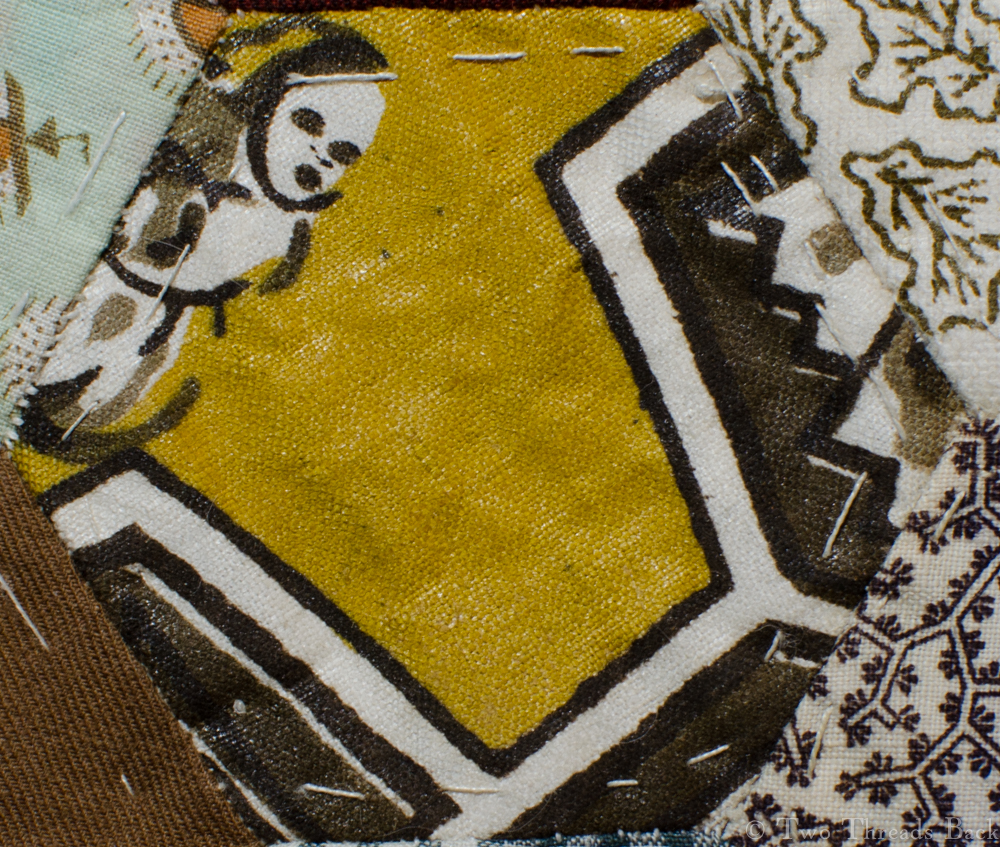
It might be a stretch, but these Flower Patches of yellow, white, and brown reminded me of a photo I’d seen in a costume history book. I just couldn’t recall where! All I could remember was that it was very yellow and had something to do with parasols and a theme exotic to western eyes, like something from the “Orient.”
Finally, I found this illustration from Fashioning Fashion: European Dress in Detail, 1700-1915, by Sharon Sadako Takeda. (Fabulous book!) It’s definitely yellow. And the pattern is certainly exotic. The quilt fabric, however, is heavily glazed, and I have no idea whether it was used for apparel or furnishings. I re-read the section on yellow dyes in Susan Greene’s Wearable Prints hoping to identify the type, but decided I’m too inexperienced for that.
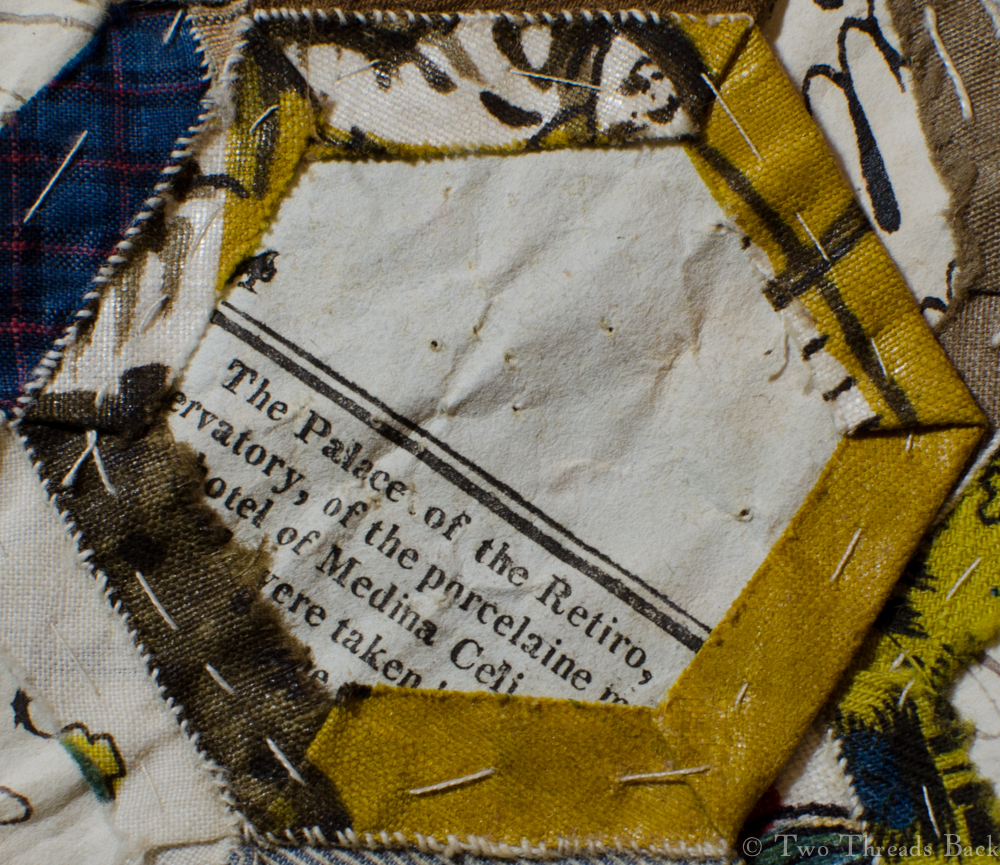
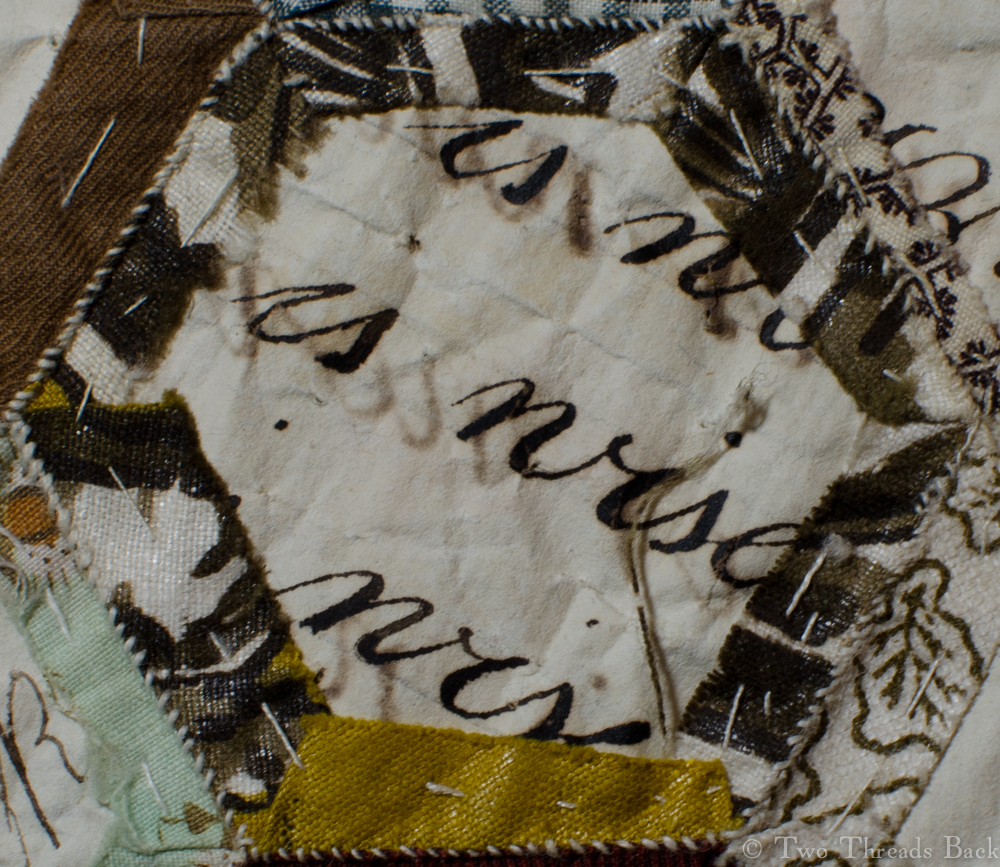
Back of the patch with a snippet of text, perhaps from the “Something Register.”
As for date, the little bit of text printed on the back of one of the pieces was an enticing clue. I was surprised to see how many early publications appeared after a keyword search. Even after I filtered the results by spelling and phrasing, there were way too many to pin it down. And I found that many publishers “borrowed” and reprinted much more often than I would have expected – even for that era. But I did get it narrowed to circa 1808 or ’09, the British Register, Political Register, Annual Register, Literary Register, Cobbett’s Register…. At that point, I guess it registered with me that the exact source would remain uncertain.
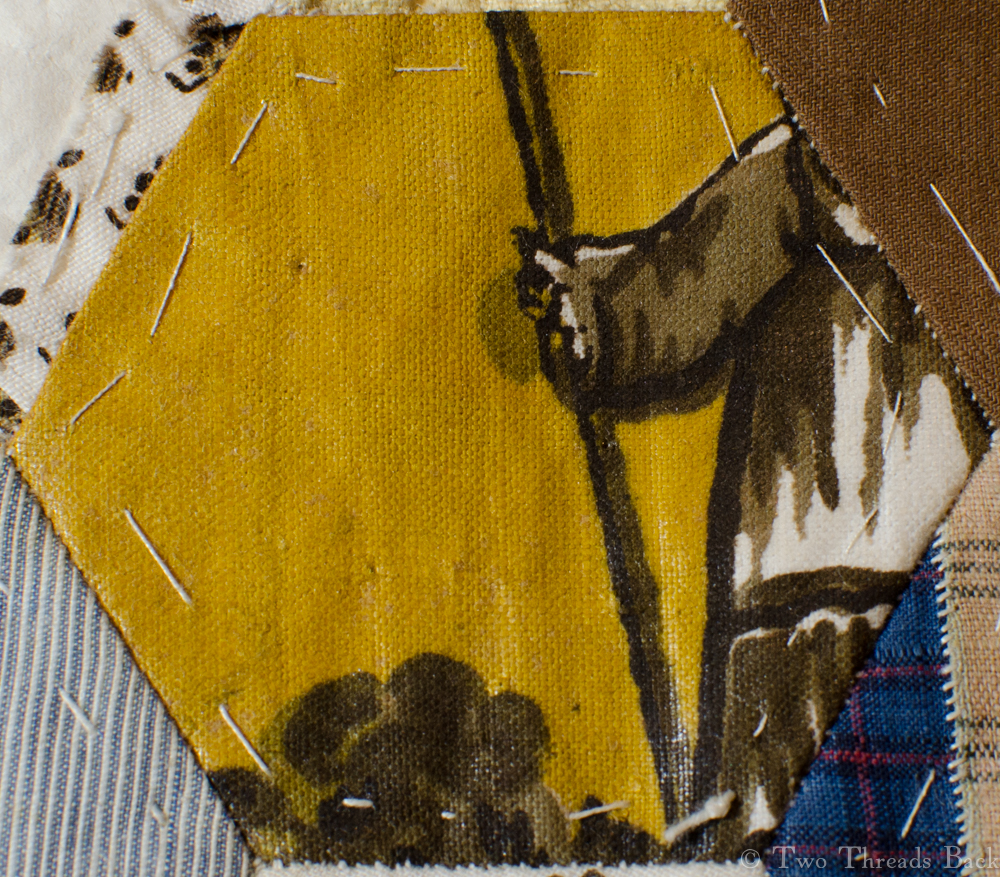
The right side of the patch showing an arm holding a – parasol?
This piece shows a person’s face.
The reverse of the patch above, with writing from a copybook.
A patch with a parasol.
And the back of the patch with a parasol, also with copybook writing.
























 Two Threads Back