For those who would like more detail and patterns that they can easily use today, there is another book, The Lady’s Economical Assistant, which has been reproduced after the 1808 edition, available from Kannick’s Korner.
I came across this one day while surfing for children’s print dresses.
It is a simple child’s gown dating to 1803 that has a story, one I could never imagine. Made of a shabby, sweet calico print, it is typical for its day: simple in cut, with a little frill around the high collar. The tragedy lies in the last day it was worn. John Marsden was two years old when he died after being scalded in an accident at home.
The Marsden family were among the earliest to arrive from England to live in New South Wales and the Powerhouse Museum website has more information on the family and this collection.
I don’t need to create imaginary stories for this dress, since his mother said enough, “The loss of those I have parted from weighs so much on my mind that at times I am as miserable as it is possible to be – outwardly I may appear cheerful but I am very far from being happy – indeed happiness and me seem long since to have parted and I have a presentiment that peace will never more be an inhabitant of my bosom.”
In 1863, a missionary named Emmanuel Boehringer was traveling north from Virginia when he passed through Sharpsburg in September. There he met with a scene of devastation and misery. He stayed to help tend the wounded of the Battle of Antietam and was haunted by the thought of so many new orphans, a forgotten casualty of war. Inspired to make a home for them, he founded the Orphan’s Home of the Shepherd of the Lambs.
The name was later changed to Bethany Orphans’ Home, and hundreds of children were cared for and educated over the years. Boys also learned farming and girls learned domestic arts. But wait! Sewing is not just for girls!
Bethany Orphanage Boys
Apparently it was deemed practical for boys to learn to stitch, too. And although rare in those days of division of labor, it wasn’t unheard of – I occasionally come across references in old sewing manuals to boys being taught sewing. According to Emily Jones, who wrote a manual in 1884, “Every infant schoolmistress who has tried the teaching of needlework to boys, speaks most warmly in favor of it.”
And the skill can be so useful! She goes on to give one of my favorite quotes, spoken in a Winnie-the-Pooh-sort-of-way:
“A Waterloo veteran said to me the other day, “I don’t know much about sewing, except putting on buttons, and I don’t know whether you would consider mine the correct way, but they used to stick on, and that is a good point in a button.”
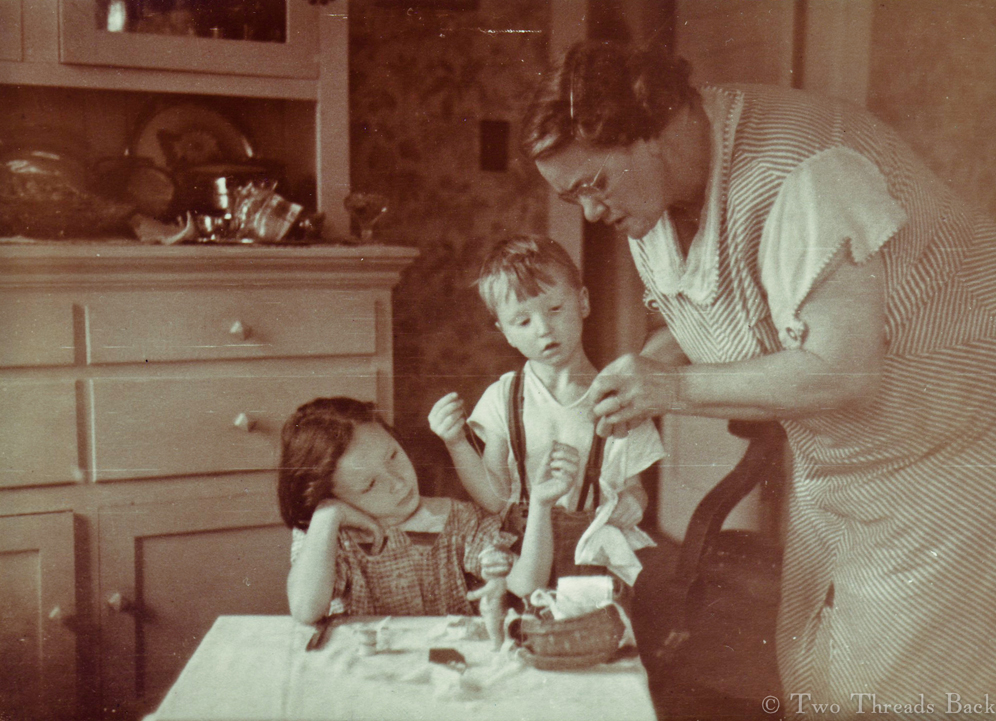
I’m naturally drawn to images of sewing, and I come across a little treasure now and then. There’s something very touching about a pose like this. The scene is perfect in its way. The little girl with her tiny sewing basket and doll, little brother wearing suspenders and holding the thread, and mother carefully fixing the work! It makes me wonder about their lives – who were they?
Well, in this case I do know their names because they’re written on the back of the photo. Iva Fuller, Jean Ray and Charlie Ray. So I suppose she’s not their mother, maybe an aunt or grandmother? I guess it’s a lesson to me about creating stories around pictures and objects. But I doubt it will stop me from doing it!
A quick search did not help me identify the people or place. Do you know them? The year was “about 1934.” And I’d love to hear from someone who can identify the type of doll!
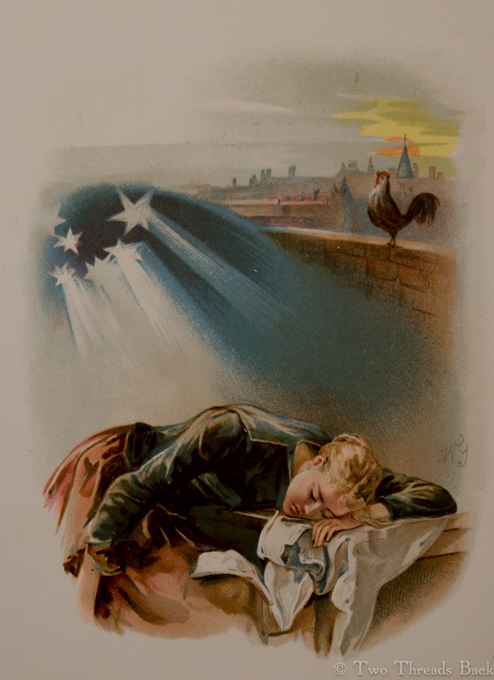
Exhausted from an all-night binge of shirt-making.
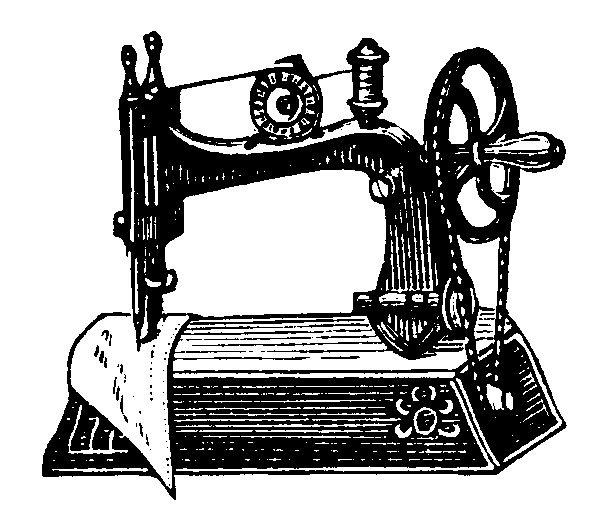
Just when I get complacent, thinking I’ve found a bit of information and can safely pack it away, something comes along to surprise me. As Seen on TV advertising is not new to our generation. Well, maybe the TV part, but not the advertising! About 150 years ago readers of Godey’s Lady’s Book were told how much easier their lives would be if they only had that new invention, The Sewing Machine.
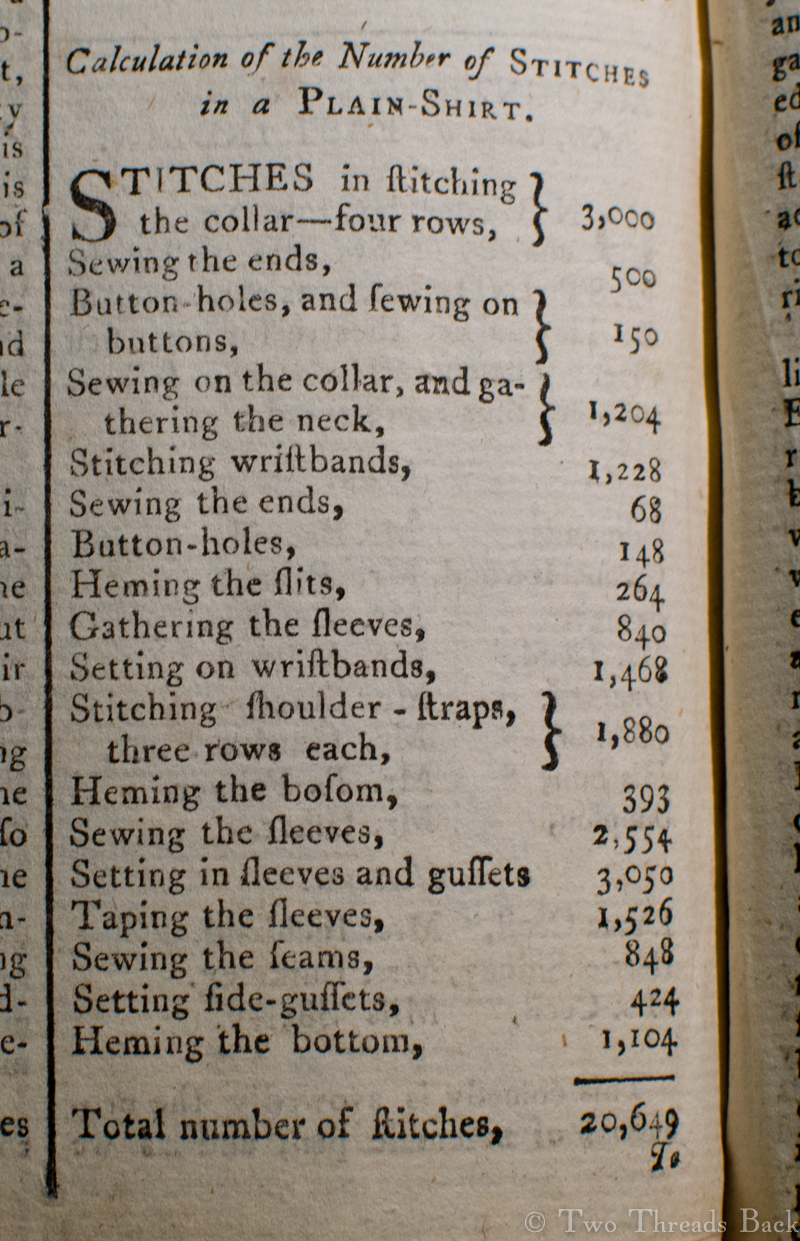
Value Of A Sewing-machine.—The following curious calculation of the number of stitches required in making a man’s shirt, gives us a realizing idea, as a Yankee would say, of the value of the sewing-machine in one single branch of needlework. As a household aid this invention is invaluable to women. Is it not pitiful that more than twenty thousand stitches have often been required to make one single shirt, for which the poor seamstress received, probably, not over seventy-five cents or one dollar:—
“Stitching the collar, four rows, 3,000; sewing the ends, 500; button-holes, and sewing on buttons, 150; sewing the collar and gathering the neck, 1,204; stitching wristbands, 1,228; sewing the ends, 68; button-holes, 148; hemming the slits, 264; gathering the sleeves, 840 ; setting on wristbands. 1.468; stitching on shoulder-straps, three rows each. 1880; hemming the bosom, 393; sewing the sleeves, 2,532; setting in sleeves and gussets, 3,050; tappiug the sleeves, 1,526; sewing the seams, 841; setting side gussets in, 424; hemming the bottom, 1,104. Total number of stitches, 20,620.”
In true journalistic tradition, Harper’s presented, almost word for word, the same thing in 1869. Only their math was a little different.
The following curious calculation of the number of stitches in a shirt, which somebody has had the patience to make, we mean the calculation, not the shirt, by any means, may induce some gentleman to present his wife with a good sewing machine.Stitching the collar, four rows, 3000; sewing the ends, 500; buttonholes and sewing on buttons, 150; sewing the collar and gathering the neck, 1204; stitching wristbands, 1228; sewing the ends, 68; buttonholes, 48; hemming the slits, 264; gathering the sleeves, 840; setting on wristbands, 1468; stitching on shoulder straps, three rows each, 1880; hemming the bosom, 393; sewing the sleeves 2335; setting in sleeves and gussets, 3050; tapping the sleeves, 1526; sewing the seams, 848; setting side gussets in, 424; hemming the bottom, 1104. Total number of stitches 20,530.
Apparently this “curious calculation” didn’t begin life as a sewing machine ad. It appeared in the years after, but also in the years before the sewing machine. Note how the article was borrowed and adapted (just like the blogs we’re writing now – ha!)
Now come the long evenings with devices for amusing them. In the intervals of recreation there is “work to do.” This word “work” is significant of an employment which astonishes men, and seems never to tire the fingers of their industrious helpmates and daughters; except that, with an expression which we are at a loss to take for either jest or earnest, because it partakes of each, they now and then exclaim, “women’s work is never done!” The assertion is not exactly the fact, but it is not a great way from it. What “man of woman born” ever considered the quantity of stitches in a shirt without fear that a general mutiny among females might leave him” without a shirt to his back?” Cannot an ingenious spinner devise a seamless shirt, with its gussets, and wristbands, and collar, and selvages as durable as hemming? These inquiries are occasioned by the following Letter from a Lady:— “To the Editor of the Every Day Book.—
Sir, I assure you the Every Day Book is a great favourite among the ladies, and therefore I send for insertion a calculation, furnished me by a maiden aunt, of the number of stitches in a plain shirt made for her grandfather: —Stitching the collar, four rows, 3,000; sewing the ends, 500; button-holes, and sewing on buttons, 150; sewing on the collar and gathering the neck, 1,204; attaching wristbands, 1,228; sewing the ends, 68; button-holes, 148; hemming the slits, 264; gathering the sleeves, 840; setting on wristbands, 1,468; stitching shoulder-straps, three rows each, 1880; hemming the neck, 390; sewing the sleeves, 2,554; setting in sleeves and gussets, 3,050; taping the sleeves, 1,526; sewing the seams, 848; setting side gussets, 424; hemming the bottom, 1,104—Total number of stitches 20,646 in my aunt’s grandfather’s plain shirt, as witness my hand, —Gertrude Grizenhoofe.—Cottenham, near Cambridge, Sept. 1825.”
It was great fun tracing the path of these “curious and significant” calculations, although a bit confusing because sometimes a publisher would acknowledge the source (quite helpful), sometimes not (greater challenge), and sometimes it was a reprint from their own magazine (I got lost). Not to mention, their math could be as wobbly as mine! The trail of the tale was pretty typical for 19th century publishing.
However, I was astonished to finally come across the same calculation in another magazine – from 1782! So this stitchery factoid was much older than I had supposed, even more exciting!
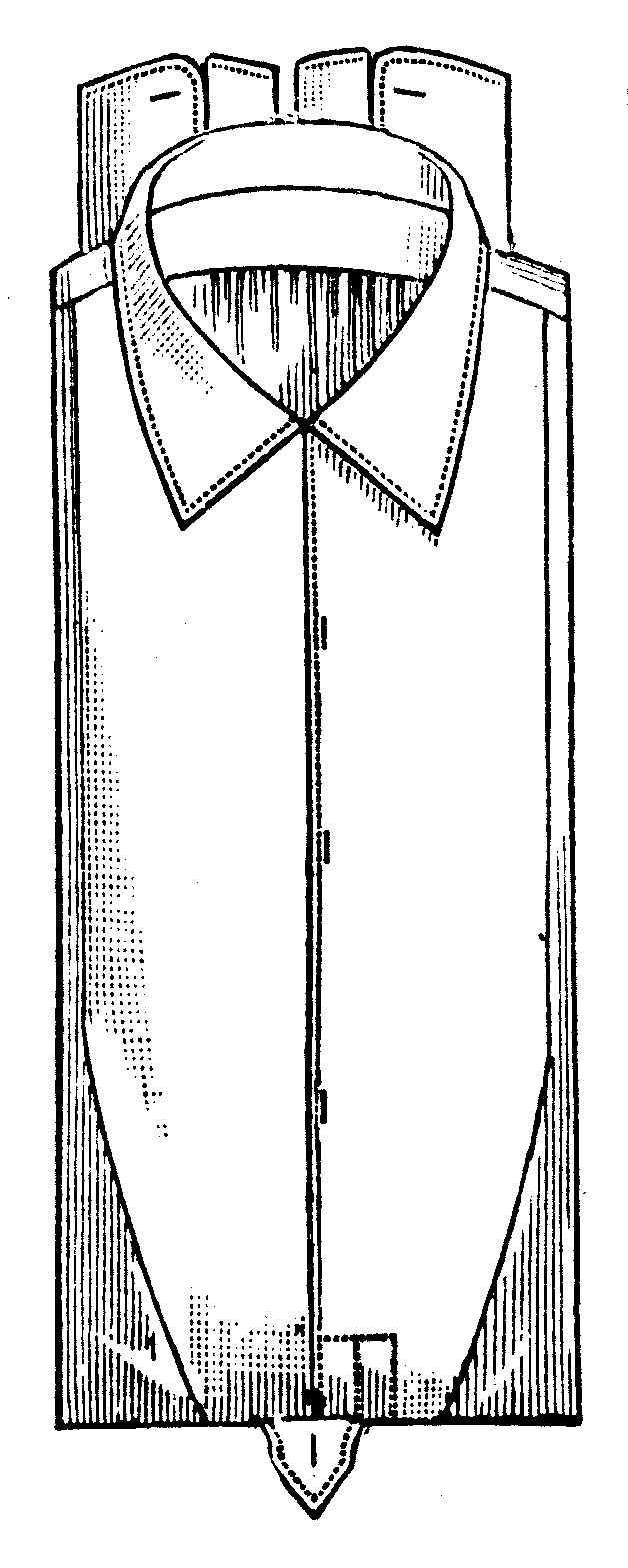
As a plain-sewing-square-cut-shirt devotee, I’m fairly familiar with the terms used in their construction. I know about the “nineteen pieces in a shirt, twenty in a trimmed one.” But I was puzzled by “tapping the sleeves.” After finding the other versions I assumed it was a typo for “taping.” And behold! In The Lady’s Magazine, the word was clearly ‘taping’ – but what did it mean? Tapes in the early garments were usually what we call drawstrings today. Hmm… Ideas, anyone?
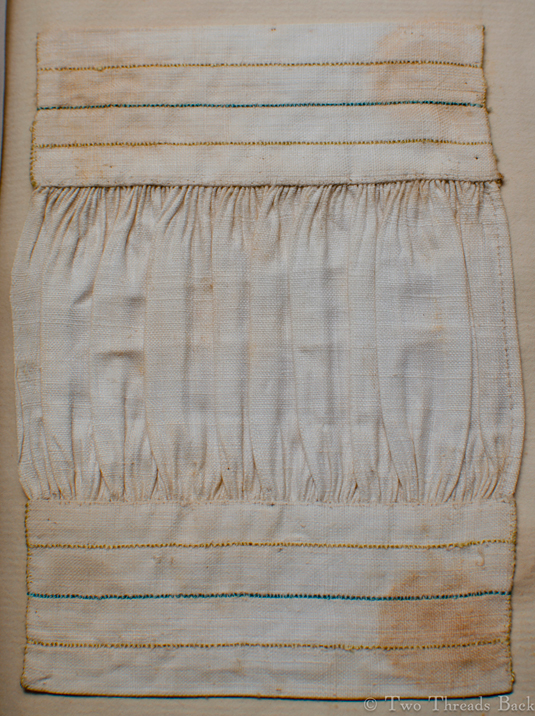
The little wristband appears in English, European, and American school samplers throughout the nineteenth and into the early twentieth century. Girls were first taught the basic stitches and expected to master each one. But of course the purpose of learning stitches is to make something!
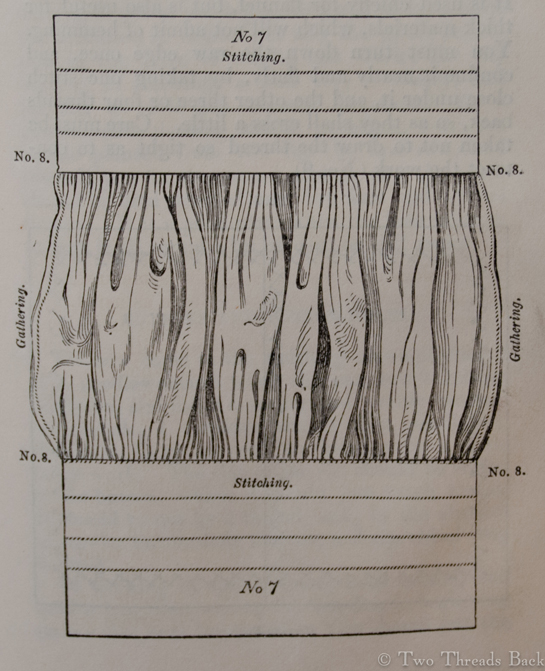
Illustration of a pattern for a sample cuff, 1850.
When they were accomplished in running, stitching, and seaming, the time had come to assemble parts of a garment. This was often how they learned to stroke and gather tiny pleats into a band – each side gathered and the pleats attached separately on both sides. The ends of the band were seamed (overcast) with very tiny stitches. What could be more suitable than a little cuff? It only required a scrap of fabric and was easy to handle.
This method of inserting and fixing the sleeve in the band is also a clue when examining a garment to determine its age (or whether it’s a good reproduction!). I’ve noticed that almost all early pieces of plain sewing use this method for cuffs, collars, and waistbands, anything gathered and set into a band.
After the sewing machine became common later in the century, construction methods adapted to its use. Even though some plain work was still taught using the old method, the new way became standard – to the point where today we rarely know any other.
Another sample of a cuff from a mid-19th century manual – see how tiny the stitches are!
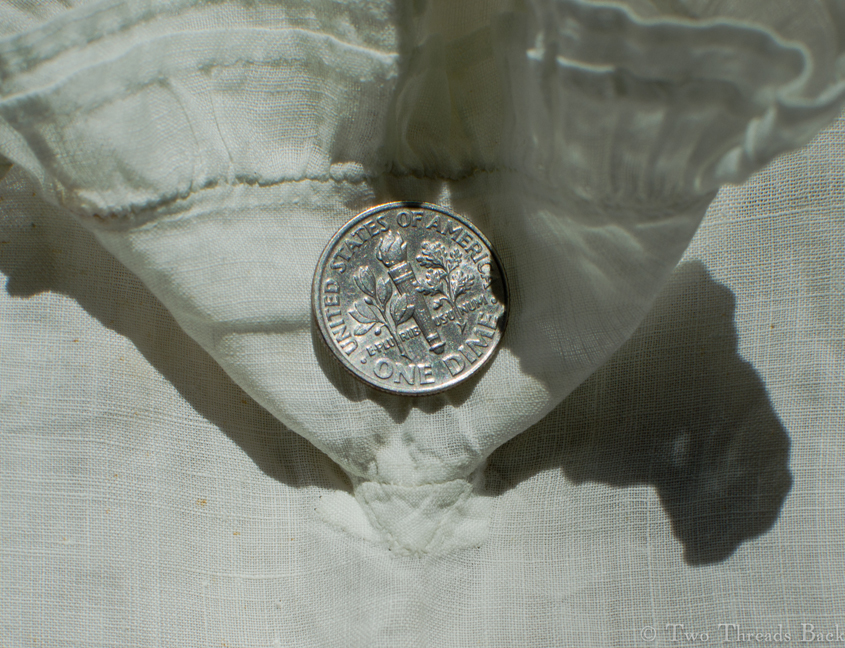
Baby shirt of linen, early 19th century, with the tiniest of stitches – and gussets!
Is there anything more trying than trying to remember how to insert a gusset? So many ways! The fabric and the placement of this little triangle may incline us toward one method or another, but for someone as construction-challenged as I am, it means once again pulling out a sample to go by – or some instructions.
We’ve all heard the story of the roast that was cut before roasting because “Mother always did it that way.” Perhaps the point (no pun intended) may be applied to gussets in this case as well. We know that some garments required gussets for fit and ease of movement, particularly those of a “square-cut” pattern. They were very effective and often quite beautifully executed.
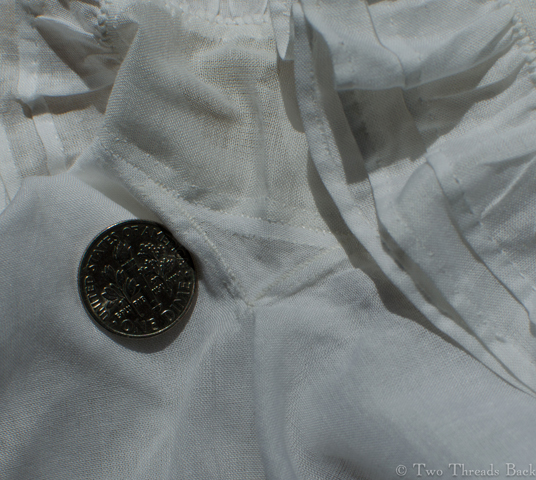
This gusset is so tiny it could almost sit on the dime and swing its legs!
Well here is an example of roasted gussets: have you ever seen anything so tiny, so exquisitely worked – and so unnecessary? I ask you, what use were these lovely little bits of linen to the baby’s comfort? None at all, I daresay. But shirts and shifts had gussets, so there they are. Oh my goodness, what inspiration for a clumsy novice like me! And as you can see below, I was willing to try. Unfortunately my efforts didn’t quite measure up. At least the baby will never notice!
Baby shirt of muslin, early 21st century by yours truly, with an attempt at the tiniest of stitches – and gussets!I didn’t even have the courage to use the same style gusset. Maybe next time….





 Two Threads Back