Who doesn’t love to watch a magic trick? I think they can be a lot of fun, at least as long as I’m not the volunteer from the audience. Especially for this trick!
1784
To pull off any Perfon’s Shirt without undreffing him or having Occafion for a Confederate.
This trick requires only dexterity, and nevertheless when I performed it at the Theater-Royal in the Hay-Market everybody imagined that the person whom I had tricked out of his shirt was in a confederacy with me.
The means of performing this trick are the following, only observing that the cloaths of the person whose shirt is to be pulled off be wide and easy.
Begin by making him pull off his stock, and unbuttoning his shirt at the neck and sleeves, afterwards tye a little string in the button-hole of the left sleeve; then, passing your hand behind his back, pull the shirt out of his breaches, and slip it over his head, then pulling it out before in the same manner, you will leave it on his stomach; after that go to the right hand, and pull the sleeve down so as to have it all out of the arm; the shirt being then all of a heap, as well in the right sleeve as before the stomach, you are to make use of the little string fastened to the button-hole of the left sleeve, to get back the sleeve that must have slipped up, and to pull the whole shirt out that way.
To hide your way of operating from the person whom you unshirt and from the assembly, you may cover his head with a lady’s cloak, holding a corner of it in your teeth.
In order to be more at your ease, you may mount on a chair, and do the whole operation under the cloak. Such are the means I used when I performed publicly this trick.
–PHYSICAL AMUSEMENTS and DIVERTING EXPERIMENTS, 1784
That kind of describes what it feels like when I’ve tried to change clothes in the car. Actually, I think this trick would require a good bit of dexterity, as well as a few practice runs. But still not as much as was required to make this little boy’s shirt. A lot of stitches went into it; decorative backstitching on the collar and cuffs measures about 32 per inch. The simple hemming was 12-14 stitches per inch and seaming (like shallow overcasting) was up to 20 per inch!
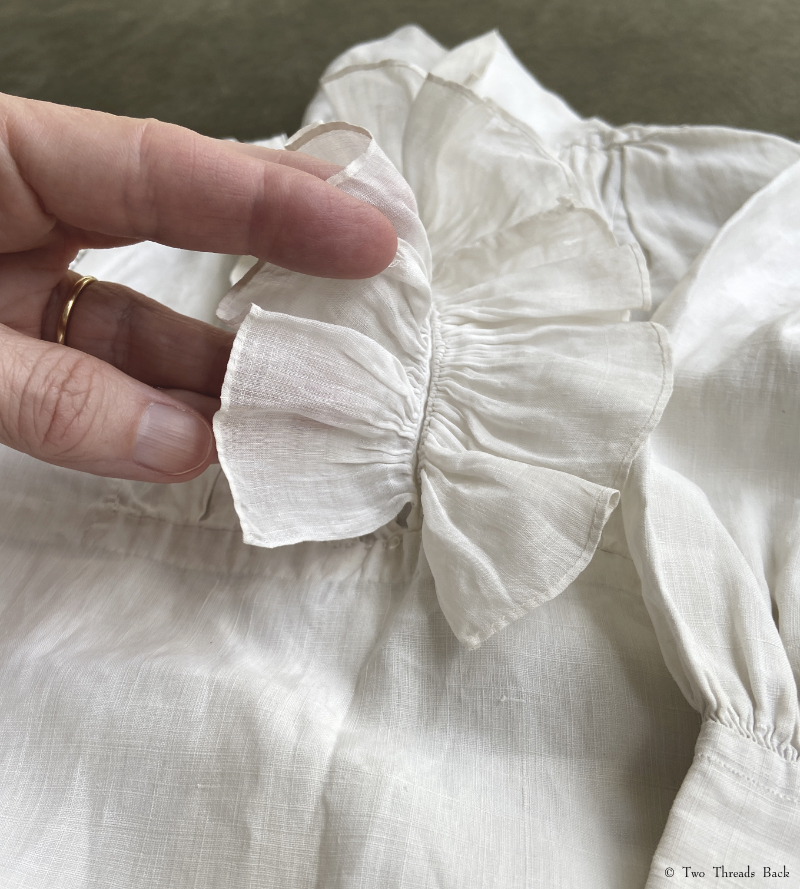
A small boy’s shirt, early 19th century. The fineness of all the plain sewing I try to photograph is hard to convey, since close-up shots make the materials seem coarser. But in a more scaled shot, it’s hard to see the dainty stitching. Maybe this one where I’m holding it adds perspective. It would fit a 4 or 5 year old.
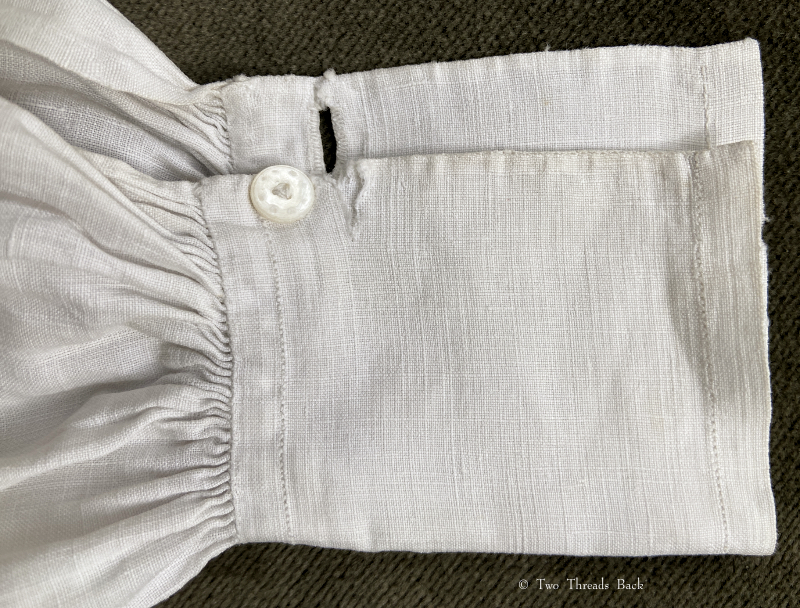
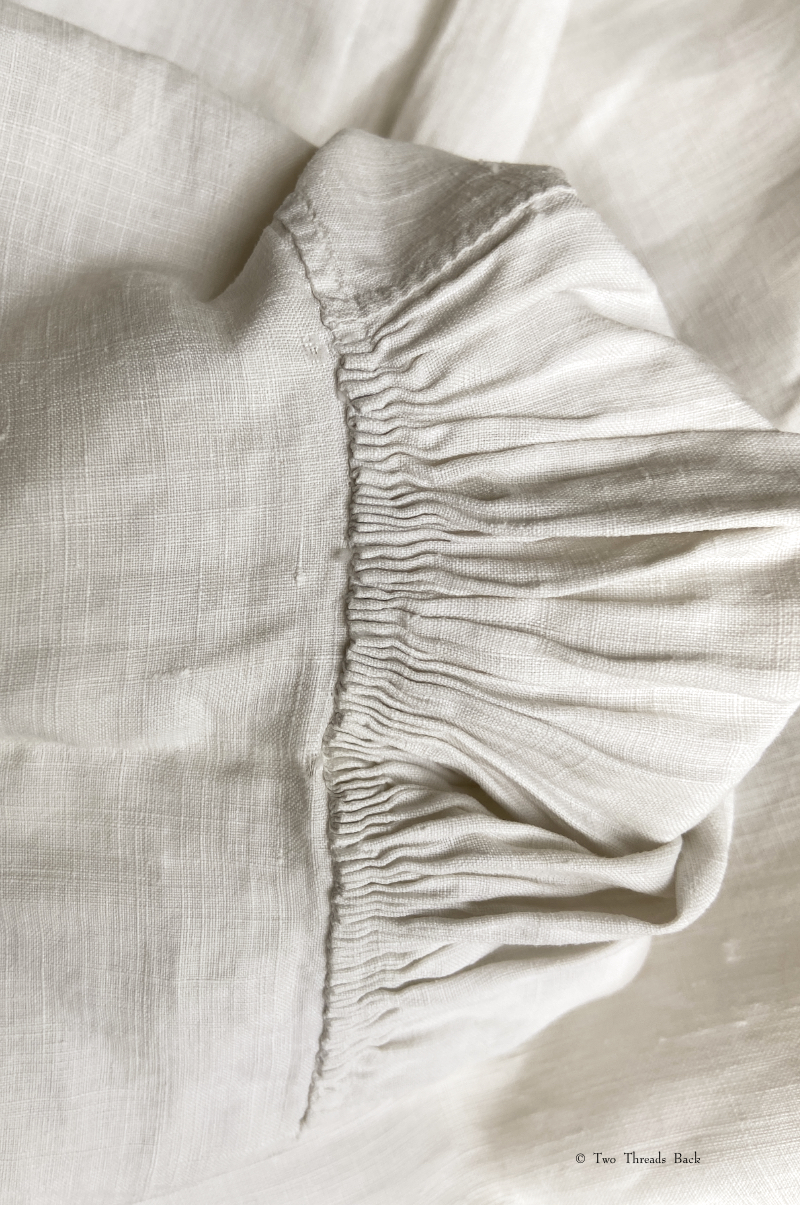
He did get some wear out of it! There are several mends and worn spots, like on the wristband here. So this buttonhole is where the conjurer would attach the string!
The boy’s shirt is made like a man’s shirt. There were 20 parts in a “gentleman’s” shirt:
The body, two sleeves, two wristbands, two binders, two shoulder-straps, one collar, two sleeve-gussets, two neck gussets, two side-gussets, two wrist gussets, one for the bosom, and the frill.
This one, however, was made with without the shoulder straps (a strip of linen along each shoulder), binders (lining next to the armscye), wrist gussets, or a “bosom gusset.” It did have a frill and an inserted pleated front made out of finer linen
It was interesting to see that the two separate ruffles were both sewn to the wearer’s left side, and hemmed folded in the same direction, making them look correctly worn when both are folded over toward the right and exposing the pearl buttons. On all the other shirts I have or have seen, the ruffles are hemmed with each side’s hem folded inward toward the front opening.
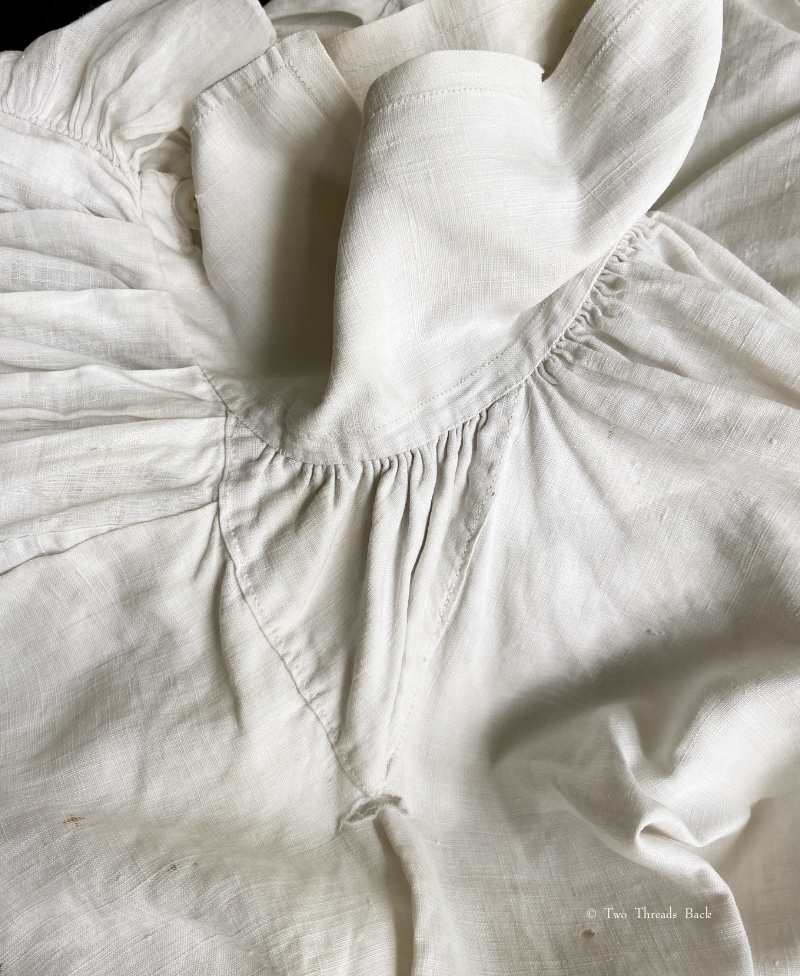
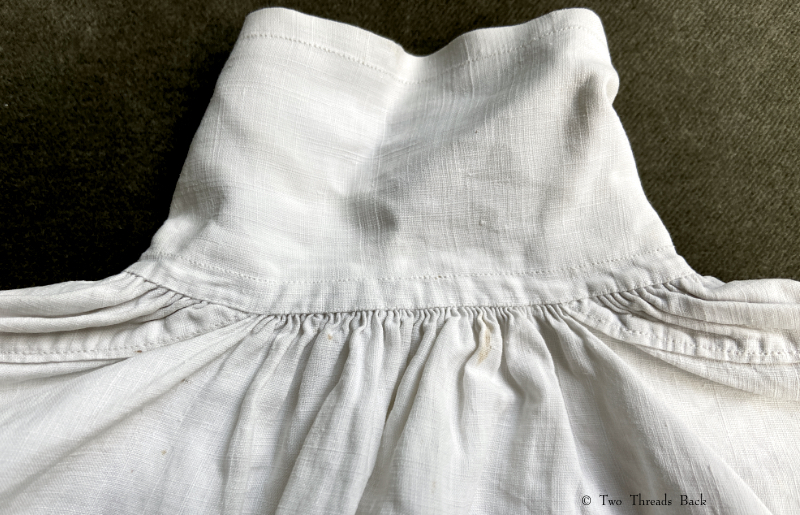
This is the neck gusset next to the collar, and the tear at the point along the shoulder gives a hint why most shirts needed the reinforcement of “shoulder straps.” Perhaps more for strength when tugged than for abrasion!
Bet the little guy couldn’t wait to unbutton his collar – it measures barely over 10 inches when buttoned!
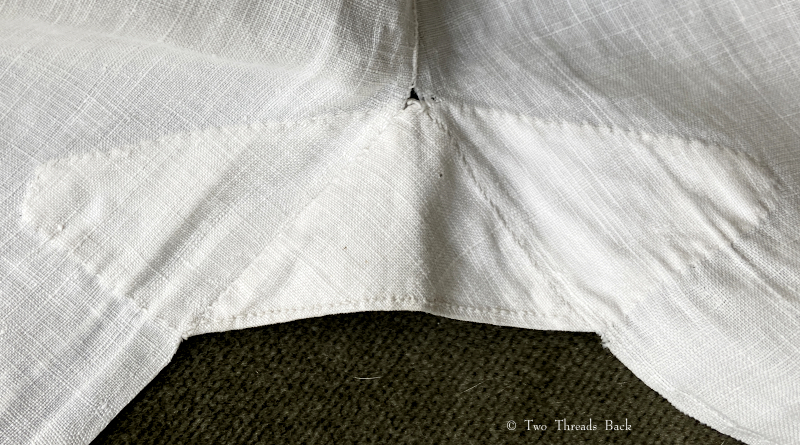
The neatly sewn underarm gusset.
Inside view of the sleeve gathers at the shoulder. These aren’t usually visible in surviving shirts, because they are hidden inside “binders” which weren’t used on this one. The other shoulder has two coarsely-mended vertical tears, one at the same point on the gusset.
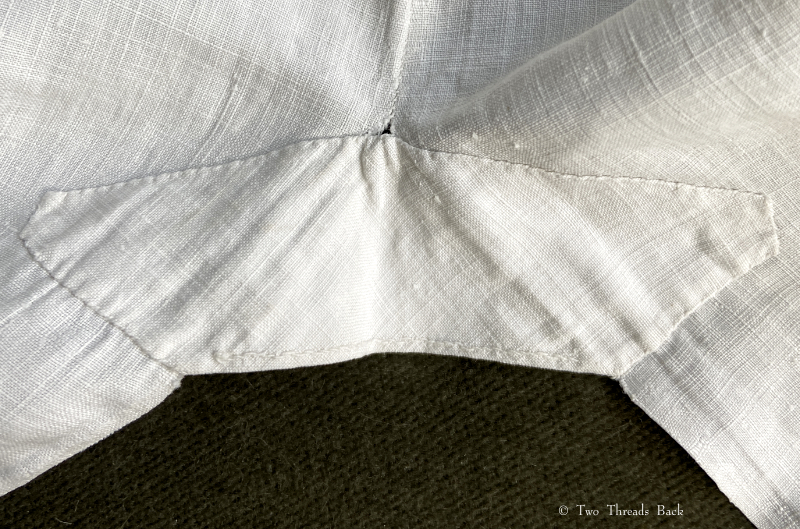
Side gusset exterior.
Side gusset interior.
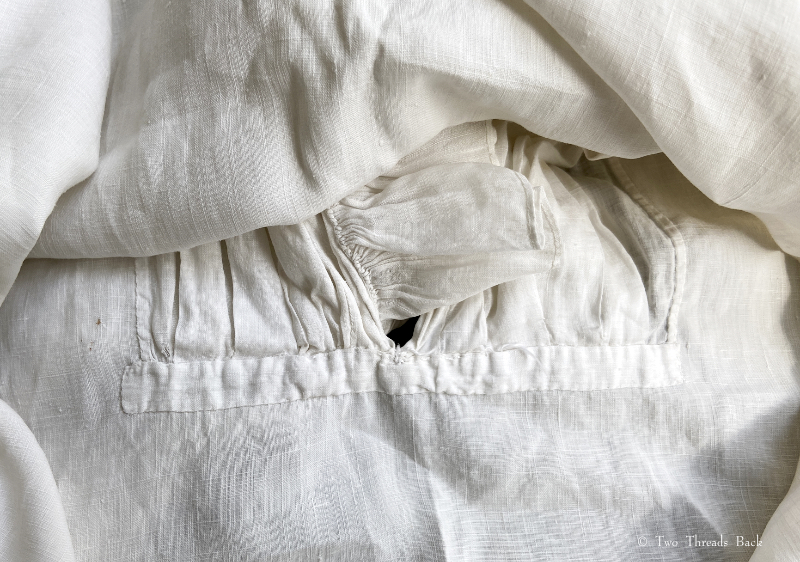
A peek inside the the shirt front, which had 4 pleats on each side of the front opening. A narrow strip of linen covers the bottom edge.
The SHIRT TRICK was republished in other books over the following decades. It even showed up as late as 1870, but by that time the cut of a man’s shirt was more fitted and complex, and I doubt the stunt would work as easily. Maybe the little fellow who wore this had a copy of the The Boy’s Own Book (1828) and had a go at it? I can’t imagine the maker would have appreciated seeing her work handled so roughly and the “person who was unshirted” might have had to conjure up an explanation!
Click to enlarge and see the decorative dot in the center of each diamond.
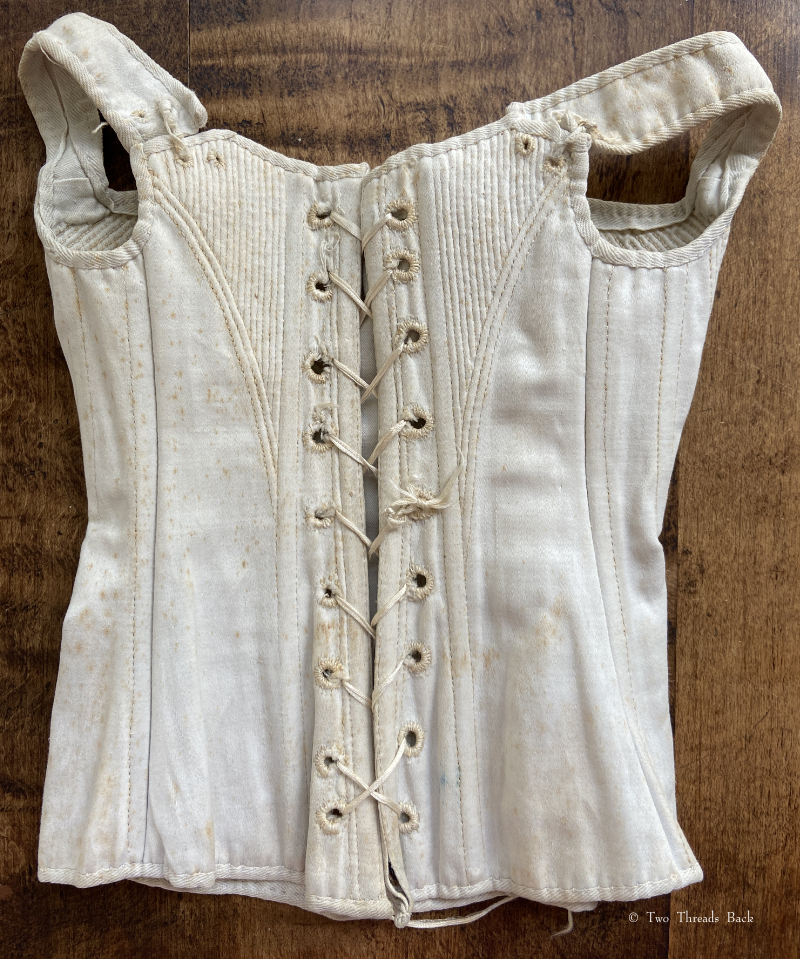
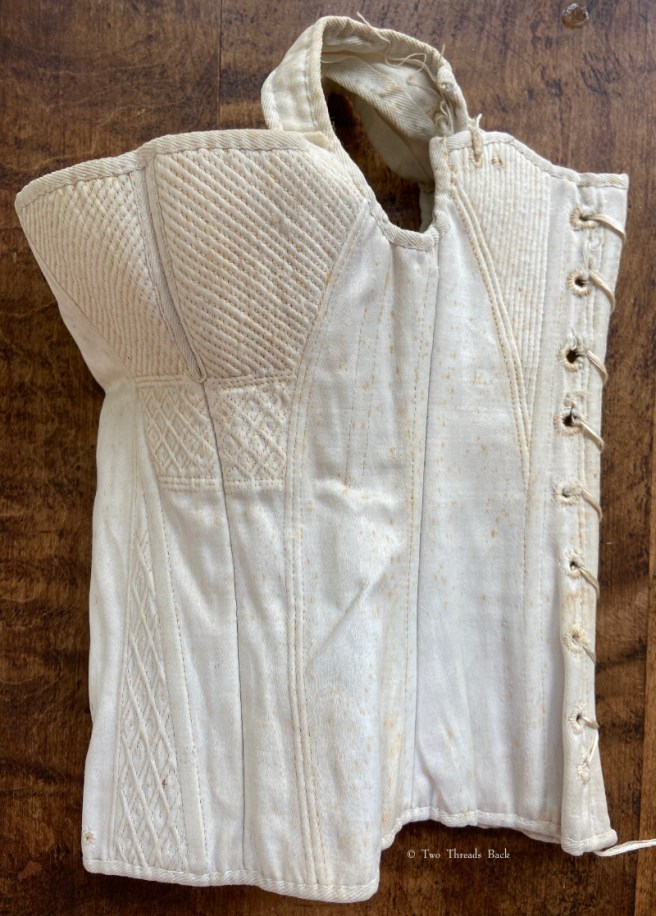
Not only do I have a weakness for plain sewing, but for miniature things as well. Tiny garments like doll clothes, or the samples that girls made when they were learning to sew are irresistable! That’s why I was thrilled to find this half-size treasure from – can it be the 1820s? At first I thought it must have been made for a doll, but it would have required a pretty large little lady for that time, and the incredible detail seems extreme for a doll. Maybe it was a shop model, or sent from a corset-maker to a client as a style sample? It’s certainly a puzzle, so I’d welcome any expertise!
Signs the lacing was pulled too tight…hmm…
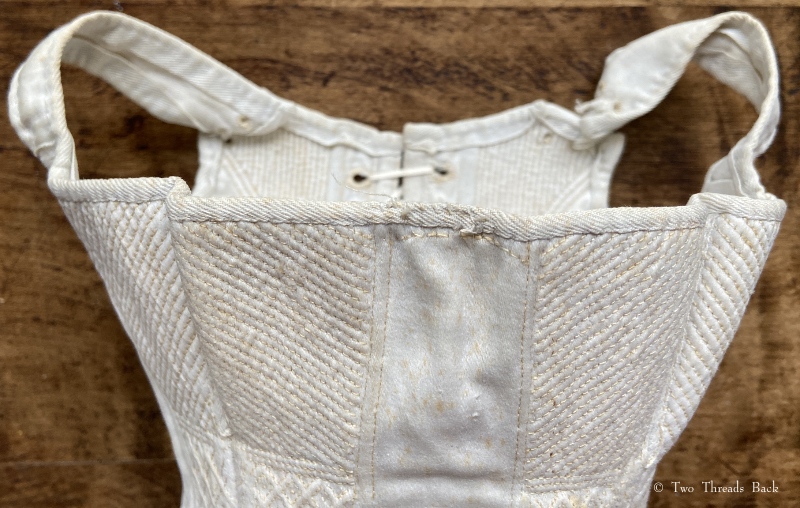
The side view shows how the pattern was designed for the well-endowed! It’s not as noticeable from the front.
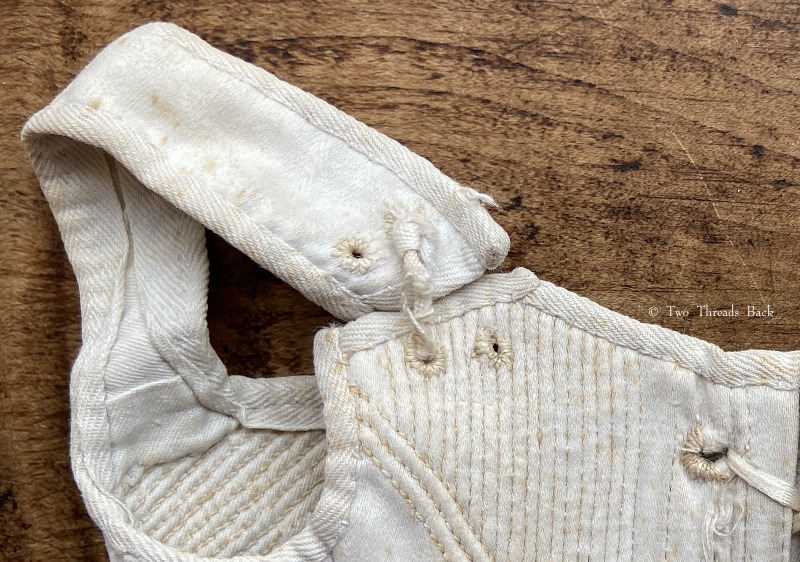
It’s seven inches in length, 12 around the waist, made of two layers of cotton sateen, bound with twill tape, and of course, hand-stitched. The silk laces are in place as found, laced closed. It’s sewn with very fine silk thread which I believe was originally white, but has now yellowed a little more than the cotton fabric. I can see whalebone inside one of the boning channels where there is a slight separation at the end. I have no idea what the cording is, but the backstitches that hold it in place are worked about 20 per inch!
Click to enlarge for better view – their stitching wasn’t totally perfect, but a whole lot better than mine!
Compared to earlier 18th century stays that were heavy and heavily boned, or to later corsets that might contort and constrict the female torso, this style – excluding the busk – seems pretty comfy. That didn’t stop the lectures on tight-lacing, even during the early 19th century. The Poughkeepsie Journal opined in 1823:
I deem the corset of the present day to be the perfect engine of torture, and infinitely worse than the stays of days gone by. These last besure were injurious, but they left the resemblance of a female shape; the corset on the contrary presents the waist as regularly round and untapering as a white lead keg. The olden stays I remember were laced with a silken string of the size of the finest twine, but the corset requires a cord equalling the bow-string of a Kickapoo Chief.
What on earth is a white lead keg? Well, I checked. There was such a thing. Like a metal paint bucket today – just don’t use it to draw your well water! The author insists
no other animal could survive it. Take the honest ox, and inclose his sides with hoop poles, put an oaken plank beneath him and gird the whole with a bed cord and then demand of him labor. He would labor indeed but it would be for breath. Splinter and belay a pig in the same way and a whine might be aspirated, but it would be a whine of expiration.
Assuming your ox was honest, it would probably agree with the author. Unfortunately, the belayed pig wouldn’t have a chance! (It’s not often that 19th century prose make me LOL, but that last sentence succeeded.)
In the 1820s, Dr. Godman, a physician, anatomist, and naturalist who lived a remarkably full but too-short life (click here to follow a quick rabbit trail) denounced busks – lengths of flat wood, bone or steel inserted into a channel down the center front of a corset – as especially injurious:
Another instrument of torture is added in the form of a steel or hickory busk, which is pushed into its sheath in the already too tight corset, extending along the whole length of the breast bone… to keep the body from bending forward in the centre, and to prevent the dress and corset from ‘hooping up,’ as it is called.
The following scene occurred at a boarding-house in Philadelphia. The girl of the house … filled the tea-kettle, and brought it to the kitchen hearth, where she placed it on a bench. To place it over the fire required considerable stooping, and this, as it turned out, was impossible to her. Repeated and fruitless were her attempts, by a sort of crouching attitude, to accomplish her object; there was no one present to assist or to relieve her from the restraint which prevented stooping, and in despair she gave up, and stood by the kettle as if debating what she should do. The mistress came to inquire if the water was boiling, and found it not yet on the fire! – to her utter amazement, ‘the young lady’ confessed that she had her ‘long-busk’ on – that her ‘lacing,’ which was excessively tight, was in a ‘hard knot’ and that she ‘could not possibly stoop’ to put on the kettle!
He wasn’t without humor either:
Can anything on earth be more ungraceful than the gait, the walk of a female who is extremely corsetted? From the shoulders down, as stiffly inflexible as the parlour tongs, she can only advance by a sideling shuffle of the feet, which appear to get forward by stealth…
Here you can see the bottom of the busk pocket from the outside and the eyelet holes for a tape or cord to hold it in place.This is the bottom of the corset showing the inside of the busk pocket. I’ve used a broken ivory fan stick to show how it was inserted.You can see the top of the busk pocket has a curved row of stitches to keep the busk in place.One strap is tied with a tape, and the other with a narrow cord. I can imagine a little girl doing this for her doll.
Maybe I’ll never know what this little corset was made for. The workwomanship (assuming it was a female stitcher) is exquisite, which suggests a model, either to exhibit skill or make a sale. But a few signs indicate wear, which makes me think it adorned a doll. Maybe its history included it all: made as a specimen of skill, served as a model or sample, and then retired to spend its later years on a later doll. Of ‘corset’ doesn’t really matter, whatever its past, it’s still a work of art!
Maybe you’ve heard of “l’esprit d’escalier” or “staircase wit.” I hadn’t until recently, even though I’ve suffered from it all my life. It describes that maddening moment when you come up with the perfect, brilliant reply – after it’s too late to be useful. Well, finding the perfect image just a little too late can happen in blogging, too!
It’s been a year since I wrote the last post about sewing aprons. I’d wanted an example to study and to illustrate the post, but in decades of searching and collecting I’d never come across one. Wouldn’t you know, it was only two weeks later that I actually found a real surviving one! It’s obviously not an early nineteenth century apron like I’d really love to find, and I can’t be positive it was used for sewing, but it fits the all the descriptions to a T.
A closer look at the button, the featherstitching, the direction of the hems on the sides, and the “seamed” band.
It’s a charming white dimity with pink featherstitching and a waistband that buttons. Late 1800s, early 1900s perhaps? It looks like it could have been made in school, rather than at home. I say that because the stitches seem to be textbook-style hand sewing: precise (if not dainty) hemming, seaming, setting-in, and buttons, combined in a class-projecty sort of way. And a couple of tiny ink spots near the bottom!
Seeing an example close up did answer the hemming question for me: did they fold the side hems face up or face down before turning up the bottom for the pockets? Or did they do a little snip on the edge so that each hem could be folded to the back, the way I did for the doll’s apron? Answer: face up. For this one, anyway. The nice deep pockets are then seamed together so that the folded hems are inside.
I hope the maker was happy with her little apron. I suspect she treasured it since it’s survived all these years. Maybe it proved useful for holding her sewing things while she was climbing stairs – and she had the wit to appreciate it!
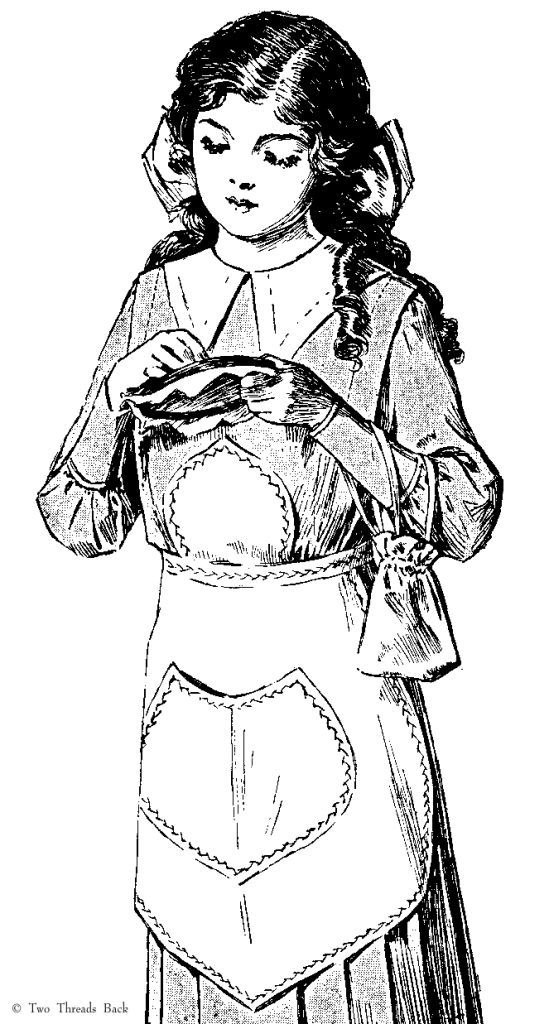
I don’t remember where I first came across the term “lap-bag.” It was used in the infuriatingly casual way that long-dead authors have of assuming we know what they’re talking about, and I didn’t give it much thought. But when I recently came across the illustration below, c.1860, my reaction was – in the words of my 4-year-old grandson – “what is the heck of that?”
Of course I pursued the elusive lap-bag, only to discover it wasn’t so peculiar after all. It has a respectable history, especially if you consider it’s only a variation on a very useful, very humble, and very common garment. I think this young emigrant to Australia summed it up perfectly in 1850:
The ladies gave me a nice piece of print to make a lap-bag, which will be very handy on board ship, as it ties round the waist, and has little pockets to hold one’s thimble and scissors.
It’s simply a type of pocketed apron that was used for keeping sewing items handy, something especially helpful for girls’ sewing classes. The pinafore was another variation, recommended as early as the 1810s for plain needlework lessons, both in England and America.
Each girl should be provided with a pin-afore, or slip … taken in at the conclusion of school time…. The pin-afores are marked 1, 2, 3, &c. up to the number of girls that the desk contains: the number of the desk is also marked upon them, thus – 5/3, which would signify that the pin-afore belongs to the 5th girl in the third desk.
In 1858, when Alice Neal penned her reminiscences of Eliza Leslie for Godey’s Lady’s Book, she remembered her own school days.
As long ago as sewing was made a special branch of female education – and we leave our readers to infer the date [she was born in 1828] – the Wednesday afternoons at the school which I attended in Boston were enlivened by reading aloud. The circle of little people, with their pink and blue chintz “lap-bags,” a style of sewing receptacle entirely unique, stitched away on their sheets and patchwork, while the older girls read in turn.
A children’s story from 1871 tells how “The girls all had to be provided with lap-bags, worn like aprons, with the ends brought up and stitched together. These were to keep the work from getting soiled, and hold the thimble, cotton, needles, scissors, etc.” School inventories included lap-bags, and one teacher explained,
These little lap-bags,” remarked the teacher, are the very first articles I teach the children in the Primary class to make; and they use them through all the grades until they graduate from the cutting department. Each bag is labelled, and at the close of the sewing hour the work is neatly rolled up, put inside, then collected in these large baskets.
Some later sources called them sewing aprons, but these matched the description as being aprons “made of extra length to allow the turning up of a quarter yard or so for a pocket.” After reading all about these receptacles, I decided to attempt my own. It’s quicker and cheaper to make things in miniature, so doll size it would be!
But what to use? I found references to brown holland (unbleached linen), calico prints, Scotch gingham (a better quality gingham), and pink and blue chintz. My obsession with charity sewing schools inclined me toward the brown holland, since that was the utility fabric they suggested. I just happily happened to have a bit of it with the original glaze (a glossy sizing) remaining, so the next step was to make sense of the directions that accompanied the illustration. Simple. For most people.
A pattern to scale. Yes, including the gusset.
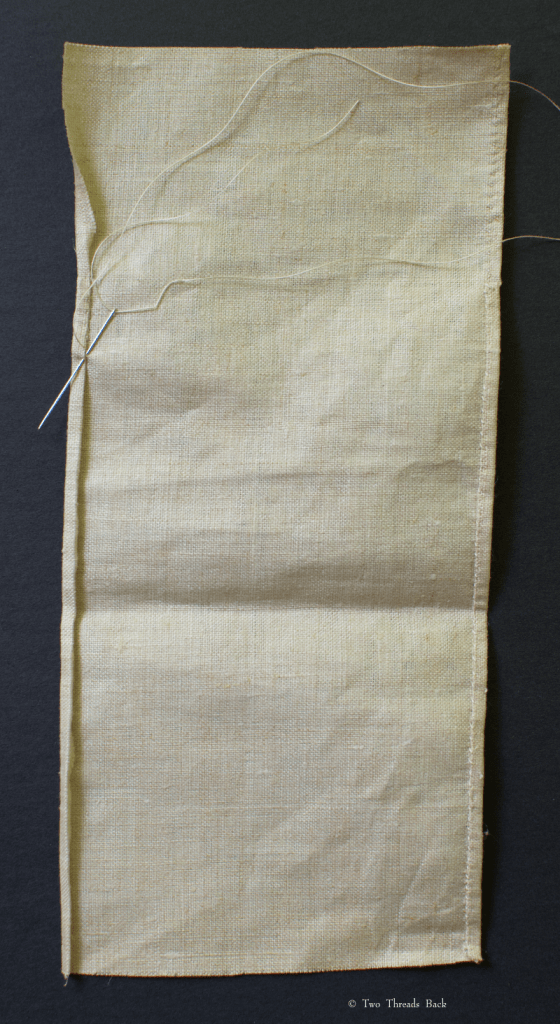
Oops. I had actually started hemming one side before it dawned on me that either the pocket or the apron would be hemmed the wrong side out. Snip and flip to the rescue!
Time to insert the gusset. Yes, the pattern was to scale. Apparently the finished gusset had a growing spell.
Next came the marking. As much as I wanted to follow advice and place the numbers where they’d show when the work was folded, I couldn’t make it work. But my doll will still take her place as the “fifth girl in the third row.”
I also made the “pincushion of white calico with a cover of coloured print to which the tape is sewn, so that the pincushion being taken out, the cover may be washed with the bag.” In theory.
A lap-bag ready for work.
Trust writers of the era to impart moral virtue into anything that would hold it. I don’t mind, at least not when they’re praising hand sewing.
If it is best to train the child along aesthetic lines in any phase of art, then let him be trained to appreciate and prefer a piece of true art in needle-work, even plain sewing, over a wholesale manufactured article which may be bought at cheap rates.
Let me illustrate by a school girl’s sewing apron, neatly though plainly made, hand-sewed by herself, and appreciated because she wove into its very stitches her own power and love of doing a thing for herself, and, too, having done it the best she could, over a very elaborate one selected from a whole boxful in a store marked “your choice for 10c.”
As aesthetic development and culture help to make a person a better person, so sewing can be made to help a girl to become a better girl and a more powerful and valuable woman to society.
Why not turn up your nose at that 10¢ store-bought apron, make your own, and become a powerful woman! You’ll be glad you did.
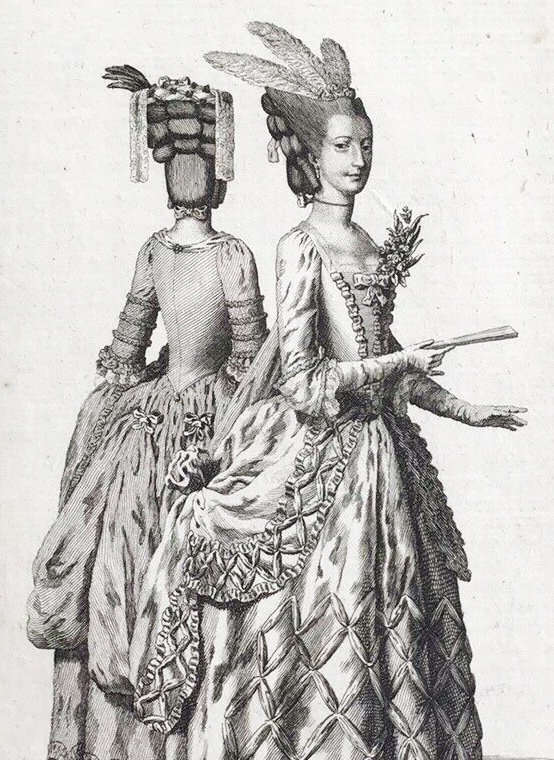
I know what lappets are, costumely speaking, and with regard to women’s millinery. They’re those long, lacy, streamer things that hang down from a headdress. The fanciest ones were made of fine lace and could be terribly expensive. They were popular in the 18th century but seemed to fade by 1800 when the classical look was in vogue, and then regained favor, at least with “mature” ladies, in the middle to late 19th century. Early ones were usually found in pairs, or occasionally joined slightly shaped in the middle, while 19th century ones could be . . . more creative.
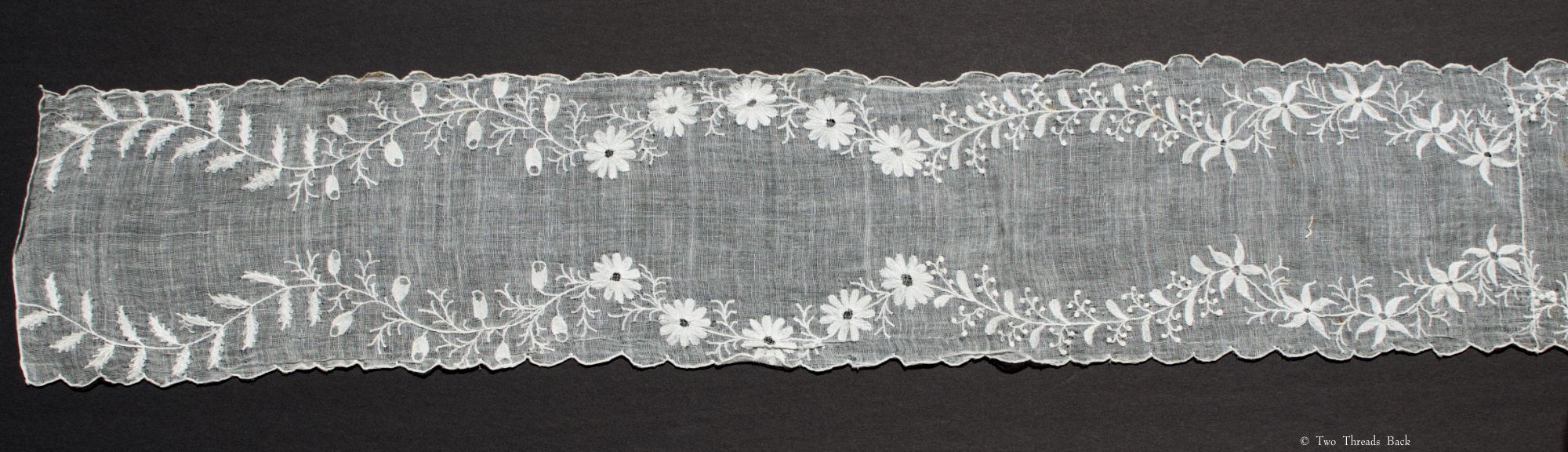
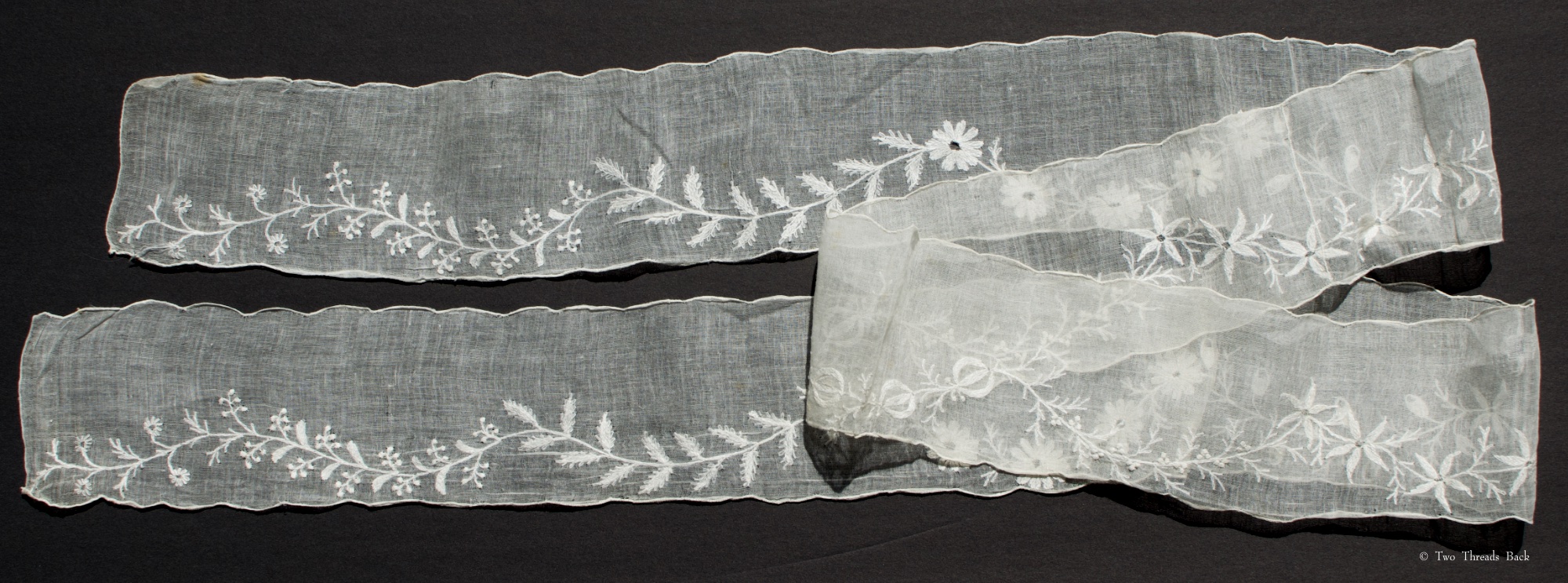
But what have I got here? Two different long strips of fine white muslin, neatly (but probably not professionally) embroidered with whitework. Are they one-piece lappets, or something else?
They appear to date to the late 1700s or early 1800s, judging by the materials and floral patterns. One is 58″ x 4″ and the other is 63″ x 3.” The design on the wider one is mirrored on both edges, while the other is worked along one edge only. All edges are scalloped, and there’s a join on both at 20 inches (not the middle) from one end which the embroidery carries right across. Found together + like patterns + like materials = same maker? The design was embroidered to fit, which indicates they weren’t cut from another garment. They seem too fragile for a sash and too narrow for a scarf.
So how in the world would you wear them? It seems like draping across the top of your head would be a bit awkward. I’d feel about as graceful wearing a length of toilet paper.
The most fabulous book on accessories of this era is Heather Toomer’s Embroidered with White, and I searched it for clues. It has beautiful photos of lappets. In pairs. With dense embroidery. Sigh. In her book on the next time period (just as brilliant), lappets appear as extensions of other accessories, such as fichus and pelerines. So I’m still wondering what these were for. Help!
The fabric is joined about 20″ from one end (not centered) on both pieces.
The darning is finer than the embroidery!
While on the subject of long narrow textiles, I’ll present my next puzzle: tuckers. I’m wandering into dangerous territory when discoursing on 18th century costume, since I know so little. However, I had no trouble finding period references to tuckers. Their wearing location on female anatomy guaranteed attention, one way or another.
Tuckers, as defined in 18th century dictionaries:
TUCKER, tuk’-ur. f. A small piece of linen that shades the breasts of women.
-A Slip of Linen or Lace, pinned along the Top of Women’s Stays -A border of linen or lace on the bosom of a shift -A fine piece of lace, cambrick, &c. pinned or sewed round the neck of a woman’s shift, gown -A shred of linen &c., about the neck of a woman’s shift -A slip of fine linnen, run in a small kind of ruffle, around the uppermost verge of the women’s stays -A strip or ornament of linen worn by women at the uppermost verge of the stays
Then we have Garsault’s 1771 L’art de la lingère, where I’m up to my tucker in speculation:
Tour de gorge en mousseline festonnée. Il se fait d’une aune de long sur un seizieme de large. Painfully translated: Scalloped muslin tucker. It is made one [≈yard] long by one sixteenth wide. A 1788 French-English dictionary defines “tour de gorge” as “tucker,” and “tour de dentelle” as a lace tucker.
This post is already too long to include Joseph Addison’s slightly naughty essay on the tucker – although if you’re curious, you can find one of many reprints here.
There’s no lack of period illustrations of tuckers, but it’s the logistics that have me baffled. Sure, you can tuck a straight band of fabric around the top of your stays – but then all but a few inches in front is hidden under a gown. You can tuck a straight length around the neckline of your gown – but then you have to negotiate the curves, and my mystery pieces seem awfully wide to do it without looking rumpled.
A Lady’s Maid Soaping Linen c.1765-82 Henry Robert Morland 1716-1797 CC-BY-NC-ND 3.0 I don’t presume to know if she wearing a “separate” tucker, or if that’s trimming on her shift. Or neither. But it’s a good illustration of the trickiness of turning corners!
A Laundry Maid Ironing c.1765-82 Henry Robert Morland 1716-1797 CC-BY-NC-ND 3.0 Her frill seems to be a little fuller.
Many paintings show gathered ruffles at the neckline, whether lace or embroidery, although the Lady’s Maid Soaping doesn’t look very frilly. Of course you could always adorn your own tucker, if you were good with a needle.
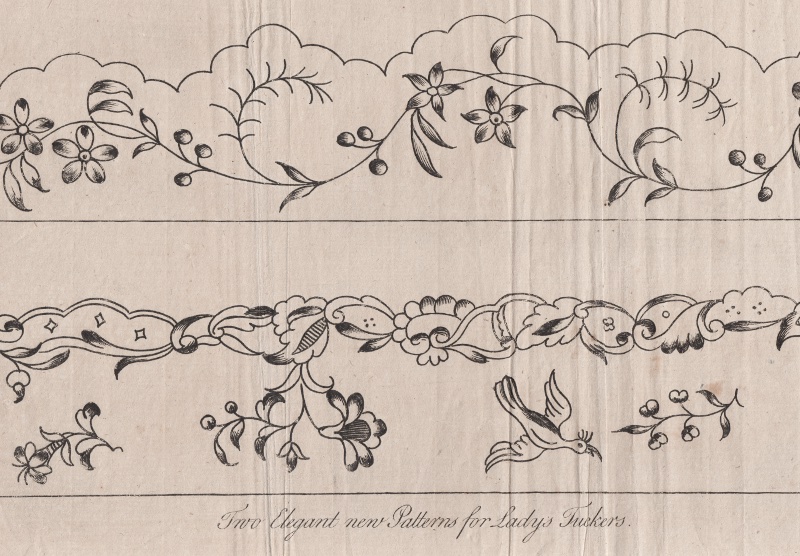
A pretty pattern from 1772.
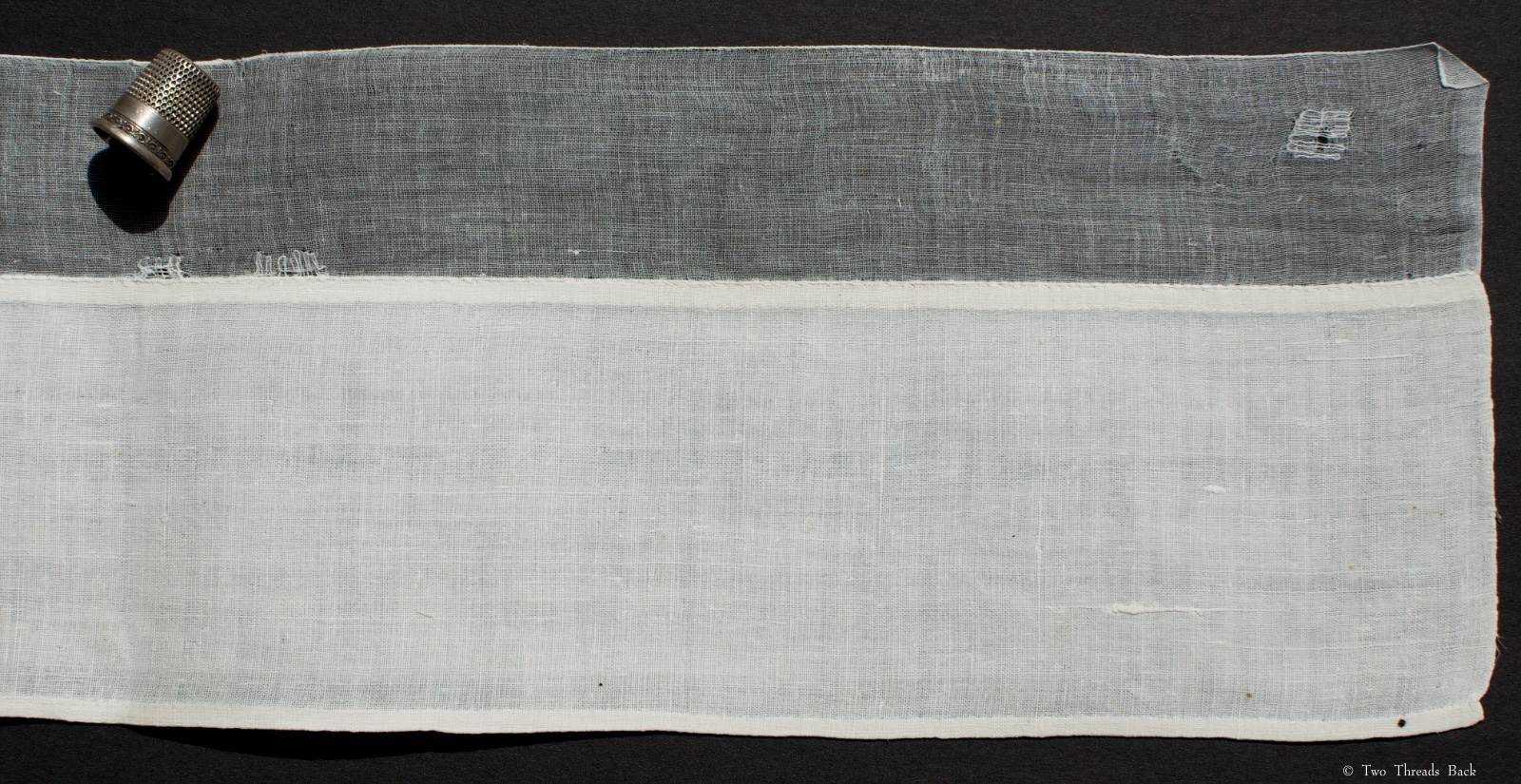
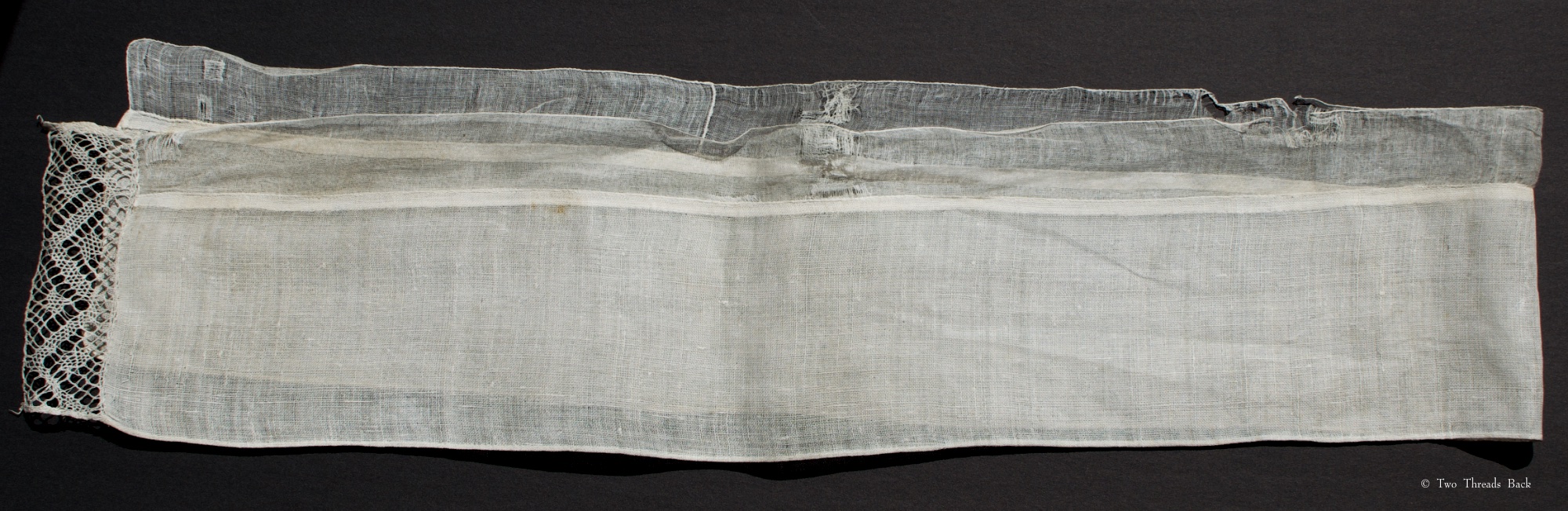
Now here are the four long strips of linen that perplex me, ornamented along one edge, all owned by a woman who lived from 1760-1805, in France. They measure a bit over 40″ long and the linen is @3.5″ wide. If they’re not tuckers, what the heck are they and how did she wear them? Maybe they were part of a headdress. Folk costume. Dresser scarf. Tourniquet with feminine flair.
A closeup of the careful mending. The darns are as fine as the other plain sewing.
There’s a bit of lace on one end only, and a cambric border on one edge. You can see there’s also a good bit of wear.
This one is in better shape, has lace along the edge, no trim on the ends. And her “marked” monogram.
A beautifully simple one, marked with both initials, although the cambric trim on this one didn’t fare so well.
I’ve called these pieces lappets and tuckers, but I truly don’t know. Research didn’t settle anything for me this time, so any help is welcome. Maybe someday in the future our descendants will ask the same questions about our garments. I know I’ve shopped for workout clothes and been just as confounded – these strappy scraps of spandex go how?!
Gertrude. “My dear Jessie, what on earth is that Bicycle Suit for?”
Jessie. “Why, to wear, of course.”
Gertrude. “But you haven’t got a Bicycle!”
Jessie. “No: but I’ve got a Sewing Machine!”
Reading old magazines. Really old. It’s what happens when you’ve been stuck at home too long.
VIRTUE UNREWARDED
Melissa Melinda McCann
Projected a laudable plan
To reform woman’s dress
On a standard no less
Than the models affected by man.
She invented remarkable ways
Of belaying her garments, and praise
Was distinctly her due,
For the neighbours she threw
Into constant and breathless amaze.
Unmindful how some might deride,
She determined her skirt to divide;
No change was too radical—
Transient—nomadical—
Each idea new should be tried.
All draping she wholly abhorred—
Her vials of wrath she outpoured
Upon tailors and dress-makers
Calling them mess-makers,
Banded in fiendish accord.
Point de Venise was as bad—
Never a trimming she had;
For her no chimerical,
Cheap, millinerical, Passementerical fad.
And so she elected to go
Unadorned from her crown to her toe;
A strong common sensible—
Quite indefensible
Funny old feminine crow!
These were the thanks that she got;
From naughty newspapers, hot shot;
From her friends, levity—
Hints of longevity—
Tragical, quite, was it not?
To have to sew your own punishment! Although I suppose to some people sewing is punishment.
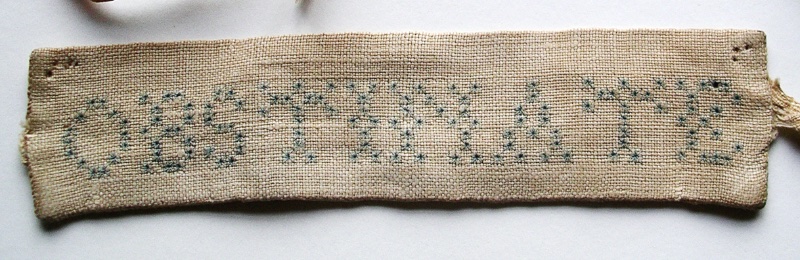
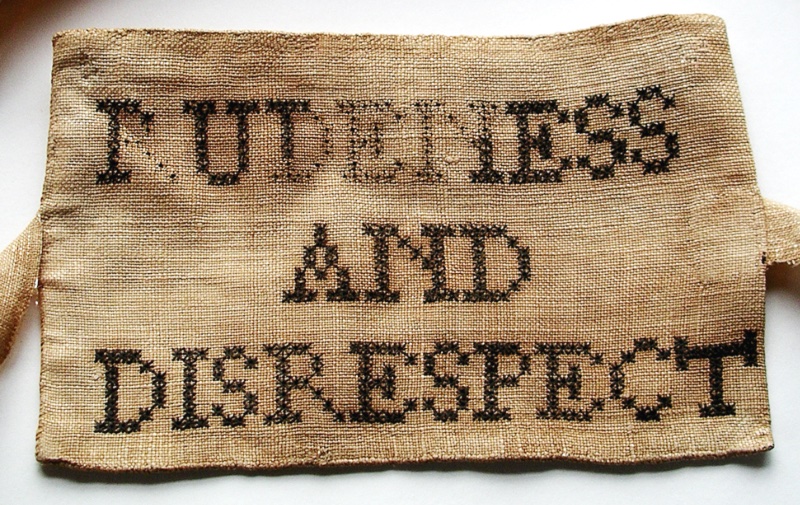
Above is my attempt at making a 19th century punishment badge. These were meant to be worn around the head of a schoolchild who was guilty of the named crime, probably made by another pupil. I copied the lettering exactly and have to confess I was torn between the pathos and humor. Inattention?
Mea culpa. Courtesy Christ’s Hospital
Public humiliation as a form of discipline is as old as history, but it takes on a particular poignancy when you think of little children wearing a label proclaiming their crime, for all their small world to see.
Remember Jane Eyre?
On reaching the bedroom, we heard the voice of Miss Scatcherd: she was examining drawers; she had just pulled out Helen Burns’s, and when we entered Helen was greeted with a sharp reprimand, and told that to-morrow she should have half-a-dozen of untidily folded articles pinned to her shoulder.
“My things were indeed in shameful disorder,” murmured Helen to me, in a low voice: “I intended to have arranged them, but I forgot.”
Next morning, Miss Scatcherd wrote in conspicuous characters on a piece of pasteboard the word “Slattern,” and bound it like a phylactery round Helen’s large, mild, intelligent, and benign-looking forehead. She wore it till evening, patient, unresentful, regarding it as a deserved punishment. The moment Miss Scatcherd withdrew after afternoon school, I ran to Helen, tore it off, and thrust it into the fire: the fury of which she was incapable had been burning in my soul all day, and tears, hot and large, had continually been scalding my cheek; for the spectacle of her sad resignation gave me an intolerable pain at the heart.
Helen wore a paper sign, but it seems some children were made to spell out the crimes by stitching their own badges. The next excerpt is from The Sunday School Teacher’s Magazine and Journal of Education, 1855. The author recalled attending a free school as a small girl. It was taught by Miss Middleton, a lady of independent means who had devoted her life, rather ineffectually it seems, to good works.
Our governess considered it needful to govern by at least a mixture of severity with kindness. Her modes of punishment were various. A rather formidable one was binding a label with a specific crime marked upon it around the forehead, and placing the culprit on a form as an object for the deliberate gaze of the whole school. Most likely these expressive tokens of guilt were originally manufactured by the children’s own hands, and remind one of a murderer erecting his own gibbet.
Once a long row of delinquents was ranged on a form, who had committed some kind of treason during our mistress’s absence; and absent she frequently was from her post. We had then a scholar who was notorious for her unconquerable love of fun… She being amongst the mounted ones, contrived to overbalance the form, and bring all to the ground, producing a scene which very naturally excited the mirth of all who beheld it, and turned our punishment into a frolic.
That must have been a sight! I wonder if they were all wearing their labels when they tumbled to the floor? The author goes on to describe what happened when she was falsely accused of tearing a pinafore and made to “wear her crime.”
Photo Courtesy Christ’s Hospital
But the question with my governess was, ” Who rent [tore] the pinafore?” Somebody must have; though having been perpetrated in the dark, it was probably rather difficult to determine the author. Now I was one of the least, and therefore as likely to be guilty as any one. I suppose by this reasoning Ann brought her mind to the conviction that I was the guilty party, and she unhesitatingly accused me of the crime. I very naturally denied the charge. But I was compelled to wear the most detestable of all the bandages, and mount the form with the word LIAR branded on my brow. Can I ever forget that moment? No! the scar of that wound will not be effaced by time, however long a space be allotted me; and though I have long ceased to bear malice, the memory of this painful circumstance will be for ever connected with the name of Ann W. Surely nothing chafes the soul of a child so much as an unjust accusation, and unmerited punishment. – Maidstone. Christiana Elizabeth.
If you’ve read the Plain Needlework page on this blog, you know about Joseph Lancaster’s contribution to needlework education. However, some of his early comments on class discipline are rather hard to take – at least for modern sensibilities, even when allowing for the times in which he wrote. He also used labels to shame children who offended. From his 1807 manual,
When a boy is disobedient to his parents, profane in his language, or has committed any offence against morality, or is remarkable for slovenliness, it is usual for him to be dressed up with labels, describing his offence, and a tin or paper Crown on his head. In that manner he walks round the school, two boys preceding him, and proclaiming his fault; varying the proclamation according to the different offences.
And another reference,
Labels of Disgrace. When boys are in habits of talking, or being idle in school time, it is common in the free schools under my direction, as variety in punishment, to make an offender stand up and suck his fingers, with the label ‘Idle’ or ‘noisy’ or ‘suck-finger baby.”
Courtesy Christ’s Hospital
These methods were mild compared to others he recommended. Although to be fair, I can’t imagine the task of managing – much less teaching – a single class of over a hundred unruly street children.
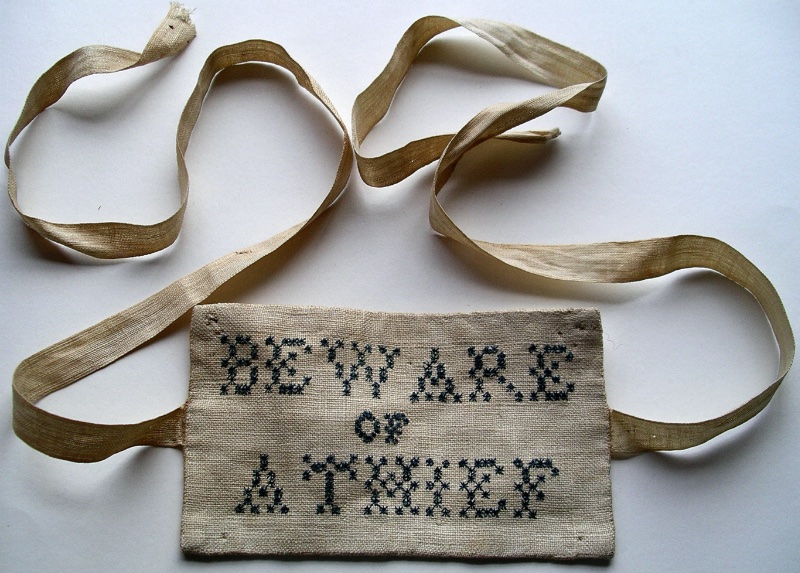
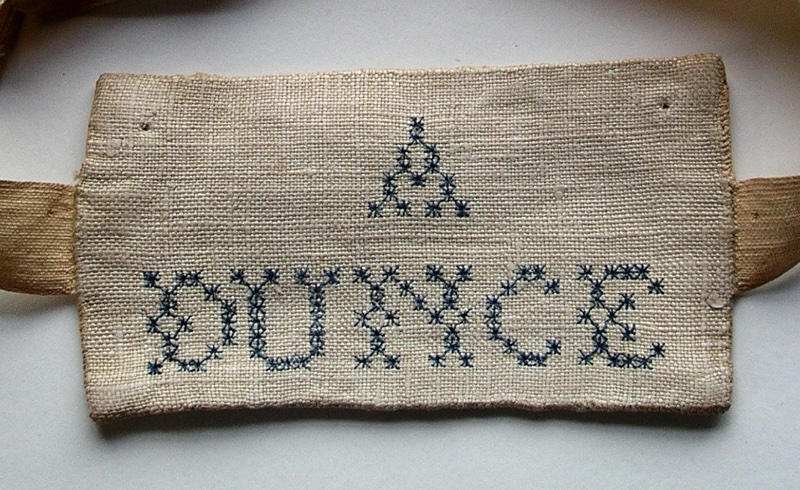
What sort of offenses warranted this fate? Thanks to generous help from Christ’s Hospital, Horsham, we can see some of the unacceptable behaviors marked on bands from their museum collection.
“Punishments for moral offences, which consist in branding the offender as a thief, a liar, or some other odious appellation, by making him wear a label with any such inscription round his neck, should be indignantly repudiated by the teacher,” -1872 Handbook on the Teaching and Management of Elementary Schools. Photo Courtesy Christ’s Hospital
1866 Report, “There are, it seems, teachers in Boston who do not make much use of the rod, but resort to other modes of punishment which are quite as objectionable, such as shutting up children in closets — though absolutely forbidden, plastering up their mouths — unusual if not cruel, decorating their heads with the dunce’s cap, or placing upon them some badge of disgrace.” Photo Courtesy Christ’s Hospital
Note how the ties are attached differently in this one. Perhaps it was meant to be worn around the neck. A Sunday School Guide from 1806 states, “The standing on a stool, or form, in a corner, for a certain time, and in some cases with a label hung round their neck, specifying why they stand there… may be tried before the extremity of expulsion be used.” Photo Courtesy Christ’s Hospital
From The Christian Observer, 1805: “If the child asks pardon and behaves properly, she is soon restored to her place; if not, she passes to the form entitled Disobedience; and for immoral offences they are sent to the form of Disgrace, with a label, declaring the offence, fastened to them.” Photo Courtesy Christ’s Hospital
This one is hemmed rather than backed, and has what is likely the class or form marked on the side. Photo Courtesy Christ’s Hospital
I’m probably guilty of all, but the one that caught my attention was INATTENTIOn. That had my name written all over it (ha) so that’s the one I wanted to make. Although from respect – and exhaustion – I left out ‘DURING PRAYERS.’
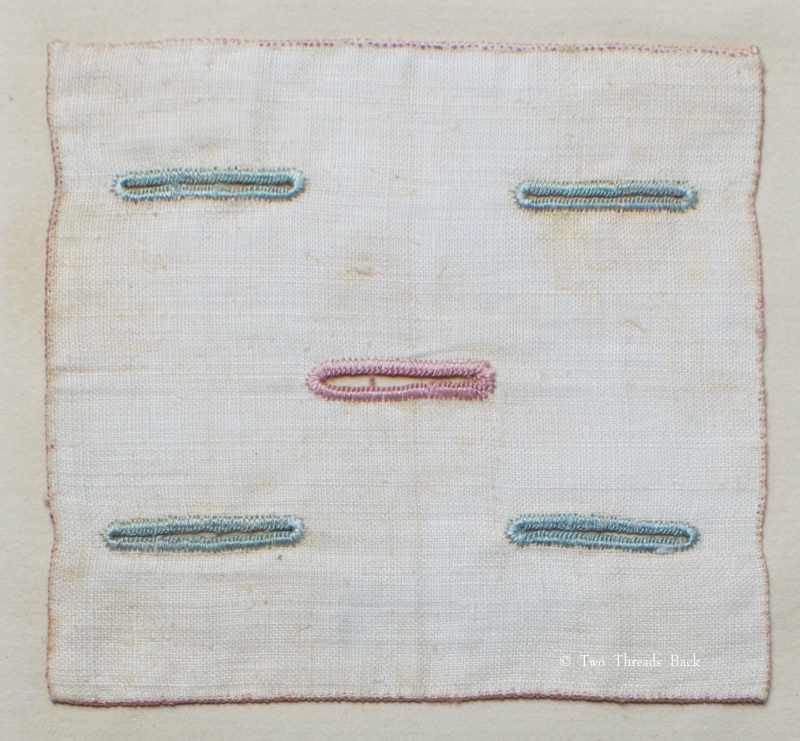
The bands reminded me of the tiny sewing samples made for needlework lessons, illustrating plain sewing techniques.
Tiny marking sampler from teaching manual, 1833.
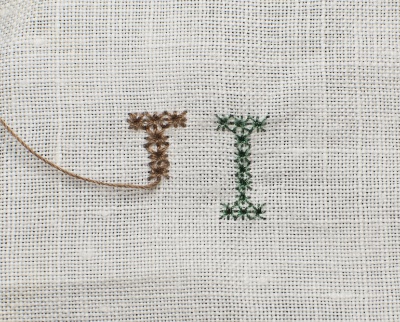
The first one needed was marking. Cross-stitch is the basic marking stitch, but these are marked with “oylet” or “eye-let-hole” stitch, which is
quite a fancy stitch, and rarely employed. The oylet holes are formed by working in small stitches round each square, about four stitches in the four corners, and four intermediate stitches between, are necessary to form each oylet hole. -Workwoman’s Guide, 1838
or as directed here, in 1853:
Eye-let-hole Marking is done by making a stitch across two threads from the centre as a fixed point, above, below, on each side, and at each of the four angles.
Well OK, no problem, I could do that. Or so I thought until I tried it on a scrap of old linen. Enter 5 diopter magnification with 60 little LEDs, and voila! Of course my eyes were crossed and my head tilted sideways for a week.
I hadn’t even done the first letter before I realized that the stitches that resembled little stars on the original looked like lumpy knots on mine. Even worse at reading distance than in the close-up photo. Hint: use the right thread. Finer silk worked much better. I also learned that it takes twice as long to unpick an “oy-let” as it does to stitch it!
Finishing the badge was a little easier. I folded the linen back onto itself, and then “seamed” the other three sides. Seaming (also called sewing, oversewing, overhanding in the 19th century) is my favorite stitch to do, and you can see a beautiful example of it around the edges of this tiny specimen from 1820.
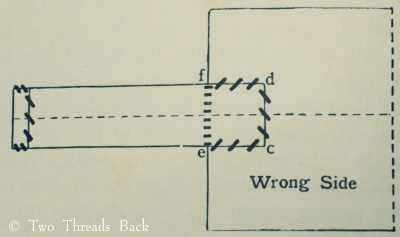
The label needed ties, too. I’m amazed that nineteenth century classes even included a “proper” way to do something as simple as sewing on ties or tapes. In the illustration below, the tape has the raw end tucked under and three sides are hemmed to the fabric. Then the tape is folded back against the fabric and the fourth edge is seamed to the fabric. Neat, sturdy, and strong as super glue. Well, theirs were anyway.
I don’t have a purpose for the band I made; I’m not even sure why I felt compelled to make one. Perhaps it was just a way to almost touch the past. It would be a shame to lose its lessons.
If you have a nose for rabbit trails, even the simplest search can make you lose your way – if not your head! I was trying to pinpoint a date for the common use of machine-made pins, but ended up following the trail from factories to inventories to short stories. The stories were the most fun, and I thought I’d share this (edited for length!) one.
THE HISTORY OF A PIN. (The Portland Transcript, 1863)
BY EDWARD P. WILSON.
“Est natura hominum novitalis avida.” [People crave new stuff.]
While walking down the street other day, something bright, embedded in the dirt between the bricks, attracted my attention; and stooping I extracted from the sand an old headless pin. It was not one of the family of pins with which we are now familiar – pins never lose their heads now a days – but one of the old style, whose head was originally formed of fine coiled brass wire; but now it was headless, crooked, rusty and worn: one of those sort of pins which in my school-boy days we were wont to call “old maids’ pins,” and which every single lady felt in duty bound, on the penalty of endless celibacy, to throw over her left shoulder.
As I sat in my arm-chair after dinner enjoying my cigar, I drew it leisurely from the lapel of my coat – a bachelor’s invariable pin cushion – and examined it more minutely. What would I give to hear the history of this old pin!
As I continued to smoke, the pin seemed to grow strangely bright, as seen through the incense which curled around me; and then it seemed to increase in size until it resembled some old, sallow man, whose back was bent by the cares and sorrows of three-score years, who stood twinkling at me through the smoky vapor; and at length I became so accustomed to regard it as human, that I was not surprised when it addressed me as follows:
“Many years have passed away since I was young and bright. I remember the day, when by a clip of a huge pair of shears, I first received a distinctive existence. Pins were worth something in those days, and were not turned out upon the world by machinery, as they are now in Connecticut, at the rate of ten tons per week. We were all made elaborately by hand, going through fourteen different processes in our construction. It was in the old Greenwich Prison, New York, where the first pins were made on this continent. We were all nicely arranged by hand in our papers, like files of soldiers. Fortunately for me, I occupied the position of captain in the first row of my paper, and stood the best chance of being soonest called into the active duties of life. After being duly packed, we were removed to a little store on Broadway, near Castle Garden. I well remember the looks of my first master. He was a little wizen-faced man, who kept a small variety store in those days.
Many long months I laid upon his dark shelves, fearing that I should spend my days in rest and inaction. But at length my days of imprisonment were over. One day a young woman came into my master’s store and made several small purchases of ribbon and edging, and just as she had started to go out, she turned back and asked for a paper of pins. How I thrilled with joy as my master placed the paper in which I had been so long imprisoned in her hand.
My young mistress took me to her home on one of the short streets in the vicinity of the East River. I had scarcely entered the house, which was a neat tenement of the Dutch style, before I became convinced that preparations were being made for some great event in the household. Judge of my surprise when I ascertained by the gossip of the servants that it was the marriage of my young mistress.
All day the household was in commotion, in baking, dusting, and arranging for the happy occasion; and when in the evening my mistress came to her room where I had been lying upon her dressing table, to put on her wedding dress, I was made happy by being called into service. Having otherwise completed her attire, which was elaborate for those days, although it might provoke the mirth of the fashionable belle of the present day, she took from her drawer a beautiful silk zone or belt, which she clasped around her waist, and fastened it with me.
As she stood before her glass to adjust her dress before making her appearance in the drawing room below, I could not help feeling a silent pride in her beauty. I had not thought her pretty when I had first seen her, but as she stood there, I could not but pronounce her beautiful. When the guests had all retired, and my master and mistress were left alone, I listened, as I stuck in a pin-cushion upon her dressing-table, to all their plans of life and happiness.
It was indeed a bright and beautiful scheme; but I am sorry to say that I lived to see many of their pretty plans fade away, and smiles give place to tears. I remained in this family nearly twenty years, occupying various places in the attire of the different members of the family; sometimes idly dropped upon the floor, and then again picked up to fasten some article of clothing.
When at length there were little ones around the hearth, I fastened their tiny garments, and sometimes, unwillingly, scratched their little chubby bodies [!!!], causing many a kick and scream, which were attributed either to colic or anger, according to the disposition of the person who had them in keeping.
One day as their eldest daughter was out shopping, I fell noiselessly from the bosom of her dress, where I had been carelessly stuck, upon the sidewalk of Broadway. It may be thought that a pin is incapable of feeling, but I felt the deepest regret when by this unlucky accident, I was severed from this family in whose service I had spent so many days; and I could not but feel a silent resentment against my mistress for fastening me so carelessly, as I had been a faithful and uncomplaining servant of hers from the very day of her birth.
I remained many weary days lying upon the sidewalk unseen, although thousands of people walked over me daily; and I sadly feared that I should be trodden into the dirt, and thus remain entombed the remainder of my days. But my fears proved groundless.
One day, after I had almost given up hope of being discovered, a little, short, dried up old man came along with his eyes upon the sidewalk, as though in search of pins, and deliberately picked me up and placed me in the lapel of his rusty coat.
I soon discovered that my new master was an old bachelor, of most eccentric manners and mode of living, who lodged in an attic on the Bowery. Once I heard him say mournfully, that he should not have been there alone, aimless in life, if it had not been for her, from which I inferred that some unhappy attachment in early life had made him misanthropic.
I remained in his service many years, sometimes fastening ugly rents in his garments; and at length he removed to Boston, where he naturally enough became more morose than ever. [!!!]
One day as he was walking upon the Common, he attempted to fasten his collar, which had an ugly habit of creeping up over his ears, when he pricked his finger with me, and threw me spitefully upon the ground, where I remained about one week.
One day a little girl on her way to school, came along and picked me up, repeating to herself the childish couplet—
‘Tis a sin to steal a pin But ‘tis a greater to steal a tater
and took me to her home where I remained several years, being used principally to fasten the clothing of her doll.
One day in summer, her brother was sent off on a vacation to a little town in the State of Maine, and I was brought into requisition to fasten his collar. I remained in his service but a few weeks, but this was the most trying period of my life. Sometimes I soared to enormous heights in the tail of his kite, sometimes I was used to pierce flies and other innocent insects, and at length he used me to fish for minnows in a beautiful bay which indents the town where he was stopping.
There I received that ugly bend which you see in my back, being bent to resemble a fish-hook. After he had thus cruelly treated me, my young master threw me carelessly upon the beach, with a piece of cotton thread which he had used as a fishing line, tied around my throat. Here I lay in the sun many long days, and as the place was not frequented, I well-nigh despaired of ever attracting the attention of any living being. But I was not doomed to spend the remainder of my days in inactivity.
One moonlight night in autumn, a lady and gentleman came upon the beach to court the cool breeze, engaged in earnest conversation, over the sand where I was lying. The lady was young and pretty, and dressed in weeds which betokened widowhood. Her drapery was long and flowing, and at length as she passed over me, I, being bent, caught in some point-lace on her skirt, and was taken along with her. Her companion was a large, well-formed man, whom she called Judge Jones.
They walked together a long time, arm in arm, but at length the Judge, very much to my surprise, withdrew his arm, and placed it around the widow’s waist, who very properly remonstrated against such a proceeding; but I observed that she made no effort to remove it, although she stated very emphatically that it should not remain there. Just then the couple approached a large rock embedded in the sand, and the widow complaining of being fatigued, they sat down there to rest.
Here the Judge not only retained his arm in the position which was so offensive to his companion, but even ventured to kiss her, an impropriety which I cannot but condemn, although I must confess that I have been an unwilling spectator to many such a scene.
At this moment his companion grew very indignant, shedding tears and declaring that she was certain that the Judge meant to offend her, which imputation he very warmly denied, although I observed that he repeated the offense.
At this, my mistress grew still more indignant, and dropping her head upon her companion’s shoulder, emphatically demanded the meaning of such conduct. Here the Judge drew her still more closely to him, and said in a subdued and tremulous voice, “My dear madame I have long wished for an opportunity to tell you that — ”
Here the writer’s head fell heavily upon an adjoining table, and gathering himself up he found that his cigar had gone out, and that he himself had been idly napping, with the old rusty pin between his fingers.
It has ever since been a question of great interest to him, what it really was that the Judge was going to tell to his companion, and how the old pin lost its head—and finally came to be lying in the streets of Cambridge, but he has vainly striven to solve them, as the old pin has ever since maintained a most unbroken silence.
Should these facts ever come to the knowledge of the writer, however, they will be duly chronicled in the columns of the Transcript.
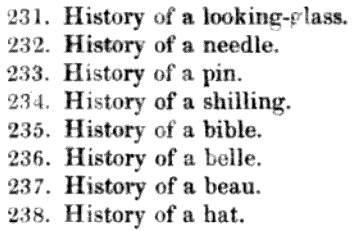
What an original idea: a story written by a pin! Well … not exactly. See this snippet from an 1835 English composition manual on suggested topics.
“A list of subjects for Themes, simple and complex, Essays, Descriptions, Narrations, &c.”
As for pinning down a date for the common use of machine-made pins, there is good information out there – if you want to stick to the subject and not wander around. Here is a good place to start for a more serious approach.
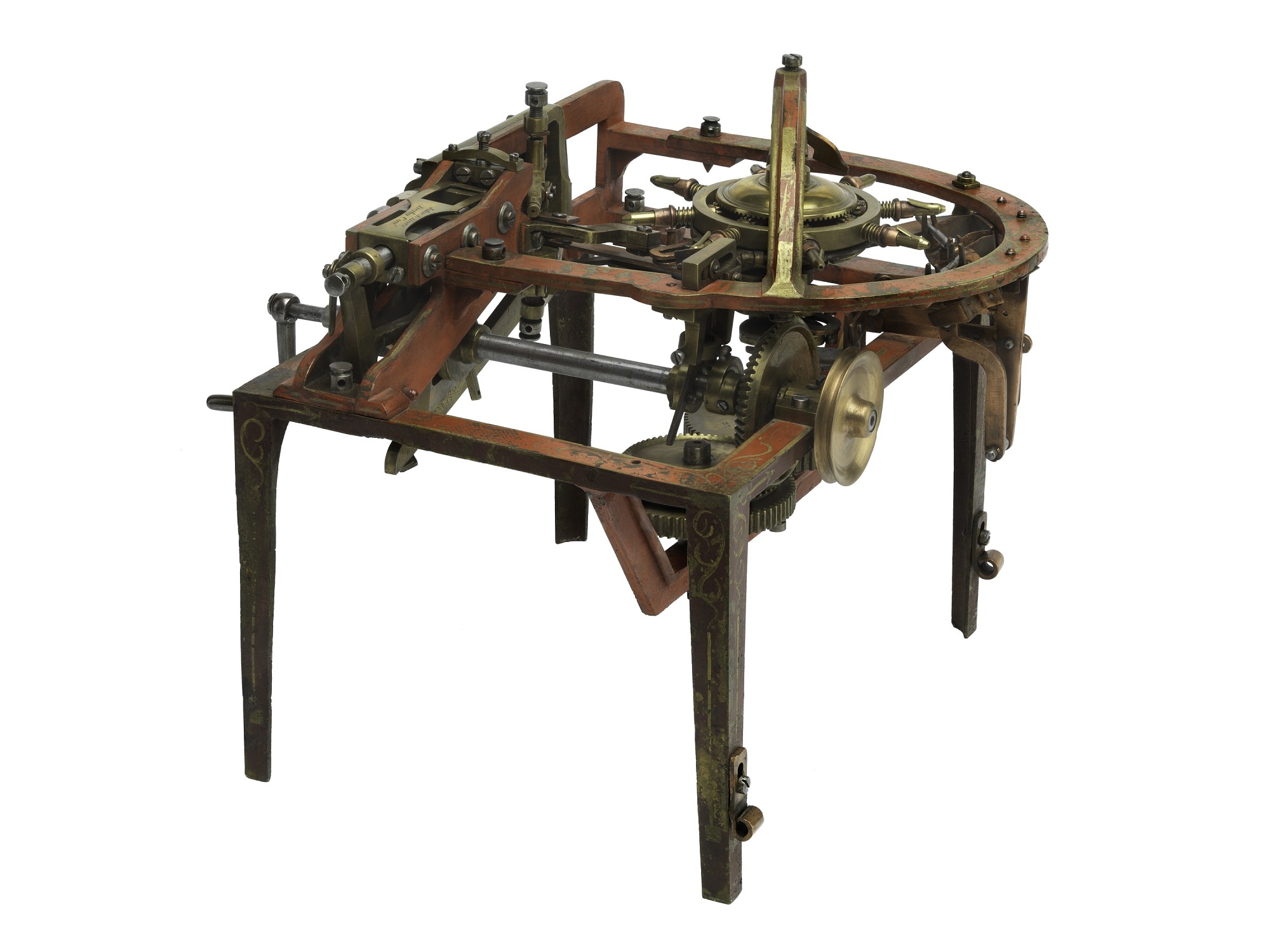
John Howe’s patented pin making machine. Smithsonian Institution, NMAH-JN2015-5114, Jaclyn Nash
So when might I have found machine-made pins in a sewing basket or on a dressing table? It seems that by the late 1830s technology and economics combined to phase out skilled labor in favor of automation. Pins were no longer likely to lose their heads. And if I could just stay focused, I might not either. But where’s the fun in that?
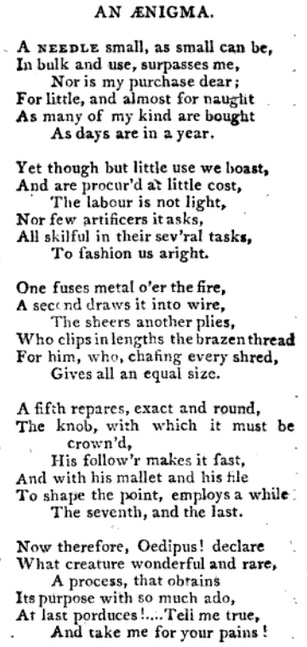
Posthumous Cowper, from “The Literary Magazine, and American Register,” 1803























 Two Threads Back