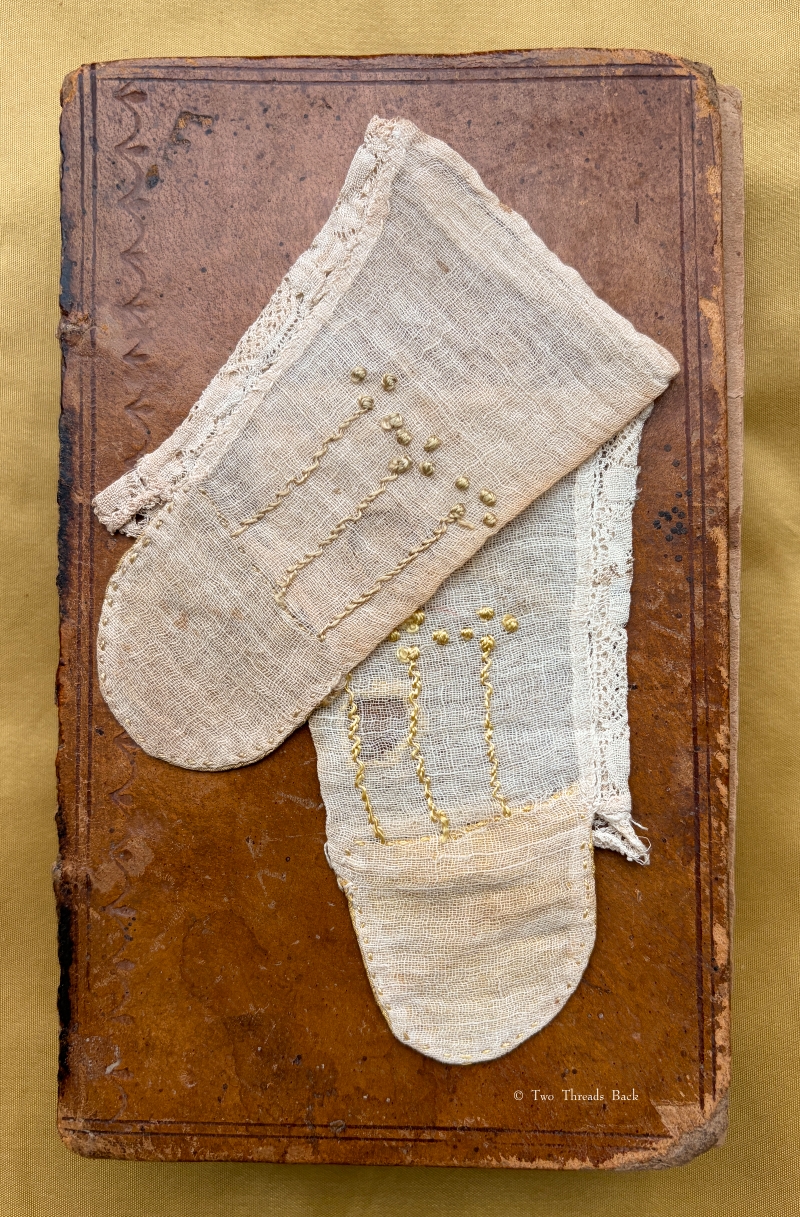
It’s only a tiny glove, So ragged, and old, and worn— You scarce would stoop in your daily path To look at the thing forlorn; You never would think by those fingers small, A heart could be rent and torn.
It’s only a little thing, This treasure I hoard and keep; But many a vision of joy it brings, And sometimes it makes me weep. And I dream a dream of a fair-hair’d boy Under the flowers asleep.
It’s only a little glove, Yet dearer it is to me, For the restless feet that pattered and beat Their music upon my knee— Dearer for sorrow, and care and pain Than the riches of land or sea.
It’s only a tiny thing; But I love it with deepest love— A golden link in the chain that binds My soul to the world above; And I know I am nearer to Heaven each time I bow o’er that tiny glove.
I often go looking for something specific in that great Black Hole of a library, Google Books, but wander off on a rabbit trail. I found this poem by Matthias Barr in The New England Farmer, 1868. I know it’s contrivedly sentimental – even in his own time that was a “hallmark” (ha!) of the author’s poetry: “avoiding minute criticism, Mr. Barr’s poetry may be said to contain more of ‘goodness’ than of greatness” “touching all the sources of parental feeling” “sweet little poetic effusions” “there is something in the tones of his poems on children that brings tears to tender eyes”
And one reviewer rivaled Dorothy Parker’s wit: “Mr. Barr has well earned his present reputation and we trust he will long enjoy it.” Hmm.
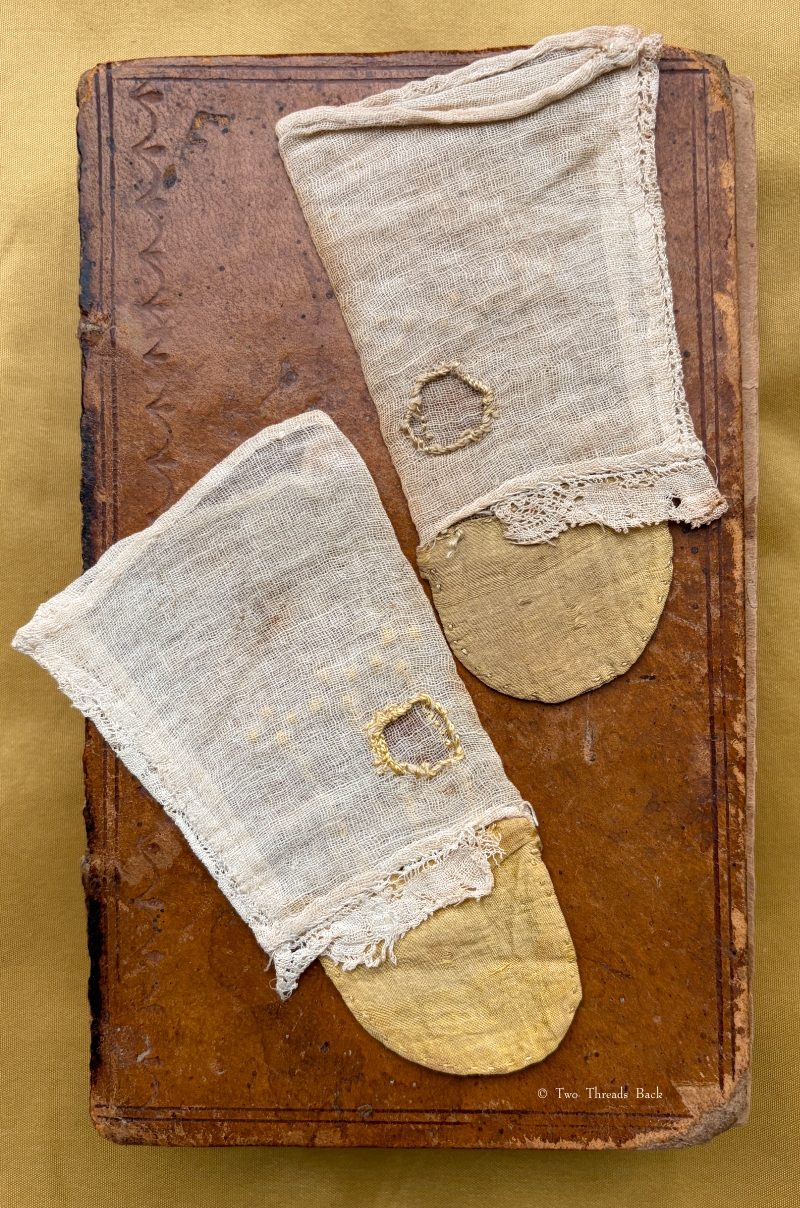
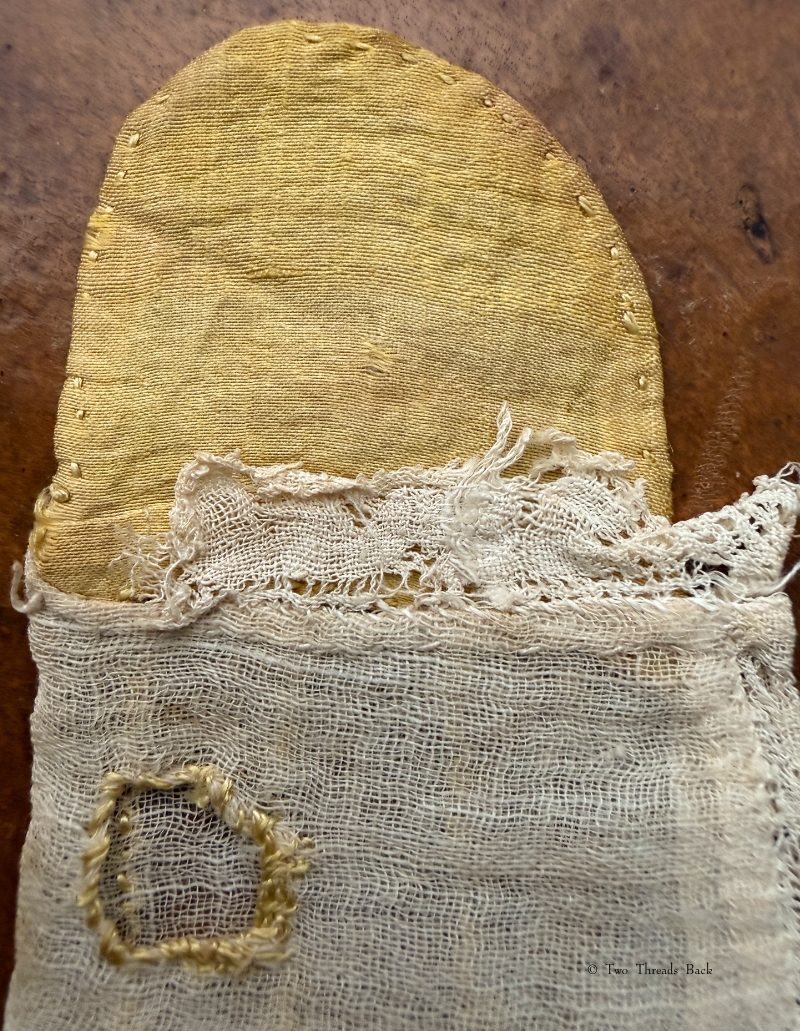
Nonetheless, the poem seems made for these sweet little mitts. Someone saved the tiny fragments of linen, lace, and silk for two or three hundred years. You can almost picture a baby’s hands going straight to its mouth, indifferent to its fancy dress. Usually only the finest baby’s clothing survives, perhaps ones that were worn just for a Christening and then packed away. These must indeed have been dearer than the riches of land or sea!
Sweet little infant’s mitts, mittens, gloves, measuring 2 x 4 inches. They were quite elegant when they were newly made! I don’t know the date, perhaps the second half of the 18th century. Possibly earlier.
Can you imagine trying to fit a wiggly, resistant little thumb through?
Since I’d wandered down a rabbit trail anyway, I continued searching for more on the Scottish poet Matthias Barr. An interview in 1911 revealed a surprising sense of humor with a wry touch of self-deprecation. He seemed to be quite a clever gentleman, a musician and artist as well as a poet, but it’s the children’s poems that have (sort of) survived, with their appeal to tender hearts. We don’t always need profound words for comfort, sometimes we need sweet ones. I think the person who first saved these little mitts would understand.
N.B. Mr. Barr was quite a handsome gentleman, if this picture is a true likeness!
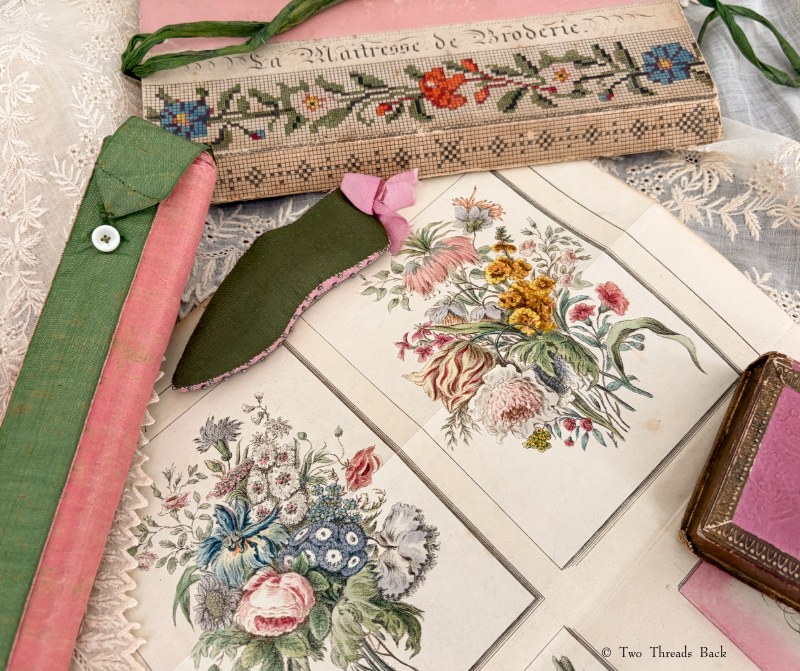
And green. And gold, and seeds, beads, shells, fish scales, feathers, hair, paints, papers, and too many kinds of threads to name. There was no limit to the elegant (or not so elegant) crafts that Romantic Era ladies of leisure could enjoy.
Yes, this sort of handiwork is probably the polar opposite of plain needlework. (I did warn about rabbit trails!) Colorful, creative, and infinitely variable in materials and form, vs. white, repetitive, and predictable in materials and form. I can’t help it, sometimes eyes just need candy!
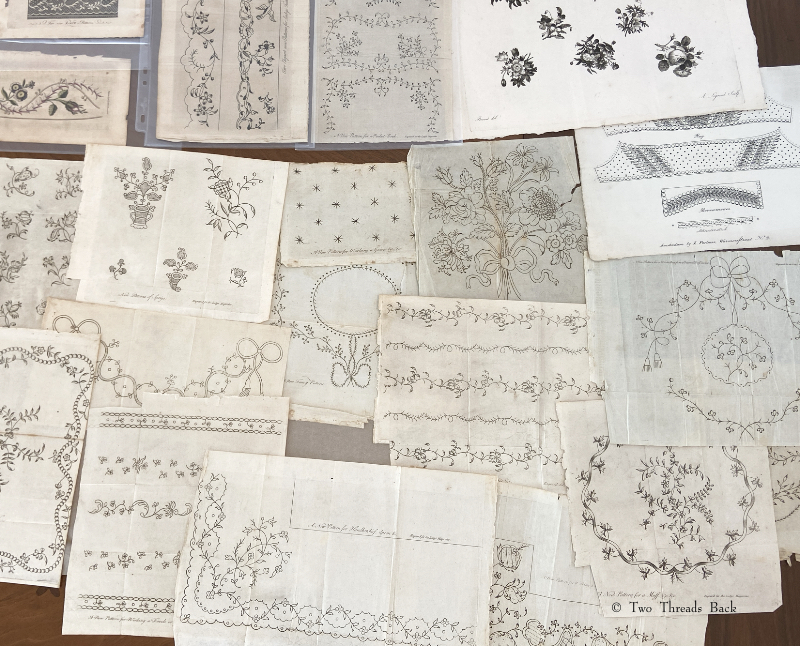
The earliest patterns to be included in periodicals, such as these from The Lady’s Magazine and La Belle Assemblée, were for needlework and published without hand coloring…
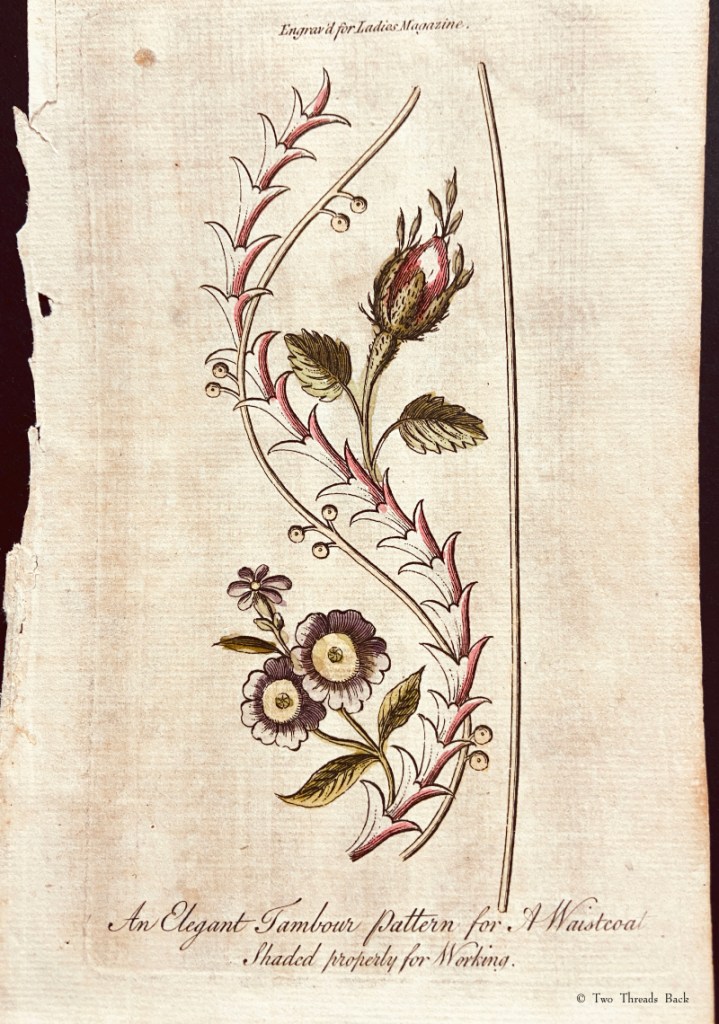
… with an exception to prove the rule. A “properly shaded” pattern from the Lady’s Magazine, 1772.
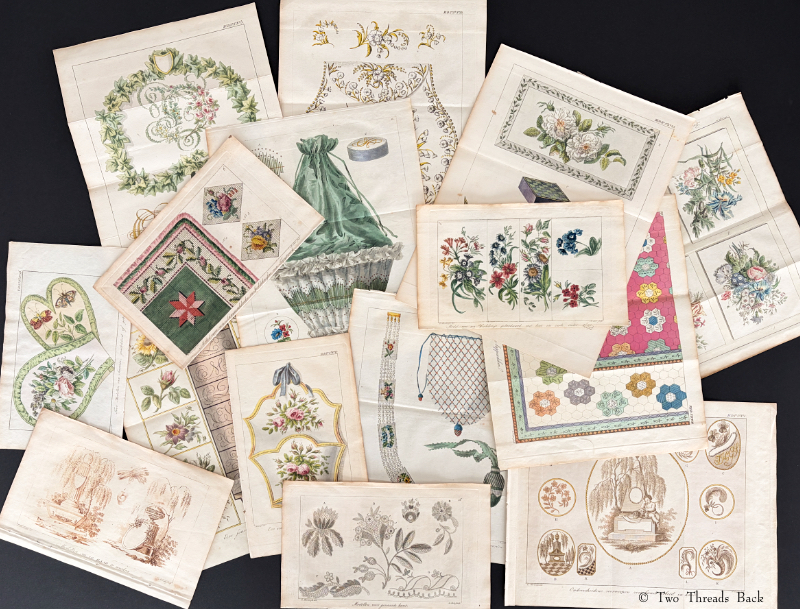
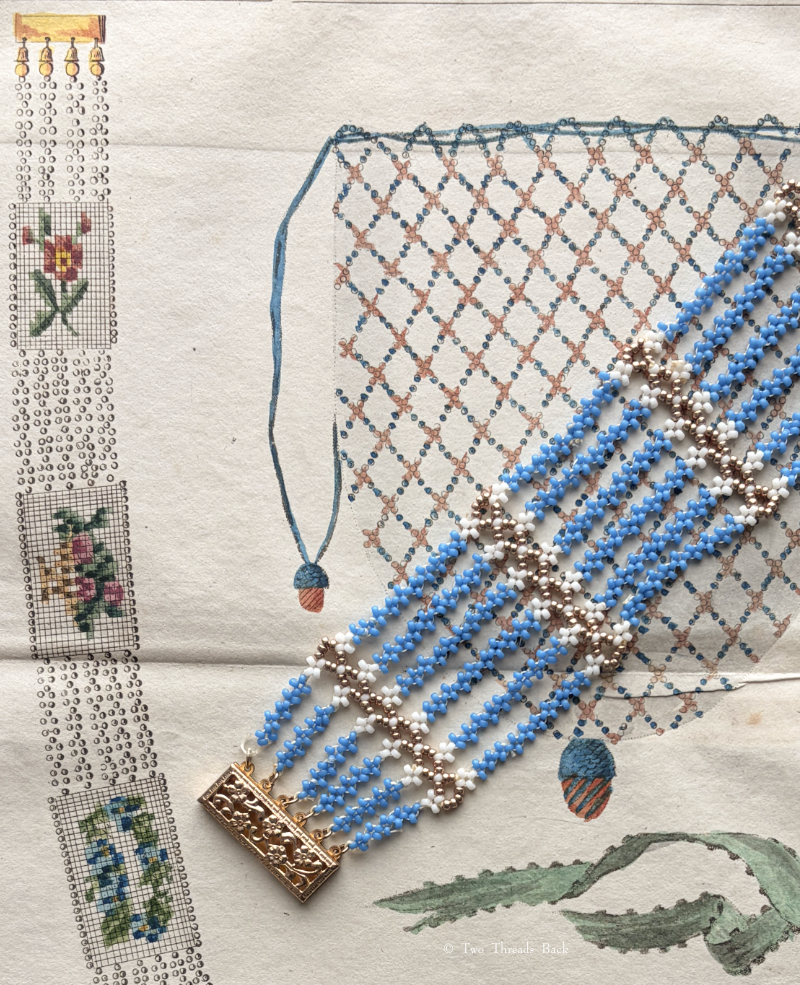
Surviving patterns are almost as much fun to study as the items that were made from them. Penélopé, of Maandwerk was a Dutch ladies magazine which offered hand colored patterns and projects as early as 1821 (it ran until 1835). Half of each issue was devoted to crafts and half had a literary focus. The patterns range from stunning to “what were they thinking?”
Penélopé offered not only needlework, but patterns for things like hairwork, painting, patchwork quilting, beaded reticules, etc., many in color. These are for a variety of projects c.1820s.
Of course if you want to play with old patterns today, you don’t have to use them for their original purpose. Not everyone needs a bell pull, a mantelpiece container for “spills,” or a hand screen. I’ve had fun scanning and printing designs to use in projects like labels, cards, and ornaments. There are lots available online, both for sale and free (public domain): Google books, Hathitrust, the Internet Archive, and the Antique Pattern Library, are fabulous sources, and I’ve used them all.
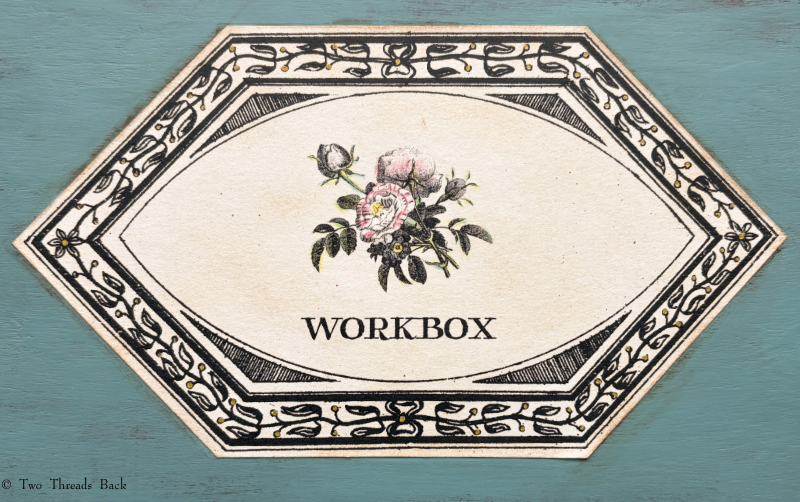
This is a combination of two patterns I used to make my own label for a workbox.
My daughter surprised me one birthday with her version of Jane Austen’s bracelet. I was thrilled! It’s exciting to see that ladies of the day really were getting ideas from these publications. Or wait…maybe it was the other way around?!
I suppose ladies saved and passed patterns around then the way we used to do with recipes. Today it seems like everything is digital – even recipes! I do love how accessible and how easy that makes sharing ideas and inspiring creativity. But isn’t there something extraordinary about a pretty paper that lets us hold an idea in our hands, long after its maker is gone?
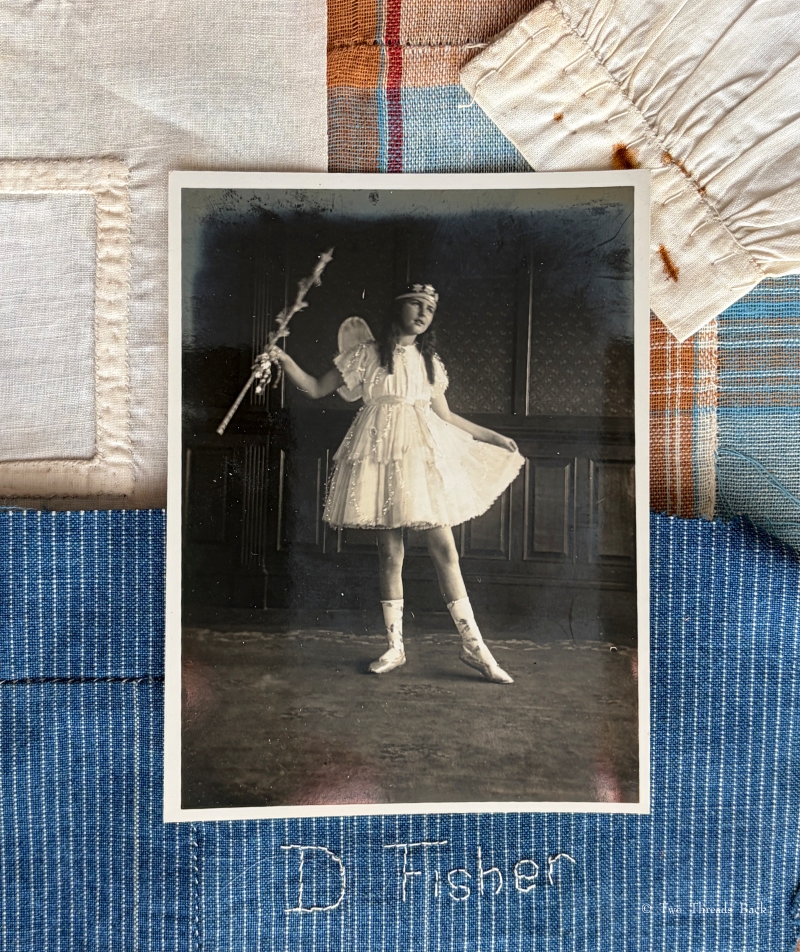
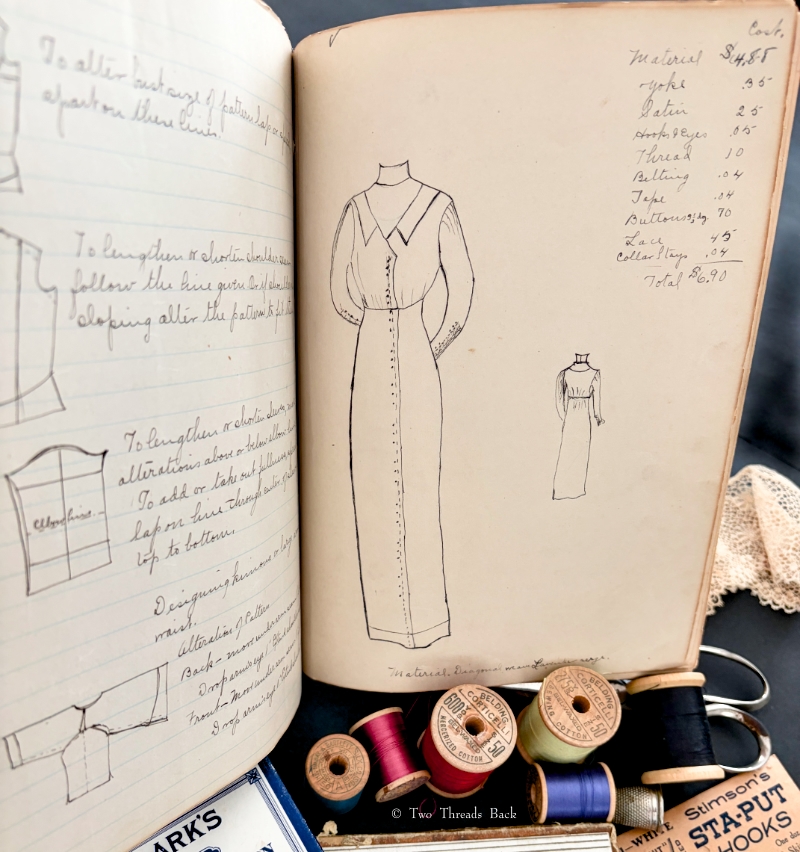
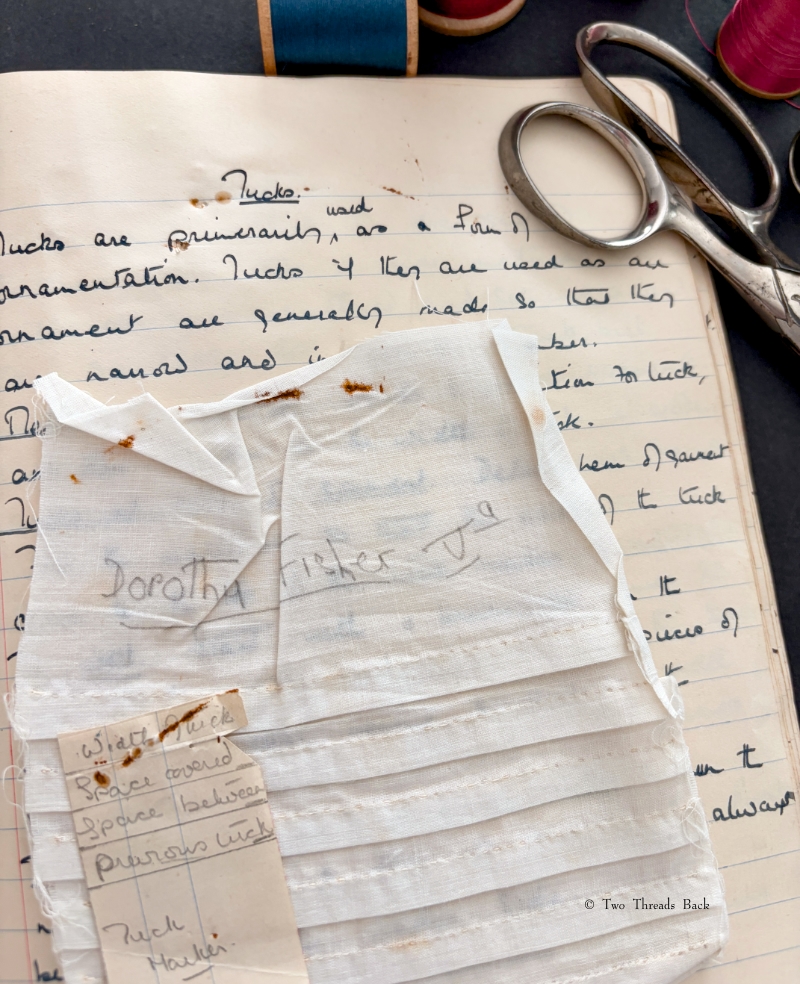
Well, one never was in Kansas and the other isn’t now! Here are two sweet sewing books. The one made by Eliza is American, from Kansas. The one made by Dorothy, who reminds me more of Glinda the Good, is from England. Besides the Wizard of Oz connection (I admit that was a stretch) they have other things in common.
TIME. Eliza’s book is dated 1912-1913, and was compiled during her Home Economics Housekeeper’s Course at Kansas State Agricultural College. Dorothy’s book isn’t dated, but assuming the photo is of her and taken around the time she attended the class, it was probably made soon after Eliza’s. It seems they studied sewing at different ages, however. Dorothy was obviously still a young girl, while Eliza was over 30 when she completed her course, as census records show she was born in 1881.
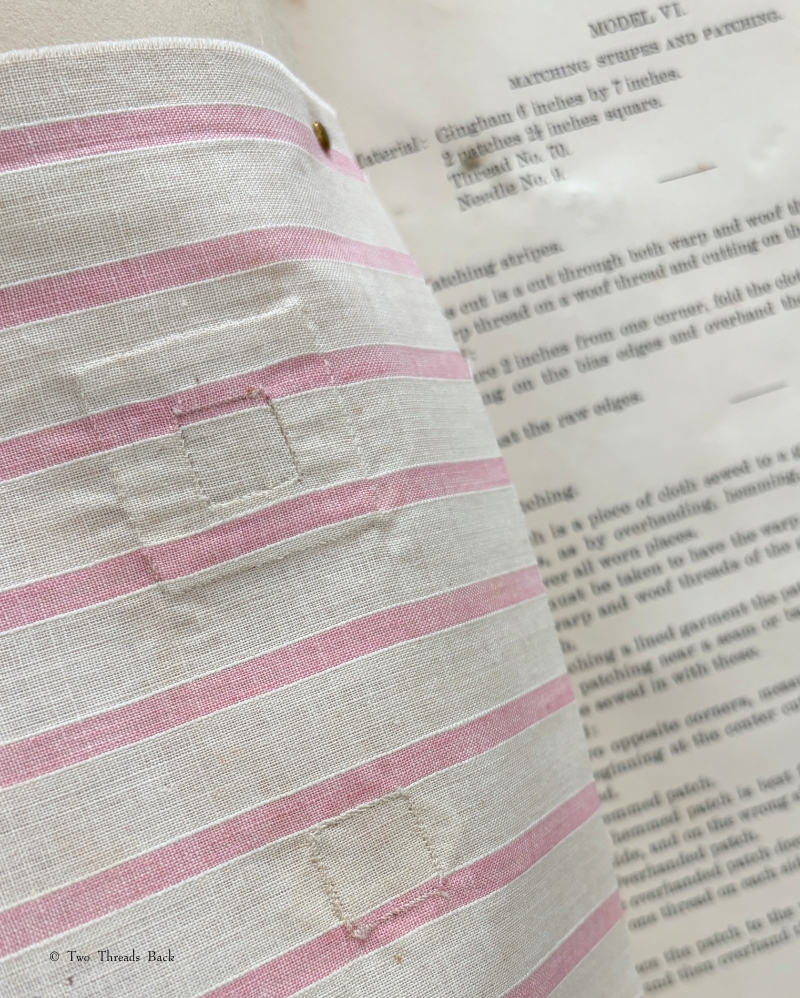
TECHNIQUES. Both cover the basic hand sewing stitches and seams, and they included samples of them in their books. They also learned patching, darning, and making plackets. Dorothy’s work is all done by hand, but Eliza has samples made by hand and machine.
Dorothy obviously put effort into her work, but compared to others I’ve seen, I don’t think sewing was her favorite subject.
Eliza’s work is more precise. However, she was older and likely more experienced when she took her course.
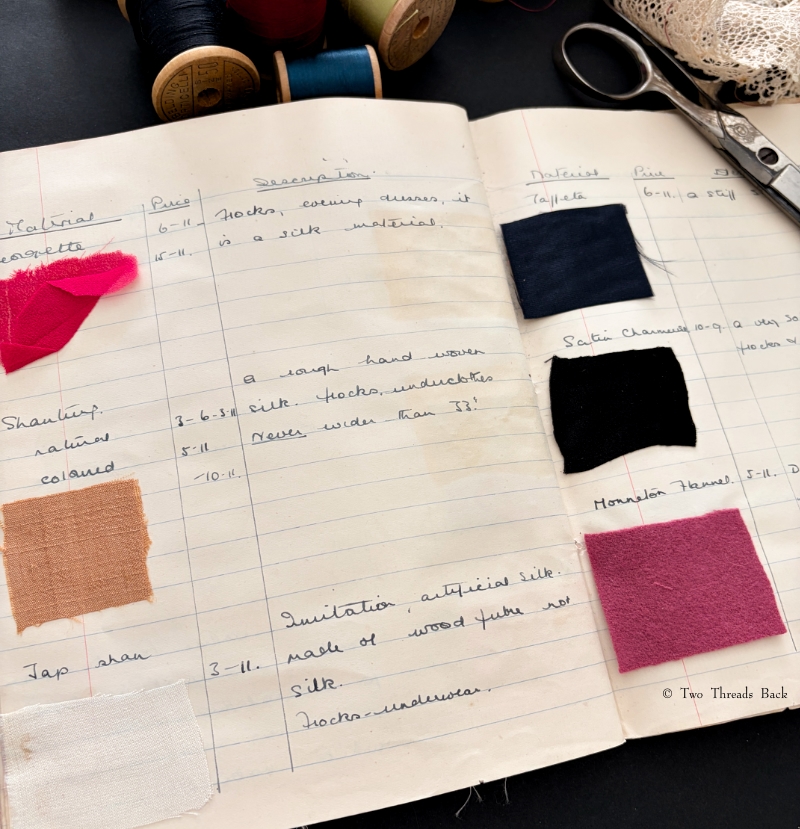
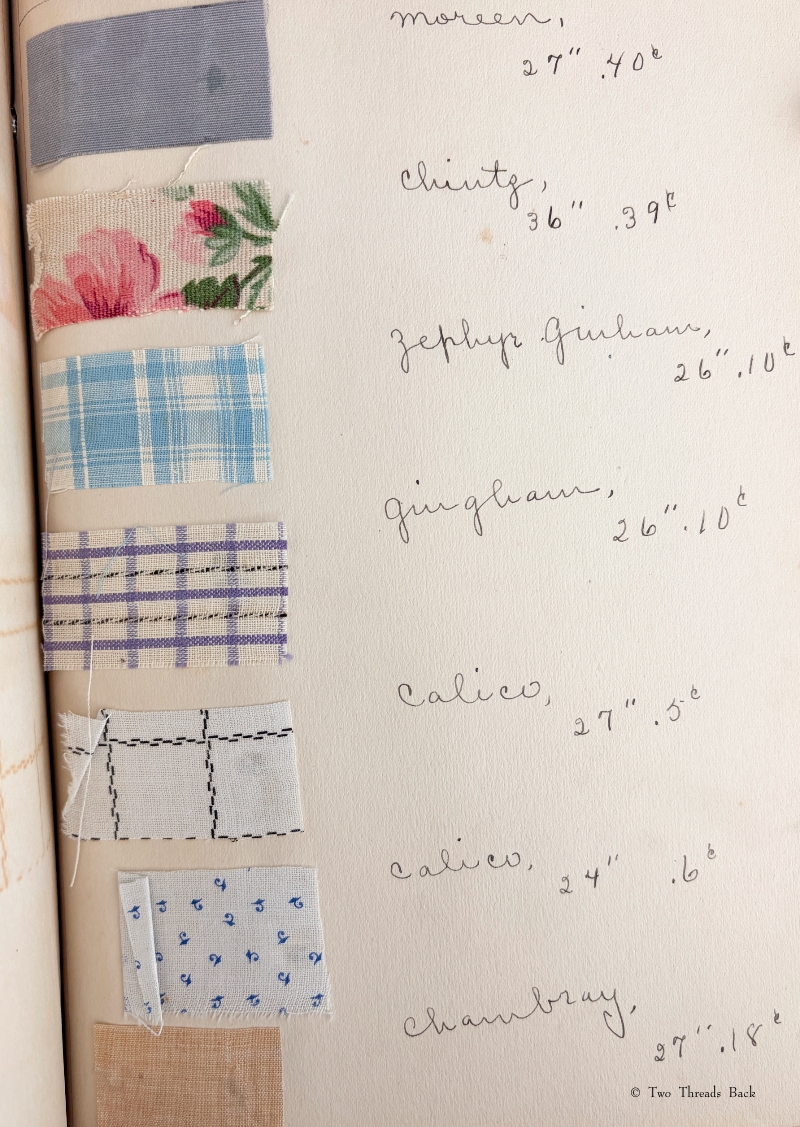
TEXTILES. Thrift was a virtue! Learning to make clothing economically was considered an important part of their education. Students needed to be familiar with fabric types and know which ones were appropriate for different garments. Truth in advertising could often be … well, elusive. And illusive. (For how to promote sales the right way, you can see some extravagant 1892 marketing here.) Textbooks practically encouraged suspicious shopping, and gave hints on how to distinguish good goods from bad goods. Both Eliza and Dorothy included swatches of fabrics in their books, a feature that became common after 1900.
Dorothy noted prices and purpose. Some of the fabrics are the same, or at least they go by the same name, today: georgette, shantung, taffeta.
I wonder if Dorothy was allowed to sew with any of these? I suspect not.
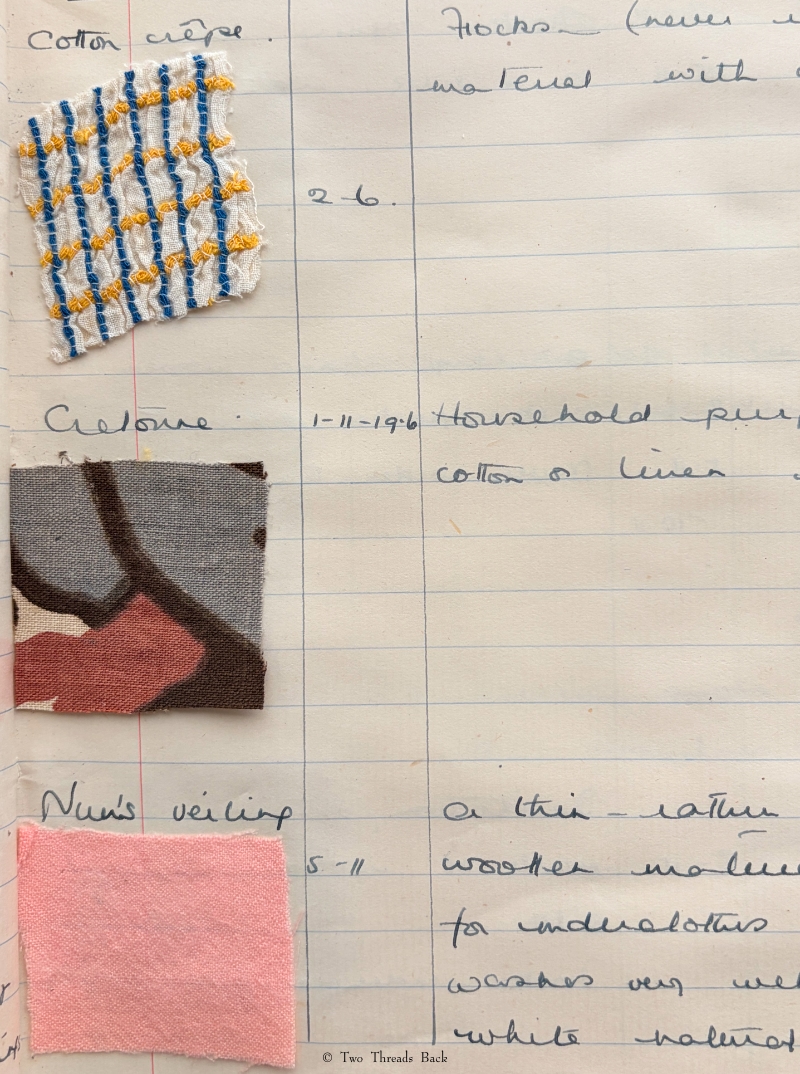
Eliza’s book has 3 pages of cottons, in addition to wool and silk!
The fabric samples are my favorite part of early 1900s-era sewing books. “Extinct” (or nearly) names appear in catalogs, journals, and books from those days, and while research and historians provide helpful descriptions, there’s nothing quite like seeing and touching a tiny bit of the textile for myself. Tarantulle is longcloth – who knew? Not me. A dictionary defines nun’s veiling, and yes, you can still buy it today (I checked), but it’s so much more fun to see a pink snippet from 1915. Textbooks tell me that albatross was wool, but Eliza had a nice cotton specimen. I can’t imagine asking for albatross at a fabric shop today! Well, if there were any fabric shops left today. There aren’t any near me. Maybe they’re still in Kansas?
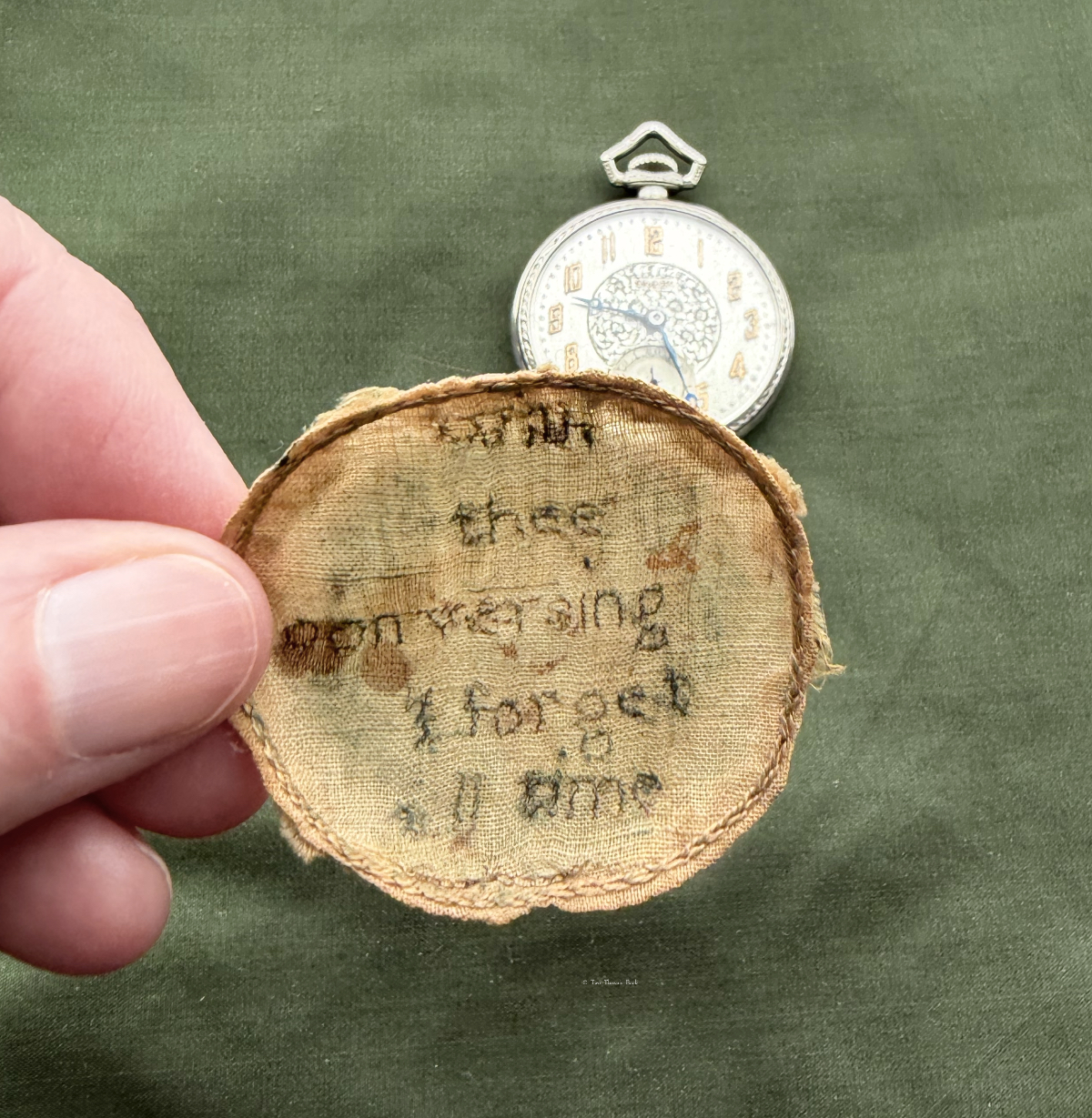
Plain sewing often taxed the eyesight and dexterity of a seamstress and many of the examples I’ve shown used mind-bogglingly small stitches. They certainly boggled mine, anyway! Such microscopic work wasn’t limited to practical garments and household linen; it could also be used to make a sentimental token for someone special. The “watchpaper” above (which is obviously not paper) is an example.
A watch was quite a luxury until the 18th century, but by the end of that era they were more common, although still greatly valued. It was customary to protect the delicate workings inside with little circles of paper that could be printed with a variety of pretty or amusing things such as portraits of famous people, landmarks, poetry, or even advertising for the maker. And of course, they gave ladies the perfect opportunity for artistic expression. Now highly collectible, some papers were painted, or perhaps inscribed with elegant calligraphy while others were… drumroll… made to show off needlework!
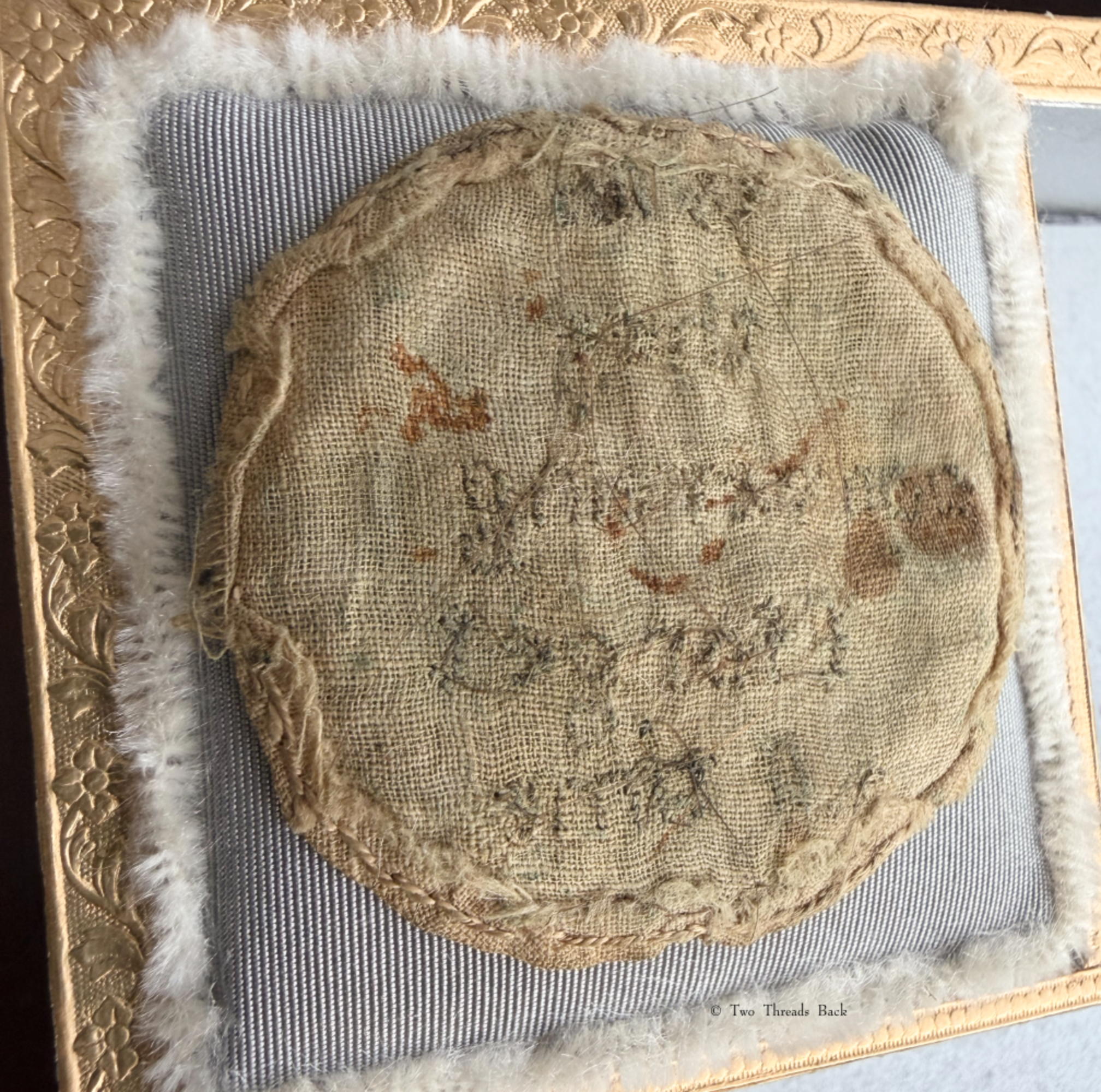
Watchpapers could be embroidered, made of lace, or use simple stitches such as cross-stitch (marking) to convey affection or good wishes. I’m not sure what kind has been used to make the one above since it’s so small and time has taken a toll. What I find most touching is that the maker who stitched
“With thee conversing I forget all time”
has woven the silk thread with her (?) his (?) hair for the embroidery! If you are a bit ambivalent about the “hairwork” or preserved locks found in old jewelry or albums, I understand. But I think the eeriness is part of its appeal, a personal touch through time that makes the past real.
I like the idea of making one of these myself. It would be utterly useless since I haven’t got a watch for it. It would create eyestrain to the point of a headache. But it would only require scraps of material and a little bit of time – my kind of project!
PS You’ll find more on the history of these tiny treasures online, and lots of pretty ones to see (Pinterest or auction sites) if they catch your fancy. PPS This one will be available on my Etsy site soon, as I continue uncollecting!
“About 1849.” Except for the owner’s name, that’s really all I know about the history of this particular little sewing album. It’s bound with marbled paper card stock, edged with silk ribbon, and the colorful pages have the feel (and unfortunately the quality!) of children’s construction paper. Written inside the front cover is “made about 1849 by Mary M. Quiston, later Mrs. Reid, later Mrs. Porter.” (The “M. Quiston” might be “McQuiston.”)
Samplers of cross stitch (marking), embroidery, or darning skills have a long history in Britain, America, and Europe, but the popularity of books containing specimens of plain sewing stitches began in England in the 1810s. They were developed as part of the “monitorial” education system where pupils who had mastered a skill instructed the ones who were just learning it.
This system of “mutual education” was originally applied to basic reading, writing, and arithmetic, then to plain needlework since it was an essential part of female education. Understanding sewing instruction techniques was much easier if you had a small sample to see. Books with samples of hemming, stitching, seaming, marking, etc., were originally intended to help a teacher follow “the system” in her classroom, but also developed into treasured collections preserved by the girls who had worked them in order to demonstrate their accomplishments.
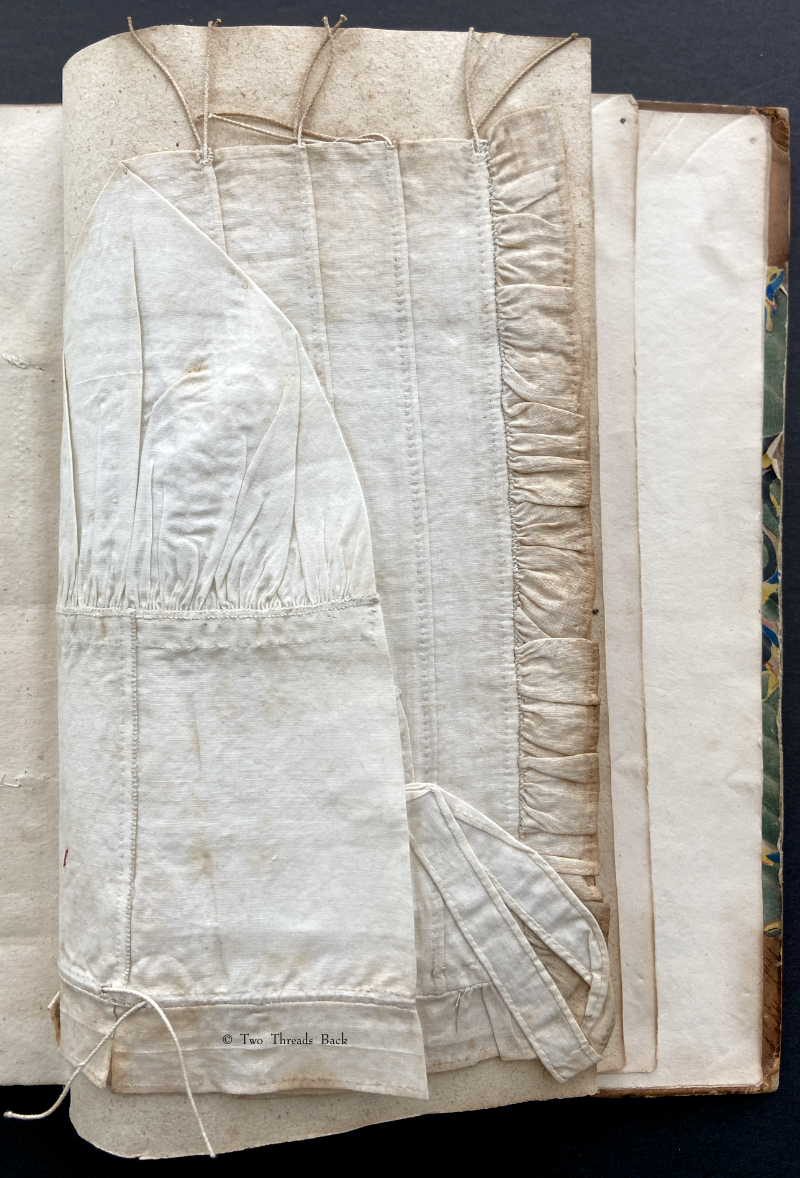
This is one of two caps included in the 1816 British and Foreign School Society manual, a book intended as a guide for educators who were using their monitorial system. It’s attached to the page so I can’t fold it out to show it well, but there’s a tiny number “1” marked in red cotton barely visible on the left. The other cap is marked (surprise!) “2.”
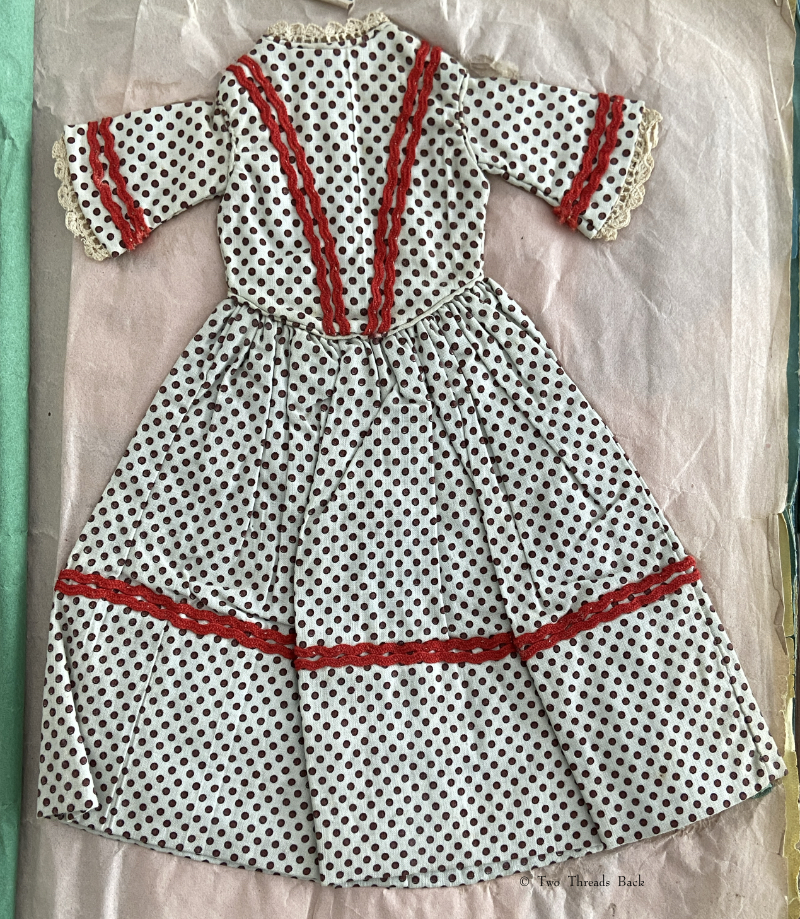
The earliest books might include a miniature shirt, cap, or apron, but it wasn’t long before they added other items like stockings, sleeves, dresses, trims, etc. to the classes. Educators appreciated the savings in time and expense that using small samples offered (and heaven knows charity schools needed to economize!) but maybe they had another reason as well: it was fun making tiny garments that were just like doll clothes! Here are some of my favorite pages from Mary’s book.
This dress is a simpler style than the sheer one above and it’s made of printed cotton.
Mary sewed this child’s dress with nine tucks in the skirt, gauged gathers, and trim she (probably) made herself.
We can’t forget the MOST important garment in the Plain Sewing repertoire: The Shirt. No course in plain sewing was complete without this accomplishment!
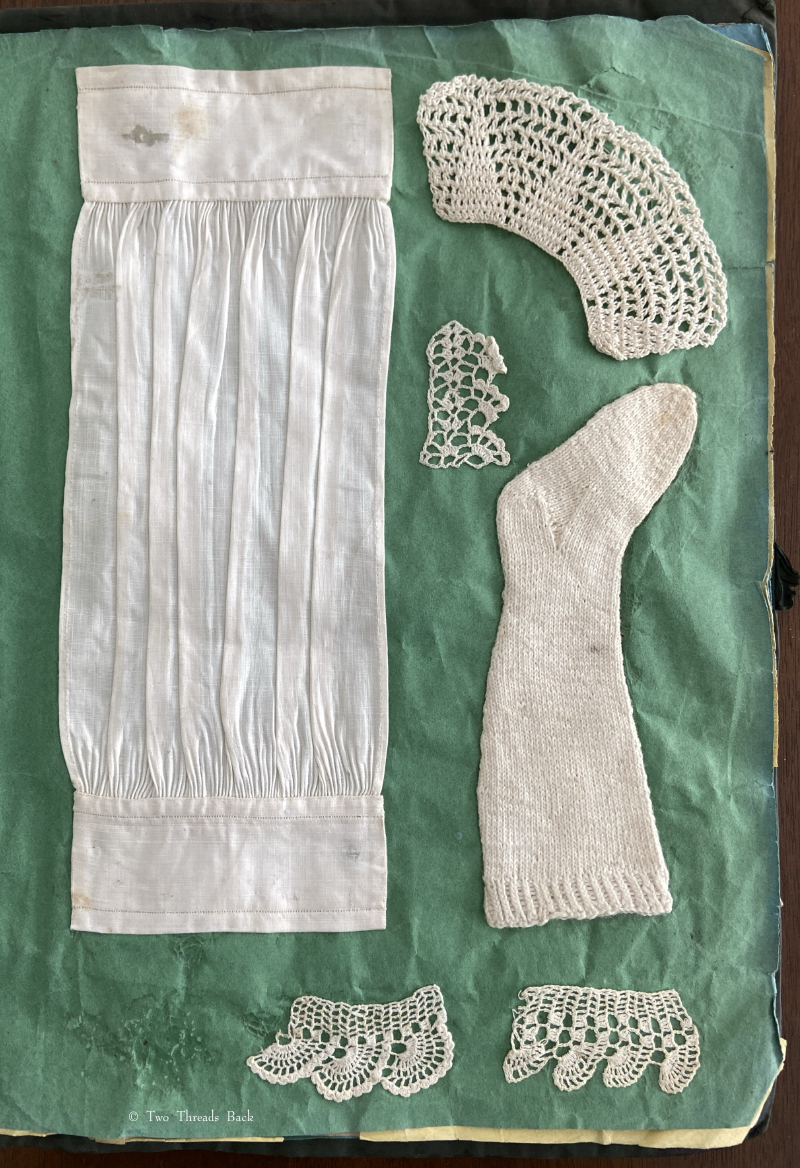
Here’s an example of the practice cuffs or wristbands that would have been worked before she advanced to making the above shirt. Knitting was also an essential needlework skill for women, and most 19th C sample albums included examples. There was a single full-sized stocking tucked into the book also.
Plain and fancy! Mary did all the hemming, seaming, and making buttonholes in her earliest lessons, but she obviously got to learn some fancywork as well. If you get a thrill looking at daguerreotypes of that time (Pinterest is sooo addictive) you might recognize the vandyke collar pattern that was so popular then.
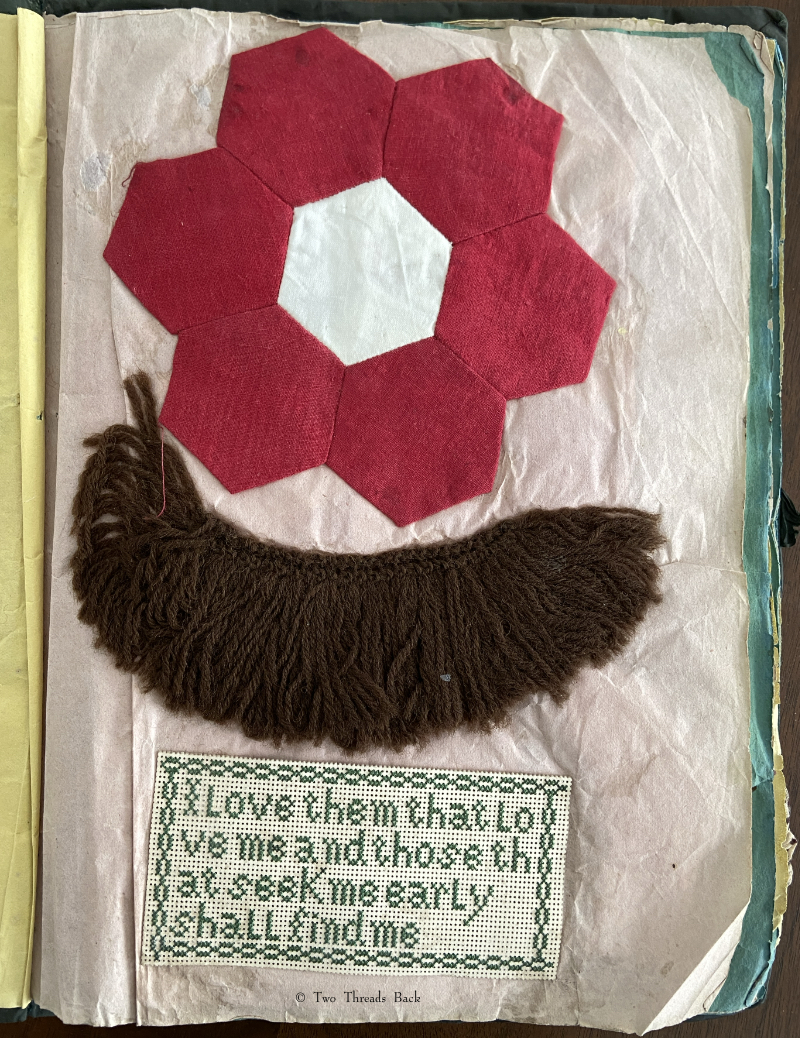
Nope, it’s not a walrus mustache. It’s some pretty (or not!) wool trim, useful for Victorians who didn’t know the meaning of restraint in decor. Mary also made a hexagon quilt patch and worked a scripture verse on punched paper. I don’t understand why 19th C needle workers seem so untroubled by words that run out of roo– m. Why???
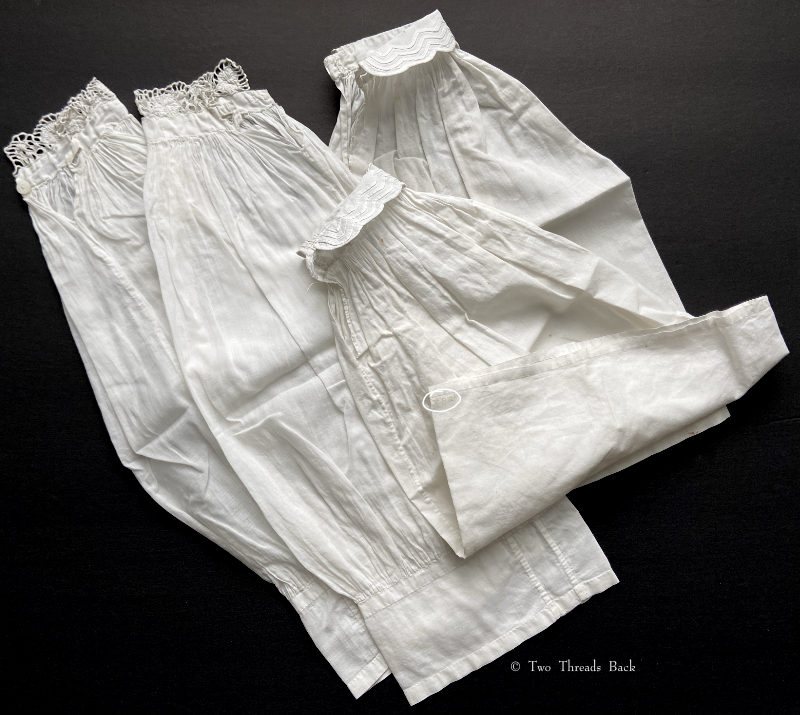
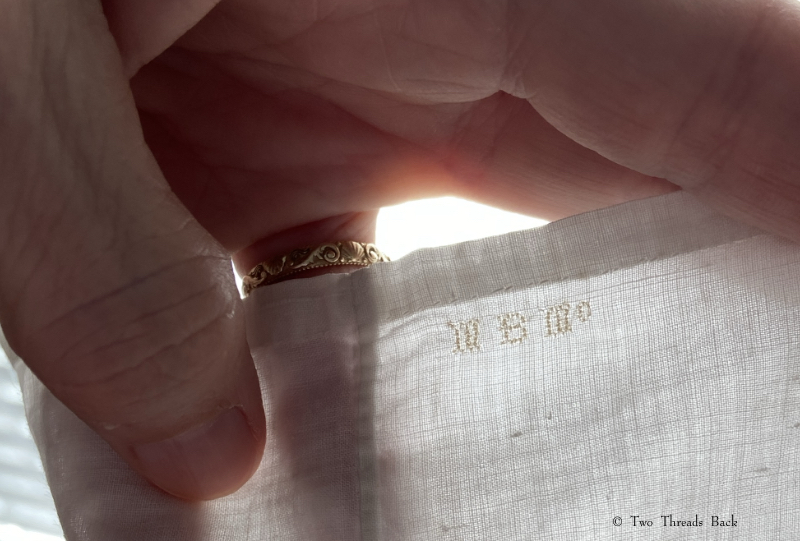
Two pairs of undersleeves were kept with the book. I assume they were Mary’s work because they have her initials marked in cross stitch. I’ve circled them in the photo to show how small they are. The sleeves show wear, so I don’t know if they were part of her sewing instruction or later work that stayed with her album.
The marked initials are less than 4mm tall. I never cease to be amazed at the tiny stitches they could make. The letters look like M B Mc to me. McQuiston?
I wish I knew more about Mary. How old was she when she learned to sew? Did she have daughters who wanted to take the dresses for their dolls? I would have! Did she use her skills for the rest of her life, or pack them away, back “around 1849”?
Library of Congress, Prints & Photographs Division, FSA/OWI Collection
My dear sister Fannie, As I have just dropped my scissors in the well, have no more sewing cut out, and can conscientiously spare the time, I will write you a few lines. Indeed I would have written you before this, but I have no time at all to do anything for myself. I’m teaching the boys from eight till time for doing my cooking. All of us are quite well, so are all Pa’s folks.
Pa has not settled down steadily to work since Ma’s death. Keeps us uneasy all the time. I have set no hens yet, but intend to raise a lot this year. What luck are you having with your chickens and geese this year?
Can your baby walk yet? Mine is beginning to talk, has eight teeth and four more in sight. He is not much trouble now, only he climbs and can go up the stairs a good deal faster than I can. With much love to yourself, Ben and the children, I am as ever, Yours affectionately, Mollie
1882 Letter to to Fannie Dudley in Florida from her sister in Georgia1
You can’t sew without scissors, right? Seems like a pretty good excuse to me! I haven’t been sewing much lately either, but I’ve managed to entertain a few leisure hours with good books. Here are some I’ve found so interesting that I thought I’d share.
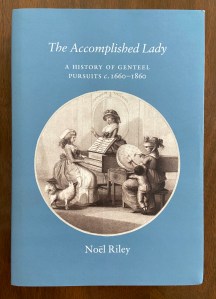
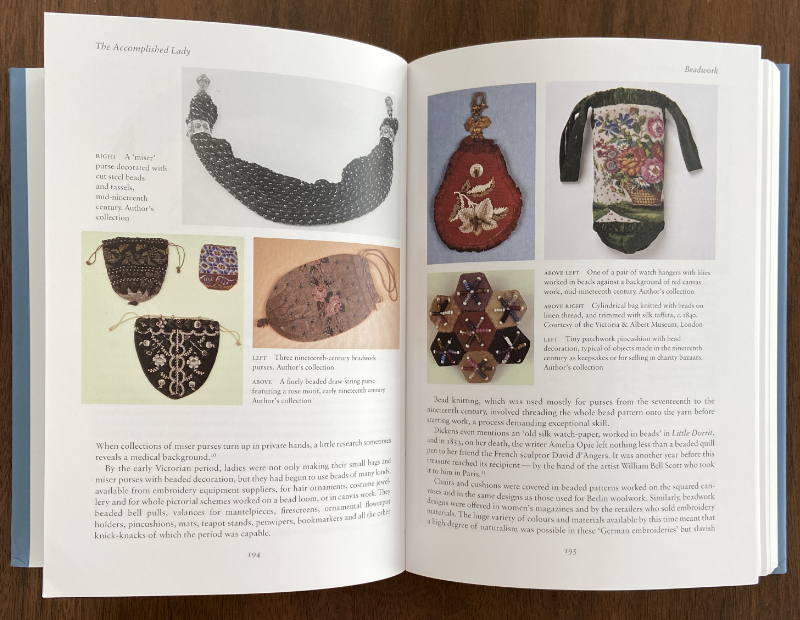
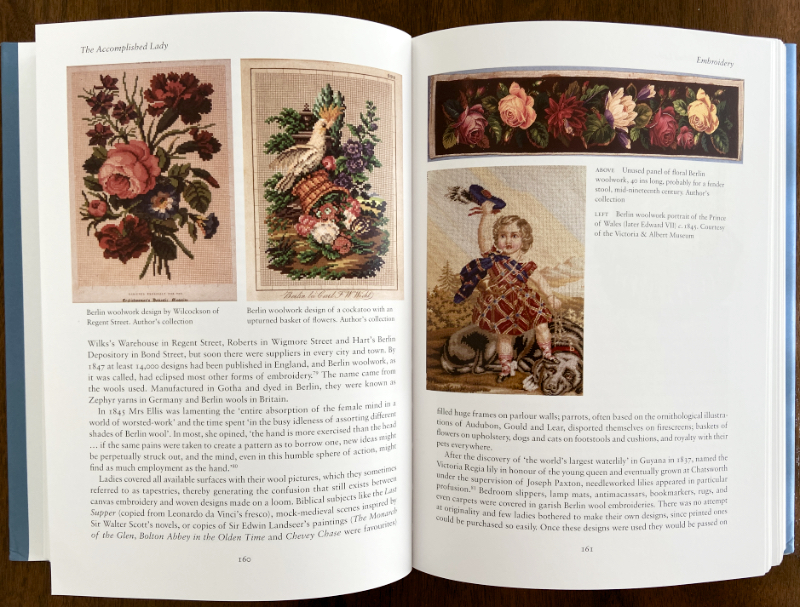
The Accomplished Lady, A History of Genteel Pursuits, c. 1660-1860 by Noël Riley is a guilty pleasure for this plain sewing enthusiast, since it’s far from plain. It’s a fabulous look at the 17th-19th century crafts, hobbies, and amusements that women who could afford leisure pastimes enjoyed. It covers the things you’d expect such as music, dancing, and cards, but I found the chapters on needlework, beadwork, shellwork and other nature crafts especially fascinating. Seaweed pictures, straw work, paper filigree… so many ways to exercise talent and display creativity! There’s even a bit on theorem or “poonah” painting. It’s beautifully illustrated – got to love the eye candy! – but the scholarly research which sets it all in context (without the tedious academese saturating so many similar works today – thank you, Ms. Riley!) makes it a valuable resource. The Accomplished Lady is definitely worth a book search or trip to the library!
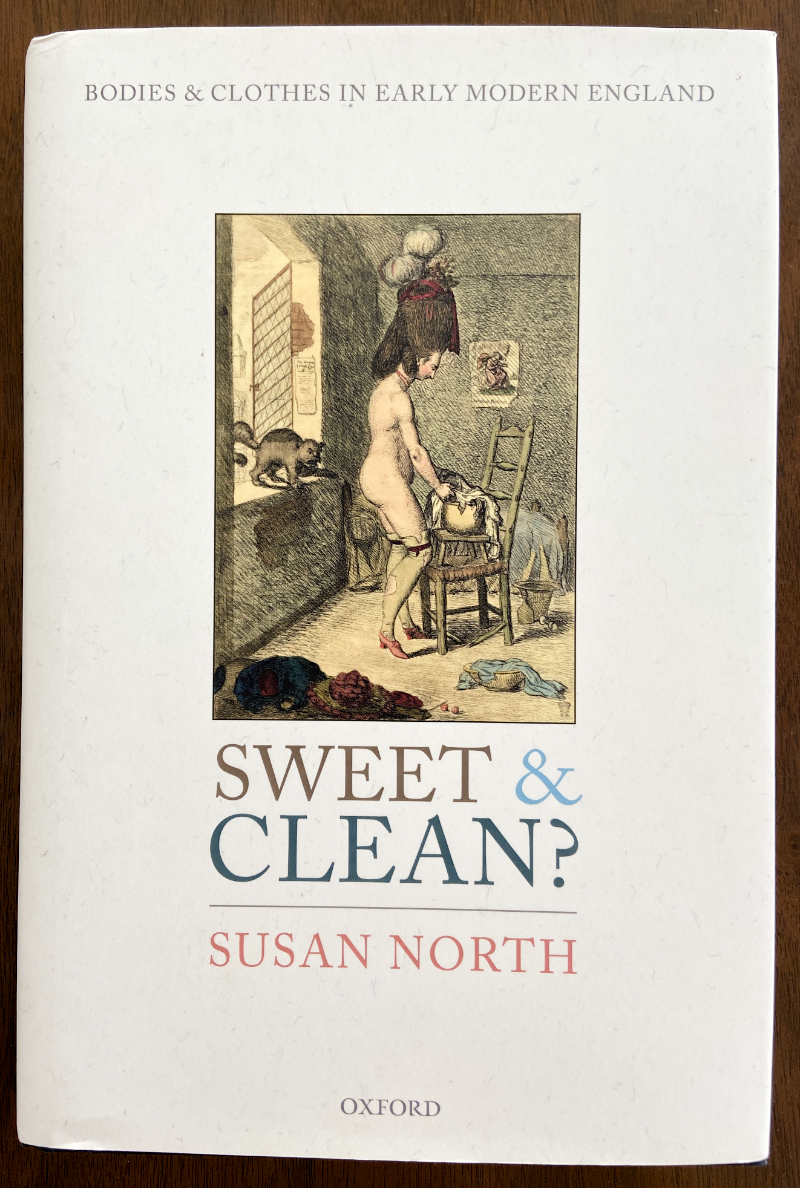
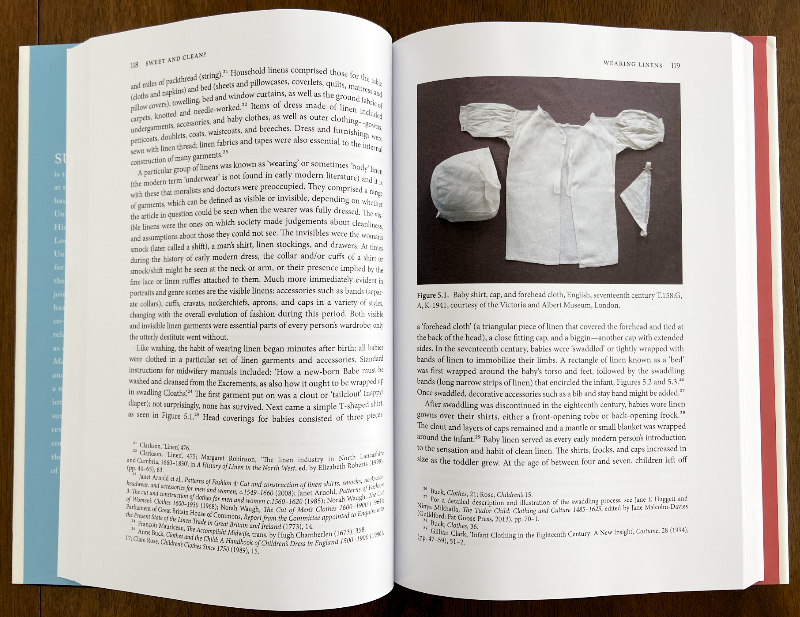
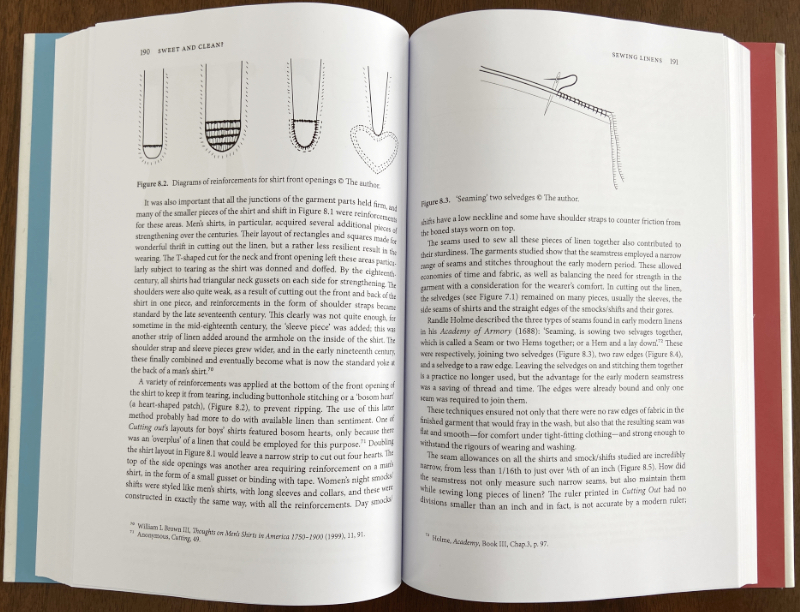
Another happy find is closer to my plain sewing focus. Sweet & Clean?, by Susan North. While the title is the topic, personal cleanliness in early modern England, there is a lot of information on the making, wearing, and washing of underlinen (shirts, shifts, etc.). That, of course, means plain sewing figures prominently!
The exhaustive research on the most private areas of daily life kept me engrossed through every chapter. If you have an interest in clothing, health, and domestic life during those years, you’ll find answers to questions you didn’t even know to ask. Sweet & Clean? might be overwhelming if you like to rush through historic site tours to get to the cafe. But if you’re someone who lingers and wants to explore behind all the closed doors, this one’s for you!
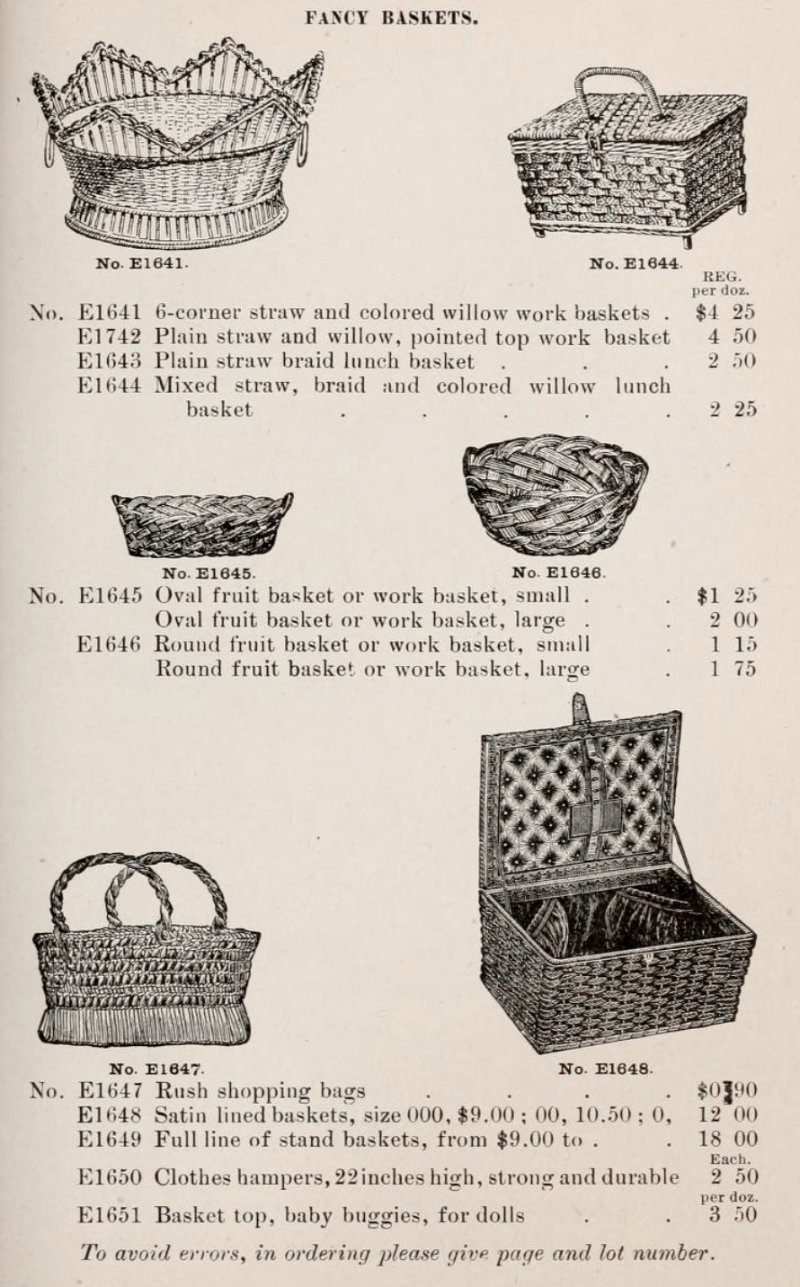
Not all my reading is print – books that are available online can be just as entertaining. Old catalogs are lots of fun to browse, and I’ve found that sewing time can dwindle because of them. Mollie’s lost scissors may have been much like these. Which, no surprise, actually look a lot like those in my sewing basket now. The image below is from Carson, Pirie, Scott & Co. Wholesale Drygoods Catalog, 1893. Have a look, it’s like shopping the past.
1893 wholesale catalog. Note the prices per dozen!
I have one like E1646 – and it’s not antique, just old!
Maybe when you can “conscientiously spare the time,” you will have as much fun reading as sewing. And if you have any good books to share, please do! It may be a while before I retrieve my scissors from the well.
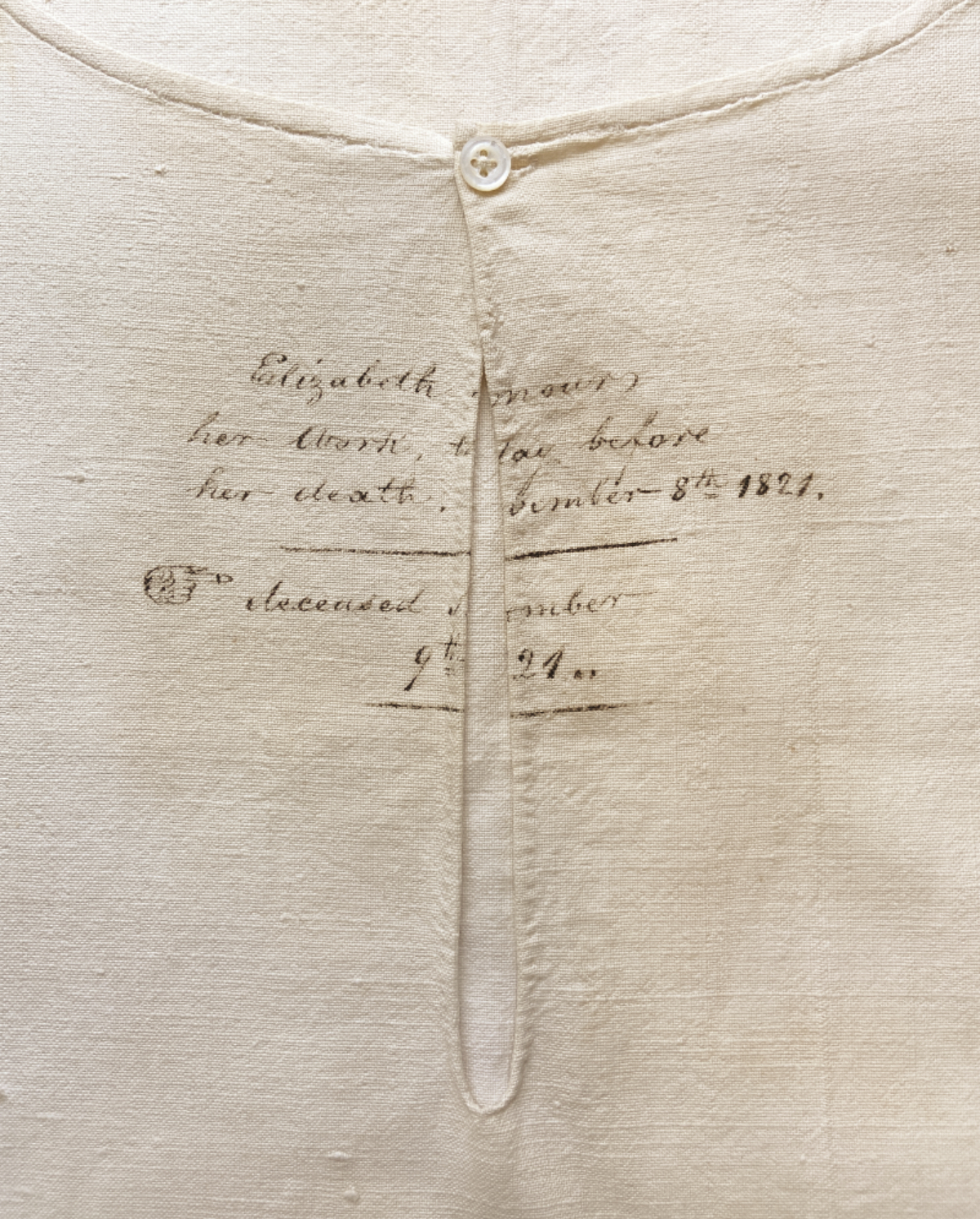
Elizabeth Armour, her work, the day before her death. November 8th, 1821. deceased November 9th, 1821.
Most of the time we never know who wore the antique clothing that we preserve and study, much less who made it and when. So it’s thrilling to find a piece with a story that connects us to a life lived long ago. Her name makes her real.
Shifts and chemises follow closely behind men’s shirts as prime examples of plain sewing. This rare linen shift has its provenance inscribed in ink across the heart. Not only does it give the name of the maker, Elizabeth Armour, but it tells when she made it, November 8, 1821, and when she died – the next day.
Occasionally notes are found attached to clothing, usually intended for family members to pass down, or perhaps when donated to museums. But I’d never seen one quite like this! How could I help but try to find out more about Elizabeth?
Elizabeth Armour’s plain shift, still in excellent condition.
Thanks to the wealth of genealogical data available online now, it was easy to search for a woman with that name and date of death. What a thrill to find her! Of course, I can’t be positive it’s the same person, but the odds seem pretty good.
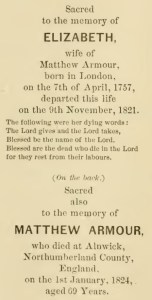
Transcript of Elizabeth’s gravestone.
Elizabeth, wife of Matthew Armour, was born in London on April 7, 1757, and died on November 9th, 1821 in Philadelphia. She was buried there in Christ Church and St. Peter’s Churchyard on November 11, 1821. Her name was entered in the register of burials as “Eliza. Armor.” I don’t know whether the gravestone still exists, but at least a record of it does:
The following were her dying words: The Lord gives and the Lord takes, Blessed be the name of the Lord. Blessed are the dead who die in the Lord for they rest from their labours.
Who was Elizabeth and what was her life like? I found traces. Elizabeth Nesbet married Matthew Armour in the City of London at the church of St. Andrew Holborn on July 2, 1780. She next appeared as the mother of Susannah Nesbitt Armour who was christened at Christ Church and St. Peter’s in Philadelphia on July 3, 1785.
Wait, Philadelphia? 1785? It bargles (as my daughter used to say) the mind! More American history than I can even begin to explore. I suppose there are so many books, essays, and dissertations written on that place and time that they would collectively collapse my little local library. Even the church the Armours attended has a past so rich it makes me dizzy. Benjamin Franklin, George Washington, Betsy Ross, and many of the signers of the Declaration of Independence attended, all during the years the Armours were worshiping there as well.
In 1788, son William was born. Matthew appears on various records during those years as a house carpenter. If there were other children besides Susan and William, I didn’t find a record of them. We know the hazards of illness and accidents in those days, but in 1793 a yellow fever epidemic (here’s a compelling read) struck Philadelphia killing 5,000 of the 45,000 residents, and caused another 17,000 to abandon the city. It struck again in 1797, ’98, and ’99. Did it touch the Armours or their kin? I doubt I’ll ever know.
Matthew continues to appear in the early 1800s on tax, census, or manifest records (he made trips to England) as a carpenter. The family moved several times within the city through the years, and siblings Susan (as she was known) and William apparently never married, but kept house together and owned a dry goods store. In an 1811 affadavit sworn as a super cargo, William (at age 22) states he was 5’9″, fair complexion, blue eyes, with 3 scars on his left forefinger! There’s something eerie about knowing 200-year-old personal details like that. But perhaps no more than slipping my hand in the sleeve of Elizabeth’s chemise?
Elizabeth may have been ailing by 1821, since the cause of death was “dropsy.” We know what she was doing in the days before her death because of the inscription on her shift. More poignantly, we know how much her handwork meant to someone, probably her daughter Susan. I understand how that feels; I have handmade treasures from my late parents that move me to tears when I hold them.
Philadelphia, Nov. 9th, 1821 Died this day of Dropsy Elizabeth Armour aged 64 years.
Matthew returned to England sometime after Elizabeth’s death, where he died at Alnwick on January 1, 1824, aged 69. In 1830, Susan and William’s cousin, Martha Cheesman (b.1818), came from England to live with them in Philadelphia. William died in 1851, and Susan in 1857. She left an estate of $15,000 with bequests to Christ Church Hospital, the Northern Home for Friendless Children, her nieces, and the remainder to her “cousin Martha Cheeseman.” That was a lot of money for the time. It seems that the dry goods business was very profitable! I was getting a little lost and weary of genealogical research at this point, so I let the trail end with cousin Martha’s death in 1906. Perhaps the shift had been left in her care?
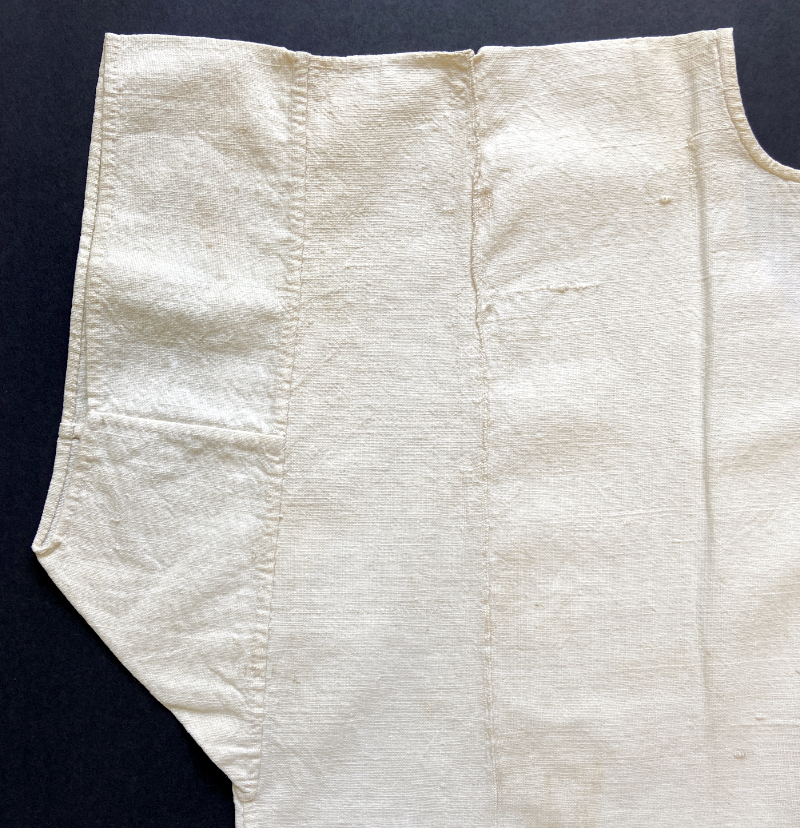
The shift is very simple. The linen is homespun and sewn with linen thread. The economic impact of the War of 1812 and then the Panic of 1819 meant times were still hard, so perhaps homespun was a necessity. The stitching is neat and even, but not particularly fine. The fabric was of insufficient width and so another piece was seamed to it to make the full width of the body, and then folded at the shoulder.
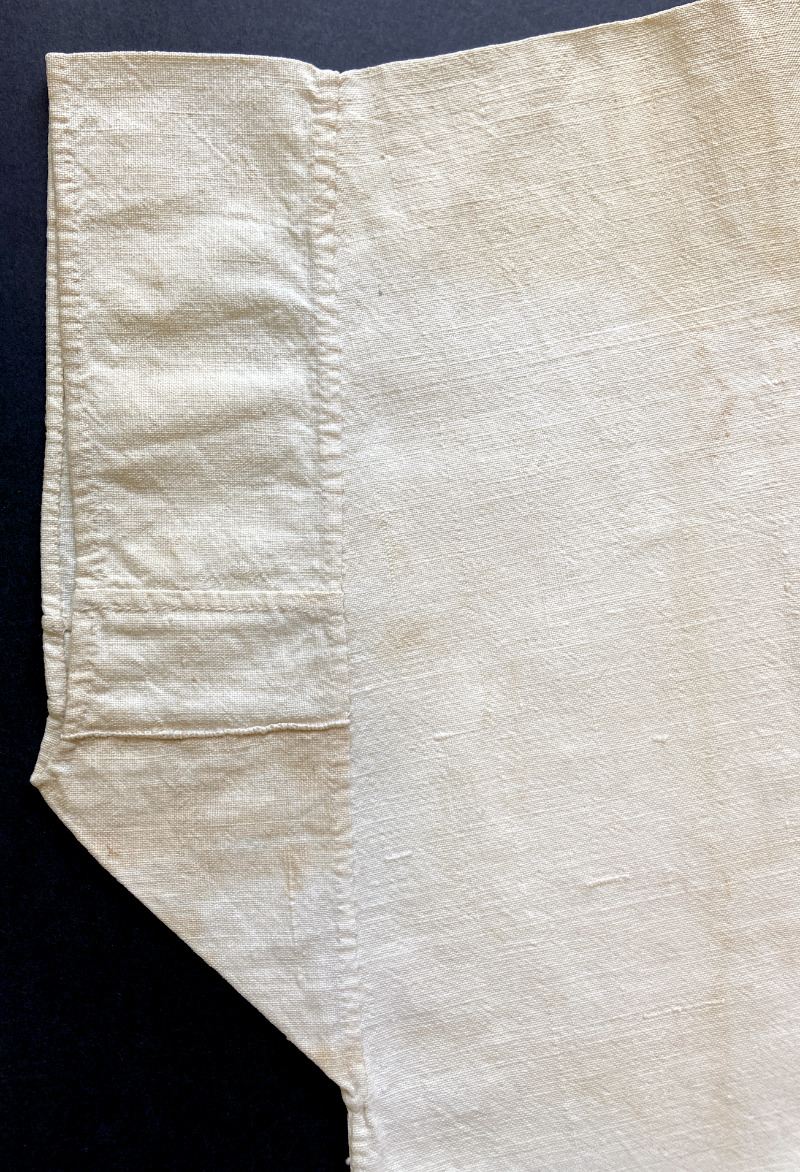
Left sleeve viewed from the back. You can also see the seamed join where fabric was added to a selvedge to make it wide enough.
The sleeves are short, and the right one is pieced. There are gussets under the arms with a small curve at the bottom. It angles slightly wider toward the hem, but has no gores. The seamed join was sewn from the outside, and because the materials were a bit coarse and the stitches a bit deep, it makes a slight ridge. I can see why it’s positioned on the outside, since it would be rather uncomfortable against the body. The inscription was made before the slit was cut for the opening, because the writing is folded under where it’s hemmed. I don’t know if Elizabeth made the shift for herself, her daughter, or a servant, but it could be considered a “comfortable” size more than a petite one.
The right sleeve is pieced, using every scrap of fabric. The left one is whole.
A view of the narrow hem and join. You can see how she “seamed” (narrow overcasting) with wrong sides together. It should make a flat, nearly invisible seam, but the linen and thread are coarse and she took the stitches rather deep.
Elizabeth Armour, maker of the shift, lived from 1757 until 1821 in England and America, through the years of the founding of the United States in a city where the most radical historical events were occurring. And what serendipity! She was there when JOSEPH LANCASTER was living (briefly) in Philadelphia! She learned plain sewing in 18th century England, and was able to make a thrifty shift of homespun linen using a minimum of fabric, in the “old” fashion – just as styles were about to change from “shifts to chemises.”
The majority plain needlework I’ve seen (or drooled over) through the years, whether manuals, samplers, or items of clothing, has been from England, and the rest from here in the U.S. It’s truly remarkable to find “threads” from England, America, world-changing history, endearing family sentiment, Joseph Lancaster, and plain needlework all sewn together with a story in this shift. I’m awed.
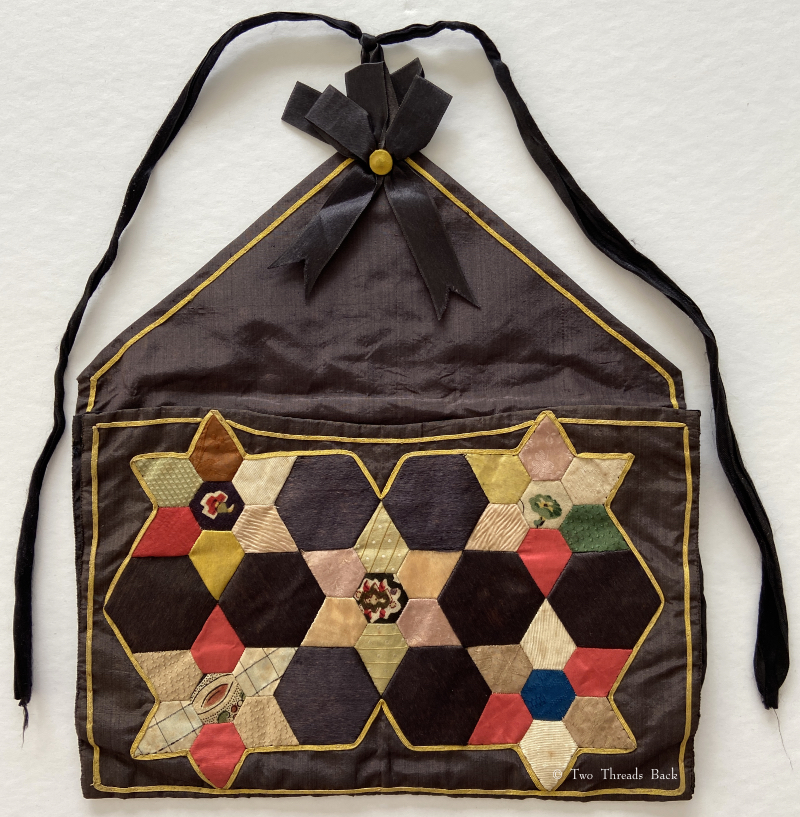
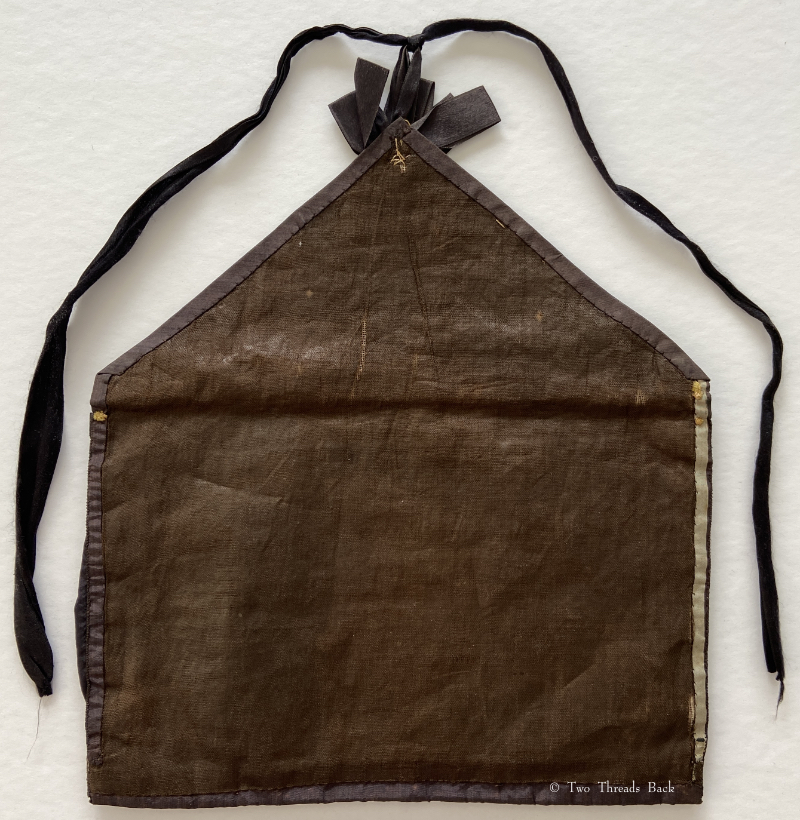
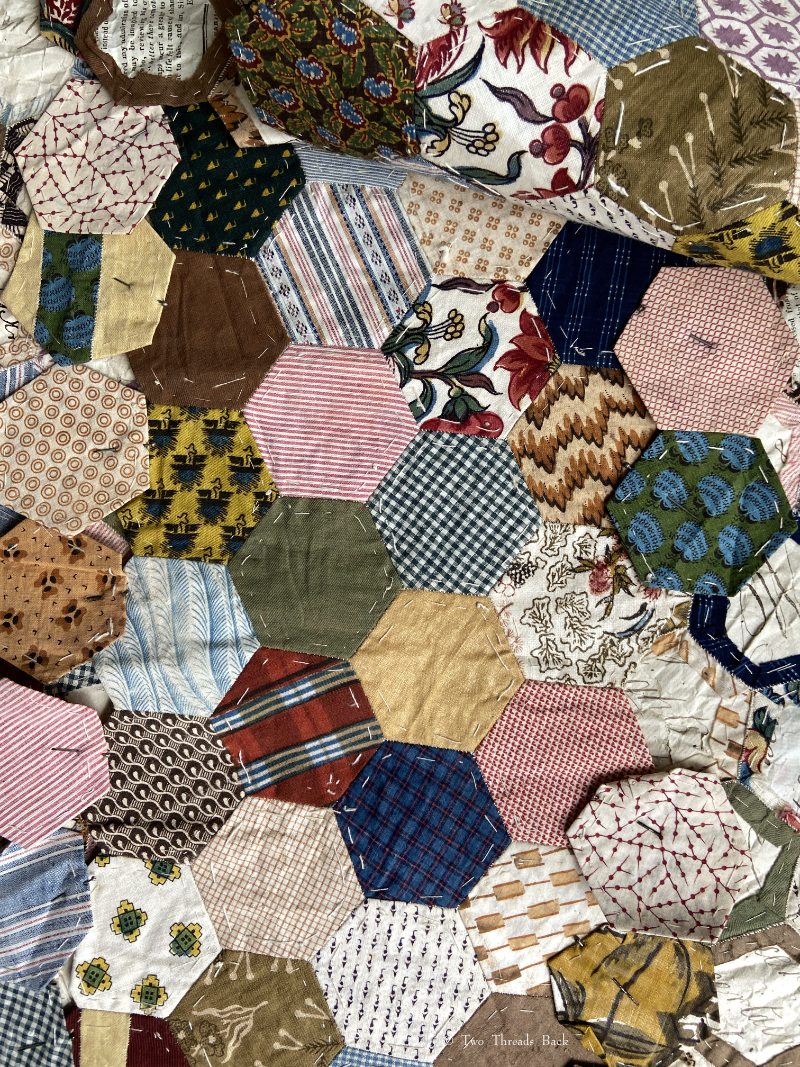
Patchwork projects, c1820. English paper piecing: an elegant silk “pocket” or case – perhaps for letters or needlework? – resting on unfinished panels of utilitarian cotton remnants (more pics below).
Patchwork quilting has earned a lofty place among the textile arts today, but 200 years ago a few writers felt inclined to poke fun at it. I was happily following rabbit trails, chasing plain sewing nuggets, when I came across some entertaining words on patchwork. A sketch written in 1821 found fault with the work AND the worker:
PATCH-WORK.
I have an old female cousin, who has passed a quarter of a century in rags, or rather amidst patches, destined to a most marvellous arrangement, for the furniture of a suite of apartments–a saloon, a boudoir, and a bed chamber. She began her paltry collection by begging of all her acquaintance, and wearing out every one by messages, notes, and applications for odd bits and patterns [i.e., printed fabrics].
She also told two score of lies, in order to obtain samples of different linen-drapers, but upon a very unwelcome observation of mine, she changed her operations.
Asking me one day if I did not think that the window curtains, ottomans, sopha-covers, et cætera, of her bow-windowed saloon would have a very novel, tasteful, and fantastic appearance, if composed of patch work judiciously arranged and bordered by a vandyke pattern worked by herself? I replied, “that the best patch-work which I ever saw had but a beggarly appearance, and that it would take her half her life, and lose her half her acquaintance, to collect the materials; that I always looked upon a patch-work curtain, or quilt to be fit only for a servant’s bed at an inn; that it was a complete make-shift, nay, that if she would make shifts for herself, or for the poor, she would be much more laudably employed. For I consider this patch-working something like lady-shoemaker’s work, below the dignity of the performer, and of little use when done.
All my observations would inevitably have been disregarded, for my cousin Cassandra is like many other old maids–she constantly asks advice with a predetermination to take her own way, but the term beggarly hurt her pride, and the thought of loss of company, to one who could not live without a morning gossip, and an evening casino, was very alarming; so she determined on buying remnants and small pieces of a thousand patterns; and in the long period above mentioned, she completed her patch-work hangings and furniture, which every one praised before her face, and treated with contempt behind her back. This chef-d’oeuvre of useless toil, was, however, shown to all her acquaintance, and furnished the subject of a hundred morning and tea-table conversations. –The Hermit in London, 1821
Well, that was pretty harsh! And I daresay a few million quilters today would agree. I’d rather he’d directed the fun toward installation art, but oddly enough it wasn’t around then. Satire could be brutal back in those insensitive days, and of course anything that hinted of vulgarity (patches!) was fair game. Knowing that the author was writing to entertain made me think perhaps it was a one-off, and the prevailing attitude was more favorable.
However, Lydia Maria Child (not one for tepid opinions), author of the Girl’s Own Book, was rather condescending as well when she said “we do not want young ladies to emulate their grandmothers in making patch-work quilts, or covering their apartments with hexagon- or octagon-starred carpets,” although in an earlier edition she admitted it to be a tolerable alternative to boredom:
PATCH-WORK. This is old-fashioned too; and I must allow it is very silly to tear up large pieces of cloth, for the sake of sewing them together again. But little girls often have a great many small bits of cloth, and large remnants of time, which they don’t know what to do with; and I think it is better for them to make cradle-quilts for their dolls, or their baby brothers, than to be standing round, wishing they had something to do. The pieces are arranged in a great variety of forms; squares, diamonds, stars, blocks, octagon pieces placed in circles, &c. A little girl should examine whatever kind she wishes to imitate, and cut a paper pattern, with great care and exactness. –The Girl’s Own Book, 1833
Perhaps she had a point about tearing cloth just to sew it back together! But to balance out the disparaging remarks, I found a sweet essay about a patchwork quilt written in 1845 –and it mentions PLAIN SEWING! True, the author ranks a beloved patchwork quilt below a snowy counterpane, but the following excerpt glows with the warmest nostalgia. (Other textile historians have referenced it, but here’s a link to the original if you’d like to read the whole piece without my edits for brevity.)
THE PATCHWORK QUILT.
There it is! in the inner sanctum of my “old-maid’s hall”–as cosy a little room as any lady need wish to see attached to her boudoir….
Yes, there is the Patchwork Quilt! looking to the uninterested observer like a miscellaneous collection of odd bits and ends of calico, but to me it is a precious reliquary of past treasures…. Gentle Friends! it contains a piece of each of my childhood’s calico gowns, and of my mother’s and sisters’; and that is not all.
I learned of the world’s generosity in rewarding the efforts of the industrious and enterprising…. What predictions that I should be a noted sempstress; that I should soon be able to make shirts for my father, sheets for my mother…. What legends were told me of little girls who had learned patchwork at three years of age, and could put a shirt together at six. What magical words were gusset, felling, button-hole stitch, and so forth, each a Sesame, opening into an arcana of workmanship… and a host of magical beauties!
Here is a piece of the first dress I ever saw, cut with what were called “mutton-leg” sleeves. Here, too, is a remnant of the first “bishop sleeve” my mother wore; and here is a fragment of the first gown that was ever cut for me with a bodice waist… and, oh, down in this corner a piece of that in which I first felt myself a woman- that is, when I first discarded pantalettes.
Here is a fragment of the beautiful gingham of which I had so scanty a pattern, and thus taxed my dress-maker’s wits; and here a piece of that of which mother and all my sisters had one with me. Here is a piece of that mourning dress in which I thought my mother looked so graceful; and here one of that which should have been warranted “not to wash,” or to wash all white. Here is a fragment of the pink apron which was pointed all around. Here is a token of kindness in the shape of a square of the old brocade-looking calico, presented by a venerable friend; and here a piece given by the naughty little girl with whom I broke friendship, and then wished to take it out of its place…. Here is a fragment of the first dress which baby brother wore when he left off long clothes; and here are relics of the long clothes themselves. Here a piece of that pink gingham frock so splendidly decked with pearl buttons. Here is a piece of that calico which so admirably imitated vesting, economical, bought to make “waistcoats” for the boys. Here are pieces of that to set off my quilt with, and bought strips of it by the cent’s worth – strips more in accordance with the good dealer’s benevolence than her usual price for the calico. Here is a piece of the first dress which was earned by my own exertions! And here are patterns presented by kind friends, and illustrative of their tastes.
Then there was another era in the history of my quilt. My sister–three years younger than myself–was in want of patchwork, while mine lay undisturbed. Yes, she was to be married; and I not spoken for! I gave her the patchwork.
Then came the quilting, a party not soon to be forgotten, with its jokes and merriment. Here is the memento of a mischievous brother, who was determined to assist otherwise than rolling up the quilt as it was finished, snapping the chalk-line, passing thread, wax and scissors, and shaking hands across the quilt for all girls with short arms. He must take the needle and thread. Well, we gave him white thread, and appointed him to a very dark piece of calico, so that we might pick it out the easier; but to spite us, he did it so nicely that it still remains, a memento of his skill with the needle.
And why did the young bride exchange her snowy counterpane for the patchwork quilt? These dark stains at the top of it will tell–stains left by the night medicines, taken in silence and darkness. The patchwork quilt rose and fell with the heavings of her breast as she sighed over the departing joys of life. Through the bridal chamber rang the knell-like cough which told us that we must prepare her for an early grave. The patchwork quilt shrouded her wasted form as she sweetly resigned herself to the arms of Death.
And back to me, with all its memories of childhood, youth, and maturer years; its associations of joy, and sorrow; of smiles and tears; of life and death, has returned to me The Patchwork Quilt. The Lowell Offering, 1845
Did you notice the reference to plain sewing? And making shirts? She’s singing my favorite song! An “arcana of workmanship.” Now there’s a title for a future post. Of course I don’t really think most people disparaged patchwork. There are too many survivors that show just how artistic, skillfully worked, and beloved pieced fabric was. I probably admire it more than most because I have no “pattern sense,” I can’t work with measures, shapes, design layout without a mental meltdown.
I’m happy simply to share the sentiments of the “Old Maid” above whose patchwork looked
to the uninterested observer like a miscellaneous collection of odd bits and ends of calico, but to me it is a precious reliquary of past treasures; a storehouse of valuables, almost destitute of intrinsic worth; a herbarium of withered flowers; a bound volume of hieroglyphics, each of which is a key to some painful or pleasant remembrance, a symbol of—but, ah, I am poetizing and spiritualizing over my ” patchwork quilt.”
The points of the stars are all silk, and the centers are linen.
The back is made of brown glazed linen, and the stripe on the edge is a selvedge on the silk binding.
It’s made to allow room to for holding contents (whatever they might have been!), and the decorative button is handmade of silk over a wire ring.
More of the unfinished panels. You can see closeups of the patches in the Flower Patch posts.