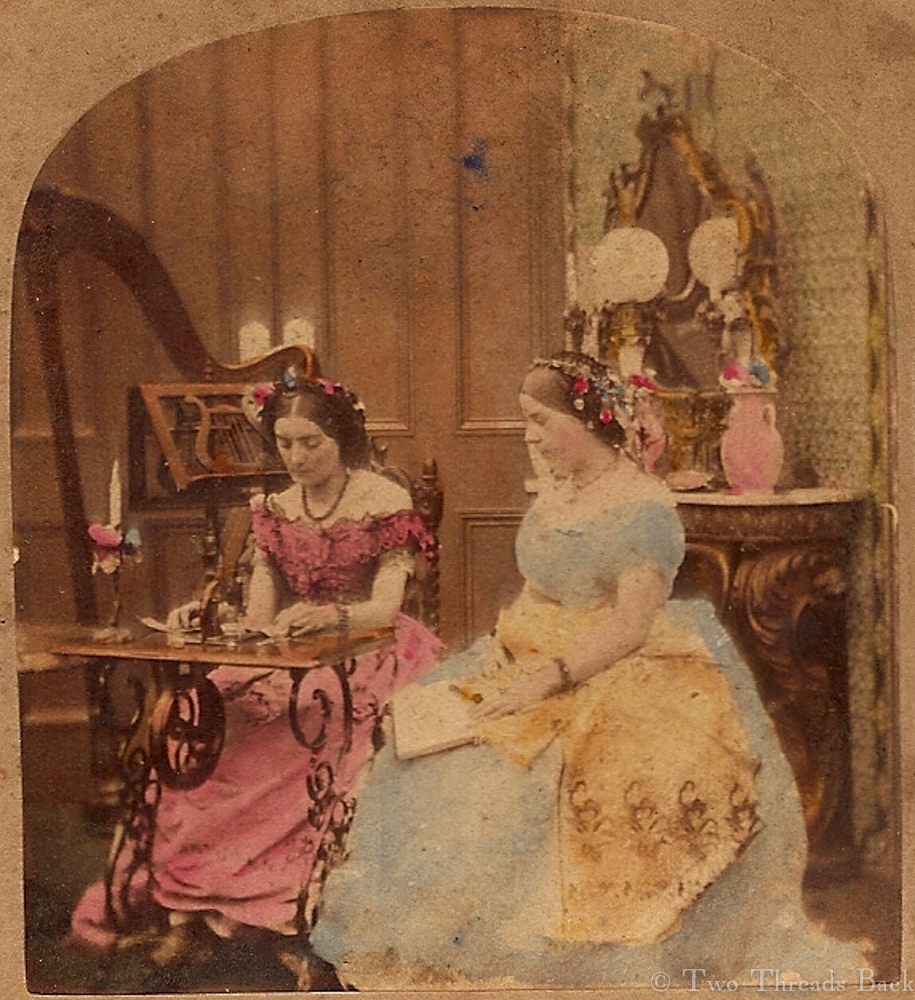
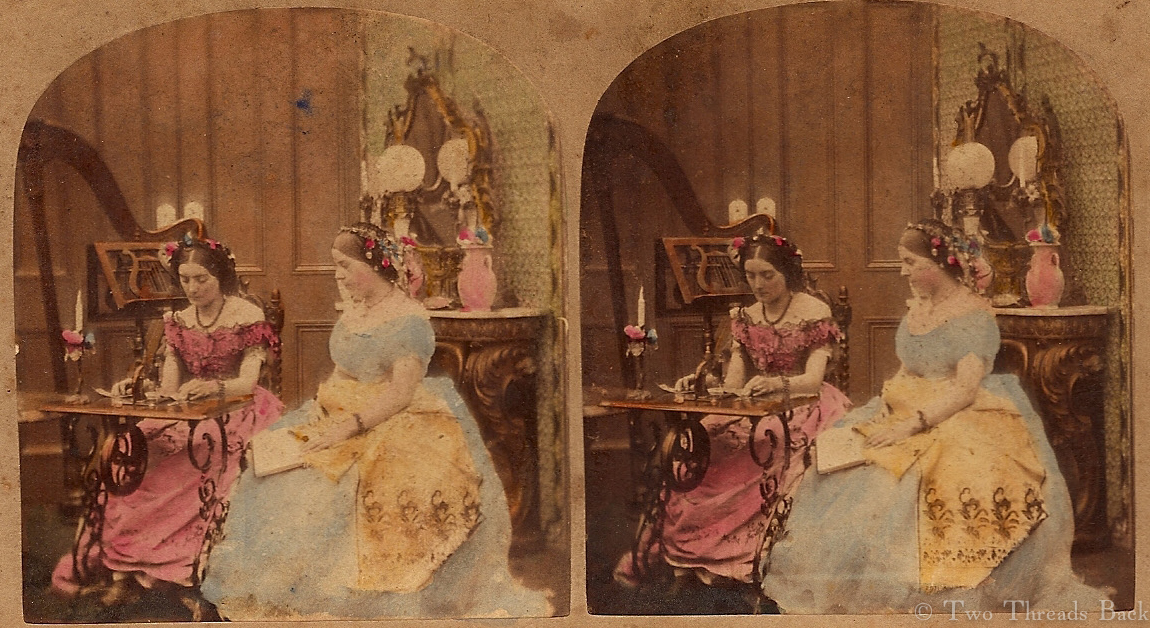
Except the parlor, perhaps? Well, it’s identified on the back as the boudoir, but the meaning of words changes according to time, place, and whim, so we’ll accept her terms. This is a charming stereoview image of two circa 1860s ladies in full dinner dress, sitting down to play with their new sewing machine.
I can’t identify the machine, but I see the seamstress has a music stand and harp close to hand, just in case she wearies of needlework. And a friend with a manual close by to instruct and advise. (Ok, it’s not a manual – what could it be?) A picture-perfect postprandial occupation while the gentlemen are smoking: a lamp, vases of flowers, elegant furnishings, and a congenial companion – what more could you ask?
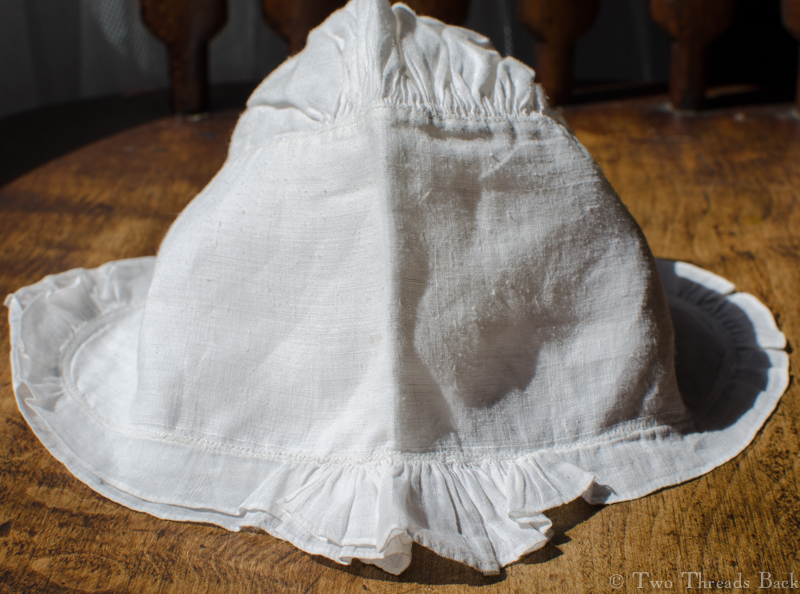
This little cap is a favorite. Yes, the linen is coarser than the lovely smooth cambric in most of the other really old baby things I’ve found. The slubs are noticeable, and they show even more due to washing and wearing. But there’s just something about that little ruffle around the brim. And the extra gathers right in the center – can’t you just see them sticking up, stiff with starch? Rather like a little plume or crest!
A perfect frame for a baby’s face.
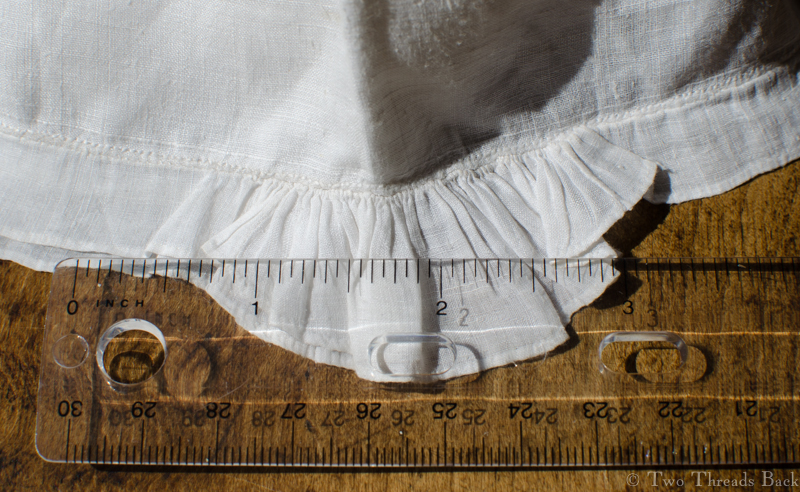
The measurement around the brim, including the ruffle, is about 12 inches; the center front to the back is about 9 inches.
Baby’s cap with the two-part brim folded open.
It seems like every time I examine a garment to write about it or list it for sale, I find something I’d overlooked before. And sometimes it’s unusual, a feature I haven’t seen before. That happened here, too.
The little crown was stroked and gathered and attached to the upper brim with backstitches, the same way cuffs or collars were attached to shirts. Then the under-layer-brim was hemmed to the crown from beneath. That does make the technique look like “setting in,” a construction process taught from (at least) the 18th to the early 20th centuries – if you’re one of the rare people who’ve seen my book Plain Needlework, you know what I’m talking about.
The strangest thing though, is how the upper layer is hemmed. It’s backstitched! But not securely on the folded hem itself; instead the stitching rests along the very edge. In fact, I really don’t see how it holds. I’ve looked at it with magnification because it’s so different from what I’m used to seeing. But that’s right. The hem is barely caught with the backstitches.
The under layer is normal – if you can call a 1/16 inch hem normal; it’s simply hemmed. Then the ruffle is whipped and gathered on both. The back of the cap is gathered and set in a narrow band, also with backstitching.
A closer view of the “plume” – and you can see the backstitched hem.
Like last cap I wrote about, this one is in remarkably fine condition and there are no vestiges of ties. Unlike many other fine linen bits, it’s lost its starch. I think the wearer would have approved. Floppy ruffles are more comfortable.
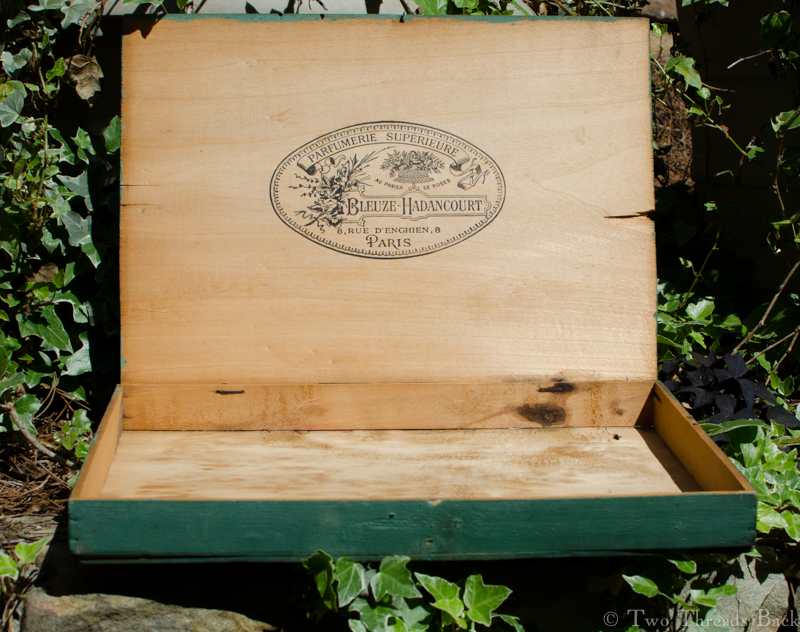
Do you like to rescue old things, just because they’re old, even if you don’t know what you’ll do with them? I do. So years ago, when I was helping with a “collection deaccession” and saw this really cool old box that was being discarded, I offered it a home with me.
A green box from Paris, Parfumerie indeed.
It’s been upstairs ever since. Periodically I clean, reorganize, and clear out because I’m compulsive that way. Maybe it helps me handle stress, whatever. I call these events The Counting, in honor of Cold Comfort Farm. Last year when it was time for a Counting, I put all the items I use for antique sewing displays, including the old painted box, together in a tightly sealed plastic bin.
In the following months I went up a couple of times to pull something out of it, and when I lifted the lid, gasped and choked over fumes some sort. The smell was a little like really nasty varnish, maybe mixed with bug spray. It was distressing because I didn’t know the source and I didn’t want it polluting my old textile bits. I got up close and personal, sniffing the sewing box, the tools, the little lace sleeves and collars, and even the parfumerie box, but I couldn’t tell where it was coming from. Since the green box was the only thing relatively recently acquired, I assumed that was the culprit and took it out. No more smells.
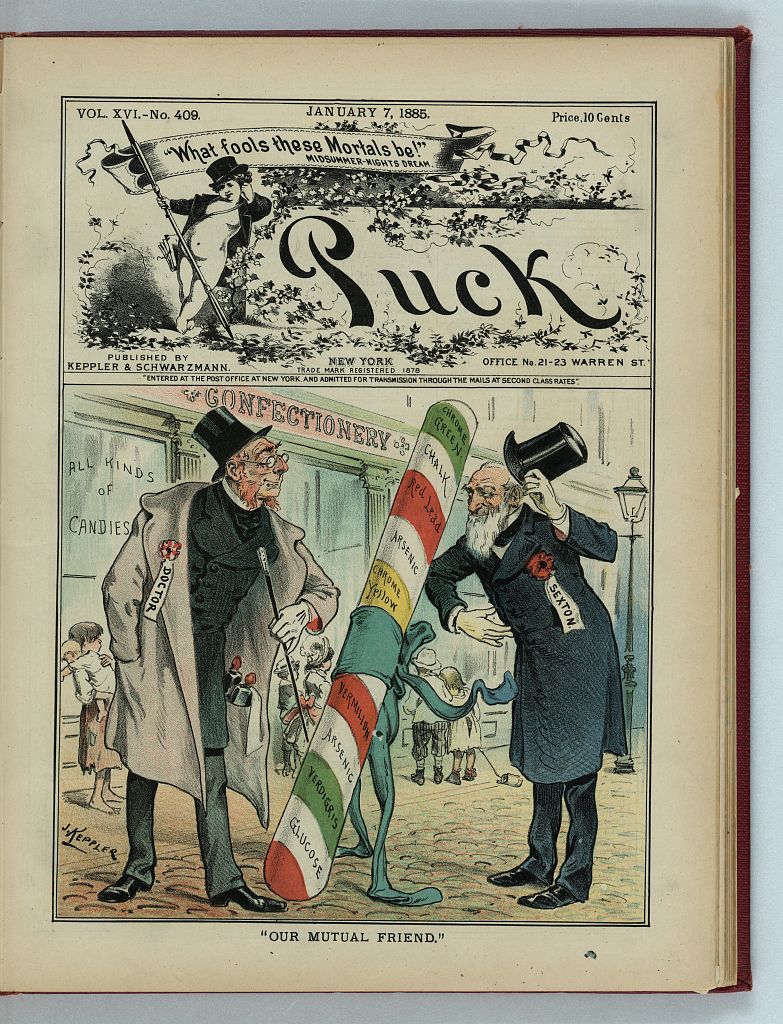
Early eye candy.It’s just sat on a shelf, wrapped in paper, ever since. Until this week when perusing the fabulous Wearable Prints, 1760-1860, History, Materials, and Mechanics, by Susan Greene, and reading about green dyes. Of course I’ve heard of frequent use in the 19th century of arsenic in dyes, paints, and foods – it was even a scandal in its own day. But I never thought it would provide me with anything but some occasional macabre reading. Now I wondered, have I been harboring a criminal, a poisoner?
Some more internet research has left me a little warier of casual collecting or repurposing. I really don’t know if the green box is toxic (it isn’t all that old), but I’m not going to take any chances. It’s sealed up tight and stored under the eaves in the attic now. I can’t bring myself to trash it because you never know when you’ll need a nice conversation piece. For unwelcome visitors.
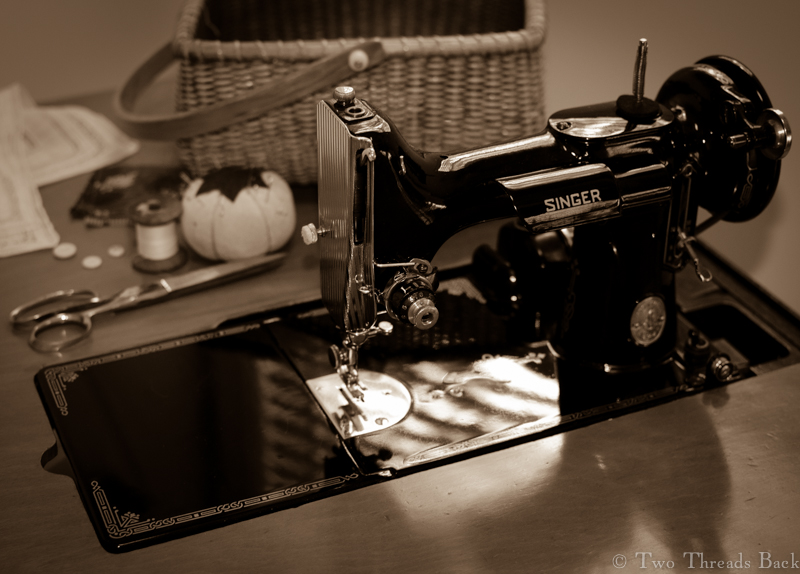
I suspect I’ve got just as many ancestors as anyone else, but mine weren’t notable for leaving closets and attics full of heirlooms. The oldest thing I’ve got is my DNA. However, that doesn’t mean I don’t have some treasures! One of my dearest is my grandmother’s old Singer sewing machine. Yes, me. The hand sewing monomaniac loves a machine.
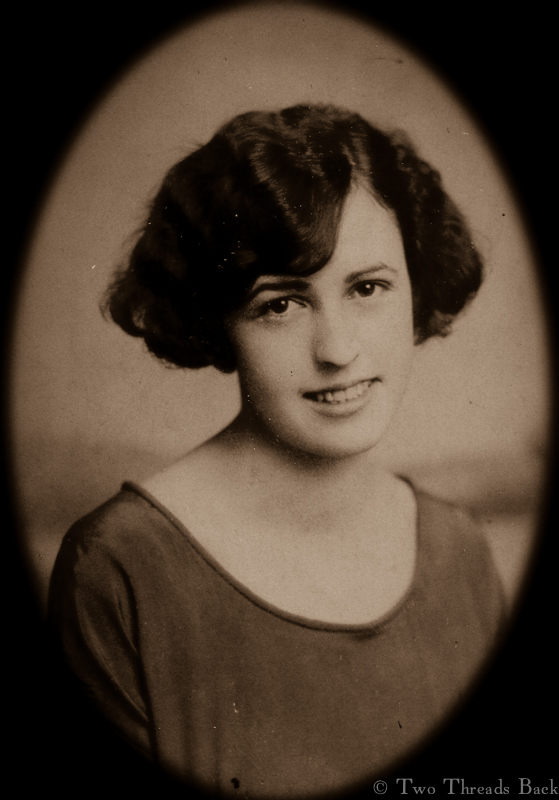
My grandmother, an amazing seamstress.
She (the machine) was born Christmas of 1948. My grandfather bought it as a present for my grandmother that year. I don’t suppose anyone knew that the featherweights would become classics.
She (the machine) had already earned retirement by the time I welcomed her into my home, but nope, I kept her going. She only does straight stitch, can you imagine? Why would anyone, some quilters excepted, want a machine that doesn’t do fancy stitches? Not even zigzag?
Weeell, just ask a featherweight fanatic. Simple, small, light, reliable, long-lived. What more could you ask? I wish the same could be said about me – well, maybe not the simple. If you have time, take a look at Singer Instructions for Art Embroidery & Lace. The possibilities using an older machine, even treadle, are dazzling. It’s hard to believe anyone could do such elaborate work without today’s technology. It was published (1911) and republished, and can be downloaded free in a variety of formats. So don’t underestimate their potential, between the attachments and techniques, a seamstress could really do just about anything with an old Singer.
Notice I said “a seamstress”in that vague and distant not-me sort of way. Because just about all I’ve done is use the basic set up and a couple of attachments. Even the buttonhole kit remains in its sarcophagus, waiting for the day I’m brave enough to resurrect it. Although I do have Grandma’s buttonhole samples resting under the presser foot, like they always did.
For my birthday last year, I had the machine restored to her original condition. I found an expert who did a superb job and a talented friend who did the table. My little champion sewed beautifully before, but now she’s a dream to use. Even if only for plain (machine) sewing!
Ta da! After ten grueling years (ok, I don’t really know how long, but it has been years) I finally finished a 19th century gentleman’s square-cut shirt of fine linen. Complete with all twenty parts, including the frill. And Dorset knob buttons.
Where did the name come from? Well, a long time ago a friend and I (I miss you, Janet!) were studying one of these shirts, one that had a heart-bit (see that blog). We reached frantically for our vinaigrettes, trying not to swoon on the artifact, as visions of Mr. Darcy flitted around the room. Somehow we started calling that handsome relic The Love Shirt. So it has been to me, ever since. And I wanted to make one myself.
That type of linen is impossible to find nowadays. However, a dear friend (thanks, Dianne!) provided the closest thing possible, and with a pattern from an 1820 book, I commenced.
Darned little gussets, all the work I did backstitching was mostly hidden when assembled. Having since acquired some cobwebby 100-year-old linen lawn, I intend to replace the muslin ruffles, this time hemming them the right direction. If there’s a harder way to do anything, I’ll find it.
Unfortunately I have a memory like Dory, so every time I put away the project for a spell, I’d have to practically learn how to do the next step all over. A 19th century seamstress would have been appalled to see me.
Um, do I sew both ends of XYZ before I ABC? Do I cut or fold first? Did I sew the sleeve on backwards? Oops. Front and back are the same before the collar goes on, right? Not if you hemmed them first. Oh right, I was supposed to check that I was putting the slit in the front. Well… I’ll just cut the back shorter and make it be the front. And my g-g-g-g-great-grandmother could make one of these in a day or so? How embarrassing.
I did learn a lot. I learned how hard it is to backstitch over two threads without going blind. I learned that there is NO not-shiny sewing thread available today. I learned that linen thread breaks, other people’s buttonholes always look nicer than mine, knots are usually unnecessary, even poor work looks better when ironed, and a drawn thread is no guarantee you’ll sew a straight line. I learned that you had to love your man, or love survival to make one of these. And I learned how to make Dorset knob buttons, my own way! Maybe I’ll write about that next time.
You can see the backstitching that nearly blinded me. And you can see the gauging thread I used to hold the stroked gathers in place. I’m going to leave it there a loooong time.
Once upon a time, folks from all over would gather, bringing their best work to show off, to compete for prizes, and to sell. These were the agricultural fairs, a tradition whose roots go back many centuries and places. Nineteenth century America saw their development as a way to encourage innovation. By mid-century, agricultural societies were flourishing.
Today their records are a rich source of information on agricultural and domestic history of the era. The premiums, which ranged from a few cents (female enterprise) to substantial sums (men’s categories!) must have been the source of great pride, outrage, bickering and boasting – oh to have been there to hear the drama! I spent a happy afternoon several years ago in a university library poring over the books full of juicy details. Yes, that was before google books.
“An embroidered map of Savannah… best collection of fall peaches … beautiful specimens of sewing silk … second best profane landscape … woolen counterpane, maker’s name unknown … from the crowded state of the room, and the great number of articles present, several paintings could not be found … second best cow “Eloise” … the committee exhibited a marked partiality for apple pies, and awarded with singular unanimity fifty cents each to Mrs. … a basket of superb wax flowers, which the chairman of the committee on flowers pronounced superior to any in his department of natural ones … S. D., 7 years of age, worsted work executed while lying on his back with a broken thigh, .50 … worsted quilt, said to contain 9765 pieces; ingenuity and labor … lemons of enormous size, preserved in alcohol…” – the list fills volumes.
Crackers, lightning rods, stoves, plows, false teeth, butter, Muscovy ducks, headstones, cologne, down tippets, dog’s hair socks, essays, fishing boots, parsnips, daguerreotypes, golden pippins, rocking chairs, canaries, grain bags, gold pens, baby-tender. Was there anything they didn’t show?
To paraphrase one report, I am greatly embarrassed on account of the limited means placed at my disposal to mention such a large number of exhibits, and I wish to say, that I doubt not there are many articles not noticed which are as well worthy of premium or gratuity as some which have been thus honored. I am reluctantly compelled to pass them over.
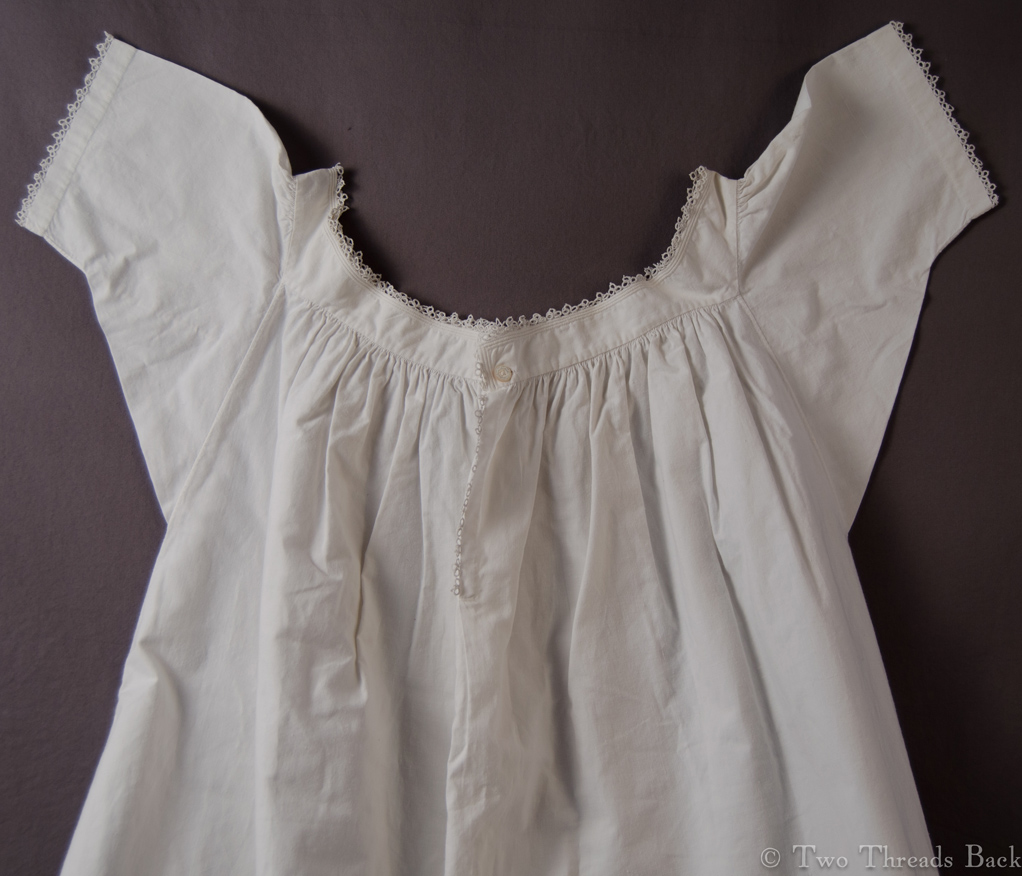
Hand Sewn Chemise
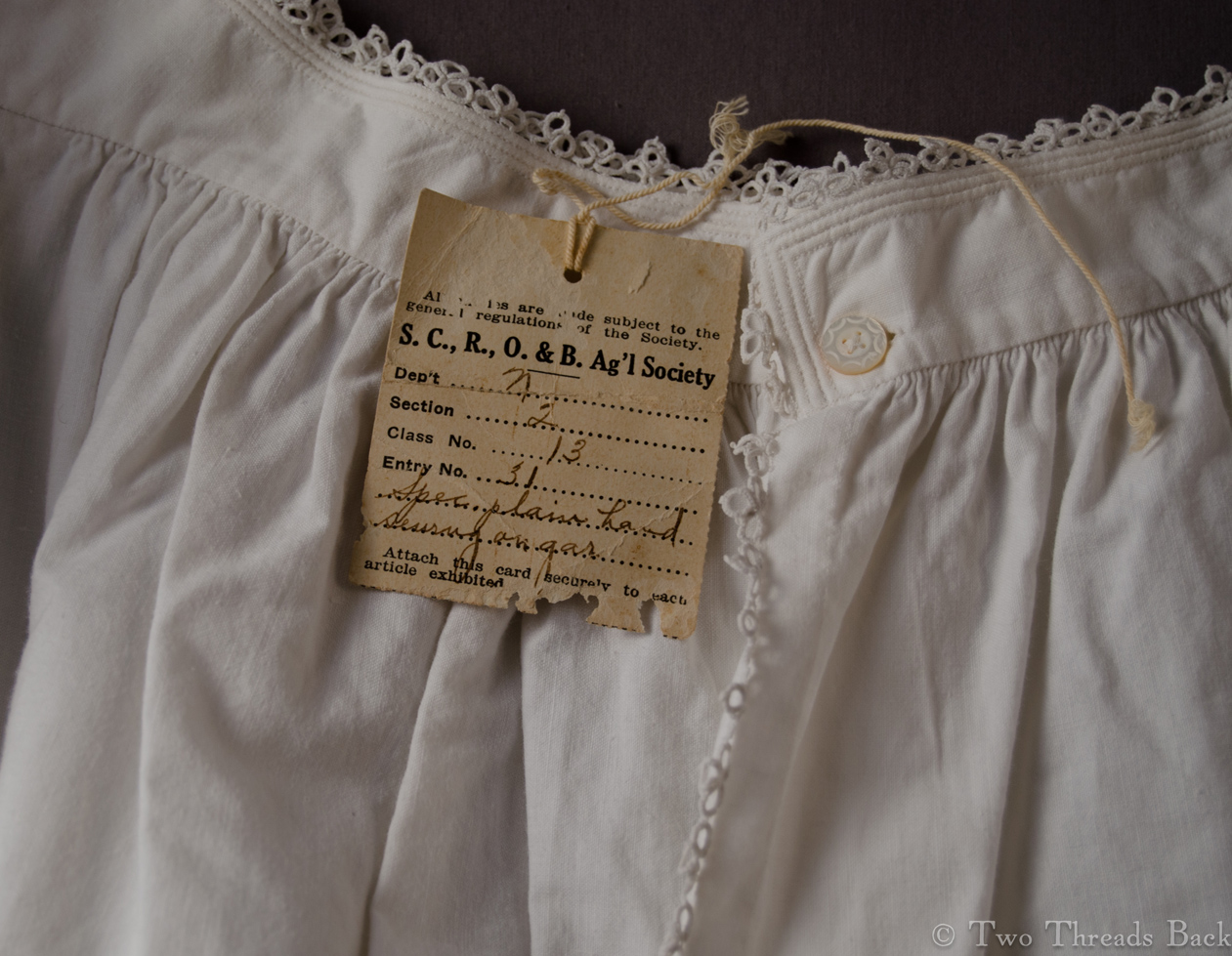
One category is especially interesting to me: plain sewing (surprise!). Here are some examples from the Sandy Creek, Richland, Orwell, & Boylston Agricultural Society of New York, c1860.
The chemises are exquisite, and it’s easy to see why their maker entered them in competition. I regret to say that I don’t know if they won a prize or not. There was no record of one with them. Nonetheless, they are fine work and perhaps the maker would be even more pleased if she knew how much, and how long, they would be admired!
By the way, check the calendar and visit your own state or local fair. If you’ve never toured the exhibits before, you’ll be amazed!
For those who would like more detail and patterns that they can easily use today, there is another book, The Lady’s Economical Assistant, which has been reproduced after the 1808 edition, available from Kannick’s Korner.
I came across this one day while surfing for children’s print dresses.
It is a simple child’s gown dating to 1803 that has a story, one I could never imagine. Made of a shabby, sweet calico print, it is typical for its day: simple in cut, with a little frill around the high collar. The tragedy lies in the last day it was worn. John Marsden was two years old when he died after being scalded in an accident at home.
The Marsden family were among the earliest to arrive from England to live in New South Wales and the Powerhouse Museum website has more information on the family and this collection.
I don’t need to create imaginary stories for this dress, since his mother said enough, “The loss of those I have parted from weighs so much on my mind that at times I am as miserable as it is possible to be – outwardly I may appear cheerful but I am very far from being happy – indeed happiness and me seem long since to have parted and I have a presentiment that peace will never more be an inhabitant of my bosom.”
In 1863, a missionary named Emmanuel Boehringer was traveling north from Virginia when he passed through Sharpsburg in September. There he met with a scene of devastation and misery. He stayed to help tend the wounded of the Battle of Antietam and was haunted by the thought of so many new orphans, a forgotten casualty of war. Inspired to make a home for them, he founded the Orphan’s Home of the Shepherd of the Lambs.
The name was later changed to Bethany Orphans’ Home, and hundreds of children were cared for and educated over the years. Boys also learned farming and girls learned domestic arts. But wait! Sewing is not just for girls!
Bethany Orphanage Boys
Apparently it was deemed practical for boys to learn to stitch, too. And although rare in those days of division of labor, it wasn’t unheard of – I occasionally come across references in old sewing manuals to boys being taught sewing. According to Emily Jones, who wrote a manual in 1884, “Every infant schoolmistress who has tried the teaching of needlework to boys, speaks most warmly in favor of it.”
And the skill can be so useful! She goes on to give one of my favorite quotes, spoken in a Winnie-the-Pooh-sort-of-way:
“A Waterloo veteran said to me the other day, “I don’t know much about sewing, except putting on buttons, and I don’t know whether you would consider mine the correct way, but they used to stick on, and that is a good point in a button.”










 Two Threads Back