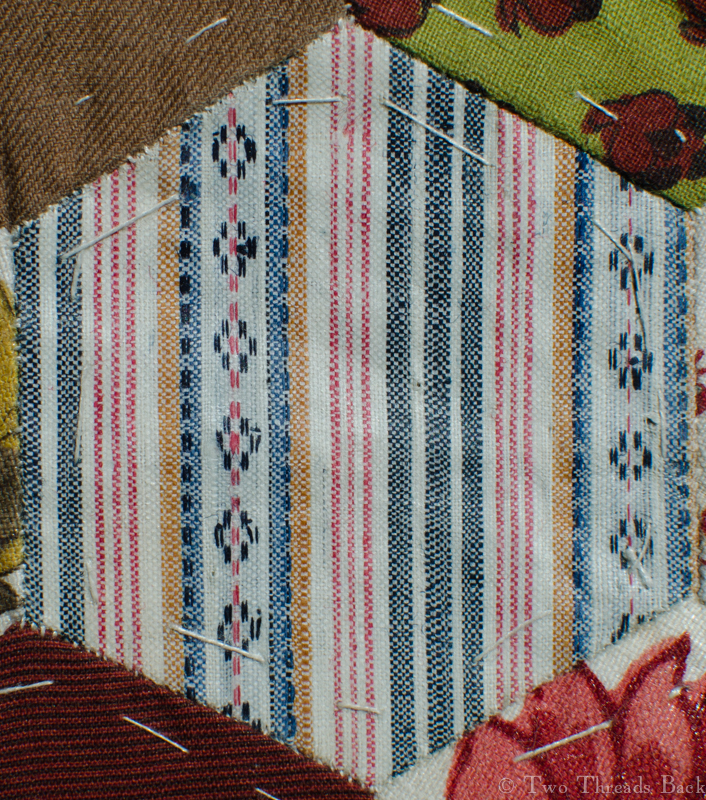
Perhaps I should have titled this “What Do You Do When Old Looks New?” These stripes are from the same early 19th century quilt as all the other Flower Patch samples, but they look so modern to me that if I weren’t completely sure about their age, I’d think someone was sneaking in new fabric. However, I’m convinced that all the different fabrics date to within the same few years. (Any fabric experts passing this way are welcome to call and opine!)
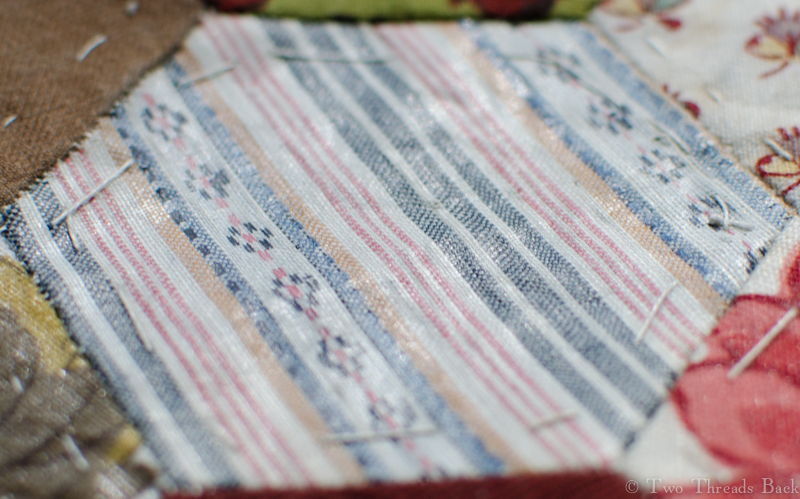
I could easily see this pattern on a man’s shirt today. But what would it have been used for then – gowns, aprons, children’s clothes? These have the same glazed finish that many of the others do, and I’ve added the very last picture to try to show that.
The same piece from the back.Another very contemporary looking pattern.How appropriate for a blog: Opinion Opinion Opinion…I’ve tried to show how shiny the sizing is, but you may only see a really bad photo.
No, I’m not delving into postmodernism here, I’m talking about sewing – and unsewing! I was sitting on my porch last week, relishing the warm spring breezes and taking advantage of the bright afternoon light to salvage a sad old black silk skirt. As I worked, I realized that most of the sewing had been done by hand, and that I might pay tribute to those hands by sharing pictures before it was gone forever.
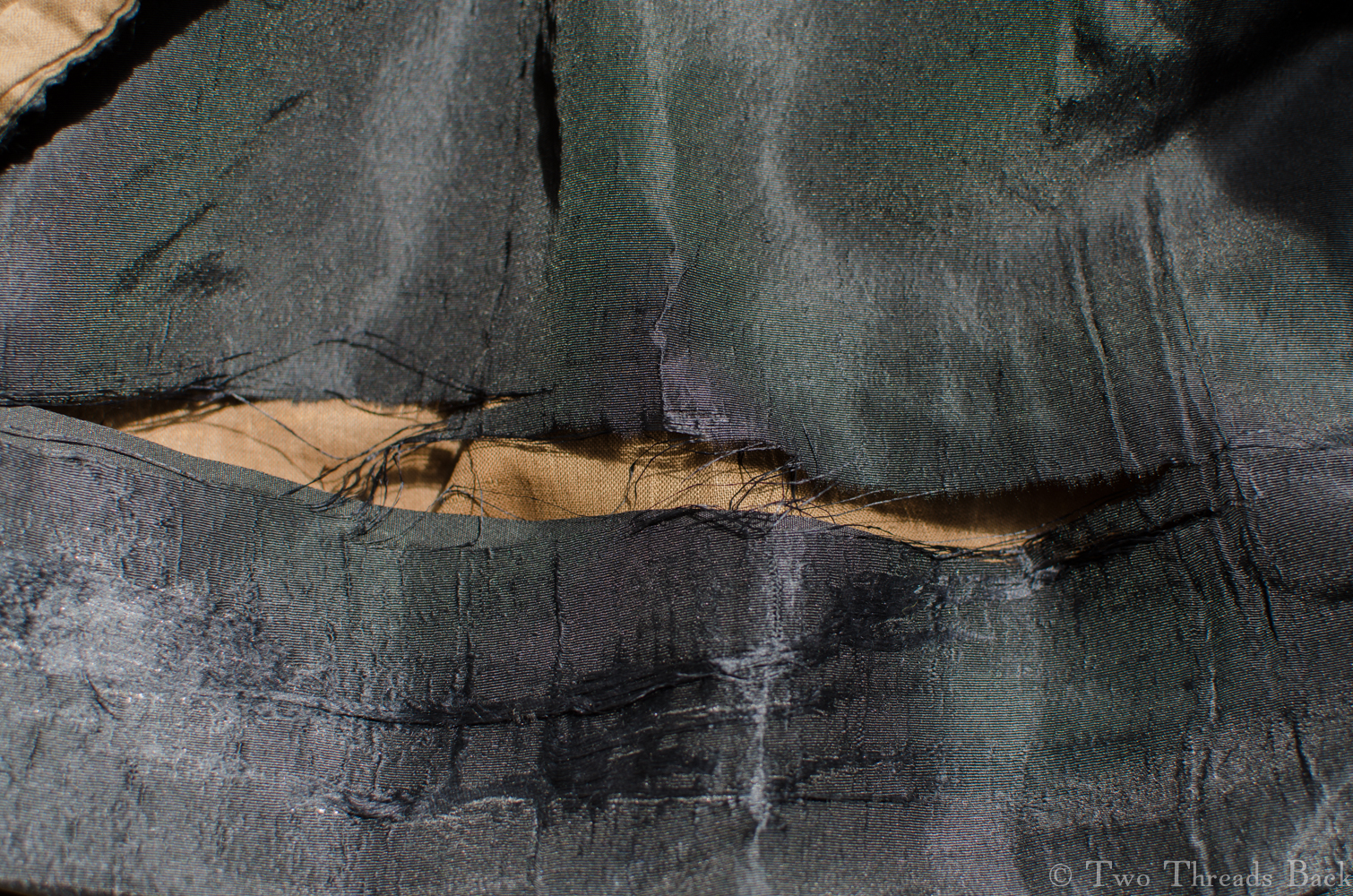
Silk damaged beyond repair.
Lest you think I cannibalize antique textiles lightly, let me assure you there was no saving this piece. It was a silk faille gored skirt – of such a generic cut that I hesitate even to date it – which had begun to shred and shatter all over. The lining was in excellent condition though, so I wanted to preserve that for reuse.
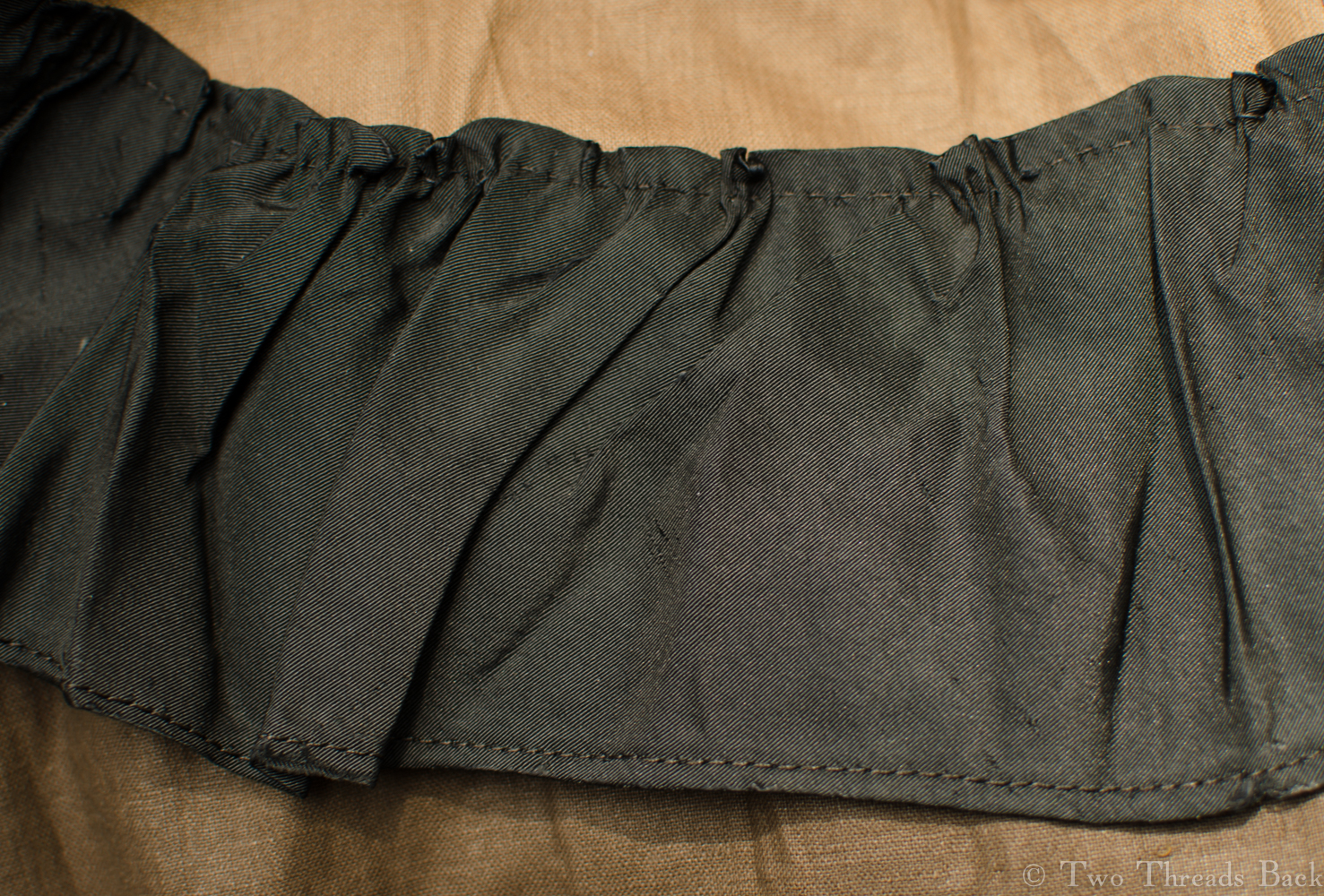
Unfortunately, I didn’t think to take a picture of the whole skirt before I began. Although it might not have added much to this post since solid shiny black is notoriously hard to photograph! The cut was smooth and somewhat fitted across the front, tapering slightly toward an “A-line” silhouette, with tight gathers in the back. It had a narrow waistband, and two tiers of ruffles trimmed the hem.
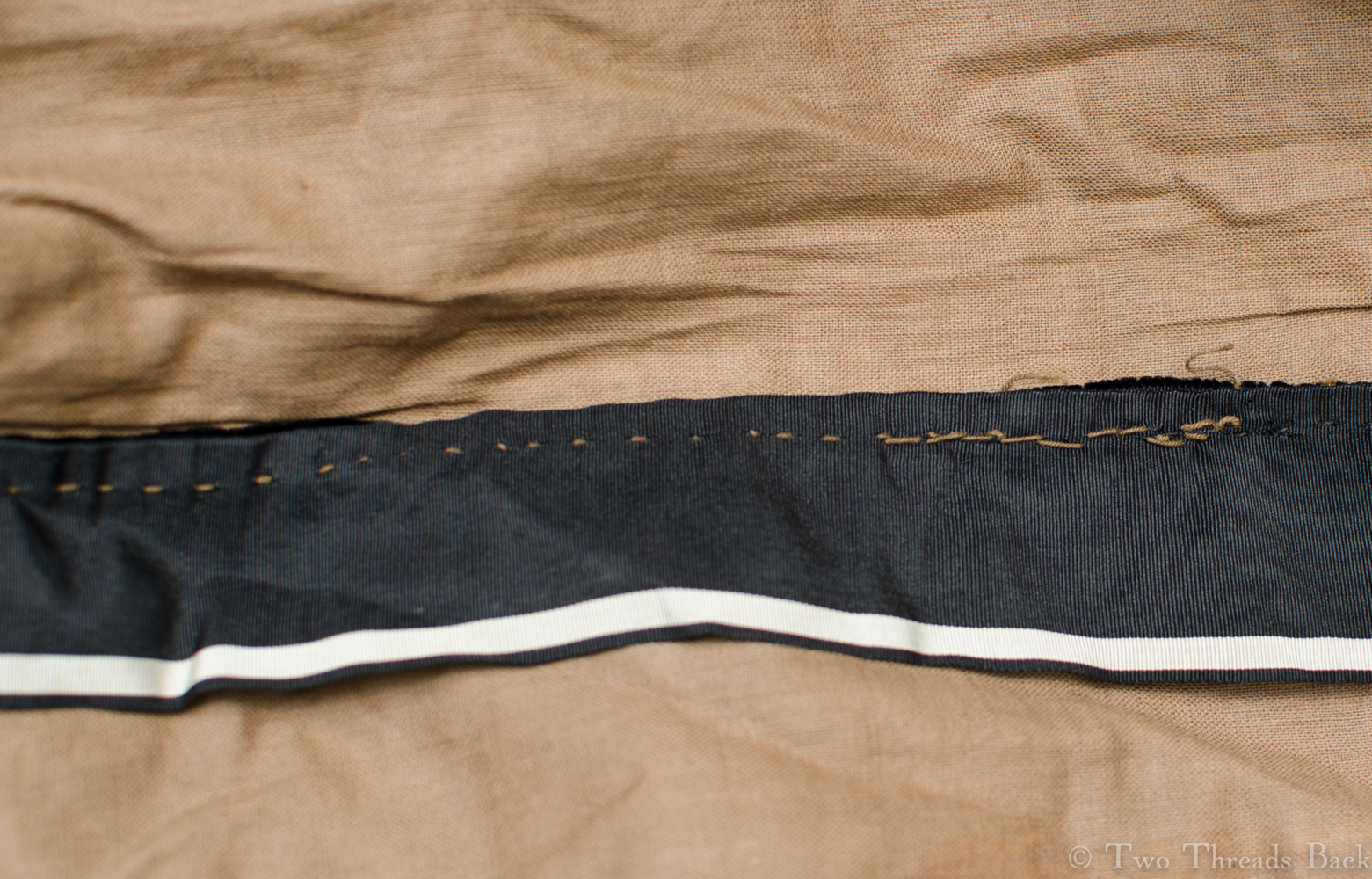
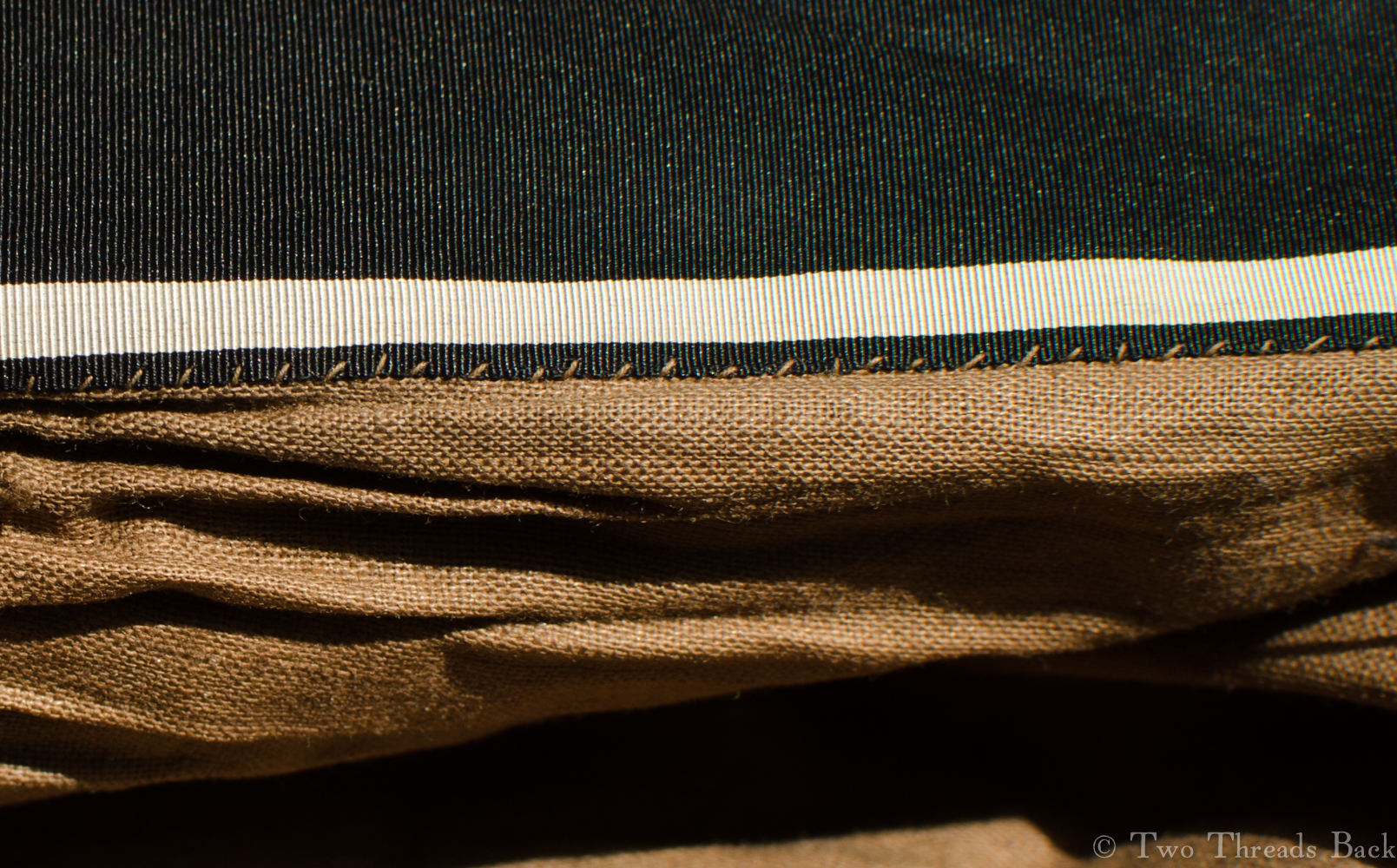
Side seam of skirt, running stitches with a few backstitches piled on for good measure.
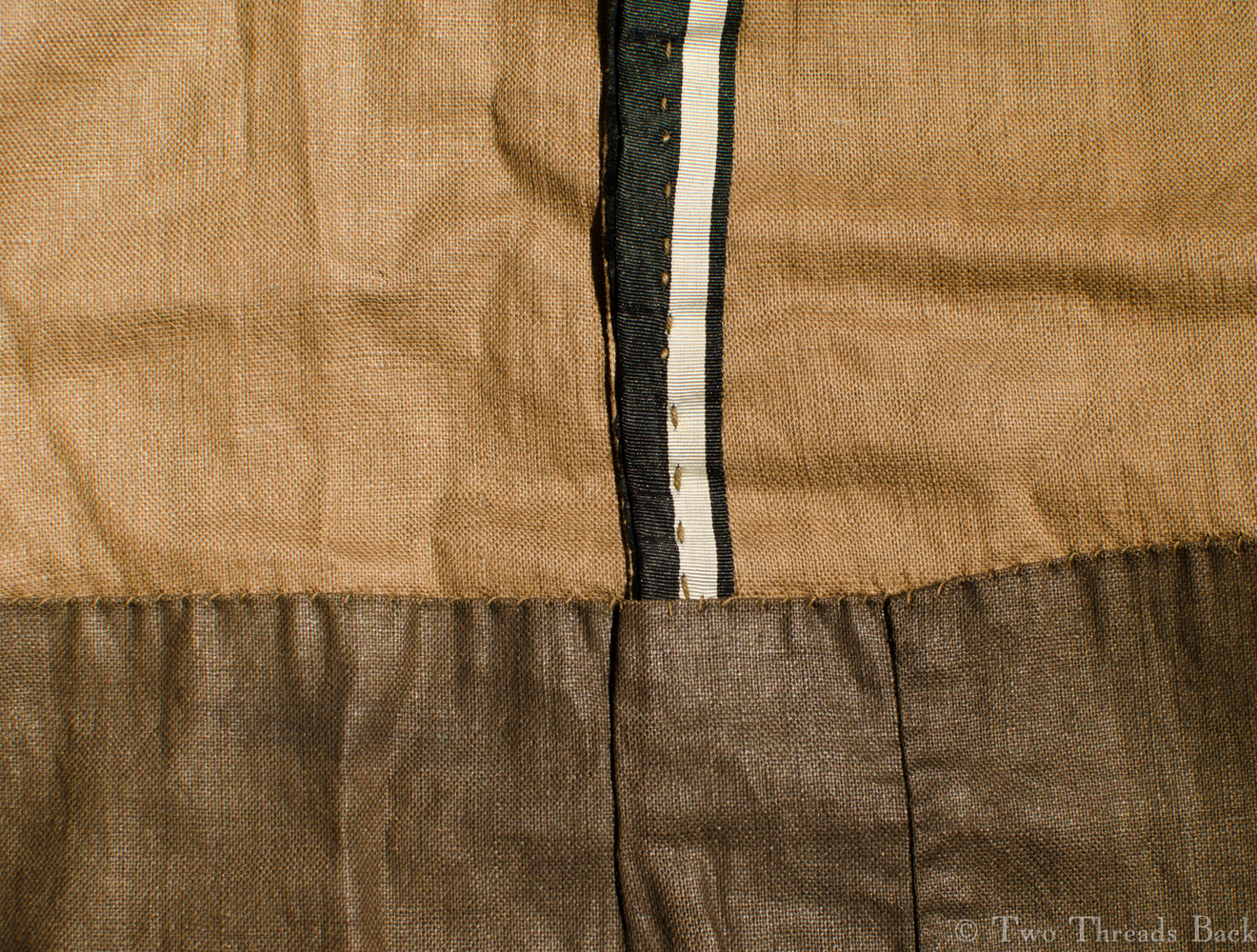
The silk fabric was about 21″ wide with white stripes along each selvage. The skirt was completely lined with the standard brown cotton, and then an extra piece of darker glazed cotton was added to the bottom ten inches. A velvet binding strip protected the edge of the hem. There was one deep pocket which looked like a later, rather clumsy, addition.
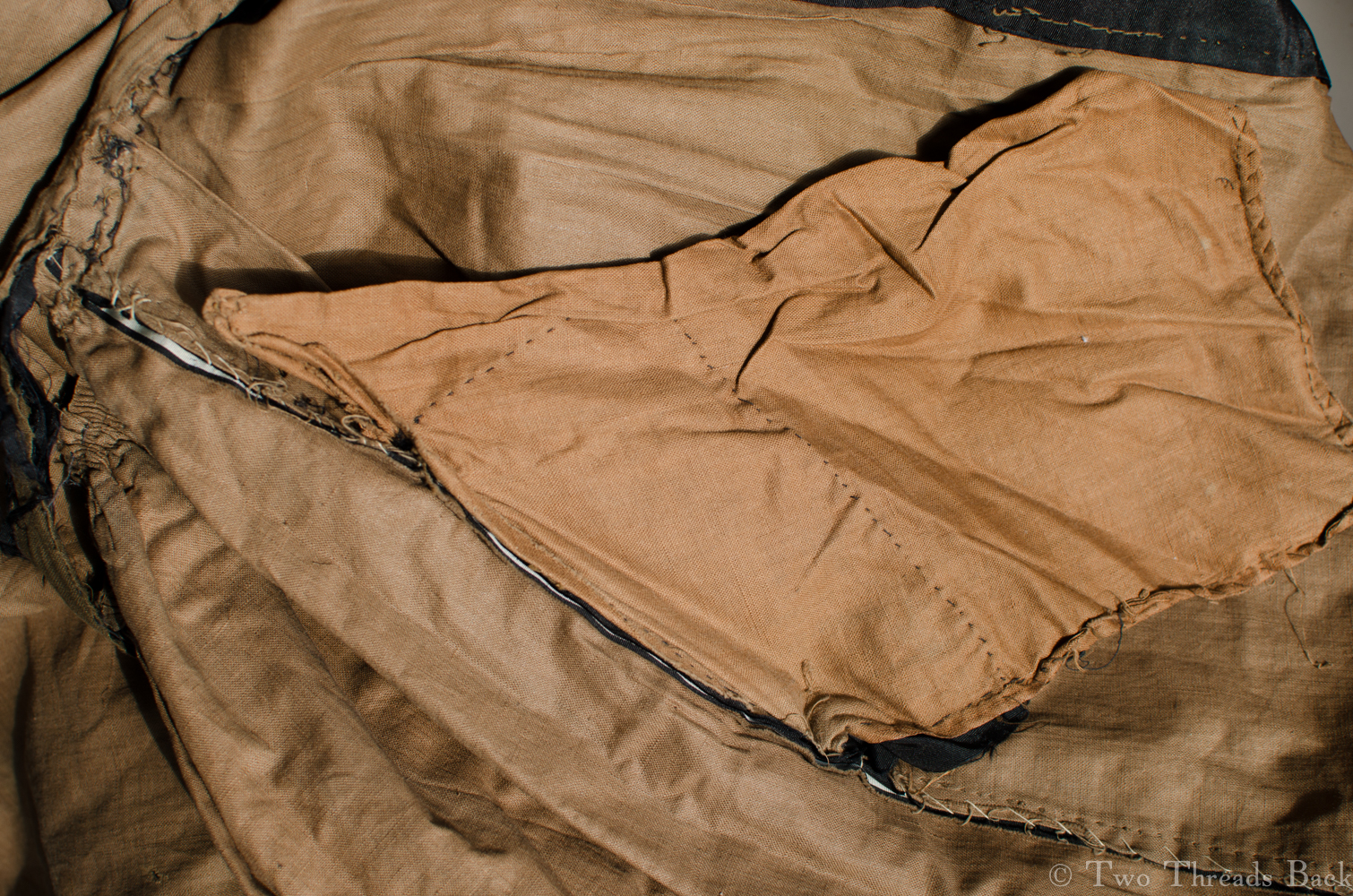
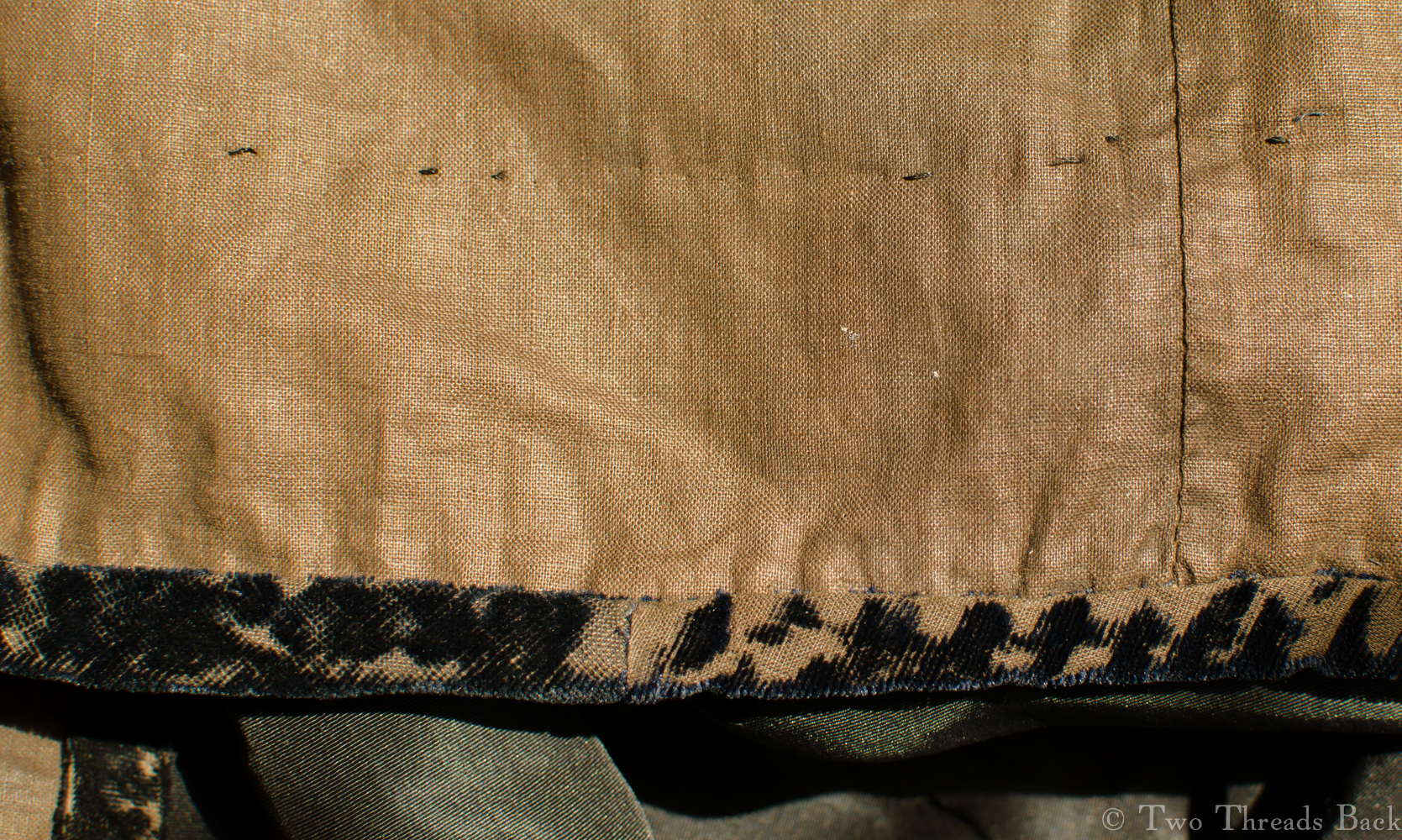
The extra lining along the lower part of the skirt is neatly hemmed down.A view of the pocket from inside. Maybe added later?
I hadn’t expected to find hand sewing in this piece, so I was intrigued to note the different types of stitching and thread. The long side seams used a basic running stitch made with a heavy brown cotton thread. Although the finished skirt was nice and sturdy, some of the stitches weren’t particularly neat or even.
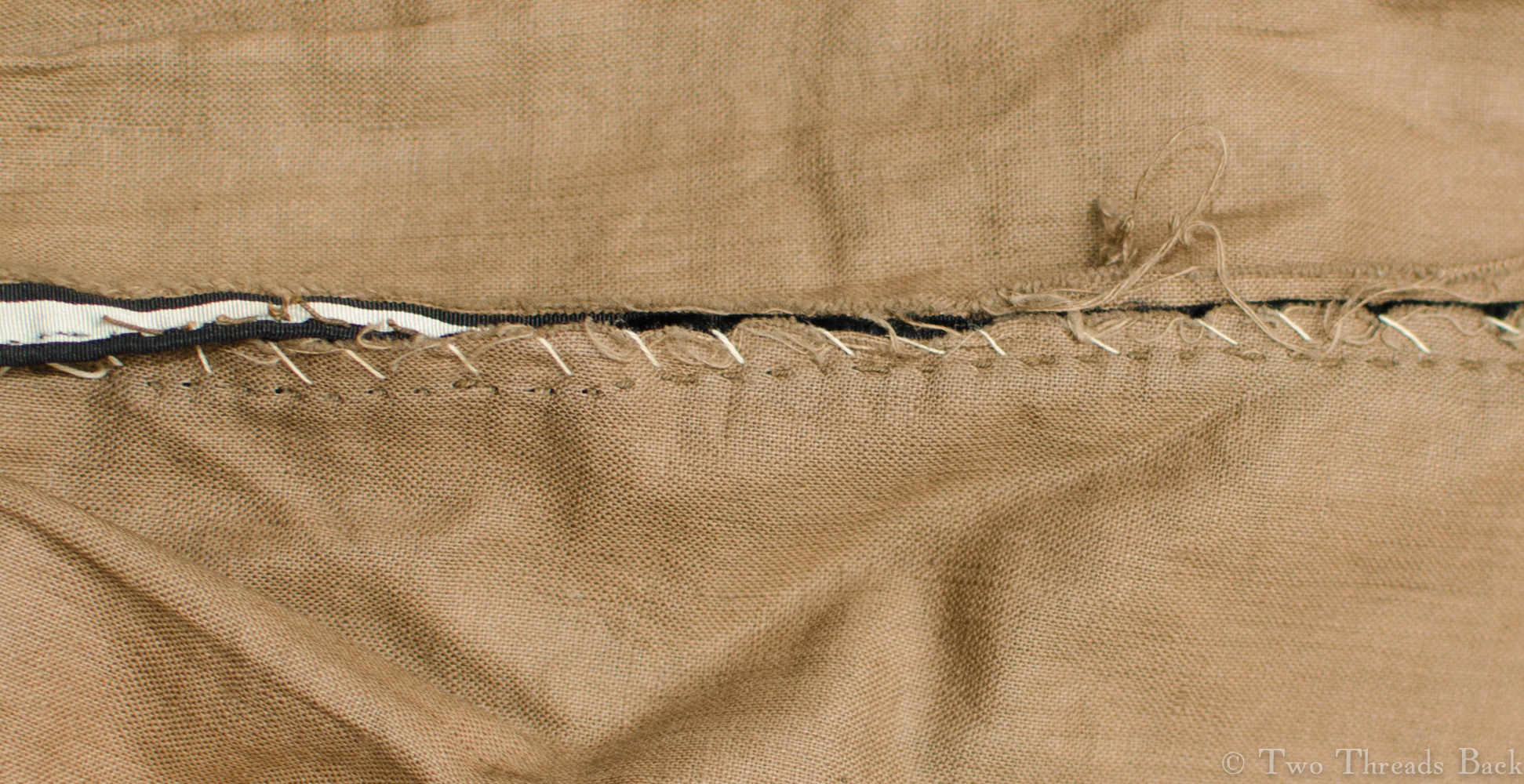
The only seam finishing, overcasting, was done where the lining edge was raw. I don’t think the maker was too worried about raveling.
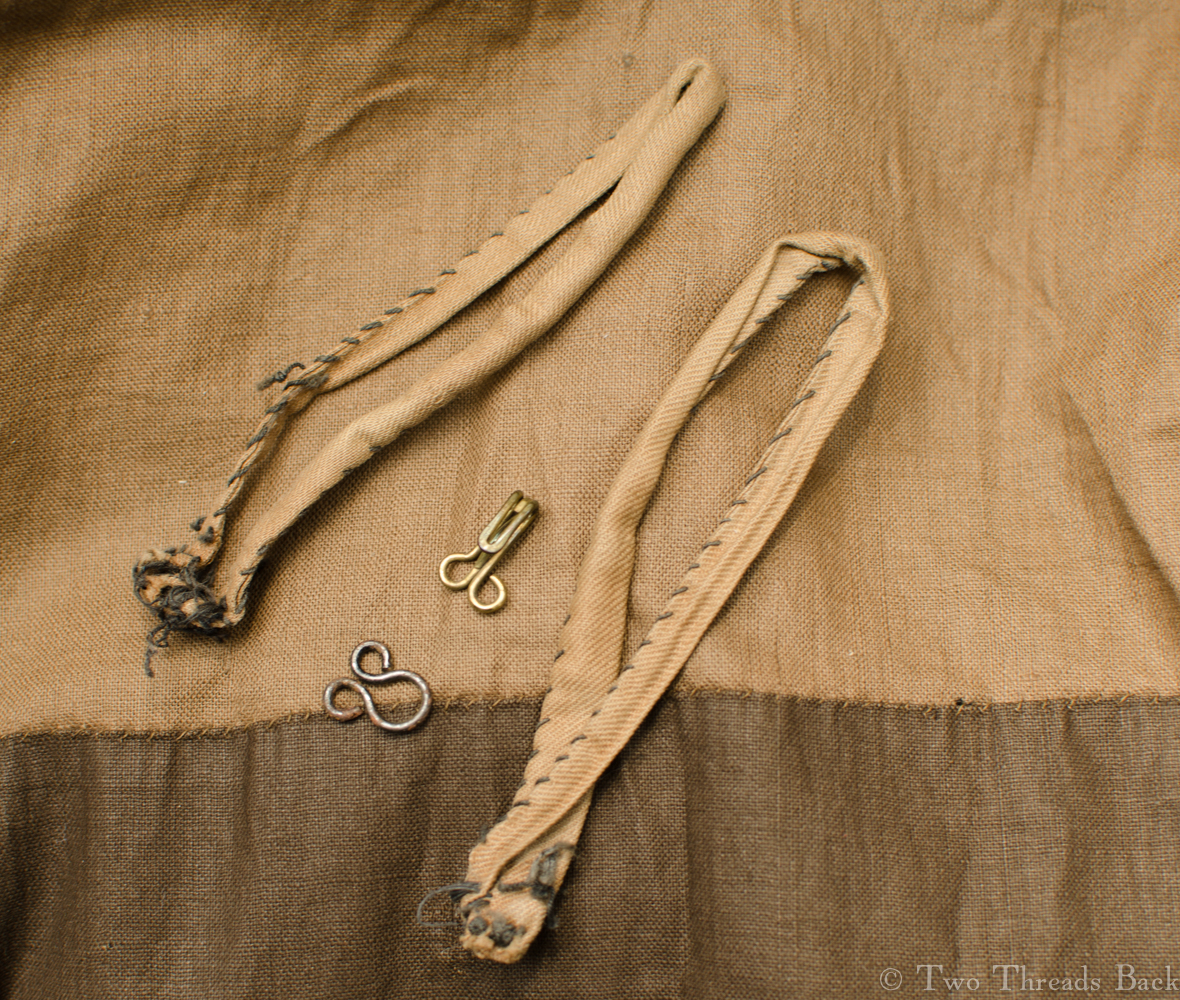
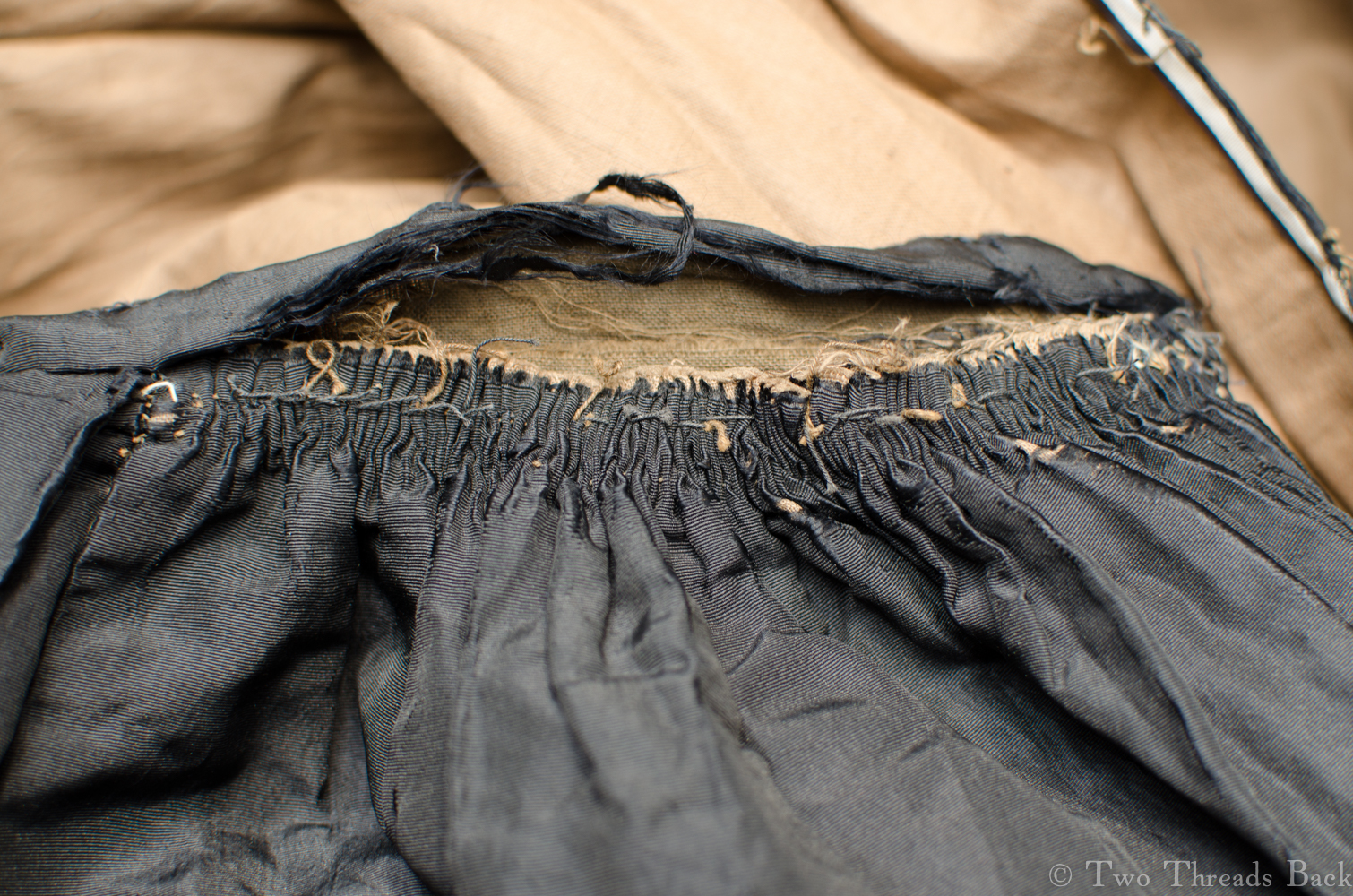
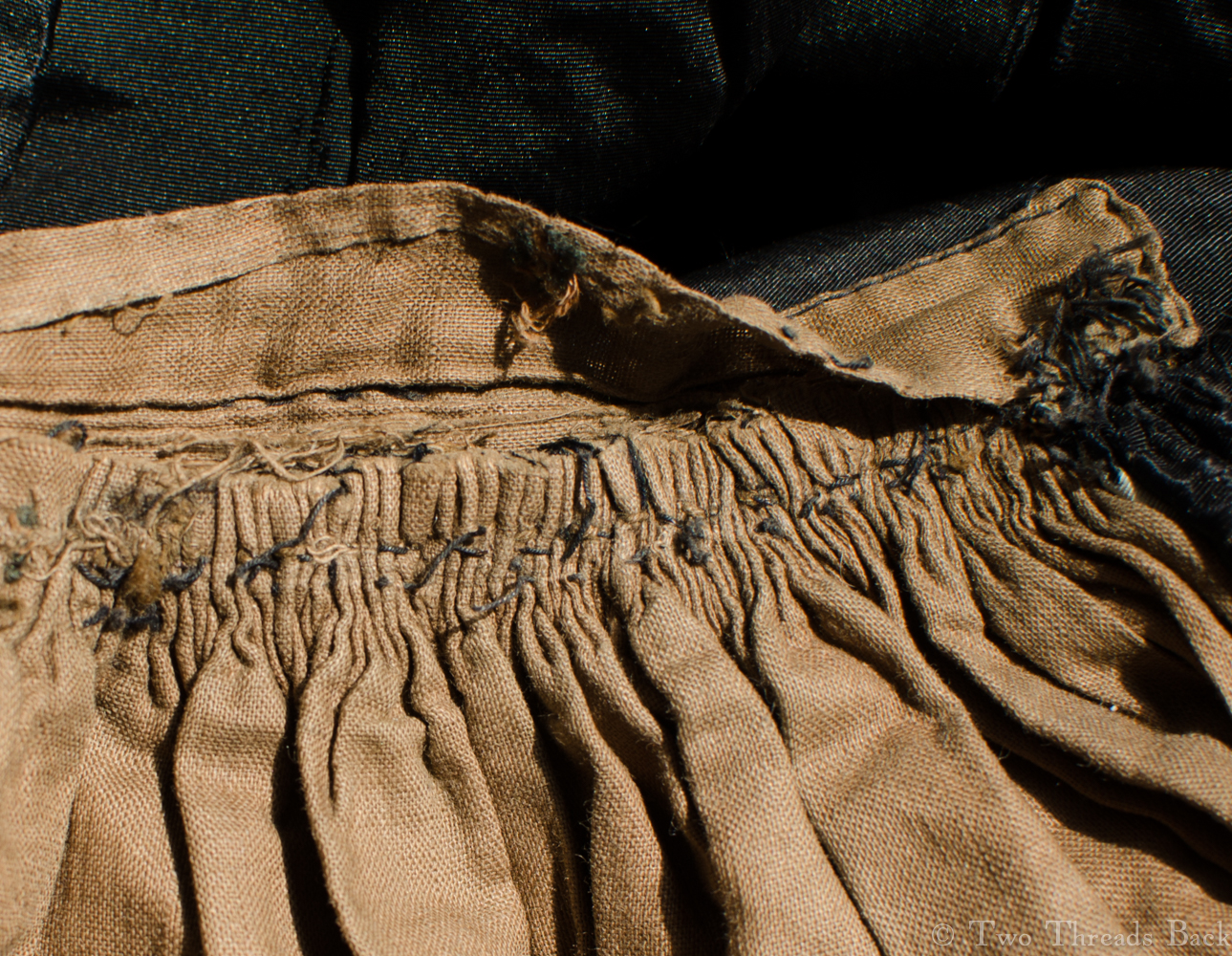
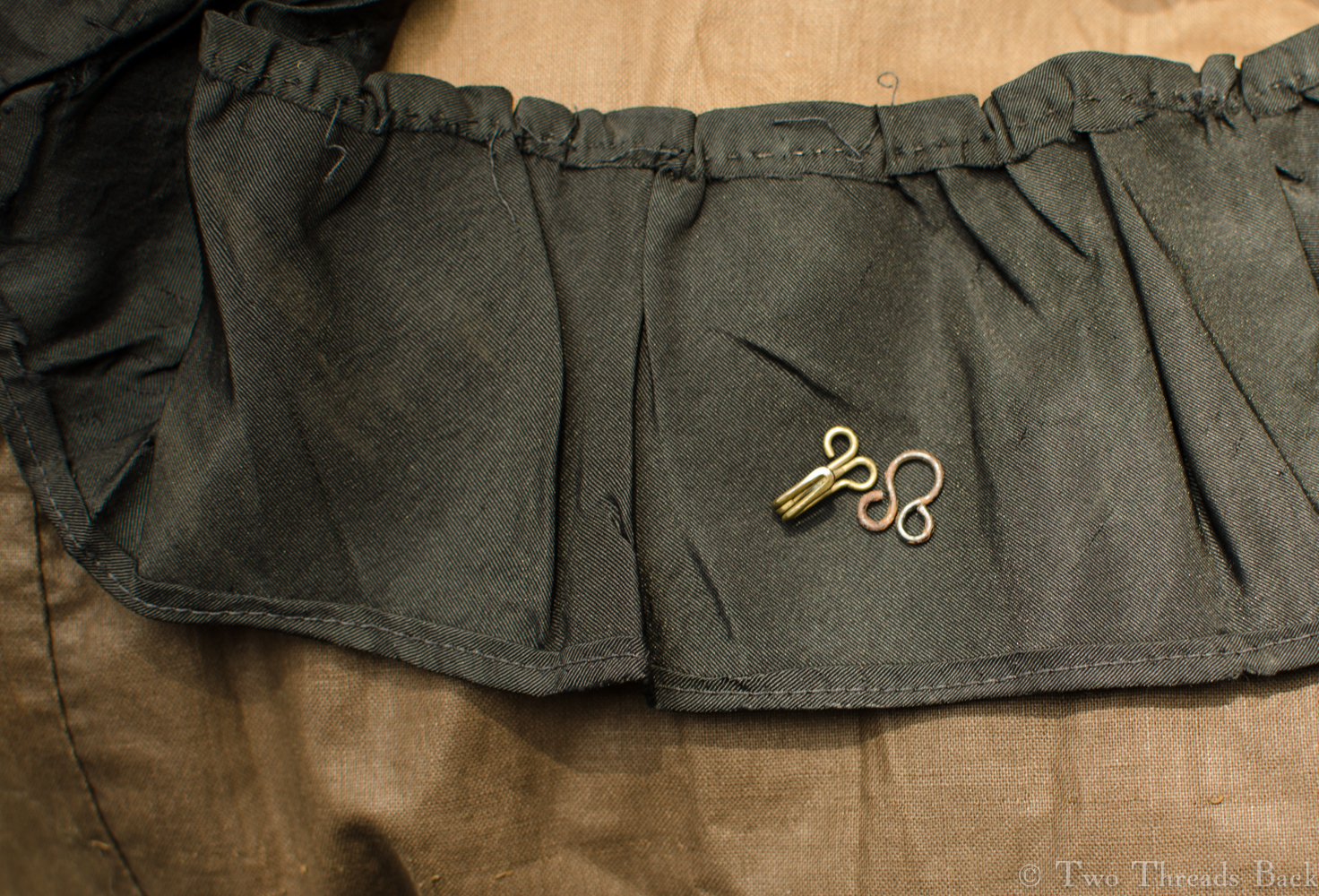
Raw edges of lining were roughly overcast with a light colored thread. The waist was “gauged” in the back. Machine work was limited to the top stitching of the waistband and the hems of the bias-cut ruffles. The only careful handwork was the finishing in some places on the lining. A brass hook and eye were the only fastening, and two loops were attached inside for hanging.
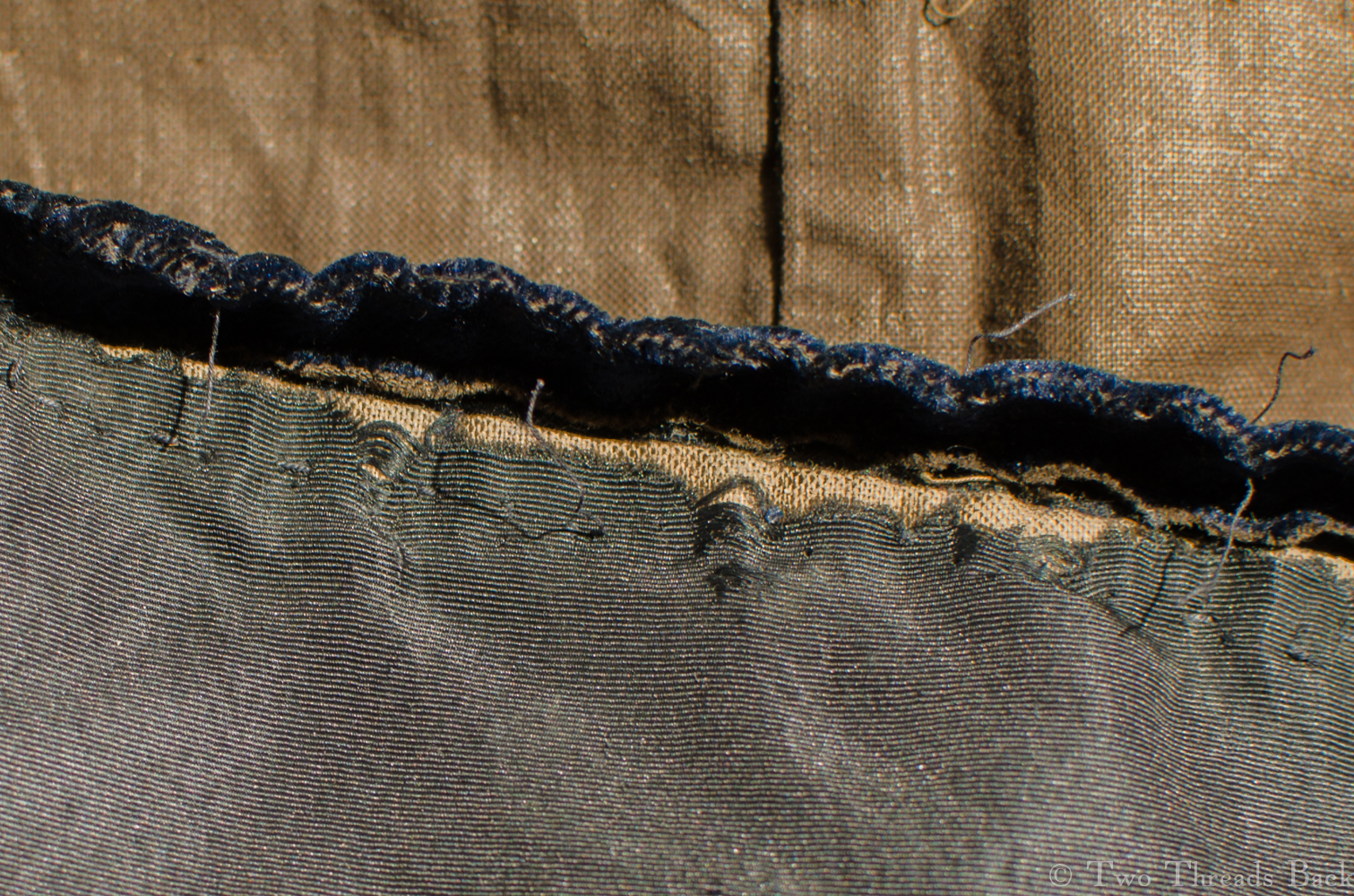
The skirt back was tightly gathered using the gauging technique.Here’s a view of the gathers from the inside.The ruffle was hemmed by machine, but gathering stitches were made by hand.And it looks like they were done at high speed!The seamstress took extra pains when hemming down the inside of the placket opening with a finer weight thread.It was common in the 19th century to finish skirt hems with a sturdy braid, wool or velvet, to protect them from wear. It could be purchased ready-made, but this velvet strip appeared homemade.
The deconstruction process was predictably tedious, but there was one moment that’s hard to describe. I was working on the old velvet at the hem when out spilled sand and bits of twigs. The debris had obviously been locked inside for a more than a century. It was as if a shadow passed by while I worked. Who was the woman who wore this skirt? Where was she walking, what was she doing, what was she thinking on the day when her shoes kicked up that sand? I don’t suppose I’ll ever know. But I hope her afternoon was as lovely as the one I enjoyed.
I tried to offer a peek inside the velvet, but it’s too dark to see. I couldn’t hold the crease open with one hand and take a picture with the other!
Yesterday a friend sent me a link to the most exciting news I’ve seen all year. Mr. Darcy’s Shirt is coming to the U.S.! Yes, you can forget Tutankhamun’s treasures or the Beauty of Xiaohe. Mr. Darcy’s shirt outranks them all.
Who can forget the (totally not in the book) scene from the 1995 Pride and Prejudice film where Mr. Darcy rises from the lake at Pemberley after his swim, only to run into the startled and stunned Miss Elizabeth Bennett? Be still my heart.
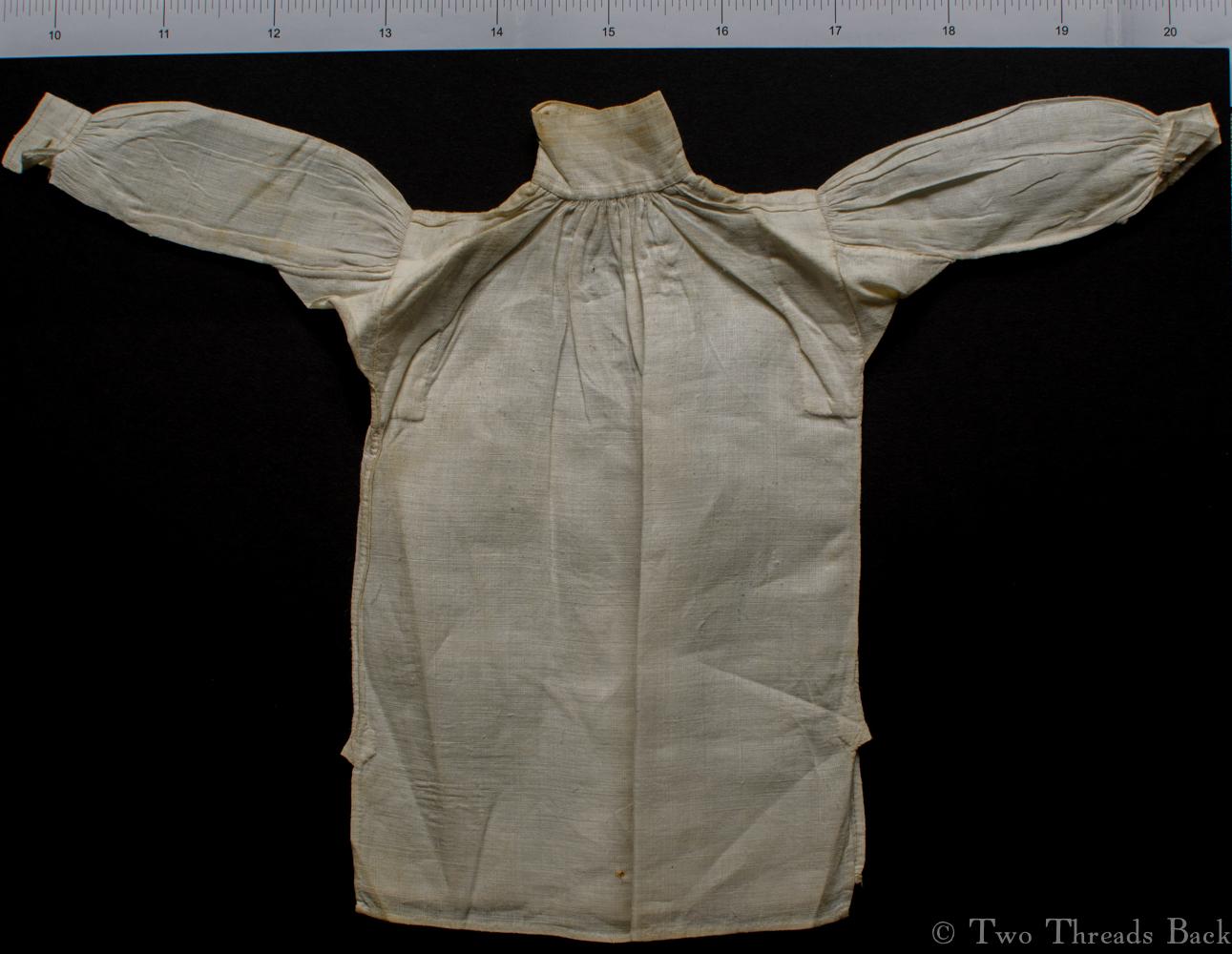
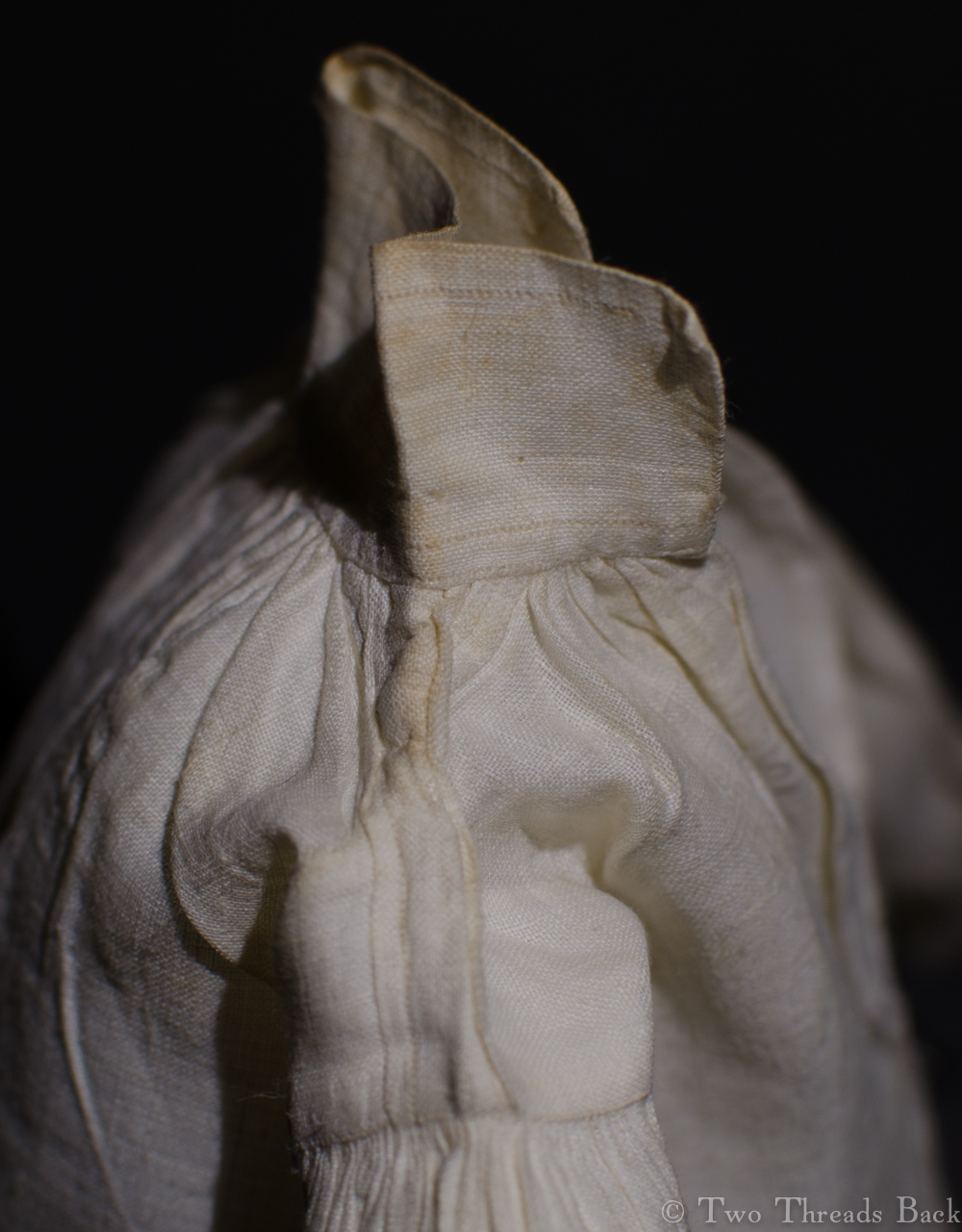
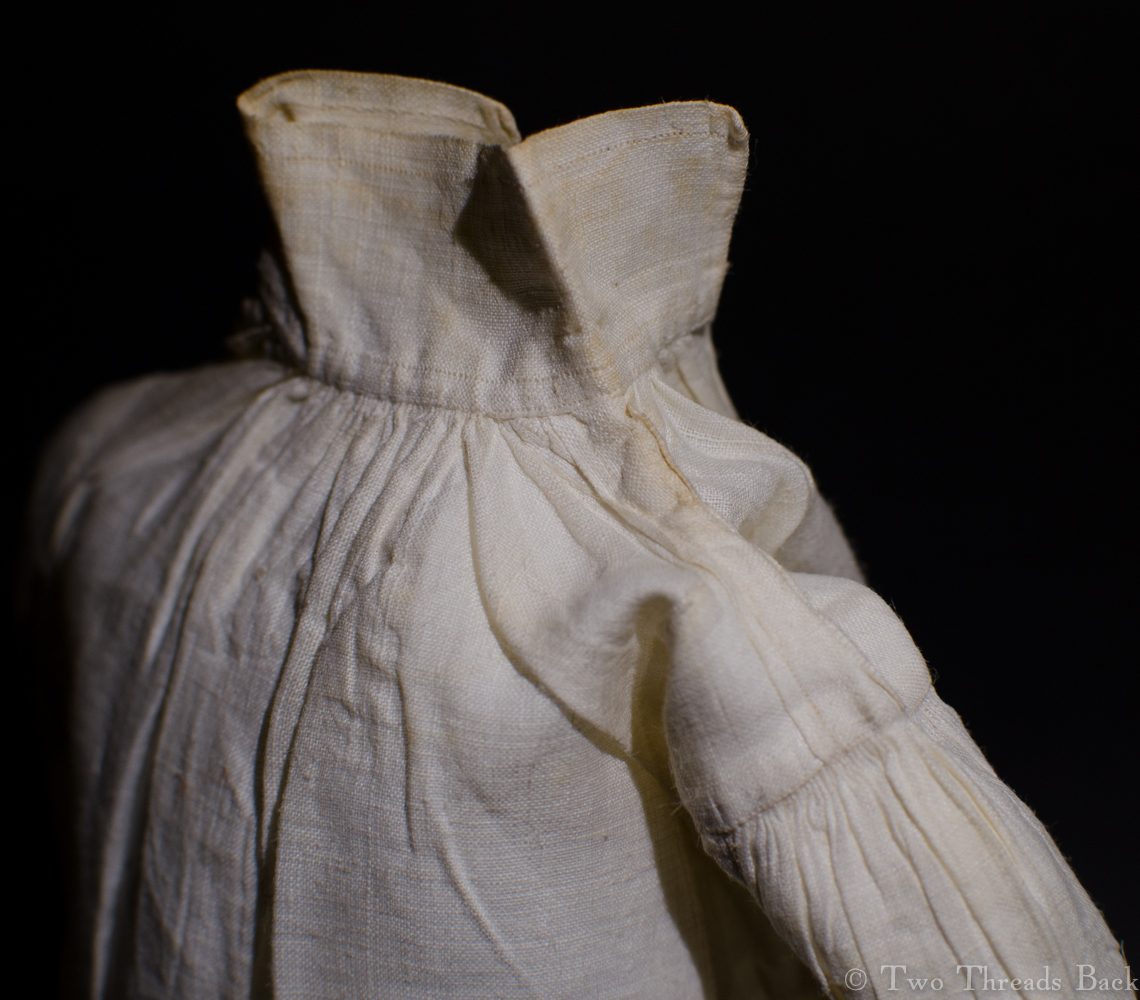
Unfortunately I won’t get to see the celebrity shirt on display, so I’ll have to content myself with a miniature version. This is a tiny “sampler” shirt dated 1838, very much like the square-cut linen one that embarrassed the soggy Colin Firth and melted the rest of us.
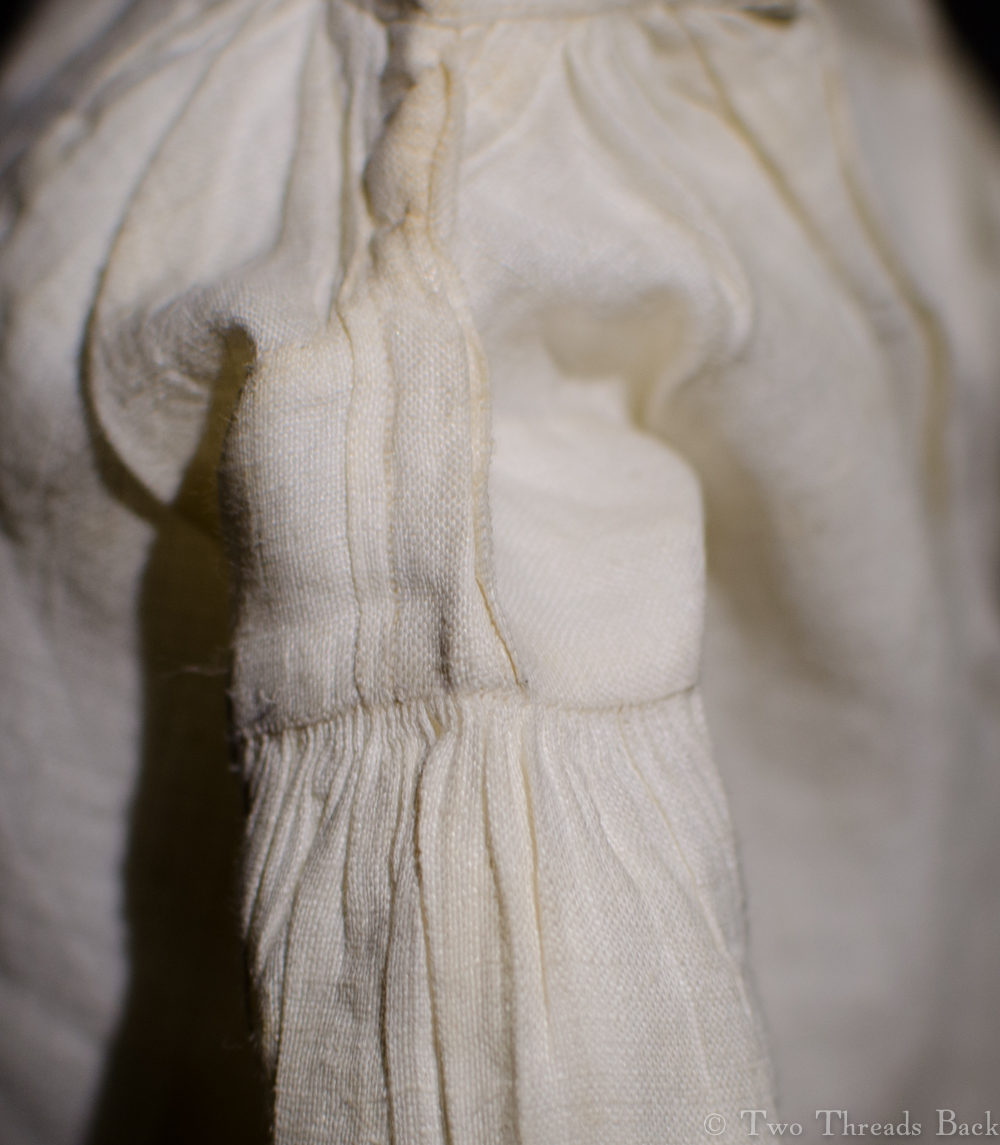
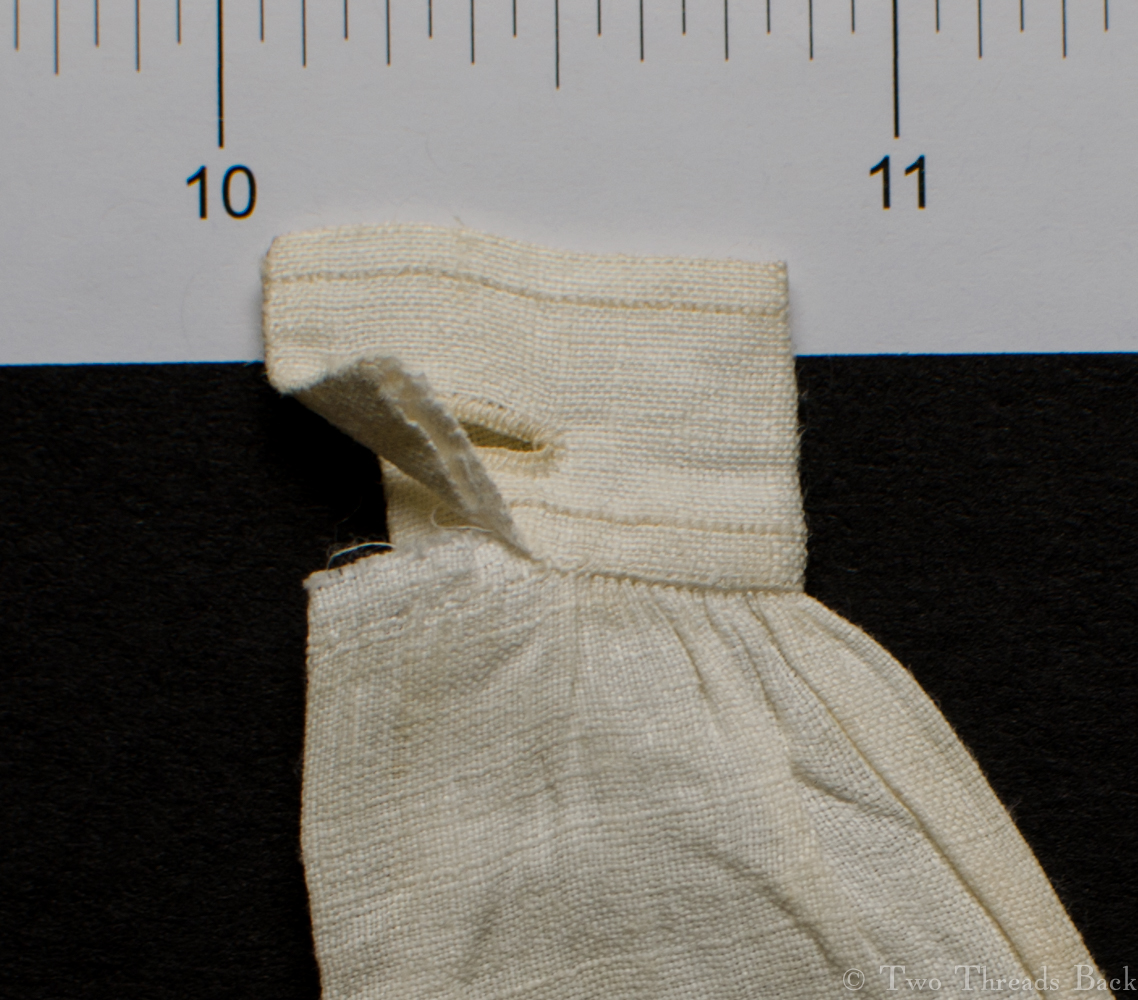
It measures 7 inches from the top of the tall collar to the hem. The cuff is 1 and 3/8 by 1/2 inch. The backstitches per inch are so small that I cannot count them. There are microscopic gussets on the collar, the sleeve openings at the wrists, and the side flaps. Oh, and of course there are the underarm gussets that are a whopping 1 inch long.
The back – notice the “binders” which line the armscyes inside the shirt.Here you can see the tiny collar gusset, over which the “shoulder strap” lies.A view of the shoulder strap which is backstitched on both edges.
The sleeves are set into the body with gathering and stroking.You can barely see the diminutive gusset at the end of the sleeve opening. Its purpose was to allow ease, so the shirt would be less likely to tear at that joined seam.This cuff has come unstitched, and you can see how tiny the sewn gathers are.Here is a view of the gusset for the side flaps of the shirt, also meant to reduce tearing and the seam.
Colin Firth in a wet linen shirt, or a sampler made by tiny fingers in days long gone? I don’t know which one makes my heart beat faster: the man-sized or the miniature. But who would shrink from a closer examination of either?
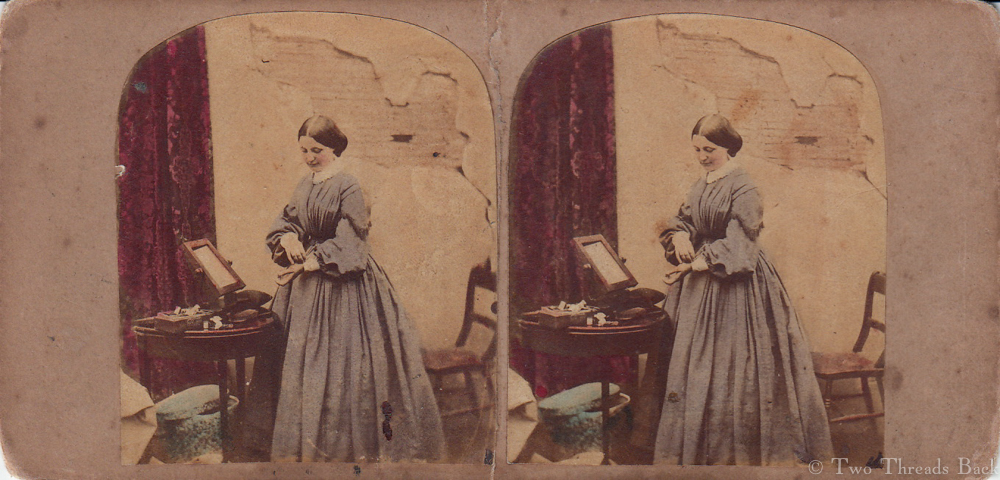
PIN MONEY – money allowed by a man to his wife to spend for her own personal comforts. When pin money is given to, but not spent by the wife, on his death it belongs to his estate. ~A Law Dictionary: Adapted to the Constitution and Laws of the United States, 1843. (You may detect some irony here.)
Most of us are familiar with the important social justice issues of the 19th century, causes like abolition and child labor. But there was another one that became quite fashionable to champion: the plight of workers who fashioned fashions. Women who worked as seamstresses, dressmakers, and milliners were vulnerable to exploitation, and as the pathos and romance of their situation caught public fancy, there was a flurry of response in literature, art, “committees,” laws, private philanthropy and even investigative journalism.
The seamstress who sewed shirts was the poster-child for the cause; you can see one period image I used in a post a few years ago here. Shirt-making was tedious and poorly paid, but the pattern was simple and most of the women who could sew knew how to make one. There was also a steady market for the product, at least until the sewing machine and mass production made hand sewn shirts obsolete.
Dressmaking was different. It required greater skill and was more susceptible to the whim of the patron (and employer if a woman worked for a dressmaking establishment) and vagaries of the trade. But it retained some shreds of respectability as a way to earn a living for those women who were not born to the working class, and yet found themselves with no means of support.
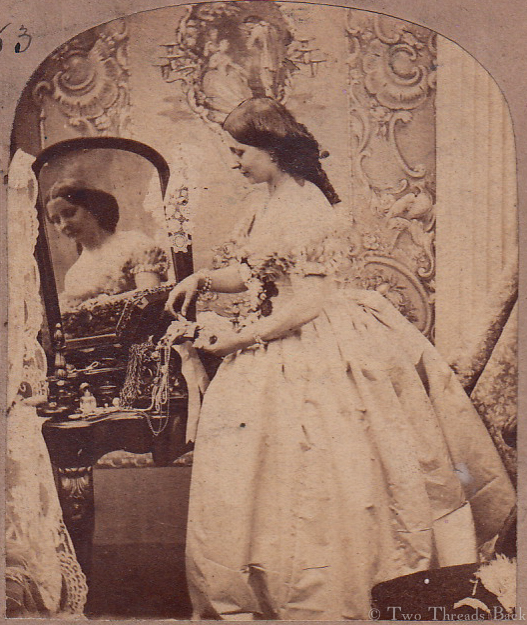
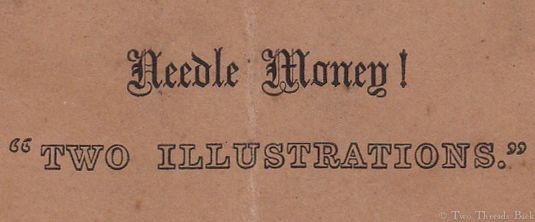
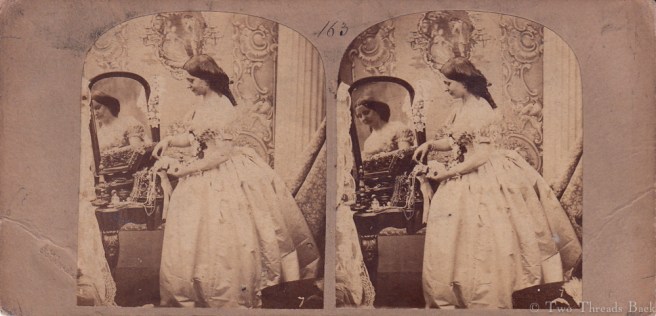
The images here are from a set of stereoviews, the one above titled “Pin Money,” with the model carelessly displaying her wealth of finery. The other is called “Needle Money,” implying that the plainly dressed lady in shabby surroundings must be earning her bread with her needle.
Apparently public sympathy didn’t quite translate into action – or not enough to bring about significant change. A decade or two after Thomas Hood’s famous poem The Song of the Shirt appeared, the image of the genteel but impoverished worker persisted. The poem below was by Francis Charles Weeden, c1860s. It was republished with the explanation:
* These two poems are printed, as written by the author, in juxtaposition, to make the contrast more striking.
I haven’t copied the whole poem, since the point and tone are pretty obvious. Victoria was reigning, but so was sentimentality!
Many bloggers have covered the subject, so if you’re interested try a search for “song of the shirt” – it will get you started. If you prefer the old-fashioned-read-a-book way, try The Ghost in the Looking Glass, by Christina Walker – not recent, but fascinating!
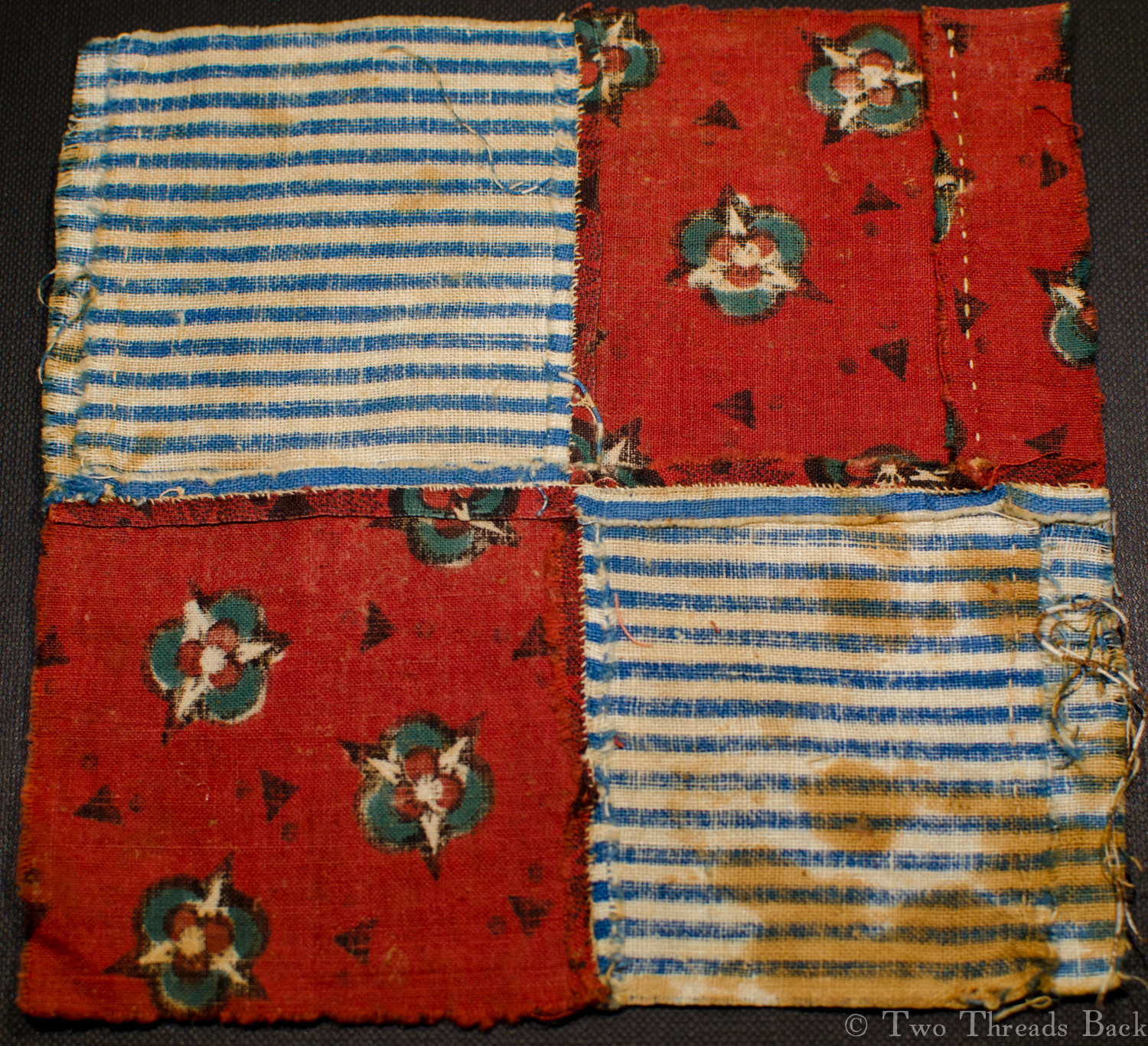
Mary’s neat sewing, with the squares joined by “seaming.” The finished block measures 5 1/2 inches square.
There once was a lady who lived and sewed in New England, way back around 1810. She had a little girl who wanted to help, and so she taught her how.
This lady (I’ll call her Mary because there’s a 27.4% chance that was her real name) was making a simple quilt out of four patch squares. Calico was dear, so she used every teensy scrap she had to make the patches.
This is a view of the back showing Mary’s careful piecing. The narrowest blue striped bit measures 3/8″ inch, not including the seam allowance.
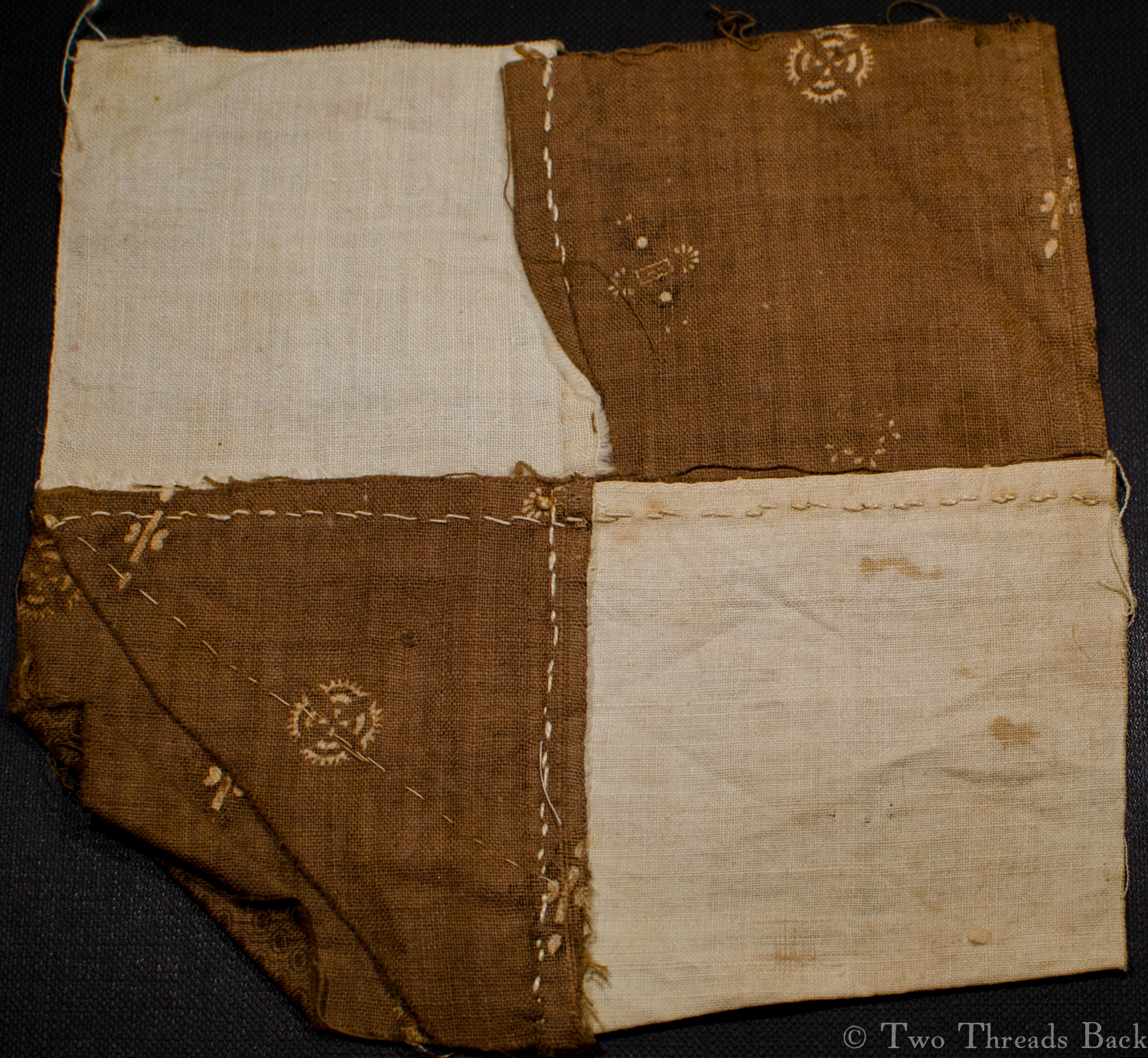
She gave Betsy (I’ll call Mary’s daughter Elizabeth because there’s a 14.3% chance that was her real name) some squares to practice on. Betsy wanted the pretty patterns to work with, but Mary was reluctant to use those for lessons, so she compromised. One print, one plain.
Betsy’s finished square. Do you notice something a little odd here?
Well, Betsy finished her block, and Mary finished 89 others. Then she packed them all away. They were never made up, but remained in a box in the attic for 200 years. Don’t you wonder why?
Betsy’s work from the back. Yes, her stitches are a little clumsier than Mary’s, but she was learning. And they’re straighter than mine – go Betsy!
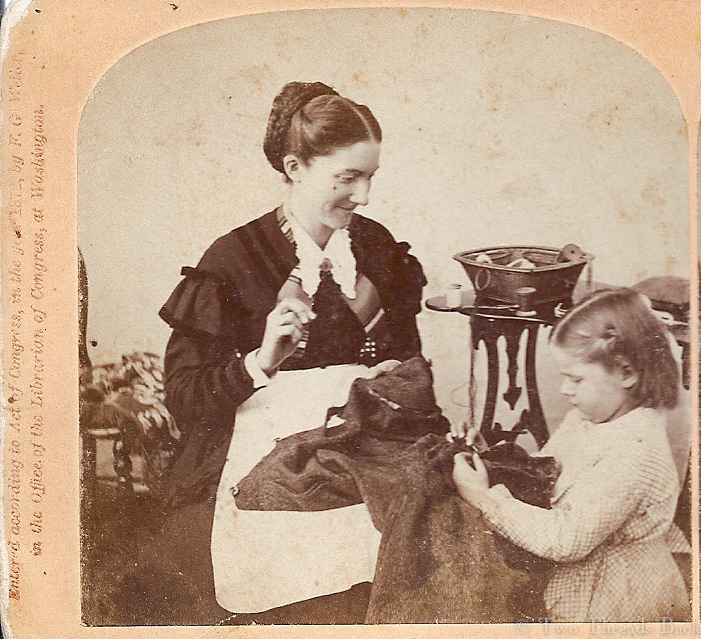
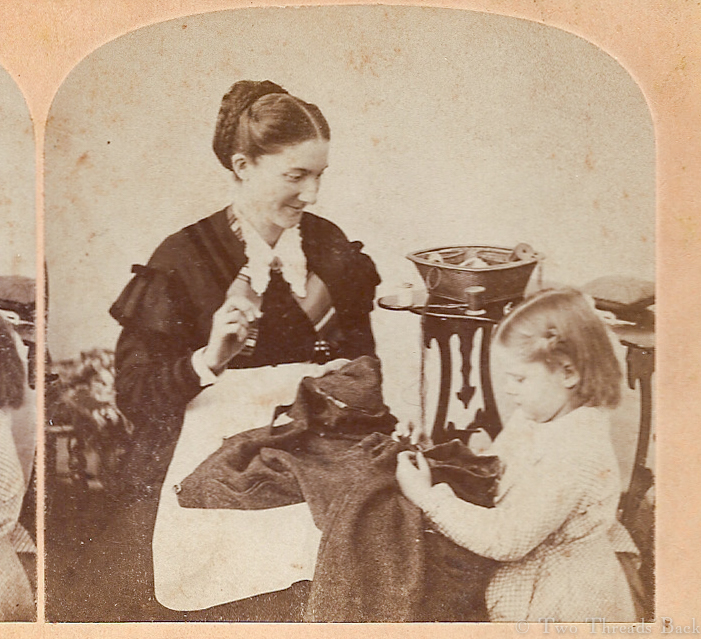
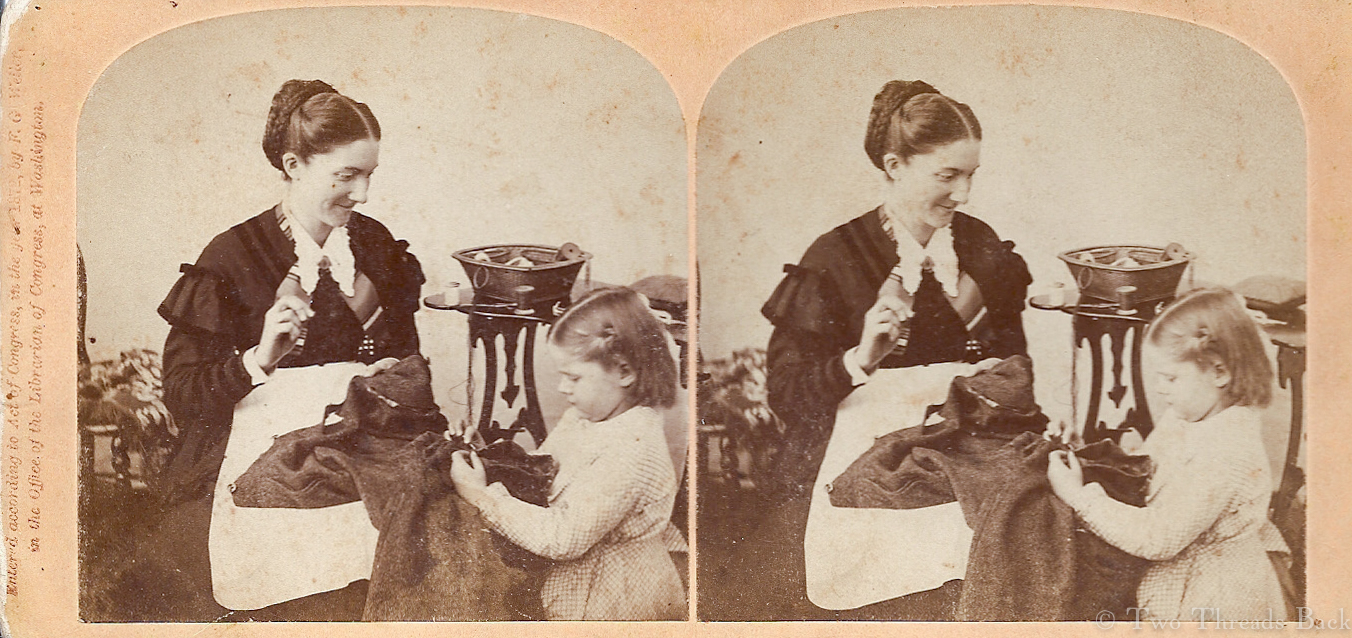
It’s time to jump forward a hundred years from the subject of my last post. Here’s a peek at a pleasing, albeit staged, scene of domestic happiness. I love these old stereoviews because the photographers often took such pains with the props, trying to tell a story. And if the subject is sewing or 19th century domestic life, that makes me very happy!
The photo on the right side, because sometimes they’re slightly different.
In this picture, it looks like Mama is mending Papa’s pants. Her daughter seems barely old enough to hold a needle, but is earnestly attempting to help. Is Mama wearing an apron over her silk dress? It certainly looks like she’s sporting a fashionable chignon. (That late ’60s, early ’70s hairstyle was sometime over-the-top and subject to ridicule.)
She may be seated in a woven cane chair, and she definitely has a sewing basket beside her on the table. It looks like the kind with small pockets fixed to the sides. The little girl’s checked dress may be an apron or pinafore, though I can’t quite tell.
This card is dated 1872, but I’ve seen another version dated 1871. Mama sewing, daughter sewing: seeing double indeed!
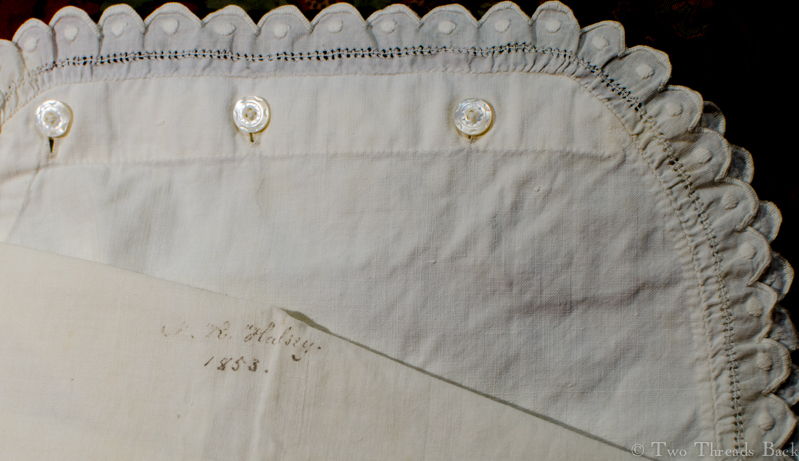
A cotton chemise, unlike either the French or English styles below. I’m going out on a limb here and guessing… American, 1853.
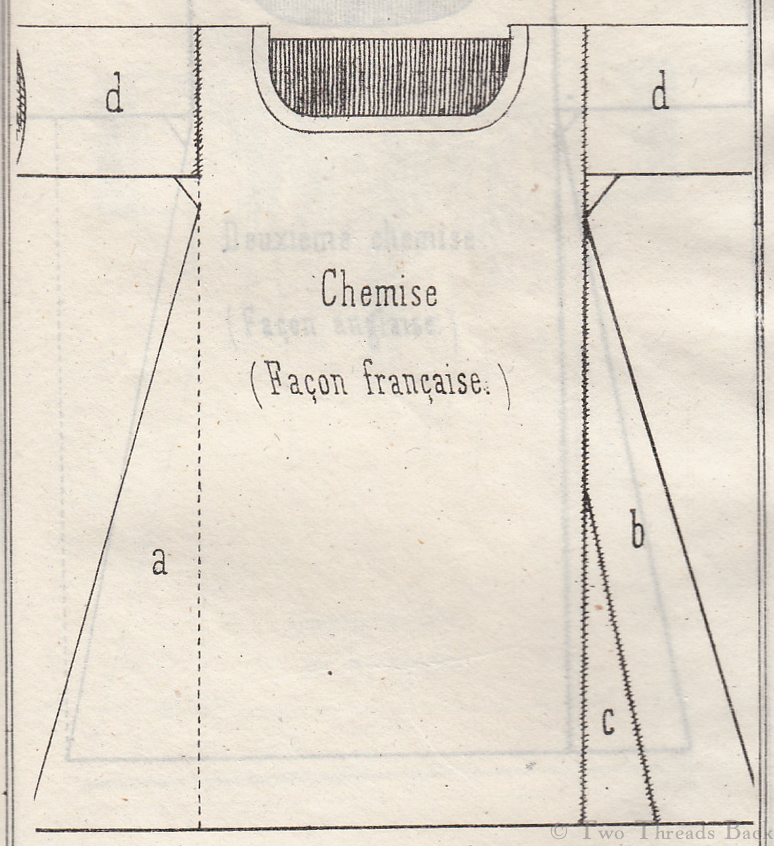
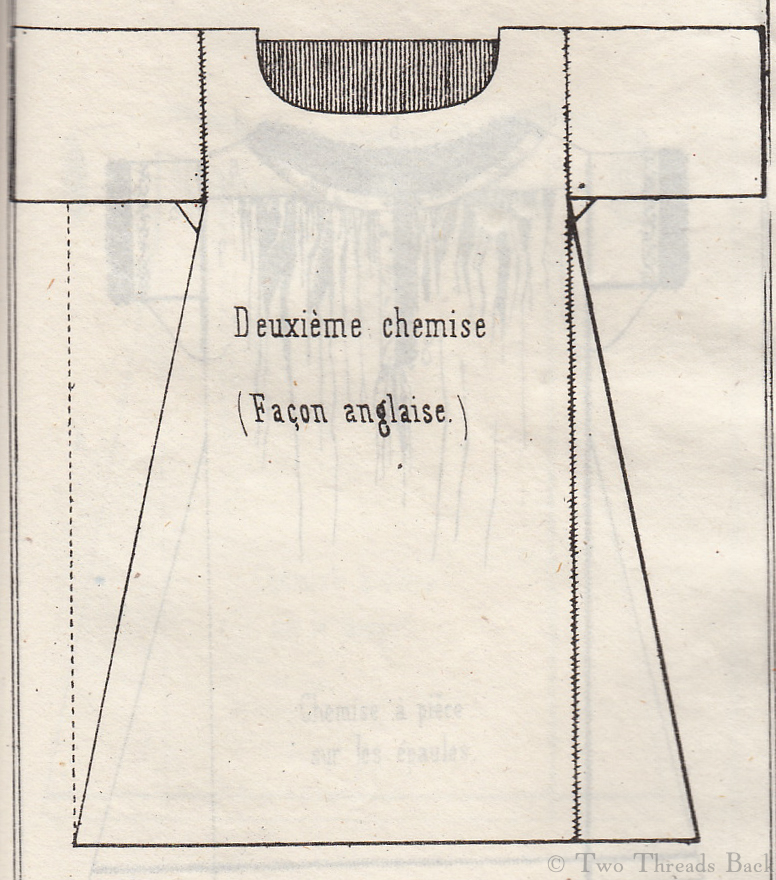
Wouldn’t you know it? Maybe there’s a Murphy’s Law of blogging. Just after proclaiming in my last post that there were no noteworthy distinctions in French and English chemises, I came across the illustrations you see below.
The only difference mentioned in the accompanying text is that the English style is for “skinny persons.” There may be more clues in the cutting directions, but with no knowledge of French, I’ll have to let that pass. The book was published in 1847, and is surprisingly primitive, at least compared to the detailed and beautifully illustrated French magazines of the same period.
However, I still can’t determine that English-made shifts were of one particular pattern, and the French used another. It seems more likely that a lady cut her shift and its gores according to the size of her fabric – and herself! But in the interest of Truth in Blogging, I submit the following:
Chemise Francaise. Of course it looks more complicated – they have a reputation to uphold.Chemise Anglaise. No nonsense, for skinny persons.
Language is a funny thing. I suppose we’re all guilty of following fads in our choice of words, and we all have particular phrases we find irritating or amusing – in other people. I recently came across an example by Jane Austen, written in 1817, just as the polite name of a woman’s undergarment was changing.
So presumably Miss Austen was still wearing shifts, when other ladies were beginning to wear chemises. She wasn’t alone, however, in her annoyance with linguistic affectations. Pantalogia, a New Cabinet Cyclopaedia, Comprehending a Complete Series of Human Genius, Learning, and Industry, Alphabetically Arranged; with a General Dictionary of Arts, Sciences, and Words (1819) has this to say:
CHEMISE, the French word for that article of linen under dress which when worn by men is called a shirt, by women a shift. Some few modern English ladies, with an affected squeamishness of delicacy, restrict the term always so as to denote the article of female dress chemise de femme; but as every one knows what they mean by the expression, and we see no reason why every one should not know what they mean, we recommend the use of the old English term, and the abandonment of the corresponding French word.
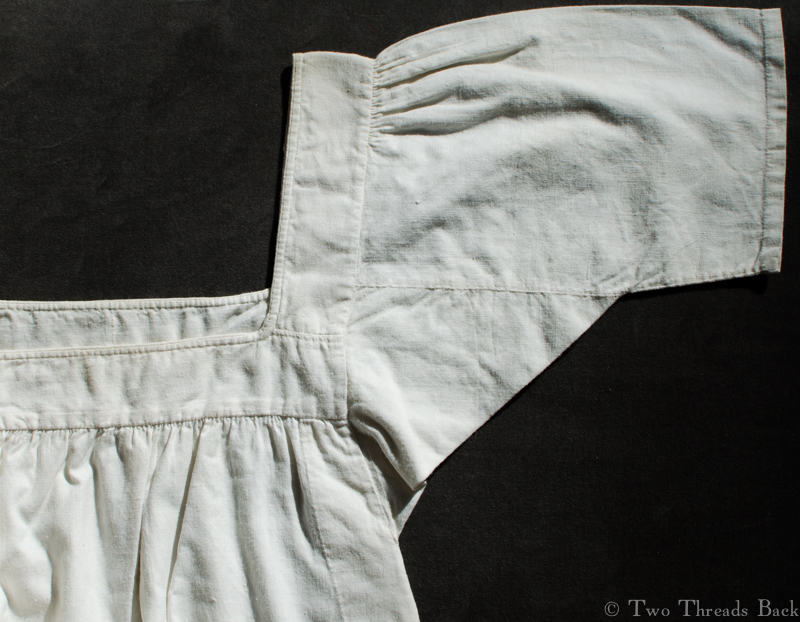
Was there really any difference between a shift and a chemise? Well, yes and no. No, because they both referred to the same lady’s undergarment. Yes, because when the word “shift” was used (up until the early 19th century), the garment was usually made of linen and was simpler in cut. As the word “chemise” became standard, variations in pattern and trimming were increasing and the chemise was more often made of cotton.
So much for the term; now was there any significant difference in the French and English methods of making this garment? I haven’t found anything consistently, unmistakably, irrefutably, definitively identifiable. When I examine an old chemise, whether in a book, online, or in person, I can’t raise an eyebrow knowingly and say, Ah yes, English, 1832.
But with the interest and expertise I see popping up in blogs and books, I wouldn’t be surprised if someone has – or will – come up with a list of distinguishing features.
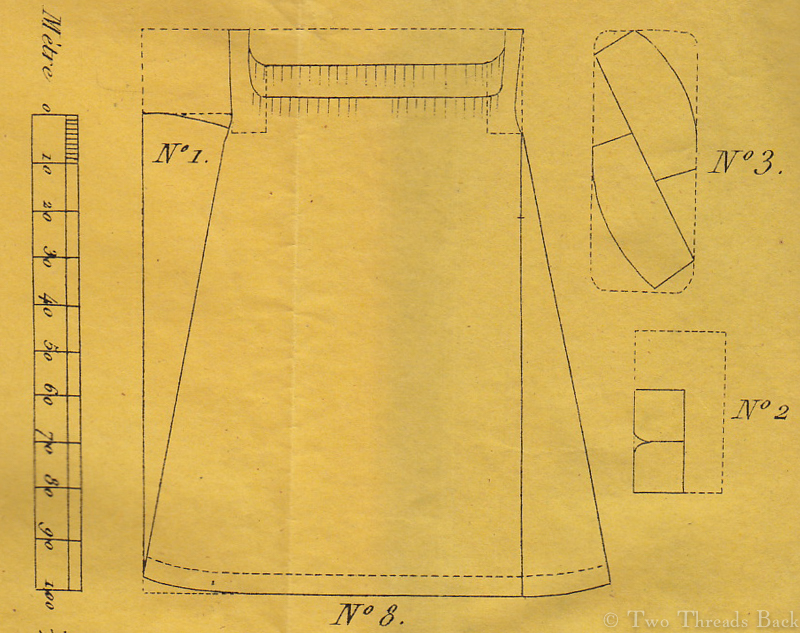
If you are curious (or courageous) and would like to compare for yourself, below is a pattern and description, 1840, from a French periodical. (Please excuse my awkward translation. If you are fluent in French and English, I beg you to let me know and help me correct it!) English patterns and instructions of the same date are available in the Workwoman’s Guide.
A pattern for a lady’s chemise, 1840.
No. 8 is a woman’s chemise. For ten chemises, purchase 25 meters of percale; take off a meter, and cut the rest into ten pieces; fold these pieces into two; on side No. 1, cut the gore that you add to the other side, cut by a thread as shown in No. 2; inside cut two gussets; indent around the neck; this is shown in No. 3; the sleeves are cut on the bias. Gather slightly on top of the arm and hem the bottom with backstitching. The armholes have to be a little curved under the arm. Take the remaining meter, measure a narrow band along the edge, then cut twenty pieces for double shoulder straps; these pieces are indicated by dotted lines; place a narrow piece of tape between the shoulder strap and its lining, there you insert the sleeve and backstitch, and you fold the lining over; gather the top of the chemise, as indicated, and insert a narrow tape of a meter in length; then cover this piece of tape with a band of percale; using backstitching and hemming, then fold under. Mark the chemise over the left gusset.











 Two Threads Back