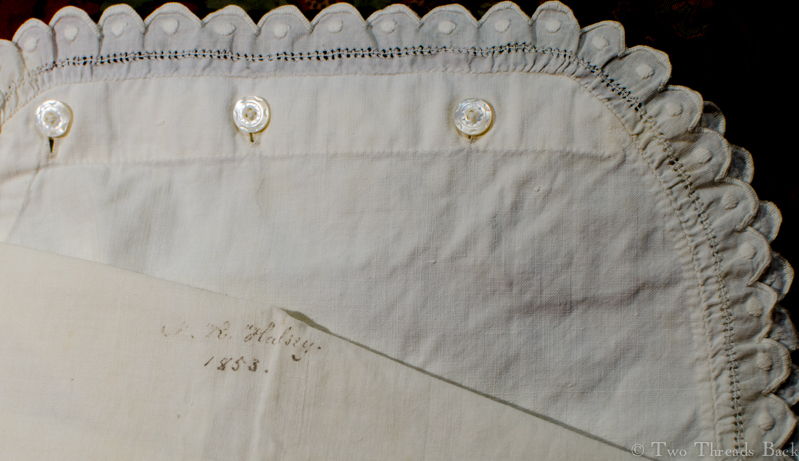
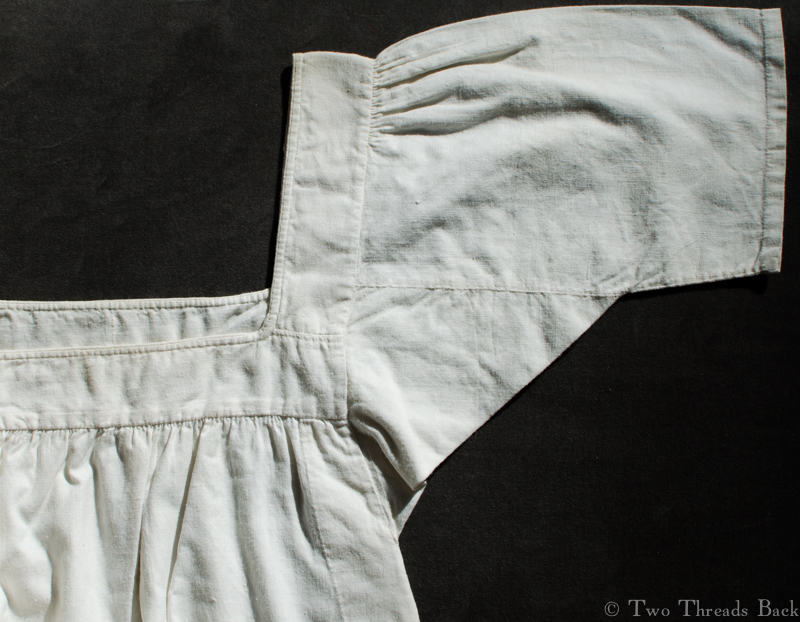
A cotton chemise, unlike either the French or English styles below. I’m going out on a limb here and guessing… American, 1853.
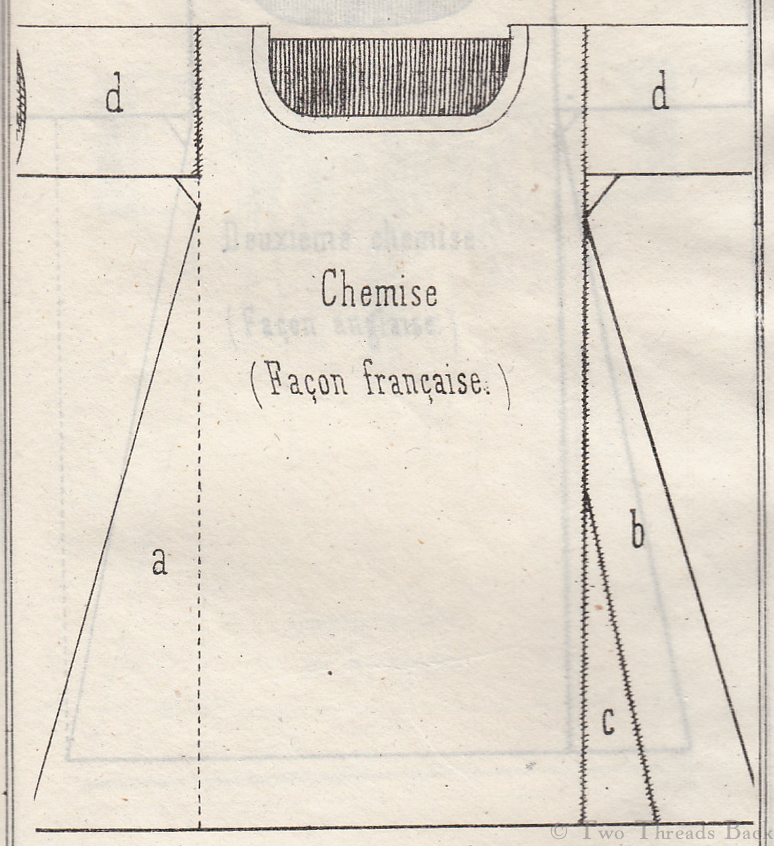
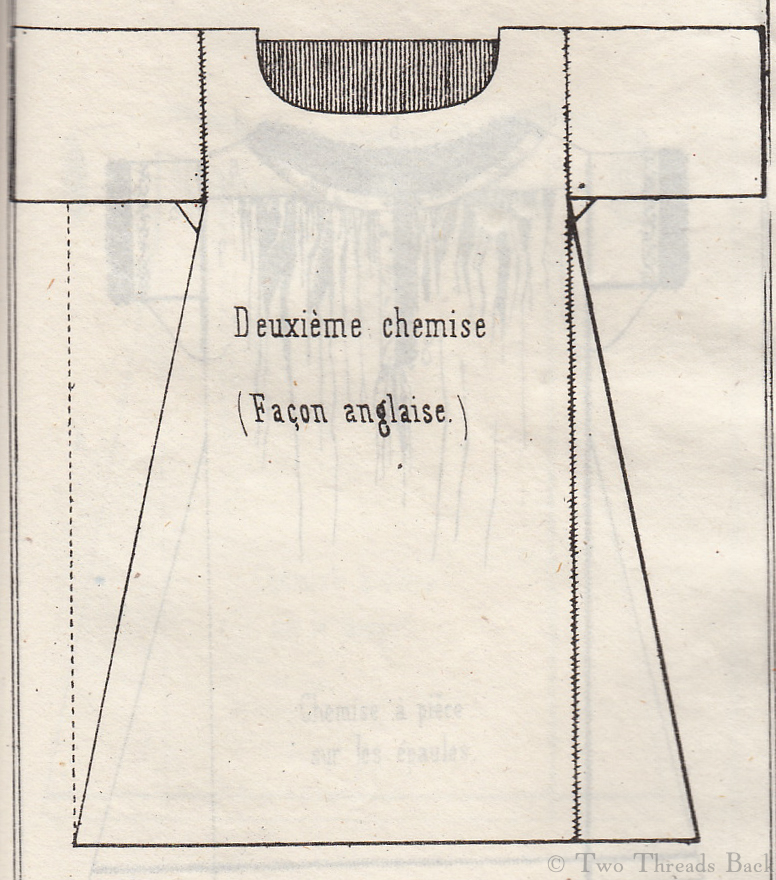
Wouldn’t you know it? Maybe there’s a Murphy’s Law of blogging. Just after proclaiming in my last post that there were no noteworthy distinctions in French and English chemises, I came across the illustrations you see below.
The only difference mentioned in the accompanying text is that the English style is for “skinny persons.” There may be more clues in the cutting directions, but with no knowledge of French, I’ll have to let that pass. The book was published in 1847, and is surprisingly primitive, at least compared to the detailed and beautifully illustrated French magazines of the same period.
However, I still can’t determine that English-made shifts were of one particular pattern, and the French used another. It seems more likely that a lady cut her shift and its gores according to the size of her fabric – and herself! But in the interest of Truth in Blogging, I submit the following:
Chemise Francaise. Of course it looks more complicated – they have a reputation to uphold.Chemise Anglaise. No nonsense, for skinny persons.
Language is a funny thing. I suppose we’re all guilty of following fads in our choice of words, and we all have particular phrases we find irritating or amusing – in other people. I recently came across an example by Jane Austen, written in 1817, just as the polite name of a woman’s undergarment was changing.
So presumably Miss Austen was still wearing shifts, when other ladies were beginning to wear chemises. She wasn’t alone, however, in her annoyance with linguistic affectations. Pantalogia, a New Cabinet Cyclopaedia, Comprehending a Complete Series of Human Genius, Learning, and Industry, Alphabetically Arranged; with a General Dictionary of Arts, Sciences, and Words (1819) has this to say:
CHEMISE, the French word for that article of linen under dress which when worn by men is called a shirt, by women a shift. Some few modern English ladies, with an affected squeamishness of delicacy, restrict the term always so as to denote the article of female dress chemise de femme; but as every one knows what they mean by the expression, and we see no reason why every one should not know what they mean, we recommend the use of the old English term, and the abandonment of the corresponding French word.
Was there really any difference between a shift and a chemise? Well, yes and no. No, because they both referred to the same lady’s undergarment. Yes, because when the word “shift” was used (up until the early 19th century), the garment was usually made of linen and was simpler in cut. As the word “chemise” became standard, variations in pattern and trimming were increasing and the chemise was more often made of cotton.
So much for the term; now was there any significant difference in the French and English methods of making this garment? I haven’t found anything consistently, unmistakably, irrefutably, definitively identifiable. When I examine an old chemise, whether in a book, online, or in person, I can’t raise an eyebrow knowingly and say, Ah yes, English, 1832.
But with the interest and expertise I see popping up in blogs and books, I wouldn’t be surprised if someone has – or will – come up with a list of distinguishing features.
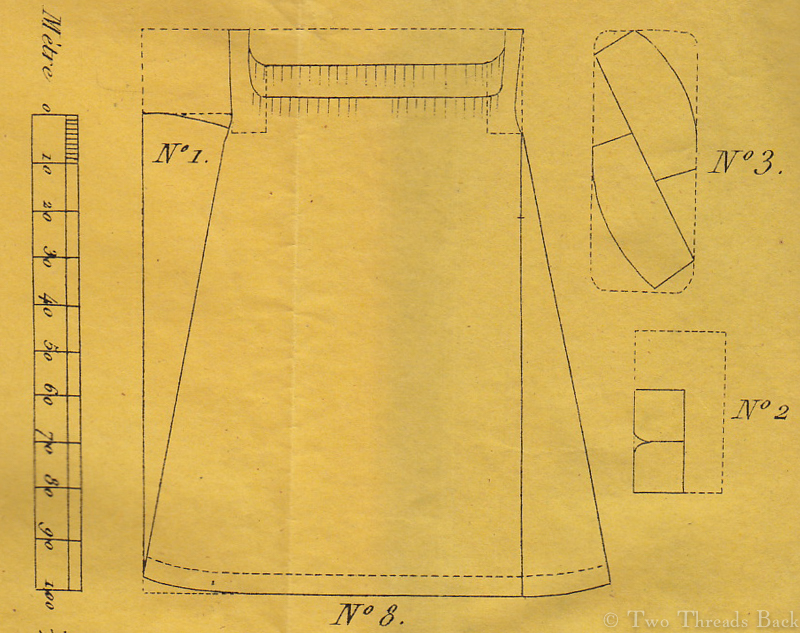
If you are curious (or courageous) and would like to compare for yourself, below is a pattern and description, 1840, from a French periodical. (Please excuse my awkward translation. If you are fluent in French and English, I beg you to let me know and help me correct it!) English patterns and instructions of the same date are available in the Workwoman’s Guide.
A pattern for a lady’s chemise, 1840.
No. 8 is a woman’s chemise. For ten chemises, purchase 25 meters of percale; take off a meter, and cut the rest into ten pieces; fold these pieces into two; on side No. 1, cut the gore that you add to the other side, cut by a thread as shown in No. 2; inside cut two gussets; indent around the neck; this is shown in No. 3; the sleeves are cut on the bias. Gather slightly on top of the arm and hem the bottom with backstitching. The armholes have to be a little curved under the arm. Take the remaining meter, measure a narrow band along the edge, then cut twenty pieces for double shoulder straps; these pieces are indicated by dotted lines; place a narrow piece of tape between the shoulder strap and its lining, there you insert the sleeve and backstitch, and you fold the lining over; gather the top of the chemise, as indicated, and insert a narrow tape of a meter in length; then cover this piece of tape with a band of percale; using backstitching and hemming, then fold under. Mark the chemise over the left gusset.
Here’s a flower patch for the lovely month of May since it is (now!) a pretty spring color. The print is similar to the others I’ve posted, but the mint green color is unusual. Actually, I’m not sure exactly what the original shade was, because you can see that it has faded unevenly – dyes of the era were notorious for their fickleness! Unlike the other fabrics, it does not have a shiny new glaze, since it must have been washed and worn earlier in its life.
A view from the back. I doubt the copybook word was “womankind”!
Early 19th century cotton print, a hexagon in Christmas colors.
Time for a short post before Christmas! Here is a patch in Christmas red and green, with a little black accent. Once again it has the peculiar (to my eyes anyway) mouse-squiggle-alien creature-seed pod-flower design. Buti? Boteh? “Shawl pattern”? Indian import or English version? I don’t know. But I do know these patterns on calico show up a lot in the first decade or so of the 19th century. If you search for Ackermann’s Repository, the plates with fabric swatches attached, you’ll see them in many dress prints.
Here’s the view from the back, which clearly shows the closely “seamed” stitches and a bit of copybook writing.
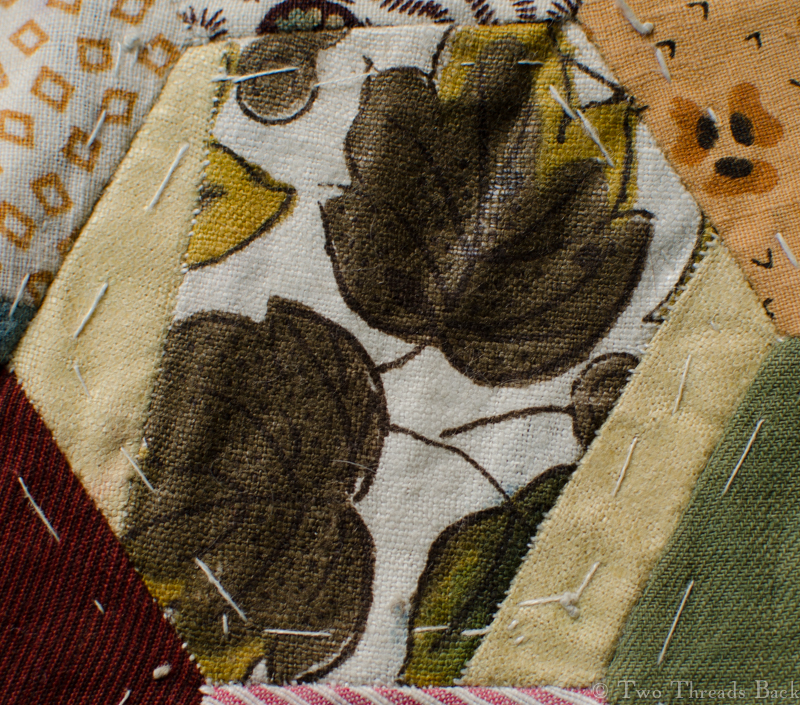
Early 19th century English paper pieced patch – with ugly leaves.
I chose another pattern for the season, and in honor of Thanksgiving week, it’s one with leaves! But to be quite frank, it’s pretty much… not pretty. Perhaps the whole pattern was nicer, and it’s only this snippet that is less than attractive to me.
The maker was certainly wanting to use it though, because she had to piece the piece. You can see just how tiny the scraps were, and it amazes me that she made the effort. Keep in mind the whole hexagon is only 2 inches across!
A view from the back, showing part of an old copybook page that was used for the pattern.
Something else that I find surprising in these sections is just how many of them have their original glazed finish, or sizing. Perhaps they were only cutting scraps, not from worn out garments. Even though times were changing, fabric itself still had more value than the average worker’s time. And it’s not just the fact that the scraps retain their glazing, I’m really surprised that so many of the pieces have it at all, enough to make them very shiny. I have to angle the photo “just so” to limit the reflection. Hmm… something to reflect on….
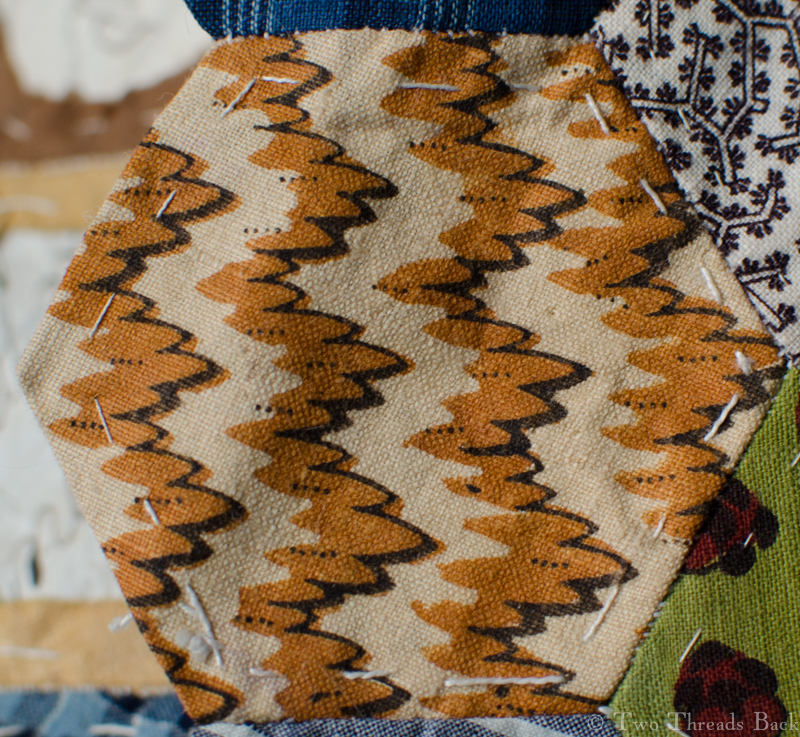
Early 19th century calico pattern in fall colors: deep rusty orange and brown on a beige background.
It’s time for another bit of calico, and in keeping with the season I chose one with fall colors. I’m afraid the close-up photo doesn’t convey just how smooth, crisp and tight the fabric is – but if you’re like me, you’d rather see it larger!
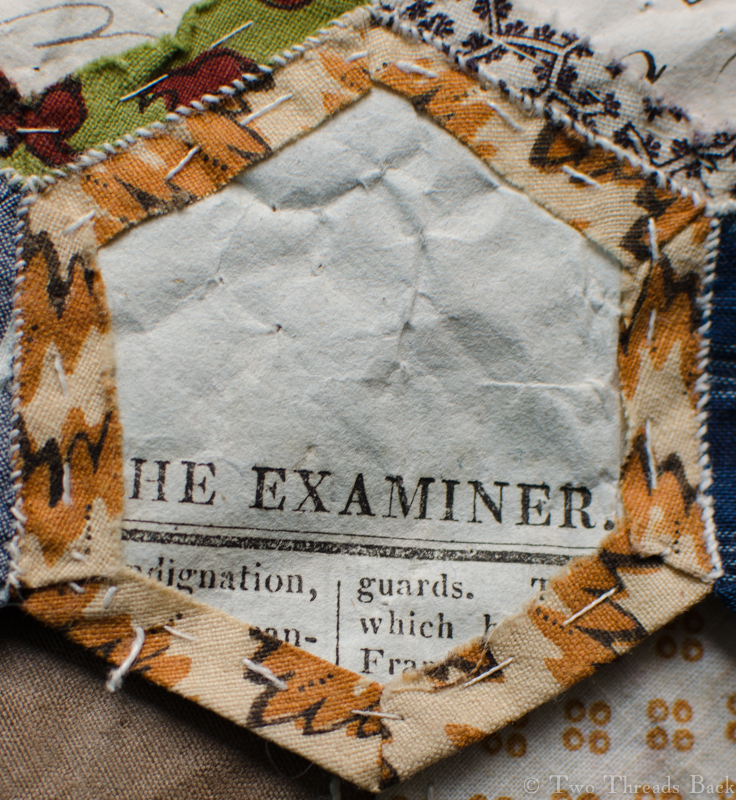
This time I’m also including the back, with “The Examiner” now being used by the lady of the house. But who knows? Perhaps she was the subscriber as well. I like that thought.
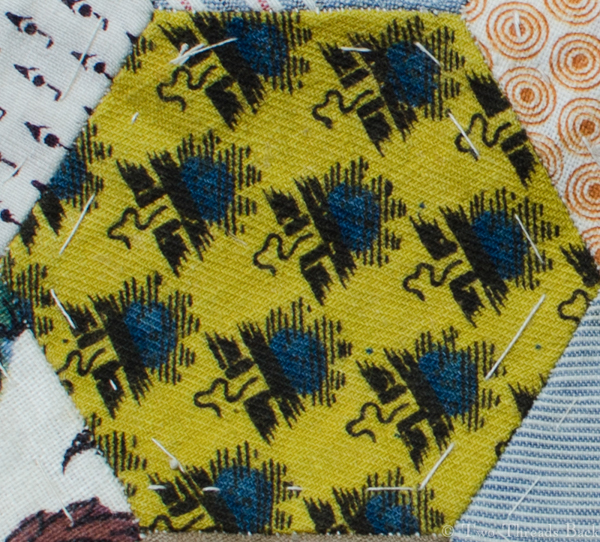
A bright yellow and blue calico patch, early 19th century.
Here we are with another patch from the same collection. There are a LOT of them, so I’ll probably not even mention that in future posts, but simply add the photo.
This one is bright and cheery in yellow and blue, with an absolutely bizarre design. It’s also reminiscent of Mousey Mousey – but perhaps when he was feeling blue on a bad hair day.
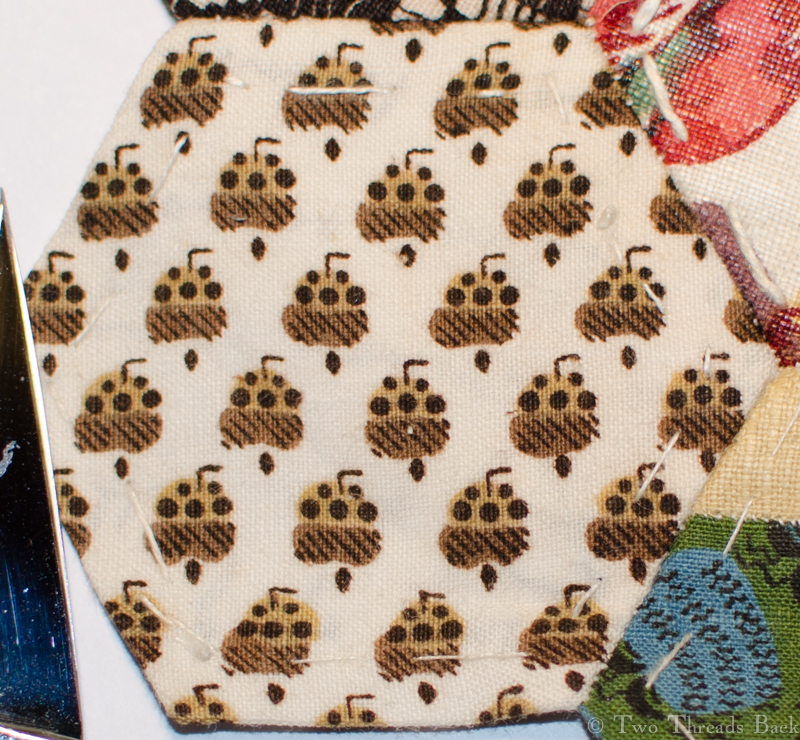
An early cotton calico from English Paper Pieced Patchwork. (Say that really fast.) It measures 2×2 inches. The odd thing on the left is my embroidery scissors holding down the edge.
Welcome to the Flower Patch! Back in the olden days when I was a child, my sister and I would sometimes take our afternoon naps on “pallets.” These were great-grandma-made quilts, all soft and worn, laid on the floor in front of an electric box fan (we lived in The South). Compelled to be still and quiet, we’d make a game of picking out our favorite patterns. Of course it sometimes degenerated into squabbles: “You can’t have that first favorite, ’cause it’s my first favorite!” We’d usually fall asleep and wake up best friends again.
I’ve recently come across a few little quilt bits – can’t afford whole garments or quilts – from my favorite era, the early 19th century, and thought I’d post a picture of a patch now and then. I wanted to record all the patterns anyway, and this seems like a good way to share them at the same time. If you happen to recognize a print, or are blessed enough to have the whole garment (which might give me the vapours), I’d love it if you’d let me know!
These patches are from an “English Paper Piecing” set. I believe it dates to the early 1800s, not only because of the patterns but because some of the paper that’s used on the back is c1808-1812. There are a few pages from English newspapers (London National Register, Monthly Magazine, etc.), private letters, and a whole lot of pages from an old copybook. Of course that doesn’t make a certain date; some fabrics could be earlier or later and it all could have been pieced later. But I’ll leave that to the experts.
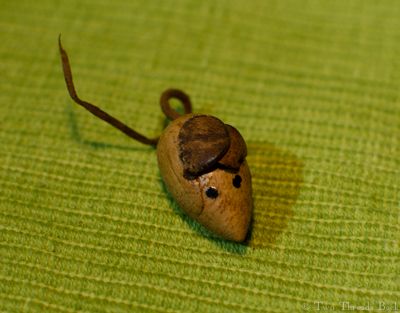
Mousey Mousey: a survivor.
The first patch I selected has a peculiar pattern. It reminds me of poor old Mousey Mousey. Mousey Mousey was a beloved toy that I still treasure, though heaven knows how anything so small (less than an inch) could survive the many decades and almost two dozen moves he has (we have) been through.
Pictured above is Flower Patch #1. By the way, it’s not my first favorite.